
Report46 pages
Digital Market Index: Q2 2025
The global digital landscape reached a significant milestone in the second quarter of 2025, as in-app purchase revenue hit a record $40 billion. This period marked a historic structural shift in the mobile economy, with non-gaming applications accounting for 52% of total consumer spending, surpassing mobile games for the first time. While total downloads stabilized at 37 billion, the market displayed clear signs of maturation; gaming downloads contracted by 6.8% year-over-year, while AI-driven productivity tools and short-drama streaming platforms emerged as the primary engines of growth. The United States maintained its position as the premier revenue market at $15 billion, though emerging regions such as Brazil and various African nations are increasingly vital for download volume and monetization expansion.
Within the gaming sector, Strategy titles overtook RPGs as the highest-grossing category, achieving a 23% year-over-year increase. However, the most significant individual performance came from ChatGPT, which became the fastest application to reach one billion downloads and secured a position among the top five global revenue earners. This surge in AI utility was mirrored in the advertising sector, where U.S. digital ad spend rose 12% to $34 billion. Major technology firms including Microsoft, Google, and Adobe significantly increased their marketing budgets to promote AI integrations like Copilot, contributing to a landscape where social media maintains a 72.5% share of total ad spend.
Retail media has solidified its role as a critical advertising channel, with U.S. impressions rising 29% to 65 billion across various retailers. Despite this broad growth, Amazon remains the undisputed leader in the space, generating nearly 80 billion impressions and outperforming all other tracked retailers combined. These findings are supported by expanded tracking capabilities across key Asian markets and diverse digital channels, though the data specifically excludes certain year-over-year Amazon metrics due to recent tracking implementation. Overall, the quarter reflects a pivot toward high-utility AI applications and a diversifying advertising ecosystem dominated by social and retail platforms.
- In Q2 2025, non-gaming applications surpassed mobile games for the first time, accounting for 52% of the record $40 billion in total in-app purchase revenue.
- Global mobile gaming downloads contracted by 6.8% year-over-year, while Strategy titles replaced RPGs as the highest-grossing gaming category with a 23% increase.
- ChatGPT became the fastest application to reach one billion downloads and secured a top-five position in global revenue, signaling a major shift toward AI-driven utility.
- U.S. digital ad spend rose 12% to $34 billion, driven by increased marketing budgets from firms like Microsoft, Google, and Adobe to promote AI integrations.
- Retail media continues to expand, with U.S. impressions rising 29% to 65 billion, though Amazon remains the dominant leader with nearly 80 billion impressions.
+1
Sensor TowerAug 2025
Presentation37 pages
Consolidated Financial Results Briefing Materials: FY3/26 Q1
Akatsuki Inc. experienced a challenging start to the fiscal year ending March 2026, reporting a 44% year-over-year decline in consolidated sales to ¥2,313 million and an operating loss of ¥1,698 million for the first quarter. This downturn was primarily driven by a 52% revenue contraction in the core Games business, resulting from a reactionary fall following a strong prior quarter, strategic title withdrawals, and heightened development costs associated with the upcoming global launch of Kaiju No. 8 The Game. While total operating expenses decreased by 18% due to a 42% reduction in research and development spending and a streamlined portfolio, these savings were insufficient to offset the revenue decline and typical seasonal fluctuations.
Despite the volatility in gaming, the IP Solutions and Comics segments demonstrated robust growth. IP Solutions sales surged 168% to ¥298 million, bolstered by the consolidation of CRAYON, Inc. and the rapid expansion of the Slash Gift online lottery service. Simultaneously, the Comics segment broadened its international footprint through the MANGA MIRAI service in the United States, integrating high-profile titles such as One Piece and Naruto. The company also accelerated its expansion into new business domains through the full acquisition of the creator agency Natee Co., Ltd. and realized ¥1.2 billion in investment proceeds following the IPO of LIFE CREATE Co., Ltd.
The financial position remains liquid with ¥33.2 billion in cash and deposits, providing a stable foundation for ongoing strategic investments despite a slight decrease in total assets to ¥50.9 billion. The current fiscal trajectory reflects a transition period as the company rebalances its portfolio, shifting focus toward high-potential global IP launches and diversified digital entertainment services to mitigate the inherent cyclicality of the mobile gaming market.
- Akatsuki Inc. reported a 44% year-over-year decline in consolidated sales to ¥2,313 million and an operating loss of ¥1,698 million for Q1 FY3/26.
- The core Games business revenue contracted by 52% due to title withdrawals, a reactionary decline from the previous quarter, and high development costs for the upcoming 'Kaiju No. 8 The Game'.
- IP Solutions revenue grew 168% to ¥298 million, driven by the consolidation of CRAYON, Inc. and the expansion of the Slash Gift online lottery service.
- The company maintains a liquid financial position with ¥33.2 billion in cash and deposits, despite total assets decreasing to ¥50.9 billion.
- Operating expenses fell by 18% overall, supported by a 42% reduction in research and development spending and a streamlined game portfolio.
+1
AkatsukiAug 2025

Report104 pages
Annual Report 2025
Annual Report 2025 details a landmark financial year for Games Workshop, characterized by record-breaking growth and the company’s promotion to the FTSE 100. For the 2024/25 period, total revenue rose to £617.5 million, with profit before taxation reaching £262.8 million. This performance was driven by a 14.2% increase in core sales—particularly within the trade channel and North American markets—and a near-doubling of licensing operating profit to £49.5 million, bolstered by the exceptional success of the Space Marine 2 video game.
The company continues to leverage a vertically integrated model, expanding its global footprint to 570 retail stores across 24 countries and an independent retailer network spanning 71 nations. To support this growth, significant capital investments are underway, including the construction of a fourth manufacturing facility by 2026 and a comprehensive IT systems overhaul slated for completion by 2029. While navigating macroeconomic challenges such as projected tariff impacts and supply chain disruptions, the Group maintained a robust liquidity position with £132.6 million in cash and distributed a record £20 million in profit-sharing to its workforce.
Strategic priorities have shifted toward long-term value alignment, evidenced by a new remuneration policy that introduces share-based compensation for executives and a "Triennial Share Award" linked to revenue and profit targets. Sustainability remains a core focus; despite a rise in total emissions driven by global freight, the company surpassed its 2032 reduction targets for Scope 1 and 2 emissions through facility electrification. Looking forward, the Group is prioritizing internal talent development, digital engagement through Warhammer+, and a potential media partnership with Amazon to further scale the brand's global reach.
- Games Workshop achieved record financial results for 2024/25 with £617.5 million in revenue and £262.8 million in profit before taxation, leading to its promotion to the FTSE 100.
- Licensing operating profit nearly doubled to £49.5 million, largely driven by the commercial success of the Space Marine 2 video game.
- Core sales grew by 14.2%, fueled by strong performance in the trade channel and North American markets.
- The company is scaling infrastructure with a fourth manufacturing facility scheduled for 2026 and a major IT systems overhaul targeted for 2029.
- Management has implemented a new executive remuneration policy featuring share-based compensation and a Triennial Share Award tied to specific revenue and profit targets.
+1
Games Workshop GroupAug 2025

Report133 pages
Vorhaus Digital Strategy Study: All Findings 2025
The digital landscape in the United States has reached a pivotal turning point as smartphones and connected televisions officially surpass traditional broadcast media as the primary vehicles for entertainment. With smart TV penetration reaching 63% and subscription services now more prevalent than cable or satellite, the American household is firmly rooted in a digital-first ecosystem. This transition is fueled by a surge in spending among younger consumers aged 18–34, who have increased their annual digital media expenditure by $235 over the past year. While the average household maintains 3.5 subscription video services, a growing trend of "subscription cycling" suggests consumers are becoming more price-sensitive and strategic with their digital commitments.
Gaming has emerged as a near-universal activity, with 80% of the population engaging across various platforms and over half of the country playing mobile games daily. The industry is seeing a significant rise in social and cloud gaming, alongside a burgeoning interest in user-generated content and non-programmer creation tools. Although traditional game discovery channels are losing influence, total annual in-game spending has risen dramatically. Notably, 70% of computer gamers now spend $30 or more annually, and there is a growing consumer appetite for the ability to trade virtual goods between different titles, potentially facilitated by blockchain technology.
Emerging technologies reveal a stark generational divide in adoption and sentiment. While the 18–34 demographic shows double-digit increases in familiarity and interest regarding the Metaverse and Virtual Reality, interest in Augmented Reality has declined sharply across all age groups. Cryptocurrency remains a niche expertise, yet a significant portion of younger investors plan to commit substantial capital to the sector in the coming year. Despite these advancements, privacy remains a critical barrier; over 60% of Americans express deep concerns regarding information security and the use of personal data for advertising. This tension between high digital engagement and data anxiety defines the current state of the American digital consumer.
- Digital-first entertainment has become the US standard, with smart TV penetration at 63% and connected devices officially surpassing traditional broadcast media.
- Gaming is now a near-universal activity with 80% of the population participating, driven by daily mobile play and a significant rise in total annual in-game spending.
- Consumers are adopting 'subscription cycling' to manage costs, despite the average household maintaining 3.5 video services and younger consumers (18–34) increasing annual digital media spending by $235.
- Privacy concerns are a major market friction, with over 60% of Americans expressing deep anxiety regarding information security and the use of personal data for advertising.
- 70% of computer gamers now spend at least $30 annually, with a growing consumer demand for cross-title virtual goods trading potentially enabled by blockchain.
+1
Vorhaus AdvisorsAug 2025

Report34 pages
Llibre Blanc de la Indústria Catalana del Videojoc 2024
I’m ready to combine the section summaries into a cohesive overview, but I’ll need the remaining sections to capture the full scope, key data points, and conclusions of the 2024 Catalan video‑game industry analysis. Could you please provide the rest of the section summaries?
- The Catalan video game industry generated €756 million in 2023, representing 53% of Spain's total revenue and a 6.6% increase from 2022. It employed 5,174 professionals, accounting for 50% of the national total.
- The industry is projected to reach €893 million by 2027, with an estimated compound annual growth rate (CAGR) of 4.3% for 2023-2027, despite an anticipated stagnation in 2024.
- In 2024, there were 262 video game studios in Catalonia, with 161 formally constituted as companies, a 10% increase from the previous year.
- Catalan studios primarily focus on original intellectual properties (91%), with self-publishing (54%) and third-party development (39%) being other popular activities. Serious games development increased to 22%.
- Digital premium sales are the main revenue source (40%), followed by outsourcing (16%) and service sales (14%). 74% of games developed in Catalonia include a Catalan language version.
+3
Direcció General d’Innovació i Cultura DigitalJul 2025

Report31 pages
Les Français et le jeu vidéo: 2025
The French video game market has reached a historic peak in engagement, with 40.2 million individuals—representing 66% of the national population—identifying as players. The demographic profile of the average gamer has stabilized at 40 years old, characterized by near gender parity. Notably, women now constitute a 55% majority within the 16-30 age bracket, while the senior segment has expanded to 5.4 million participants. This broad adoption is accompanied by an increase in weekly playtime to nearly eight hours, driven largely by a preference for social and multiplayer experiences. Approximately 86% of players utilize multiplayer modes, and 60% report forming direct friendships through gaming, illustrating the medium's role as a primary driver of social cohesion across generations.
Professional interest in the sector is also rising, particularly among young adults, over a third of whom have considered industry careers. This cultural integration is supported by a robust regulatory and educational framework. Parental involvement is high, with 67% of parents actively monitoring their children’s gaming habits and 95% expressing awareness of parental control systems. The PEGI classification system remains the cornerstone of consumer protection, utilizing independent verification bodies to ensure content appropriateness across more than 35,000 titles. This system facilitates informed purchasing decisions and maintains safety standards for the nation's "digital native" demographics.
The industry’s operational landscape is anchored by the Syndicat des Éditeurs de Logiciels de Loisirs (SELL), which represents major publishers and manages significant cultural milestones such as Paris Games Week. Beyond market intelligence and event organization, the sector emphasizes social responsibility through initiatives like PédagoJeux and various inclusion-focused partnerships. These efforts ensure that the French gaming ecosystem remains both economically vibrant and socially responsible, balancing rapid growth with a commitment to player safety and diversity.
- The French video game market has reached 40.2 million players, representing 66% of the national population with an average player age of 40.
- Social and multiplayer gaming are primary engagement drivers, with 86% of players using multiplayer modes and 60% reporting the formation of direct friendships through gaming.
- Gender parity is a defining characteristic of the market, with women now comprising a 55% majority of players in the 16–30 age demographic.
- Parental engagement is high, as 67% of parents actively monitor gaming habits and 95% are aware of parental control systems.
- The PEGI classification system serves as the primary consumer protection framework, covering more than 35,000 titles to ensure content appropriateness.
+1
SELL – Syndicat des Éditeurs de Logiciels de LoisirsJul 2025

Report20 pages
Games Industry Region Report China
The China Region Report provides a comprehensive analysis of the Chinese games market as of July 2025, positioning it as the most lucrative and influential territory in the global industry. The central thesis asserts that while China presents significant regulatory and cultural hurdles for Western companies, its domestic firms have evolved into global leaders through rapid innovation, sophisticated live operations, and a mobile-first development philosophy.
Key findings indicate that the Chinese market generated approximately $48.7 billion in 2024, representing nearly 30% of global games revenue. Data from AppMagic and Newzoo highlight that while the domestic App Store saw a slight peak in 2021, the broader ecosystem remains robust, supported by over 701 million players. The report identifies a significant shift in industry capabilities, noting that 14 of the top 30 grossing games worldwide in early 2025 were developed or owned by Chinese entities. Furthermore, the success of titles like Black Myth: Wukong signals China’s successful expansion from mobile dominance into the premium triple-A PC and console sectors.
The scope of the analysis covers major industry segments including mobile, PC, and the emerging HTML5 mini-game market on platforms like WeChat, which boasts 500 million monthly active users. It profiles dominant publishers such as Tencent, NetEase, and HoYoverse, detailing their global investment strategies and internal development successes. Methodology relies on market intelligence from AppMagic and Newzoo, supplemented by expert interviews with regional executives.
The report concludes that the regulatory environment has stabilized, offering a more transparent licensing process for international partners. Future growth is expected to be driven by AI integration in development and the continued export of original Chinese intellectual property, further blurring the lines between Eastern and Western gaming markets.
- The Chinese games market generated $48.7 billion in 2024, accounting for approximately 30% of total global industry revenue.
- Chinese entities now dominate the global landscape, owning or developing 14 of the top 30 highest-grossing games worldwide as of early 2025.
- The market supports a massive player base of over 701 million, with a significant shift occurring as domestic firms expand from mobile dominance into premium triple-A PC and console development.
- HTML5 mini-games on platforms like WeChat have emerged as a major segment, currently reaching 500 million monthly active users.
- The regulatory environment for international partners has stabilized, resulting in a more transparent and predictable licensing process.
PocketGamer.bizJul 2025
Report18 pages
The State of PC Game Distribution
The study aims to map the contemporary PC game distribution ecosystem and evaluate whether Steam functions as a de‑facto monopoly, while outlining alternative channels, associated risks, and growth opportunities for developers and publishers. It positions Steam’s dominance against emerging storefronts, physical media, and gray‑market platforms, offering strategic guidance for navigating a fragmented market beyond 2025.
Steam’s market power is evident: 2024 revenue reached $10.8 billion and concurrent active users rose from 25.4 million in 2021 to 40.5 million by September 2025. Eighty‑eight percent of surveyed studios report that Steam delivers over 75 % of their revenue, with 37 % relying on it for more than 90 %. Consequently, 72 % of respondents view Steam as a monopoly and 53 % express concern over this reliance. Nonetheless, diversification is growing—48 % have launched titles on the Epic Games Store, a similar share on the Xbox PC store, while 10 % and 8 % have used GOG and itch.io respectively. Physical releases persist, with 32 % of developers still issuing boxed copies and 72 % of consumers indicating a continued appetite for them.
Alternative distribution via e‑stores (e.g., Humble, Fanatical) and marketplaces (e.g., G2A, Kinguin) is gaining traction: 38 % of developers sell through e‑stores and 30 % through marketplaces. Seventy‑five percent anticipate at least a 10 % revenue uplift from these channels, and 80 % expect them to become
- Steam maintains a dominant market position, generating $10.8 billion in 2024 revenue with concurrent users increasing from 25.4 million in 2021 to 40.5 million by September 2025.
- Developer reliance on Steam is extreme, with 88% of studios deriving over 75% of their revenue from the platform and 37% relying on it for more than 90%.
- Despite 72% of developers labeling Steam a monopoly, diversification is underway, with 48% of studios utilizing the Epic Games Store and the Xbox PC store for distribution.
- Alternative distribution channels are gaining significant traction, as 38% of developers now sell through e-stores like Humble or Fanatical, and 30% utilize marketplaces like G2A or Kinguin.
- Financial projections for alternative channels are optimistic, with 75% of developers anticipating at least a 10% revenue uplift and 80% expecting these platforms to become increasingly vital.
+2
RokkyJun 2025

Report16 pages
Mobile Game Feature Impact Spotlight
Sensor Tower introduces Game IQ Deep Tags, a taxonomy of 70 specialized markers designed to analyze the impact of specific mobile game features on market performance. These tags are categorized into gameplay, monetization, engagement, and social elements, providing developers with a framework to benchmark competitor roadmaps and identify high-value feature sets. The analysis covers the top 1,000 mobile games globally from Q2 2024 through Q1 2025, a segment representing 16 billion downloads and $67 billion in consumer spend.
The findings reveal that feature density does not always correlate with market dominance. In the casual puzzle genre, titans like Royal Match and Candy Crush Saga utilize fewer luxury features, such as voice acting or cinematic cutscenes, compared to competitors like Gardenscapes, suggesting that core gameplay often outweighs feature volume. Conversely, in the mid-core RPG and strategy sectors, comprehensive monetization and engagement systems are standard. For instance, Age of Empires Mobile demonstrates high revenue per download by utilizing nearly all available monetization tags, while top RPGs leverage IP collaborations and recurring task systems to maximize player retention and session length.
The research identifies significant growth opportunities in the hybridcasual segment, where features like in-app purchase (IAP) bundles remain underutilized despite correlating with a $1.77 increase in lifetime revenue per download. Additionally, portfolio analysis of top publishers like Tencent, Scopely, and King shows a universal prioritization of login systems to track player data, while specific mechanics like "monetized retries" remain niche to casual puzzle specialists. Ultimately, the data suggests that strategic feature implementation, rather than exhaustive adoption, is the primary driver of commercial success across different mobile gaming verticals.
- Strategic feature selection, rather than exhaustive feature adoption, is the primary driver of commercial success across the top 1,000 mobile games globally.
- In the hybridcasual segment, implementing in-app purchase (IAP) bundles correlates with a $1.77 increase in lifetime revenue per download.
- Casual puzzle leaders like Royal Match and Candy Crush Saga maintain market dominance with lower feature density, proving that core gameplay often outweighs the addition of luxury elements like cinematic cutscenes.
- Mid-core strategy titles, such as Age of Empires Mobile, maximize revenue per download by utilizing a comprehensive suite of monetization tags.
- Top publishers including Tencent, Scopely, and King universally prioritize login systems to track player data, while mechanics like 'monetized retries' remain niche to the casual puzzle genre.
+1
Sensor TowerJun 2025

Report37 pages
Southeast Asia: Mobile Game Market Insights 2025
Southeast Asia solidified its position as the world’s second-largest mobile gaming market by downloads in early 2025, reaching 1.93 billion installs. While the region currently ranks seventh globally in revenue at $625 million, it demonstrates significant monetization potential fueled by expanding digital payment infrastructure and rising smartphone penetration. Indonesia serves as the primary volume driver with 870 million installs, while Thailand leads the region in consumer spending, generating $162 million. This growth is increasingly supported by publishers based in Singapore and Vietnam, who have emerged as a dominant global force, contributing over 5.8 billion installs to the international market through a mix of hypercasual hits and competitive titles.
Market dynamics reveal a shift toward high-engagement genres and localized content strategies. Although casual arcade and simulation games drive the highest download volumes, monetization is concentrated in Strategy, MOBA, and RPG segments. Mobile Legends: Bang Bang remains the regional revenue leader, sustained by hyper-local live operations and community engagement. Simultaneously, the 4X Strategy genre is experiencing rapid expansion, highlighted by a 77.7% revenue surge for titles like Last War: Survival. Conversely, traditional MMORPGs have seen a decline of nearly 20%, making way for Open World Adventure RPGs and sophisticated strategy games that leverage deep social and competitive mechanics.
The regional landscape is characterized by distinct national preferences and the global expansion of local firms. Vietnam has become a powerhouse for survival-themed hypercasual games, while Thailand shows a unique affinity for realistic sports simulations. Established titles like Garena Free Fire continue to dominate global charts by blending cultural relevance with nostalgic collaborations. Ultimately, the region’s trajectory is defined by a transition from high-volume downloads to sophisticated monetization, driven by a combination of community-led activations and the strategic global influence of Southeast Asian publishers.
- Southeast Asia is the world’s second-largest mobile gaming market by volume, recording 1.93 billion installs in early 2025, while ranking seventh globally in revenue at $625 million.
- Indonesia is the region's primary volume driver with 870 million installs, whereas Thailand leads in monetization, generating $162 million in consumer spending.
- Publishers based in Singapore and Vietnam have become a dominant global force, contributing over 5.8 billion installs to the international market through hypercasual and competitive titles.
- The 4X Strategy genre is experiencing rapid growth, evidenced by a 77.7% revenue surge for titles like Last War: Survival, while traditional MMORPGs have declined by nearly 20%.
- Monetization is concentrated in Strategy, MOBA, and RPG segments, with Mobile Legends: Bang Bang remaining the regional revenue leader due to hyper-local live operations.
+3
Sensor TowerJun 2025
Presentation17 pages
Financial Results Q1 2025
The financial results for the first quarter of 2025 detail the operational and fiscal performance of PCF Group S.A., a global video game developer. The data reflects a period of strategic transition, characterized by rising quarterly revenues alongside shifting profitability margins. Total revenue for the first quarter of 2025 reached 63.0 million PLN, an increase from 56.9 million PLN in the same period of the previous year. Despite this growth, the group reported a net loss of 3.9 million PLN for the quarter, compared to a narrow loss of 0.9 million PLN in the first quarter of 2024. Adjusted EBITDA also saw a decline from 11.0 million PLN to 1.7 million PLN year-over-year.
The financial performance was influenced by several key operational factors, including the integration of PCF Chicago into PCF US and the inclusion of new projects such as Project Delta and Project Echo. Conversely, profitability was impacted by lower revenues from Project Gemini and the recognition of costs related to Project Bifrost within the cost of goods sold. The group’s workforce remained stable at 675 employees as of March 31, 2025, with a significant concentration of developers in Warsaw and North American studios.
In the virtual reality segment, the subsidiary Incuvo continues to manage Green Hell VR, which saw a successful co-op mode launch in late 2024. The group plans to release Project Bison in the fourth quarter of 2025, which is intended to be the final VR title published by PCF Group. Geographically, the group maintains a strong presence across Europe and North America, with its primary development hubs located in Poland and Canada. The methodology relies on consolidated financial data and internal project tracking as of the end of the first quarter of 2025.
- PCF Group S.A. reported Q1 2025 revenue of 63.0 million PLN, an increase from 56.9 million PLN in Q1 2024.
- The company recorded a net loss of 3.9 million PLN in Q1 2025, widening from a 0.9 million PLN loss in the same period last year.
- Adjusted EBITDA fell significantly year-over-year, dropping from 11.0 million PLN to 1.7 million PLN.
- Profitability was negatively impacted by lower revenues from Project Gemini and the recognition of costs associated with Project Bifrost.
- The group maintains a stable workforce of 675 employees, with primary development operations concentrated in Poland and North America.
+2
PCF GroupJun 2025
Report1 pages
Video Game Business Snapshot: Q2 2025
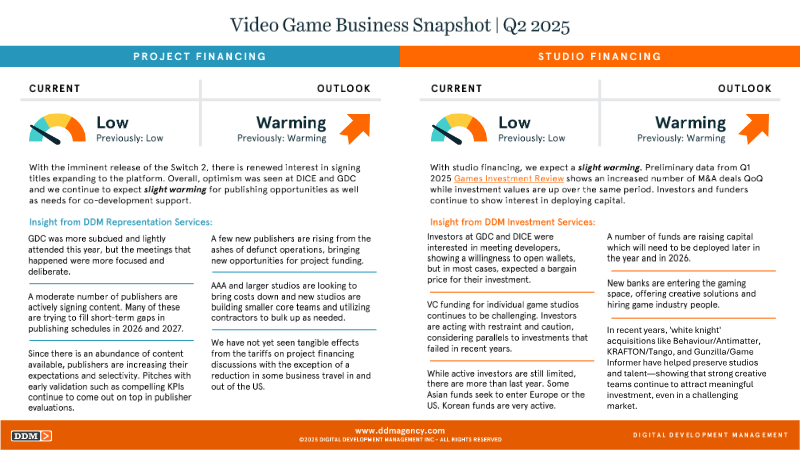
The second quarter of 2025 highlights a strategic shift in the video game industry’s mergers and acquisitions landscape, characterized by a rise in rescue-style investments often referred to as white knight acquisitions. These transactions involve established global entities stepping in to acquire studios or media outlets that might otherwise face closure or significant downsizing. Notable examples include KRAFTON’s acquisition of Tango Gameworks, Behaviour Interactive’s absorption of Antimatter, and Gunzilla Games’ involvement with Game Informer. These moves suggest that despite broader economic volatility and a contraction in traditional venture capital, high-quality creative talent and established intellectual properties remain highly valuable assets for diversified gaming conglomerates.
The current market environment reflects a transition where strategic preservation is prioritized over speculative growth. Large-scale publishers are increasingly focused on securing proven development teams to bolster their long-term pipelines, viewing these acquisitions as opportunities to integrate specialized expertise at a time when independent sustainability is difficult. This trend underscores a broader industry sentiment that while the capital market remains challenging, the underlying value of experienced human capital continues to drive significant deal flow. These developments indicate that the industry is moving toward a more consolidated but stable structure, where the survival of key creative hubs is facilitated by the strategic interests of larger market players.
- Q2 2025 is defined by a surge in 'white knight' acquisitions, where major conglomerates are purchasing studios facing closure or downsizing to preserve creative talent and intellectual property.
- Notable rescue acquisitions this quarter include KRAFTON’s purchase of Tango Gameworks, Behaviour Interactive’s absorption of Antimatter, and Gunzilla Games’ involvement with Game Informer.
- The industry is shifting away from speculative growth toward strategic preservation, as large publishers prioritize securing proven development teams to stabilize long-term production pipelines.
- Despite a contraction in traditional venture capital and broader economic volatility, experienced human capital remains a high-value asset driving deal flow.
- The current market environment is trending toward a more consolidated industry structure, where the survival of independent creative hubs is increasingly dependent on the strategic interests of larger market players.
+1
DDMJun 2025

Report28 pages
The Xsolla Report: State of Play Q2 2025
Mobile gaming has become the dominant engine of the global video‑game market, now accounting for more than half of total industry revenue and projected to exceed $126 billion in 2025, with an overall forecast of $150 billion for the segment. The surge is driven by unprecedented user engagement—4.2 trillion hours of app usage in 2024—and a rapid shift toward direct‑to‑consumer (D2C) commerce following the April 2025 court order in Epic Games v. Apple, which obliges iOS platforms to permit external web‑shops and allows developers to retain up to 95 % of transaction value. Early adopters report revenue recoveries measured in millions and a 60 % increase in user engagement for high‑volume titles.
Regulatory reforms across the EU, United States, Japan, South Korea and China are dismantling traditional app‑store monopolies, mandating alternative storefronts, transparent odds disclosure and the elimination of hidden fees. Despite tighter oversight, the mobile ecosystem remains robust, with the United States generating roughly $52 billion in in‑app‑purchase sales, while emerging markets in Latin America, Southeast Asia and Saudi Arabia expand the geographic footprint. Hybrid monetisation—combining in‑app purchases, advertising and subscriptions—is employed by 72 % of developers and now represents about three‑quarters of mobile revenue; live‑ops‑driven hybrid‑casual titles are delivering a 30 % year‑over
- Mobile gaming is the industry's primary revenue driver, projected to reach $126 billion in 2025 with a total segment forecast of $150 billion.
- Following the April 2025 Epic Games v. Apple court order, developers can now utilize direct-to-consumer web-shops to retain up to 95% of transaction value, with early adopters seeing millions in revenue recovery.
- Hybrid monetization models—combining in-app purchases, advertising, and subscriptions—are used by 72% of developers and account for approximately 75% of total mobile revenue.
- Global mobile user engagement reached 4.2 trillion hours in 2024, while the United States market alone generated $52 billion in in-app purchase sales.
- Regulatory reforms in major markets including the EU, US, Japan, South Korea, and China are mandating alternative storefronts and increased transparency to dismantle traditional app-store monopolies.
+2
XsollaJun 2025

Presentation33 pages
FY2025.3 4Q Financial Results Presentation: Round One Corporation
FY2025.3 4Q Financial Results Presentation [Company Name] ROUND ONE Corporation [Company ID] 4680-QCODE [Event Type] Earnings Announcement [Event Name] Financial Results Briefing for the Fiscal Year Ended March 2025 [Fiscal Period] FY2025 4Q [Date] May 12, 2025 [Time] 15:30 – 16:30 (Total: 60 minutes, Presentation: 37 minutes, Q&A: 23 minutes) [Venue] Webcast President and Chief Executive ...
- ROUND ONE Corporation exceeded its FY2025.3 financial plan, achieving ¥27.22 billion in Ordinary Profit (8.6% above plan) and ¥27.00 billion in Operating Profit (5.0% above plan) on total sales of ¥177.05 billion (3.3% above plan).
- The company plans to adopt IFRS from FY2026.3, projecting a consolidated operating profit of ¥31.22 billion (IFRS), up from ¥27.00 billion (JGAAP) in FY2025.3, with the USA segment contributing ¥14.68 billion (IFRS) and Japan ¥18.18 billion (IFRS).
- ROUND ONE is considering price revisions of approximately 3% for Japan (excluding Amusement) and 4-5% for the USA, both starting from Q2 FY2026.3, to mitigate rising costs, including potential impacts from Trump tariffs on amusement prizes.
- The company is expanding its 'Delicious Project' in Japan, having signed contracts with 17 high-end cooperating merchants as of May 1, 2025, to offer Japanese B-grade/C-grade gourmet in a Food Hall format, targeting inbound American tourists.
- Capital allocation for FY2026.3 includes ¥9.6 billion for existing store facility investments (¥7.1 billion in the USA for amusement machines) and ¥33.9 billion for new store facility investments (¥27.9 billion in the USA).
+1
Round One CorporationMay 2025

Report67 pages
Studie Vlaams Gamebeleid: Eindrapport
The Flemish game industry stands at a critical juncture, requiring a strategic pivot from project-based support toward comprehensive business scaling and economic consolidation. While the sector has seen a rise in the number of studios between 2020 and 2024, growth remains heavily concentrated among a few major players, creating a fragile ecosystem characterized by a lack of mid-sized companies. To ensure long-term viability and competitiveness within the global market—which is currently valued at approximately 187.7 billion dollars—Flemish policy must evolve to address the "missing middle" by facilitating access to private capital and fostering entrepreneurial maturity.
Current support mechanisms, including the VAF/Gamefonds and the Tax Shelter, have been instrumental in initial development but are increasingly viewed as insufficient for the demands of international scaling. Global competition, driven by aggressive fiscal incentives in regions like Canada and France, necessitates a more robust and integrated financial instrumentarium. Stakeholders emphasize that while talent development remains a strength, the sector suffers from a lack of commercial focus, high production costs, and difficulties in retaining intellectual property. Consequently, there is a clear mandate to shift policy priorities toward attracting foreign investment, enhancing international promotion, and streamlining governance through a centralized strategic body.
Ultimately, the objective for the 2026–2030 period is to transition the Flemish games sector into a more stable, economically diverse industry. This requires a dual approach: optimizing existing public funding to better support commercial growth and implementing new, flexible economic tools that bridge the gap between early-stage prototyping and market-ready maturity. By aligning educational outputs with industry needs, fostering cross-sectoral collaboration, and prioritizing business development over isolated project subsidies, the region can mitigate the risks of brain drain and build a resilient, internationally recognized gaming hub.
- The Flemish game industry lacks a 'missing middle' of mid-sized companies, with growth concentrated among a few major players despite an increase in total studio numbers between 2020 and 2024.
- To compete in the $187.7 billion global market, Flemish policy must shift from project-based subsidies toward business scaling and private capital access for the 2026–2030 period.
- Existing support mechanisms like the VAF/Gamefonds and the Tax Shelter are currently insufficient to match the aggressive fiscal incentives offered by international competitors such as Canada and France.
- The sector faces structural challenges including high production costs, difficulties in retaining intellectual property, and a lack of commercial focus despite strong local talent development.
- Strategic priorities for the next five years include attracting foreign investment, enhancing international promotion, and establishing a centralized governance body to oversee industry development.
+1
Departement CultuurMay 2025
Report231 pages
The State of Video Gaming in 2026
The global video game industry is currently navigating a period of significant contraction and structural realignment following a decade of rapid expansion between 2011 and 2021. Real-term spending on game content has declined by approximately 12% since 2021, as the market shifts from a growth-oriented environment to a capital-constrained, zero-sum landscape. This downturn is marked by record-high layoffs, widespread studio closures, and a sharp reduction in venture capital funding. The industry is increasingly dominated by a small cohort of entrenched live-service titles that act as "black holes," consuming the vast majority of player time and financial resources, which makes the launch of new, independent titles increasingly difficult.
Market dynamics are further complicated by extreme resource inflation, with AAA production budgets frequently ballooning to between $200 million and $500 million. While mobile gaming remains the primary driver of global revenue, it faces its own challenges, including declining download volumes and rising user acquisition costs. Meanwhile, the console sector shows signs of stagnation, with current-generation hardware trailing its predecessors in total unit sales. As traditional growth models stall, the industry is pivoting toward new strategies, including the integration of programmatic advertising, the adoption of generative AI to improve production efficiency, and a push toward cross-platform accessibility to maximize player retention.
Geographically, the center of gravity is shifting toward Asian markets, where local developers are increasingly challenging Western incumbents with high-performing, globally resonant titles. Concurrently, the rise of user-generated content platforms like Roblox and the maturation of PC-based modding ecosystems are redefining how players engage with digital worlds. Looking forward, the industry is pinning its recovery on technological advancements in cloud computing and AI-driven development, alongside regulatory shifts that may allow developers to capture a larger share of revenue through alternative distribution channels. Success in this new era requires moving beyond traditional gameplay loops toward interconnected, persistent ecosystems that prioritize social infrastructure and long-term engagement.
- The video game industry is in a period of contraction, with real-term spending on content declining by approximately 12% since 2021.
- AAA production budgets have ballooned to between $200 million and $500 million, contributing to a capital-constrained environment marked by record-high layoffs and studio closures.
- A small cohort of entrenched live-service titles now dominates the market, acting as 'black holes' that consume the majority of player time and spending, making new independent launches increasingly difficult.
- The industry is pivoting toward generative AI to combat production cost inflation and integrating programmatic advertising to offset stalling growth in traditional console and mobile sectors.
- The global center of gravity is shifting toward Asian markets, where local developers are increasingly challenging Western incumbents with high-performing, globally resonant titles.
+2
EpyllionMay 2025

Report37 pages
2025 GDC Trends Report: Connecting the World Through Games
The global game industry in 2025 is defined by a strategic pivot toward practical generative AI implementation and sustainable monetization models in response to market saturation and rising development costs. Approximately one-third of developers now utilize AI tools to streamline prototyping and NPC creation, focusing on "human-in-the-loop" workflows to enhance personalization. However, this technological shift is met with significant friction regarding ethical sourcing, copyright concerns, and the potential displacement of narrative designers. To combat AAA stagnation, studios are increasingly adopting "niche" live service models and "hybrid-casual" mobile strategies, leveraging telemetry for personalized monetization and prioritizing player re-acquisition over expensive new user acquisition.
Financial sustainability has become a primary concern, with 56% of studios now relying on personal funding as the publishing landscape becomes more selective. This has led to a surge in self-publishing and the adoption of HTML5 and WebGPU technologies for more efficient cross-platform distribution. The mobile sector reflects this shift, with narrative-driven advertising propelling the in-game ad market to $100 billion in 2024, officially surpassing in-app purchase revenue. Simultaneously, the industry is embracing social responsibility through the Accessible Games Initiative, which introduces standardized storefront tags to assist the 16% of the global population living with disabilities.
The labor market is undergoing a historic transformation, marked by a 17% layoff rate that has catalyzed the formation of the United Videogame Workers union. Despite these workforce challenges, technical innovation continues across hardware and software, evidenced by the rise of affordable mixed-reality devices and the debut of high-performance handheld platforms like the Snapdragon G3 Gen 3. Creative excellence remains a central pillar of the industry, as demonstrated by the indie title Balatro winning Game of the Year at the 2025 Game Developers Choice Awards, signaling that innovative, community-focused projects can still achieve massive success in a highly competitive global market.
- The mobile in-game advertising market reached $100 billion in 2024, officially surpassing revenue generated from in-app purchases.
- Financial instability has forced 56% of studios to rely on personal funding as the publishing landscape becomes increasingly selective.
- The industry is experiencing a 17% layoff rate, which has served as a primary catalyst for the formation of the United Videogame Workers union.
- Approximately one-third of developers are now integrating generative AI into workflows for prototyping and NPC creation, despite ongoing ethical and copyright concerns.
- Studios are shifting focus from expensive new user acquisition to player re-acquisition, utilizing telemetry to drive personalized monetization in niche live service and hybrid-casual models.
+1
Game Developers ConferenceMay 2025
Presentation46 pages
Consolidated Financial Results Briefing Materials: FY3/25
Akatsuki Inc. demonstrated significant financial resilience in FY3/25, characterized by a 46% year-over-year surge in consolidated operating profit to ¥3,915 million. While total sales experienced a marginal 1% decline, the core Games segment maintained stability through high-performing legacy titles such as Dragon Ball Z Dokkan Battle and Romancing SaGa Re;univerSe. Strong overseas performance and successful large-scale events effectively offset nearly ¥6 billion in development expenses for upcoming projects. This period also marked a strategic turning point as the Comics and IP Solutions segments achieved profitability, driven by the international launch of the MANGA MIRAI service and the rapid expansion of the Slash Gift online lottery platform.
The company’s investment arm further bolstered the balance sheet, realizing ¥2,840 million in proceeds during the fiscal year with additional capital gains anticipated from the IPO of LIFE CREATE Co., Ltd. in early FY3/26. Despite a reduction in total headcount from 803 to 697, primarily within the Games division, permanent staffing levels remained consistent, reflecting a shift toward operational efficiency. This lean organizational structure supports a robust financial position, with ¥33.3 billion in cash reserves earmarked for a ¥35 billion growth investment plan over the next three years, focusing on mergers, acquisitions, and next-generation game development.
Looking toward FY3/26, the group anticipates sustained growth in sales and profit, anchored by the upcoming release of Kaiju No. 8 The Game and the continued scaling of its digital content divisions. To reflect this positive outlook and strong liquidity, the shareholder return policy has been revised upward, increasing the target Dividend on Equity from 3% to 4%. This strategy signals a transition into a new growth phase where diversified IP solutions and global service expansions complement the established mobile gaming portfolio.
- Akatsuki Inc. achieved a 46% year-over-year increase in consolidated operating profit to ¥3,915 million for FY3/25, despite a 1% decline in total sales.
- The company maintains ¥33.3 billion in cash reserves to fund a ¥35 billion growth investment plan over the next three years, targeting M&A and next-generation game development.
- Shareholder returns are increasing as the target Dividend on Equity (DOE) has been raised from 3% to 4% due to strong liquidity and a positive outlook.
- The Comics and IP Solutions segments reached profitability, supported by the international launch of MANGA MIRAI and the expansion of the Slash Gift online lottery platform.
- Investment activities generated ¥2,840 million in proceeds during FY3/25, with further capital gains expected from the upcoming IPO of LIFE CREATE Co., Ltd. in early FY3/26.
AkatsukiMay 2025
Report2 pages
Press Start on Growth: Unlocking the Full Potential of the UK Video Games Industry
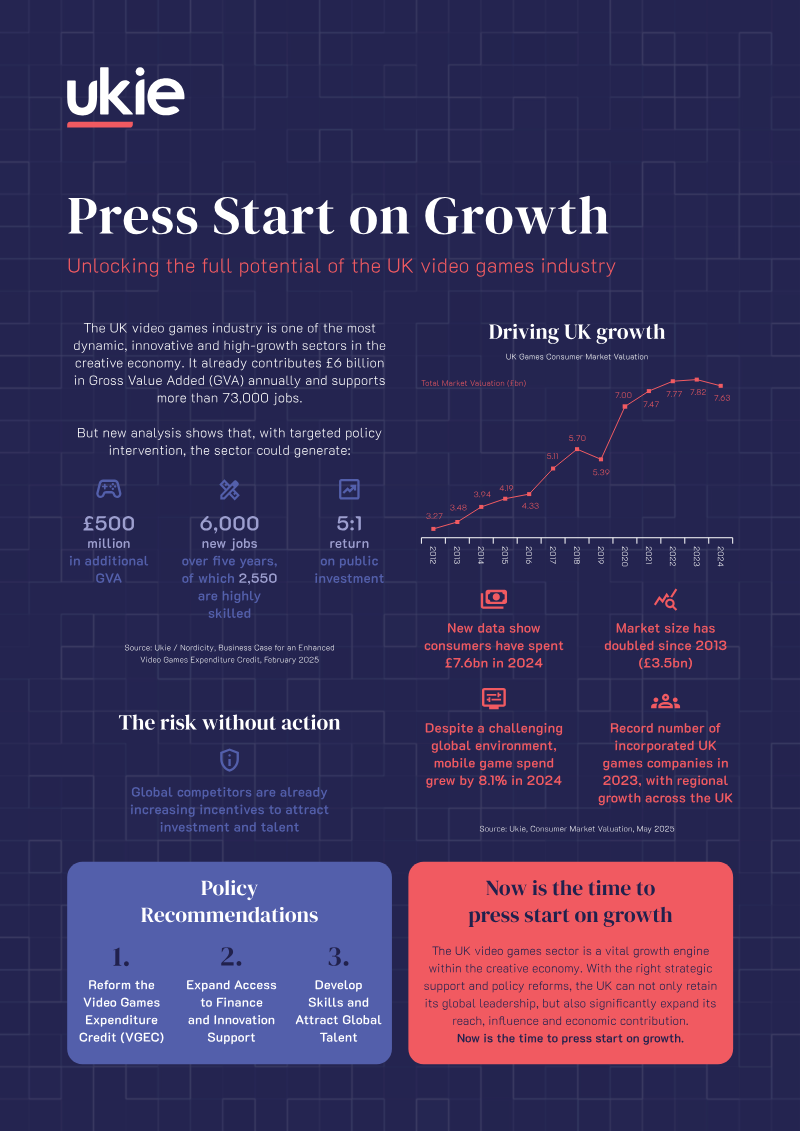
The analysis argues that the United Kingdom’s video‑games sector is a high‑growth pillar of the creative economy, already delivering roughly £6 billion in gross value added (GVA) and supporting more than 73 000 jobs, and that strategic policy action could lift its contribution to about £7.6 billion in 2024 and generate an additional £5.7 billion GVA and up to 5.4 million jobs over the next five years. The assessment covers the full UK market from 2022 through 2024, spanning software, hardware, live events, esports, ancillary merchandise and related media, and benchmarks performance against Western‑European averages.
Key findings show a continued erosion of physical boxed software, which fell 34 % year‑on‑year and now accounts for only 4 % of total spend, while mobile games grew 8 %—still below the 13 % regional average. Full‑game digital purchases slipped due to a thin slate of blockbuster releases, yet overall game volume remained stable. Live‑event spending contracted 15 % after pandemic‑related cancellations, whereas esports surged 44 % YoY, driven by a rise in UK‑based tournaments. Subscription revenue rose modestly as price hikes offset a near‑saturation of console subscriber bases. Hardware sales weakened for PS5 disc and Xbox consoles and for the Nintendo Switch, while the PS5 digital edition posted record software sales at a lower price point. Game‑culture engagement declined 13 % across PC and console categories, and related toy and merchandise sales fell 8.5 %.
The conclusions stress that without targeted reforms—particularly in financing, skills development, and talent support—the sector risks losing its global leadership. Conversely, coordinated policy could unlock further growth, broaden international reach, and reinforce the UK’s position as a leading hub for video‑games innovation and cultural influence. Data are drawn from industry sources such as Omdia, Ukie, NielsenIQ/GfK Entertainment, BFI, Comscore and the Official Charts Company, reflecting a comprehensive market‑valuation approach across multiple
- The UK video games industry currently contributes £6 billion in gross value added (GVA) and supports over 73,000 jobs, with the potential to add £5.7 billion in GVA and 5.4 million jobs over the next five years through strategic policy intervention.
- Physical boxed software sales have collapsed, falling 34% year-on-year to represent only 4% of total market spend.
- Esports experienced a significant surge of 44% year-on-year, driven by an increase in UK-based tournaments, contrasting with a 15% contraction in live-event spending.
- Mobile gaming in the UK grew by 8%, though this remains below the 13% regional Western-European average.
- Hardware sales for major consoles, including the PS5 disc edition, Xbox, and Nintendo Switch, weakened, while the PS5 digital edition achieved record software sales at a lower price point.
+1
UkieMay 2025

Presentation19 pages
People Can Fly Q4 2024 Financial Results Presentation
People Can Fly presents a strategic pivot toward cash flow optimization and a refined production focus as of April 2025. The primary thesis centers on transitioning away from the virtual reality segment to concentrate exclusively on AAA and compact-AAA video games. This shift is driven by changes in the global VR business model, specifically the cessation of platform subsidies. Consequently, the company will conclude its VR publishing activities following the release of Project Bison in late 2025.
Financial data for the 2024 fiscal year shows cumulative revenue of PLN 190.4 million, an increase from PLN 150.1 million in 2023. This growth was supported by work-for-hire contributions from Project Maverick and Project Echo, alongside the launches of Bulletstorm VR and Green Hell VR Co-op. However, the group reported a significant net loss of PLN 175.3 million, largely attributed to one-off write-offs for Project Red, Project Bifrost, and the impairment of the Incuvo subsidiary.
The strategic roadmap emphasizes securing new work-for-hire contracts, including a recently signed project with Sony Interactive Entertainment, with a target of adding two more projects this year. In the self-publishing segment, Lost Rift is scheduled for early access in 2025. Notably, Krafton Inc. has waived its right of first refusal for Projects Bifrost and Victoria, granting the company freedom to seek new publishing partners.
Operational efficiency measures include optimizing team structures and office spaces while limiting disbursements to critical investments. As of late 2024, the group maintained a workforce of 756 employees across global studios in Warsaw, Montreal, Newcastle, and other locations. The company is currently evaluating various scenarios to secure additional financing to support its revised development pipeline.
- People Can Fly is exiting the virtual reality market following the release of Project Bison in late 2025, citing the cessation of platform subsidies as the primary driver.
- The company reported a net loss of PLN 175.3 million for fiscal year 2024, driven by significant one-off write-offs for Projects Red and Bifrost and the impairment of its Incuvo subsidiary.
- Annual revenue grew to PLN 190.4 million in 2024, up from PLN 150.1 million in 2023, bolstered by work-for-hire contributions from Project Maverick and Project Echo.
- The company is prioritizing work-for-hire revenue, having recently signed a new contract with Sony Interactive Entertainment with a goal to secure two additional projects in 2025.
- Krafton Inc. has waived its right of first refusal for Projects Bifrost and Victoria, allowing People Can Fly to seek new publishing partners for these titles.
+2
PCF GroupApr 2025