Key insights
6 slides
Key number
Public gaming equities outperformed the broader market in H1 2025.
The Drake Star Gaming Index rose 28% in the first half of 2025.
Page 3 of the report28%
Drake Star Gaming Index gain in H1 2025
- S&P 500 gain in H1 2025
- 5%
Deal count
M&A activity remained steady at 46 deals in H1 2025.
Notable deals include Krafton’s $516 million purchase of ADK and Epic Games’ acquisition of Loci.
Page 3 of the reportQ22344
Q32333
Q42344
Q12448
Q22453
Q32457
Q42439
Q12549
Capital raised
Private-market financing reached $3 billion across 110 placements in H1 2025.
The report states private-market financing reached $3 billion across 110 placements. Major exits included Dream Games’ $2.5 billion minority stake sale to CVC.
Page 6 of the reportQ223202
Q323189
Q423170
Q124192
Q224187
Q324181
Q424153
Q125150
Sector split
Mobile gaming led Q2 2025 private-placement capital at $1.5 billion.
Q2 2025 private-placement capital totaled $2.6 billion across 24 deals. Mobile gaming accounted for $1.5 billion, followed by PC/console at $0.8 billion.

Valuation gap
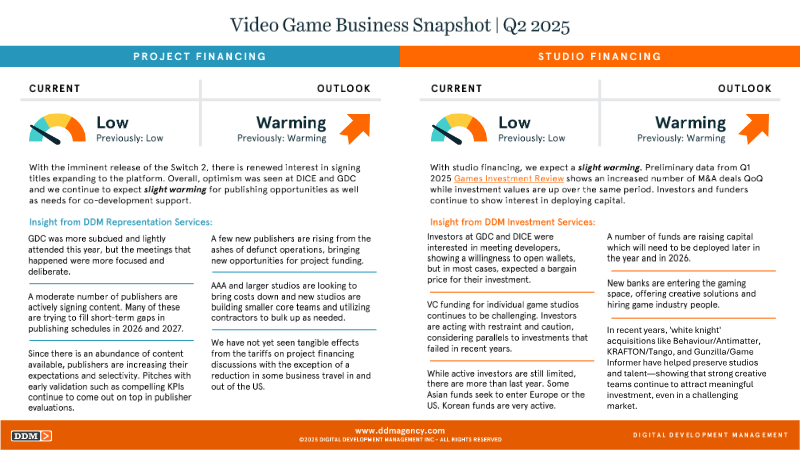
High-growth Asian firms command premium multiples over mature Western peers.
Tencent and Sea Limited command premium multiples with double-digit revenue growth. U.S. players like NVIDIA and Unity exhibit lower multiples and mixed performance.

Growth catalysts
Artificial intelligence and technology platforms are primary catalysts for projected growth.
Projections indicate a continued rise in M&A and IPO activity through 2026. The report identifies artificial intelligence and technology platforms as primary growth catalysts.

1 / 6
Ask AI about this report