Watch Dogs
21 documents in the library are about Watch Dogs, from writers such as Ubisoft, Game Developers Conference and Game Dev Unchained, the newest from 2024. Each has a summary and key insights with the page they come from.

Set in Chicago, where a central network of computers connects everyone and everything, Watch Dogs explores the impact of technology within our society. Using the city as your weapon, you will embark on a personal mission to inflict your own brand of justice. Chicago's overarching network is known as the Central Operating System (ctOS), and it controls almost all of the city's technology and information - including key data on all of the city's residents.
- Released
- May 26, 2014
- Developer
- Ubisoft Montreal
- Publisher
- Ubisoft Entertainment
- Genres
- Shooter, Adventure
- Platforms
- Google Stadia, PlayStation 3, PlayStation 4, PC (Microsoft Windows), Wii U, Xbox 360, Xbox One
- Links
- Wikipedia
Game data from IGDB.com
Key figures
This contest follows a 2019 partnership with HitRecord, where Ubisoft was criticized for paying a total of $2,000 to be split among collaborators for fan-contributed music in Watch Dogs Legion.
Hit Points, 2021 · Indecent Exposure
Market share grew to 12.8% in 2014, up from 9.6% the previous year, driven by titles including Assassin’s Creed, Far Cry 4, The Crew, and Watch Dogs.
Ubisoft, 2015 · Ubisoft Third Quarter 2014-15 Sales Results, p. 1
Digital segment revenue surged by 90.4%, accounting for 27.8% of total sales, largely driven by the launch of Watch Dogs, which sold over 9 million units.
Ubisoft, 2014 · Ubisoft Reports First-Half 2014-15 Sales and Earnings Figures, p. 2
The launch of the new intellectual property Watch Dogs was the primary growth driver, achieving 8 million sell-in units and establishing the title as a major franchise.
Ubisoft, 2014 · Ubisoft Reports First Quarter 2014-15 Sales, p. 1
Ubisoft reported a 19.9% decline in annual sales to €1.007 billion and a net loss of €65.5 million for the 2013/2014 fiscal year, largely due to the postponement of major titles like Watch Dogs and The Crew.
Ubisoft, 2014 · Ubisoft Annual Report 2014, p. 164
Documents about Watch Dogs
Ubisoft Shares Continue Decline Following Shareholder Demands to Go Private
Ubisoft is currently facing significant market volatility and downward pressure on its share price, which has fallen below the $3 mark.
- Slovakia-based hedge fund AJ Investments, which holds approximately 1% of Ubisoft, has publicly demanded that the company go private or sell to a strategic investor.
- The investor group is calling for the ousting of CEO Yves Guillemot and his family, citing mismanagement and the underutilization of key franchises like Rayman, Splinter Cell, and Watch Dogs.
- AJ Investments has threatened to organize a coalition of minority shareholders to initiate a proxy fight if their demands for a sale and further layoffs are not met.
Indecent Exposure
Ubisoft’s recent engagement strategies regarding fan-generated content have drawn significant criticism for their exploitative nature.
- Ubisoft has faced criticism for sourcing fan-made content for Assassin’s Creed Valhalla through a contest that awards only $225 in merchandise to winners while requiring them to transfer all intellectual property rights to the company in perpetuity.
- This contest follows a 2019 partnership with HitRecord, where Ubisoft was criticized for paying a total of $2,000 to be split among collaborators for fan-contributed music in Watch Dogs Legion.
- Industry analysts suggest Ubisoft’s aggressive pursuit of user-generated content may be an early, experimental effort to build a foundation for future blockchain-based economies where player creations can be traded and monetized.
Replicating Chaos: Vehicle Replication in Watch Dogs 2
Achieving seamless vehicle replication in a peer-to-peer multiplayer environment requires a sophisticated balance between network latency management and physics fidelity.
- Watch Dogs 2 utilized a peer-to-peer architecture for its four-player bounty mode, which necessitated distributed authority over entities and created significant challenges for synchronizing high-speed vehicle collisions.
- Vehicle replication relies on projective velocity blending for dead reckoning, which interpolates between local velocity and predicted master snapshots to minimize the spatial gap caused by network latency.
- To mitigate collision discrepancies in a peer-to-peer environment, the team implemented a hybrid approach that allows local physics to simulate impacts for a short duration before blending back into the dead-reckoned trajectory.
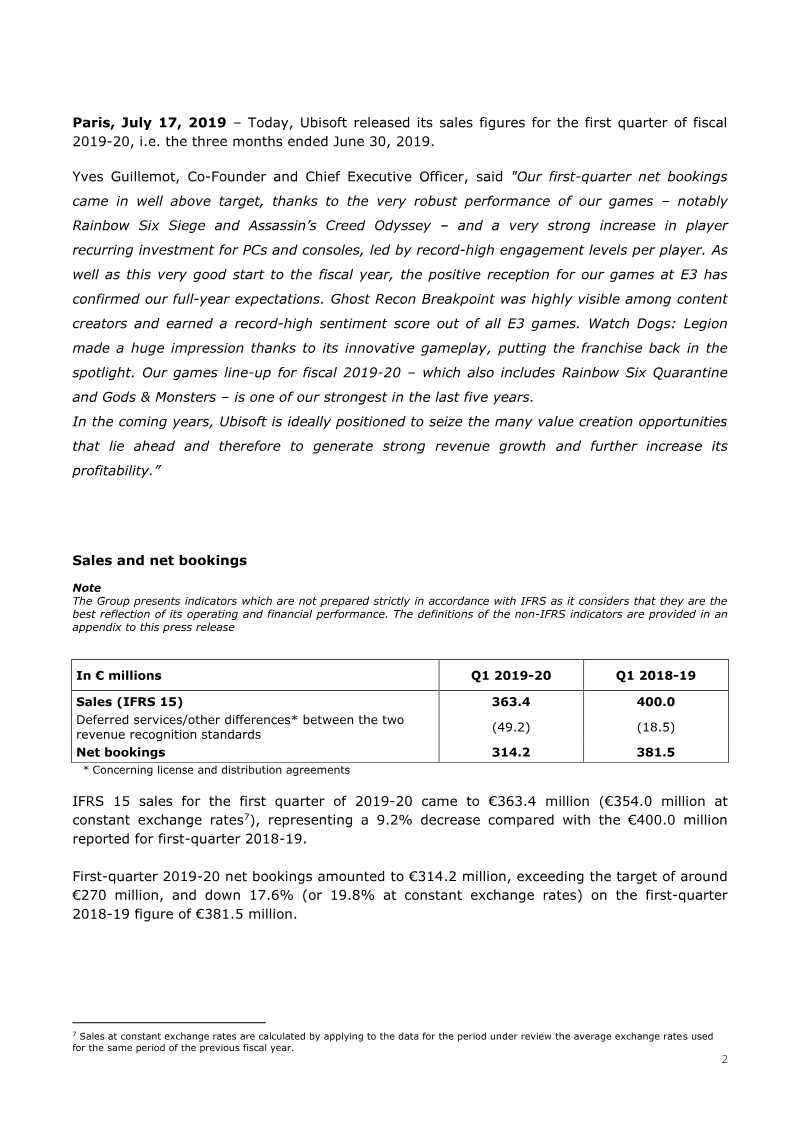

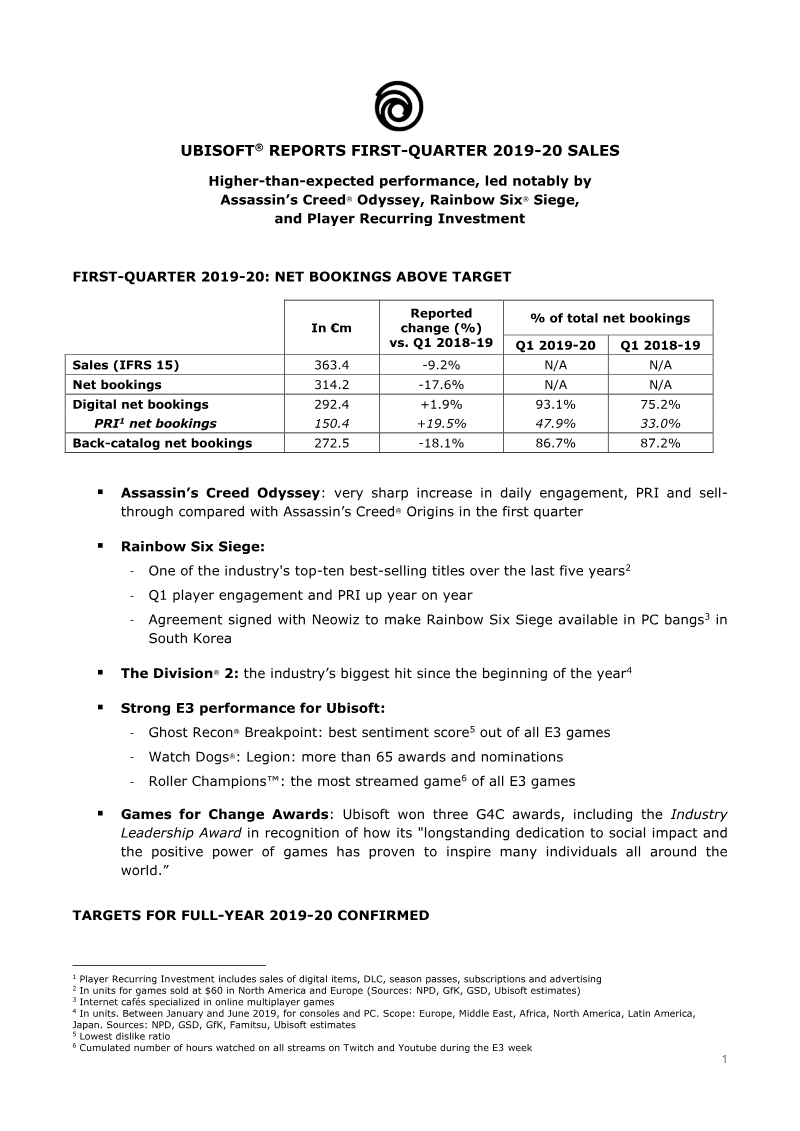
Ubisoft First-Quarter 2019-20 Financial Results
Ubisoft’s first-quarter financial results for fiscal year 2019-20 demonstrate a period of robust performance that exceeded internal targets, driven primarily by strong player engagement and recurring investment.
- Ubisoft exceeded its Q1 2019-20 net bookings target of €270 million, achieving €314.2 million despite a 17.6% year-over-year decline.
- Player Recurring Investment (PRI), including DLC and season passes, grew by 19.5% to €150.4 million, underscoring a strategic shift toward long-term revenue streams.
- Digital net bookings accounted for 93.1% of total revenue, reflecting the company's heavy reliance on digital distribution channels.

Ubisoft & Square Enix E3 Press Conference | Games ReCAP Episode 004
Ubisoft maintains a robust and stable development model by leveraging established engines and iterative design across major franchises such as Assassin’s Creed, Watch Dogs, Far Cry, and the Tom Clancy series.
- Ubisoft’s strategy of leveraging established engines and iterative design for franchises like Assassin’s Creed and Far Cry provides a stable production model that minimizes the volatility and mass layoffs seen elsewhere in the industry.
- A two-year development cadence is proposed as the optimal standard for major titles, allowing players sufficient time to master complex gameplay systems before the next iteration is released.
- Square Enix’s modernization efforts show inconsistent results, with the Final Fantasy VII Remake succeeding through real-time combat and high fidelity, while projects like the Avengers title and the Final Fantasy VIII remaster suffer from a lack of comprehensive overhauls.
Hacking into the Combat AI of Watch Dogs 2
The combat artificial intelligence in Watch Dogs 2 relies on a multi-layered cover-selection system designed to balance tactical realism with computational efficiency.
- Watch Dogs 2 AI agents evaluate cover selection based on three primary criteria: distance to the target (optimized for weapon range), line of sight (ensuring a valid field of fire), and proximity to other agents (to avoid clumping and vulnerability to area-of-effect damage).
- To mitigate the player's ability to 'cheese' combat using unreachable vantage points like scissor lifts, developers implemented a special 'unreachable' AI mode where agents prioritize survivability and lateral movement toward cover rather than pathing directly toward the player.
- The AI uses three distinct cover-seeking behaviors: 'first cover' for immediate protection, 'neighboring cover' for repositioning during combat, and 'second cover' for tactical flanking or optimizing weapon range.
Watch Dogs: Hacking it to 11
The audio design for Watch Dogs centers on the challenge of maintaining a cohesive, narrative-driven sonic identity within the unpredictable constraints of an open-world environment.
- To manage memory and processor constraints, the audio team replaced long, multi-layered musical tracks with a modular system that chops compositions into smaller, reusable parts that trigger based on in-game actions.
- The team implemented a reactive music engine that uses short, looping segments to minimize latency between game events and musical transitions, allowing the score to skip or advance sections based on player input.
- The audio team utilized a 'piano validation' technique, testing complex synth or guitar riffs on a clean piano to ensure harmonic stability and compatibility before committing to final production.
Helping It All Emerge: Managing Crowd AI in Watch Dogs 2
The creation of a living, reactive urban environment in Watch Dogs 2 centers on the implementation of an Anecdote Factory, a system designed to generate unscripted, emergent narrative moments.
- Ubisoft managed civilian behavior in Watch Dogs 2 using a logic-based system containing approximately 700 rules that, through combinatorial complexity, generated billions of potential behavioral outcomes.
- The AI decision-making process utilizes a multi-factor evaluation where agents weigh personal relationships, emotional states, and environmental context to determine whether to ignore, observe, flee, or fight during an incident.
- To maintain performance and prevent chaotic feedback loops, the team implemented 'limiters' on loud, high-impact behaviors to ensure that emergent interactions between NPCs remained within manageable, finite limits.

Breaking Marginalized Character Narrative Molds to Write Better, Richer Characters
The prevailing reliance on the cisgender, able-bodied white male as the default protagonist in video games frequently results in generic, imperialist archetypes that lack genuine relatability.
- Developers must move beyond the default cisgender, able-bodied white male protagonist to avoid generic, imperialist archetypes and foster deeper character relatability.
- Authentic representation requires grounding protagonists in specific, deliberate cultural and personal histories, as demonstrated in the narrative approach of Treachery in Beatdown City.
- Writers should avoid reducing marginalized characters to one-dimensional stereotypes or trauma-based plot devices, a failure observed in titles like Mafia III and Watch Dogs 2.
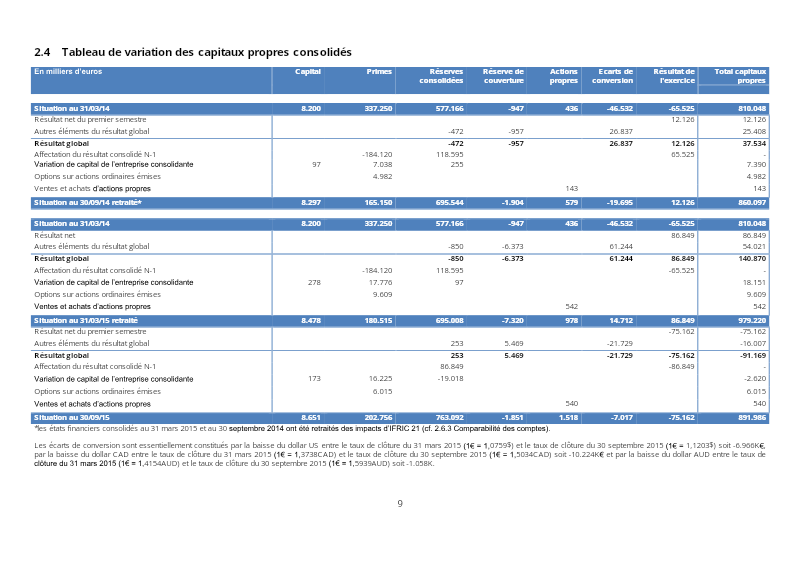
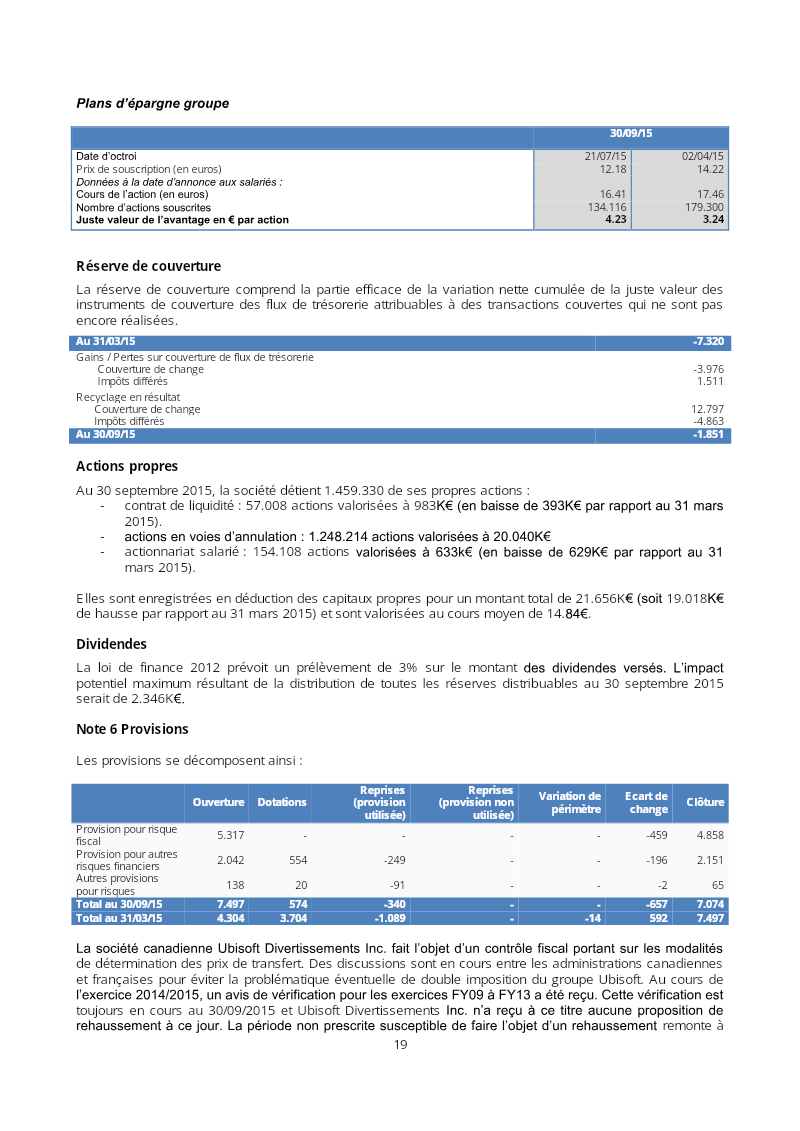
Ubisoft Entertainment: Financial Half-Year Report 2015-16
Ubisoft’s financial performance for the first half of the 2015-16 fiscal year reflects a period of transition characterized by a significant revenue contraction.
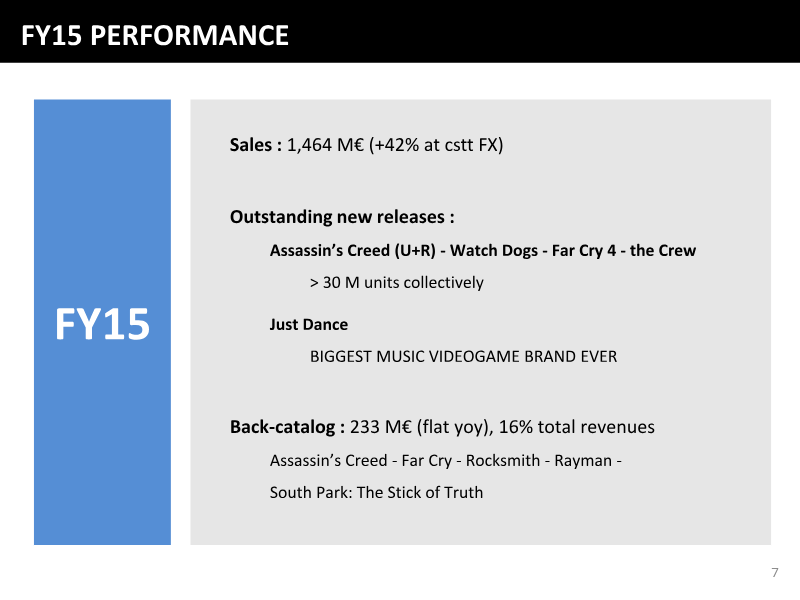

Ubisoft FY15 Earnings Presentation
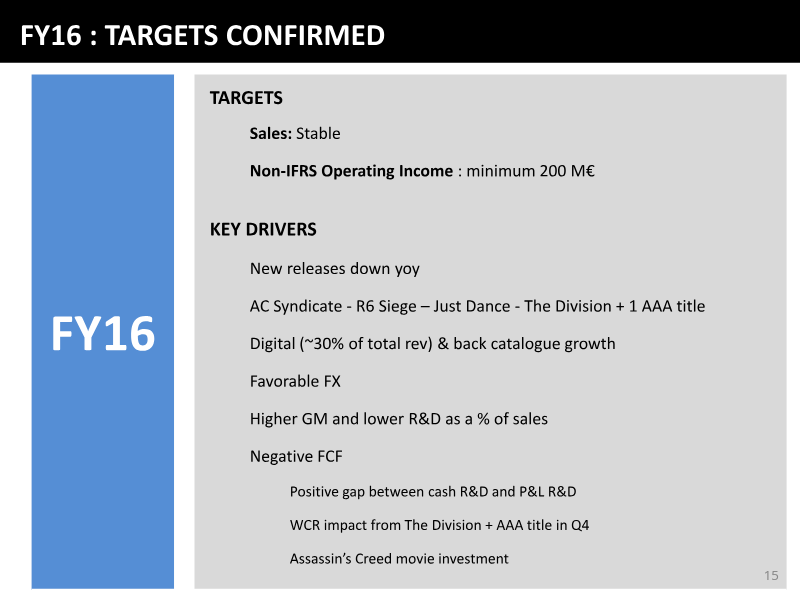
The Ubisoft Fiscal Year 2015 earnings presentation outlines a period of significant financial recovery and operational growth, driven by the successful execution of a strategy centered on systemic open-world games, digital expansion, and community engagement.

Ubisoft Full-Year 2014-15 Sales and Earnings Figures
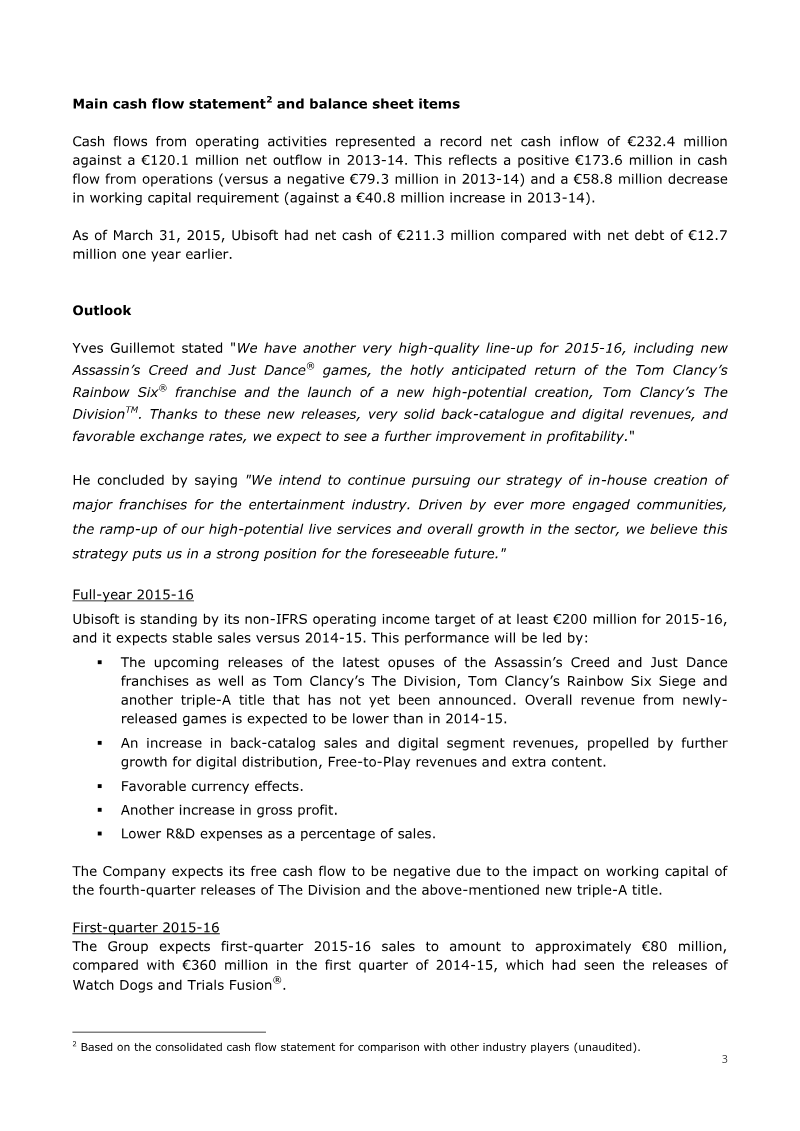
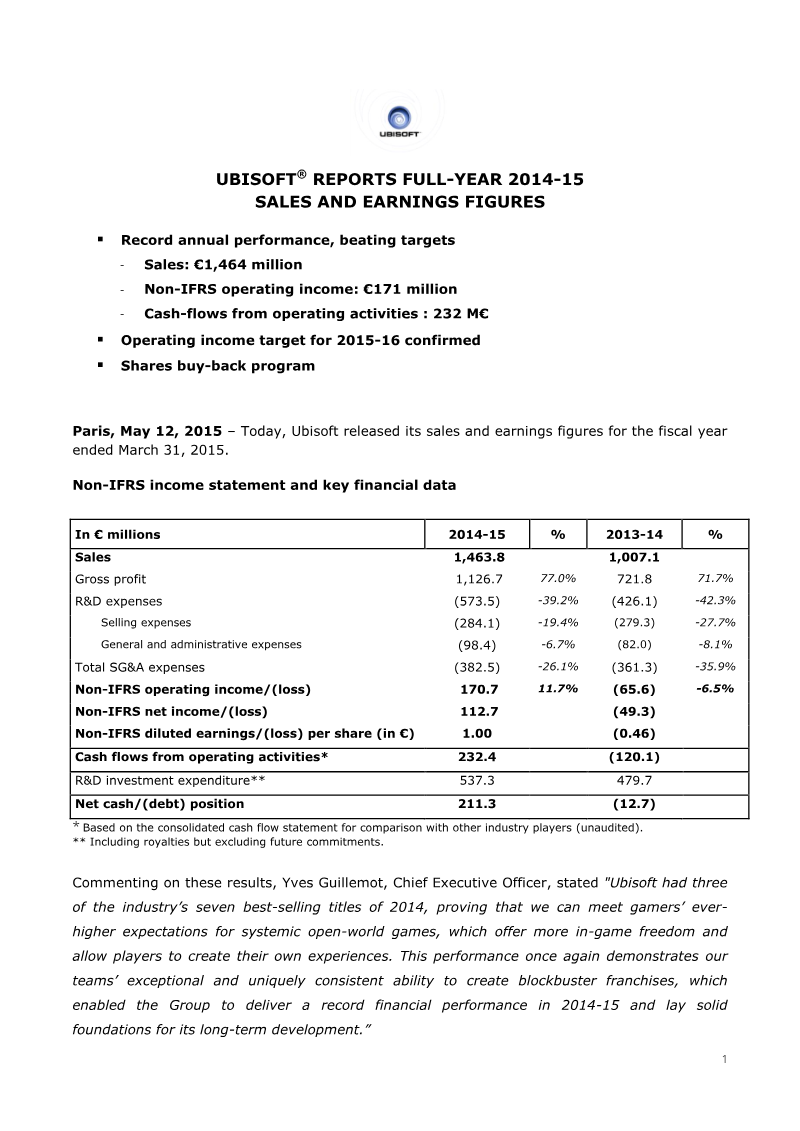
Ubisoft achieved record financial performance for the 2014-15 fiscal year, ending March 31, 2015, with total sales reaching €1,463.8 million. This represents a 45.3% increase compared to the previous fiscal year.
- Ubisoft achieved record financial performance in fiscal year 2014-15 with sales of €1,463.8 million, a 45.3% increase over the previous year.
- The company shifted from a non-IFRS operating loss of €65.6 million in 2013-14 to a record non-IFRS operating income of €170.7 million.
- Digital revenue surged 96.8% to €382.7 million, representing 26.1% of total sales and contributing to a record 77.0% gross profit margin.