Unreal
Game
Documents about Unreal
Game Designer to Player Advocate: Trent Oster of Beamdog
The evolution of the gaming industry from the shareware era to the modern live-service landscape is best understood through the career trajectory of Trent Oster, a co-founder of BioWare and current leader of Beamdog.
- Modern game development efficiency is best achieved by adopting standardized engines like Unreal rather than building proprietary technology from scratch.
- Scaling a studio to approximately 70 employees requires a transition from micromanagement to strategic advocacy, specifically focusing on protecting staff from unsustainable labor practices.
- Studios can maintain creative independence from corporate publishers by using the revitalization of legacy titles to generate the cash flow necessary to fund original intellectual property like MythForce.

How Hollywood Cinematography Is Employed to Support Games' Cinematic Visualization
The integration of Hollywood visualization techniques into game development serves as a critical bridge between narrative ambition and technical execution.
- The primary goal of pre-visualization (previz) is to create a one-to-one match between early drafts and final cinematic assets, which streamlines production and significantly reduces costs by resolving creative and technical issues early.
- Previz serves as a direct communication bridge between visualization supervisors and key stakeholders, including directors, producers, and cinematographers, allowing for rapid iteration of complex sequences.
- Effective previz acts as a foundational blueprint for final animation, preventing the need for costly, last-minute adjustments during the final rendering phase.
Unity vs Unreal (I'm Seriously Considering Switching To Unreal)
The choice between Unity and Unreal Engine represents a significant strategic decision for independent game developers, particularly as they transition from 2D projects to complex 3D environments.
- Unity holds a 43% market share compared to Unreal Engine’s 13%, making it the dominant choice for independent developers.
- Unreal Engine 5’s advanced features like Nanite and Lumen are optimized for high-end hardware, which can create significant performance overhead for mobile and Nintendo Switch development.
- The decision to switch engines is often hindered by the high cost of migrating established workflows and the potential loss of cross-platform versatility.
Shader Sauce: How to Use Shaders to Create Stylized VFX
Stylized visual effects represent a distinct design space defined by abstraction rather than a simple progression toward realism.
- Stylized VFX and realistic effects share the same foundational shader concepts, meaning the same technical principles apply regardless of where an asset falls on the realism spectrum.
- Alpha erosion creates non-uniform fading by subtracting a noise map from a texture and using a saturate node to clamp the result between 0 and 1, providing a more organic transition than traditional alpha fading.
- Vertex offset manipulation allows for dynamic mesh deformation by using vertex normals to move, scale, or rotate geometry in world space based on shader inputs.

Storytelling Siblings: The Kindred Connection between Games and Theme Parks
Theme parks and video games function as storytelling siblings, sharing fundamental principles of immersive design, world-building, and spatial navigation.
- Theme parks and video games share foundational design principles, such as using environmental cues for implicit navigation and creating 'promises'—like hidden rewards behind a waterfall—that the experience must fulfill to satisfy guest expectations.
- Modern theme parks are increasingly adopting RPG and tabletop mechanics, such as those seen at Evermore Park in Utah, where guests engage in persistent, character-based quests that allow for individual agency and long-term narrative progression.
- The themed entertainment industry is actively recruiting game developers to build interactive experiences using professional game engines like Unity and Unreal, as well as developing companion app layers for physical attractions.
Jacob Navok: How MILEs Will Transform Entertainment
Massively Interactive Live Events, or MILEs, represent a fundamental shift in digital entertainment by merging the passive consumption of streaming media with the agency of interactive gaming.
- Massively Interactive Live Events (MILEs) merge passive streaming with interactive gaming, allowing millions of concurrent users to collectively influence narrative outcomes in real-time.
- MILEs bypass high-end hardware requirements by utilizing cloud-native technology to stream high-fidelity, persistent narratives directly to mobile devices.
- The format functions as a community-driven spectacle that leverages established intellectual properties, such as The Walking Dead, to capture non-traditional gaming audiences.
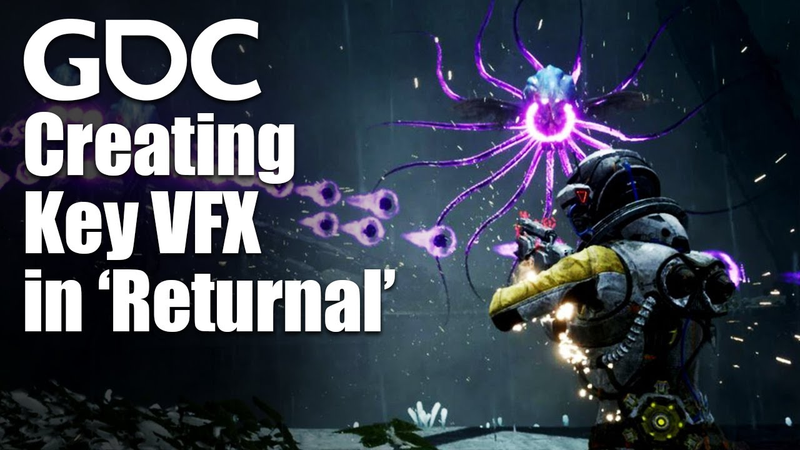
Can We Do It with Particles?: VFX Learnings from 'Returnal'
Housemarque’s development of the 2021 title Returnal leveraged a proprietary, GPU-based visual effects engine to achieve complex environmental and character effects.
- Housemarque utilized a proprietary, GPU-based VFX engine, originally developed in 2014 and integrated into Unreal Engine, which relies on custom HLSL-based code rather than pre-built nodes to achieve high-performance particle systems.
- The engine employs particle hierarchies, or 'node particles,' allowing child particles to reference parent data to procedurally generate complex structures like tentacles and destructible objects.
- By treating particles as control points for curves, the team implemented efficient tube rendering that manages complex movement and player collisions with minimal performance overhead.

Emotional Neural Style Transfer: Expressing Character AI Emotion through Paintings
This research explores the integration of neural style transfer (NST) as a novel medium for character AI to express emotion within video games.
- The research implements a system where character AI emotions, modeled via OCC and PAD frameworks, are expressed by dynamically applying neural style transfer (NST) to the game environment.
- The technical architecture utilizes conditional instance normalization to support four distinct NST variations: basic, blending, mask-based, and color-controlled style transfer.
- To preserve GPU resources for primary game rendering, the system performs CPU-based inference using TensorFlow Lite, ensuring compatibility with Unreal Engine 4 and various console architectures.
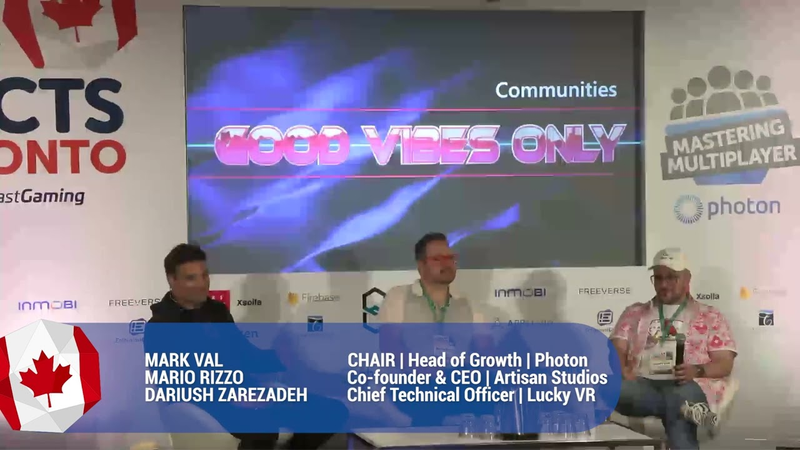
Panel: Mastering Multiplayer: The Super Session
Multiplayer gaming has transitioned from a niche segment into the primary driver of the modern industry, with 75 percent of the top 200 grossing titles now incorporating multiplayer components.
- Multiplayer gaming is now the industry's primary revenue driver, with 75 percent of the top 200 grossing titles incorporating multiplayer components.
- Developers are shifting from traditional single-player experiences toward persistent platforms that prioritize community agency and long-term engagement.
- To manage the financial and legal risks of real-time networking and data management, developers are increasingly using iterative, minimum viable product strategies and gray-box prototyping.

Gerard "HipHopGamer" Williams talks new tech, schooling and opportunism in gaming
Gerard Williams, known as HipHopGamer, emphasizes the evolving intersection of gaming culture, technological advancement, and professional opportunity.
- The democratization of game development is being driven by accessible high-end tools like Unreal Engine 5, which enable independent developers to compete directly with major studios.
- Gaming is transitioning from a niche hobby into a recognized professional field, supported by the integration of game design and development into formal educational curricula.
- Play-to-earn business models are creating new economic opportunities for global players, though the industry remains in a trial-and-error phase to balance monetization with cultural integrity.

The 'hyper-financialisation' of play-to-earn with Ben Cousens from Zebedee
Zebedee operates as a fintech service provider that integrates Bitcoin-based payment infrastructure directly into video games.
- Zebedee provides fintech infrastructure that integrates Bitcoin Lightning Network payments into games, enabling real-time, low-cost microtransactions for in-game events.
- The platform currently supports over 20 developers, with 12 titles already live on major app stores across mobile, PC, and console platforms.
- The technology is designed to replace inefficient gray-market economies with a compliant system that allows developers to capture revenue from organic player behavior while reducing fraud.

Your First Indie Game Should SUCK
The primary objective for aspiring indie game developers is to transition from hobbyist to professional by following a structured, iterative development roadmap.
- Prioritize completing a modest, low-stakes first project to build psychological resilience and technical skills rather than attempting a high-fidelity commercial debut.
- Limit the scope of your first project to a labor-time budget of $10,000 to $30,000 to ensure the game is finished quickly.
- Use industry-standard engines like Unity or Unreal and leverage asset stores to focus on core system development instead of creating basic assets from scratch.