Unpacking
Game
Documents about Unpacking
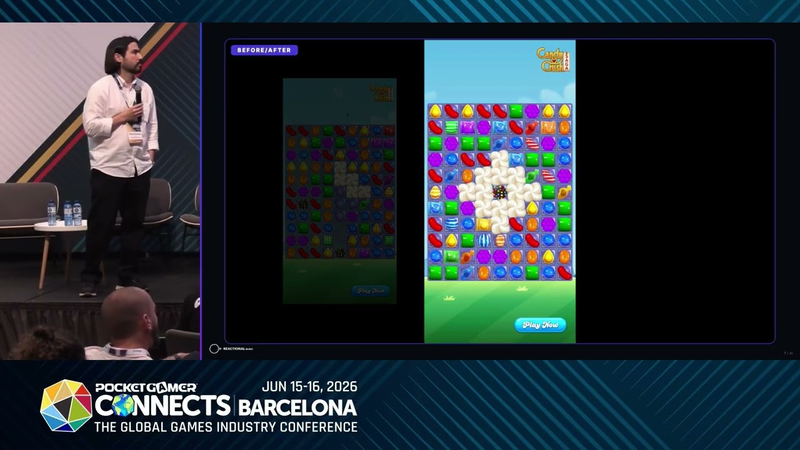
Session: Hit Music In UA-Unpacking the Impact of Commercial Hit Music In Mobile Games - T. Jenneborg
The integration of commercial hit music into mobile game user acquisition (UA) represents a significant, largely untapped opportunity to drive engagement and install rates.
- Reactional Music provides a platform that handles music licensing and technical integration to enable the use of popular, high-stream-count music in mobile game user acquisition (UA) campaigns.
- Early testing indicates that incorporating hit music into playable ads increases install rates and engagement compared to baseline assets.
- The platform utilizes a patented engine to synchronize game events with music, allowing publishers to batch-export multiple ad variations that react to specific beats or vocal melodies.
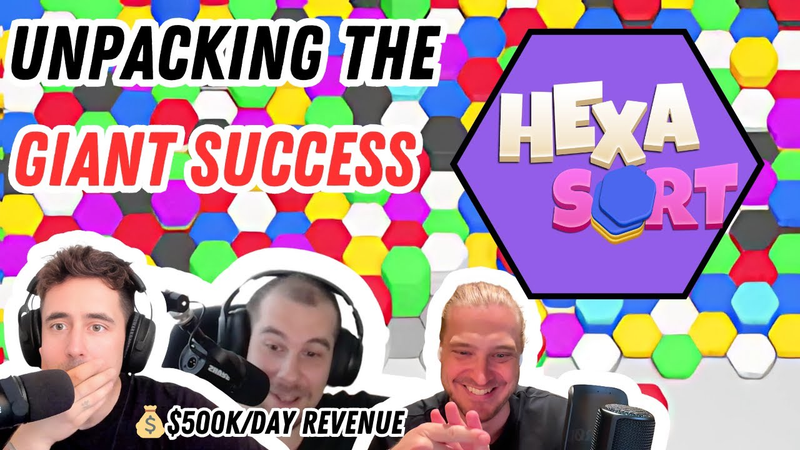
Hexasort: Unpacking the $500k/day revenue success. A new era of casual & puzzle games!
Hexasort represents a pivotal shift in the hybrid-casual mobile gaming landscape, establishing a new benchmark for combining addictive puzzle mechanics with sophisticated monetization.
- Hexasort by Lion Studios has achieved significant financial growth, doubling its daily in-app purchase (IAP) revenue from approximately $70,000 in September 2024 to $140,000 per day within a single month.
- The game maintains high user engagement, achieving an average of six sessions per day, which is considered exceptionally high for the puzzle genre.
- Hexasort utilizes an aggressive ad monetization strategy that allows for a maximum load of nine interstitial ads and 16 rewarded ads per 40-minute daily session.
two & a half gamers session #26 - Unpacking Google ads "disaster", ASA Today's new ad, Google <3 MAX
Google’s recent implementation of stricter ad guidelines, which limit intrusive full-screen interstitials and specific app-open formats, represents a strategic shift toward rewarded advertising rather than a systemic threat to the hyper-casual gaming sector.
- Google is enforcing stricter ad placement policies, specifically targeting full-screen interstitial ads that appear before app loading screens and those that remain unclosable for 15 seconds, leading to increased app rejections.
- Apple has expanded its search ad inventory by adding two new placements in the Search tab and the Search results page, a move expected to significantly increase Apple's advertising revenue following the implementation of the ATT privacy framework.
- AdMob has historically used its mediation platform to incentivize developers, with reports of the company throttling ad traffic by 90-95% for developers who exceeded a three-placement limit, effectively forcing them toward Google's own mediation tools.

Unpacking Krafton’s Strategy: PUBG, New IPs, Investments & More!
Krafton is currently undergoing a strategic evolution, transitioning from a company defined by the singular success of the PUBG franchise to a diversified global publisher focused on scaling creative innovation.
- Krafton is diversifying its portfolio beyond the PUBG franchise by investing in a multiplatform pipeline that includes inZOI, Dark and Darker Mobile, and Dinkum Mobile.
- The company utilizes a decentralized operational model, supporting specialized spin-off studios with infrastructure and resources while maintaining studio autonomy.
- Krafton is aggressively integrating deep learning and artificial intelligence to improve development efficiency, enhance anti-cheat security, and create more immersive NPC experiences.

Behind the GDC Booths: Unpacking Industry Challenges | 342
The contemporary gaming industry is currently defined by a profound disconnect between the stagnant output of large, well-funded studios and the agile innovation emerging from smaller, independent teams.
- The gaming industry is experiencing a structural disconnect where large, well-funded studios face stagnant output and bloated development cycles, while independent teams are capturing market share through agile innovation.
- Widespread industry instability, marked by recurring layoffs, is eroding institutional knowledge and threatening the long-term viability of major development projects.
- Corporate strategy is currently dominated by a focus on short-term quarterly growth and performative marketing, which prioritizes financial metrics over workforce retention and sustainable creative development.
Unpacking New Consent Rules on Mobile from Google: CMP, TCF
As of February 2024, mobile publishers operating within the European Economic Area and the United Kingdom must integrate a Transparency and Consent Framework 2.2 compliant Consent Management Platform to maintain ad revenue through Google.
- As of February 2024, mobile publishers in the EEA and UK must use a TCF 2.2-compliant Consent Management Platform (CMP) to continue generating ad revenue through Google.
- Simple binary consent mechanisms are no longer sufficient, as the new mandate requires certified platforms capable of generating granular consent strings.
- Mobile developers must choose between Google’s free native consent tool and paid third-party solutions, which offer advanced features like A/B testing and customization to improve opt-in rates.

'Unpacking': The Fun Behind the Foley
The production of Unpacking necessitated a sophisticated approach to foley design, driven by the requirement for hyper-realistic audio feedback across thousands of interactive objects.
- The development of Unpacking required the creation of 14,000 individual audio files to achieve hyper-realistic foley feedback across thousands of interactive objects.
- The team utilized Reaper for a high-efficiency workflow, employing custom scripting and dynamic splitting to process over 13,000 files rapidly.
- A centralized database managed via Google Sheets integrated directly with Unity and Wwise to enable real-time asset validation and global processing, such as resonance smoothing.

two & a half gamers session #26 - Unpacking Google ads "disaster", ASA Today's new ad, Google & MAX
Google’s recent implementation of stricter guidelines regarding full-screen interstitial ads marks a pivotal shift for the mobile gaming industry, particularly within the hyper-casual sector.
- The integration of Google AdMob bidding with AppLovin MAX removes the previous three-ad-placement limit, which is expected to increase fill rates and overall ad revenue for publishers.
- Google’s new, stricter guidelines on full-screen interstitial ads are forcing a shift in the hyper-casual sector toward rewarded ad formats to maintain monetization viability.
- Apple’s expansion of advertising into the App Store’s 'Today' tab is viewed with skepticism, as historical data indicates search-based placements often fail to scale complex gaming titles effectively.

The 2022 Game Developers Choice Awards (Full Video)
The 22nd annual Game Developers Choice Awards serves as a comprehensive recognition of excellence within the global interactive entertainment industry for the 2021 calendar year.
- Inscryption was named the Game of the Year at the 22nd annual Game Developers Choice Awards, which recognized excellence in the 2021 calendar year.
- Valheim achieved significant market impact by securing both the Best Debut and the Audience Award.
- Ratchet & Clank: Rift Apart demonstrated industry-leading technical and artistic standards by winning awards for both Best Visual Art and Best Technology.

Cozy Games Gone Bad - Classifying Wholesome Games - Extra Credits
The emergence of cozy or wholesome games represents a significant shift in the gaming landscape, characterized by titles that prioritize low-stress mechanics, community-building, and optimistic narratives.
- The 'cozy' genre is defined not by specific mechanics, but by player emotional expectations for low-stress, optimistic, and inclusive experiences.
- Cozy games distinguish themselves from industry standards by replacing traditional power fantasies with mechanics centered on domestic simulation, cooperation, and community-building.
- The genre is characterized by fluid boundaries, often incorporating complex or dark narrative elements—such as depression or stalking—without losing the 'cozy' classification.

Nature vs. Nurture: Unpacking Player Spending in F2P Games
Free-to-play monetization relies on a consistent industry reality where only one to five percent of the total player base generates revenue.
- Only one to five percent of a free-to-play player base generates revenue, making these individuals a distinct behavioral segment with a high propensity to spend across multiple titles.
- Developers should shift from vanity metrics to correlation analysis to identify specific KPIs that directly impact average revenue per user (ARPU) and lifetime value (LTV).
- Pricing entry points should typically range between five and twenty-five dollars, as setting prices too low conditions players to expect lower costs and limits long-term revenue potential.