The Last of Us
Documents about The Last of Us

Is the Video Game Industry Recession-Proof?
The video game industry demonstrates significant resilience during economic downturns, though it is not entirely immune to broader financial instability.
- The video game industry demonstrates resilience during economic downturns, as evidenced by the 2008 financial crisis where major publishers like Activision Blizzard, Ubisoft, and EA saw revenues bounce back by 2% in 2009 and 9% in 2011 following an initial 8% decline.
- During the 2020 COVID-19 lockdowns, consumer spending on console and PC games, hardware, and peripherals in Western Europe surged by 36%, representing an additional €409 million in revenue.
- Modern gaming business models, such as free-to-play titles and live services, provide revenue flexibility that caters to varying consumer budgets; for example, EA generated $3.6 billion from live services in FY20, accounting for two-thirds of its total revenue.

Playstation 5 Reveal Event Reaction | Game Dev Unchained Roundtable News
The PlayStation 5 reveal event signals a strategic pivot toward a diverse portfolio of high-fidelity first-party exclusives, experimental indie projects, and cross-generational titles.
- Sony is prioritizing a strategy of high-fidelity first-party exclusives and narrative-driven titles to maintain a competitive advantage over Microsoft’s subscription-based model.
- The PlayStation 5 hardware introduces significant technical advancements, specifically SSD-powered load speeds and dimensional mechanics as demonstrated in Ratchet & Clank: Rift Apart.
- External economic pressures, including high unemployment and COVID-19-related supply chain disruptions, pose significant risks to the feasibility of the projected console launch timeline.
Live Streaming Real Tears: The Last of Us Part II Tells Us Everything We Need
This analysis examines the shifting cultural and economic landscape of the global video game industry during mid-2020.
- The Epic Games Store reached 61 million monthly active users by mid-2020, positioning itself as a significant competitor to Steam, which reported 95 million active users in the previous year.
- Discord transitioned from a niche gaming tool to a mainstream social and educational platform, resulting in a $3.5 billion valuation.
- The video game industry is experiencing a shift toward becoming a deeply political and social medium, evidenced by the polarized audience reception and 'review bombing' of narrative-driven titles like The Last of Us Part II.

Unreal Engine 5 Reactions, And Last of Us 2 Ending a Generation | Game Dev Unchained Roundtable News
The introduction of Unreal Engine 5 marks a pivotal shift in game development, primarily driven by the integration of Nanite geometry and Lumen real-time global illumination.
- Unreal Engine 5 introduces Nanite geometry and Lumen real-time global illumination to automate light-baking and eliminate traditional optimization bottlenecks for high-fidelity assets.
- Despite technological advancements, Unreal Engine 5 does not remove the need for rigorous character animation, physics simulation, and efficient asset management in full-scale production.
- Industry experts view high-end tech demonstrations as aspirational marketing tools rather than immediate standards, as most studios continue to prioritize cohesive art styles over raw photorealism.

The Last of Us Part II Pre-Sales Surpasses God of War in Brazil
The Last of Us Part II achieved a significant commercial milestone in June 2020 by surpassing the pre-sale record previously held by God of War for a PlayStation exclusive in Brazil.
- The Last of Us Part II has surpassed God of War to become the PlayStation exclusive with the highest number of pre-sales in Brazilian history.
- Sony confirmed that the title achieved this record-breaking pre-sale performance in the Brazilian market ahead of its scheduled release on June 19, 2020.
- The previous record for the highest number of pre-sales for a PlayStation exclusive in Brazil was held by the 2018 release of God of War.

Last of Us Part 2 Delayed Indefinitely | Games ReCAP
The indefinite delay of The Last of Us Part 2, originally scheduled for a May 2020 release on PlayStation 4, serves as a primary case study for the logistical challenges facing the video game industry during the COVID-19 pandemic.
- Sony Interactive Entertainment indefinitely delayed the May 2020 release of The Last of Us Part 2 due to the logistical inability to guarantee a synchronized global launch.
- The decision to delay was primarily driven by disruptions in physical distribution chains and concerns that global internet infrastructure could not support a purely digital-only rollout.
- Naughty Dog confirmed the game was in its final stages of development, focusing on bug fixes, when the pandemic-related constraints forced the postponement.
It's Just HBO. Calm Down.
The relationship between the video game and film industries is often characterized by a fundamental misunderstanding of their respective creative and economic structures.
- Gaming is increasingly dictating cultural and economic terms, as evidenced by the NFL shifting toward arcade-style experiences with Take-Two to capture an estimated $1.4 billion in unrealized monetization potential.
- The games industry’s superior financial performance relative to Hollywood is attributed to its software-driven model and lack of reliance on celebrity-centric risk mitigation.
- Epic Games and Unity are engaged in a technological arms race, acquiring specialized firms like Cubic Motion and Artomatix to secure development pipelines and lock in customer verticals.
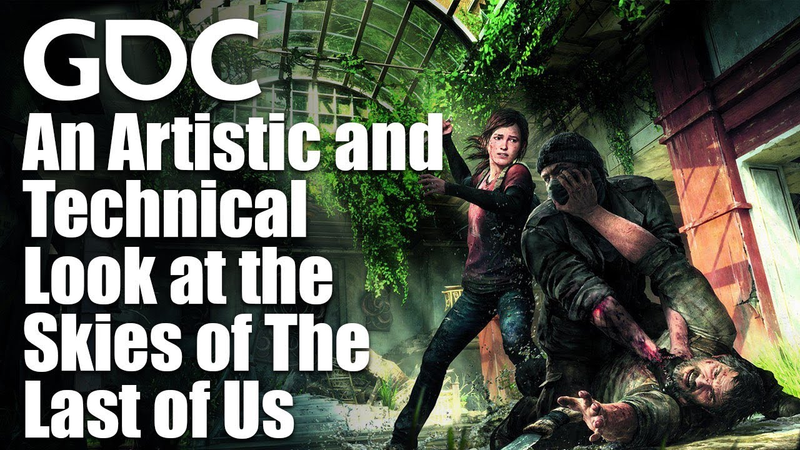
Moving the Heavens: An Artistic and Technical Look at the Skies of The Last of Us
The artistic and technical development of skyboxes in The Last of Us centers on the thesis that the sky is a critical, yet frequently overlooked, narrative tool capable of defining the emotional tone, lighting, and color palette of an entire game environment.
- The Last of Us utilized high-resolution matte paintings projected onto a dome to maintain artistic control over the game's skyboxes.
- To simulate cloud movement without the performance overhead of volumetric systems, the team implemented a UV distortion technique known as flow using vector-based motion maps.
- The development team achieved perspective-correct cloud movement by calculating the dot product of wind direction against the sky dome’s normals.

Level Design Workshop: Architecture in Level Design
The application of architectural principles to level design serves as a powerful tool for establishing mood, guiding player behavior, and creating cohesive game environments.
- Architectural consistency in structural layout, materials, and massing is more critical for player immersion than achieving photorealism.
- Designers should establish a 'party'—a fundamental organizational logic—to ensure that circulation, massing, and materials create a unified atmosphere.
- Spatial geometry should be used to intuitively guide player behavior and navigation, reducing the need for explicit signposting or decorative detail.
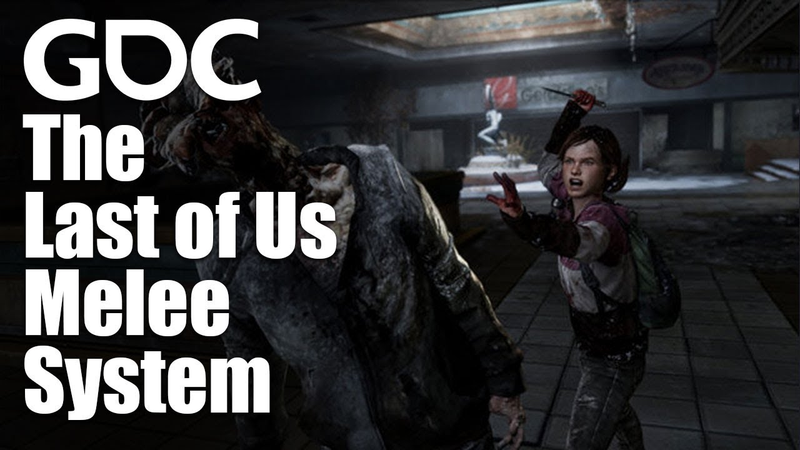
Unsynced: The Last of Us Melee System
The melee system in The Last of Us was engineered to deliver a brutal, visceral combat experience that reinforces the game’s high-stakes survival narrative.
- The melee system was optimized to function within a strict four-megabyte memory footprint while maintaining high-fidelity performance.
- Designers managed nearly 1,000 individual combat moves using a text-based Lisp scripting architecture, which allowed for rapid iteration without constant programmer intervention.
- The combat system replaced rigid, synced animations with an independent, joint-based reaction system to enable dynamic movement on uneven terrain and sophisticated flinching mechanics.

Designing the Tutorial for The Last of Us
Professional adaptability and a commitment to continuous learning are essential for navigating the complexities of modern game development.
- Effective combat tutorials should prioritize spatial design and companion modeling over intrusive, text-heavy prompts to teach complex mechanics.
- Designers improved AI performance and player agency in The Last of Us by shifting from cramped environments to more open, flexible layouts.
- Companion characters serve as vital teaching tools by actively modeling stealth behaviors and guiding players through combat systems.

Believable Humans (In Video Game Animation)
The pursuit of believable digital humans in video games has shifted from a focus on raw technical fidelity to the cultivation of emotional resonance and character empathy.
- The industry is shifting from raw technical fidelity to emotional resonance, using high-quality performance capture to bridge the gap between interactive gaming and cinematic storytelling as seen in titles like The Last of Us and Uncharted.
- Modern facial animation rigs now utilize over 1,000 blend shapes to achieve photorealistic micro-expressions and visual realism.
- A critical industry bottleneck has emerged due to a scarcity of specialized experts capable of managing complex, high-fidelity animation systems.