Myst
Game
9 documents in the library are about Myst, from writers such as DiGRA, GameDiscoverCo and Extra Credits. Each has a summary and key insights with the page they come from.
Connections
Each row is a game or company named alongside Myst, each column a document, oldest first. A mark means that document names it. Select a row to see those documents.
Documents about Myst

Review of PC Gamer March 1997
The mid-1990s PC gaming landscape was defined by a pivotal transition toward strategy, simulation, and immersive 3D experiences, signaling a departure from traditional point-and-click adventure games.
- In the March 1997 PC Gamer Awards, Civilization II was named Game of the Year, beating out high-profile titles like Quake and Tomb Raider.
- Looking Glass Studios, despite their focus on immersive sims like System Shock, produced a golf simulator during this period to generate revenue and offset the high costs of their innovative projects.
- PC gaming in 1997 was characterized by a heavy reliance on expensive, specialized peripherals like flight sticks and steering wheels, distinguishing the platform from the console market.
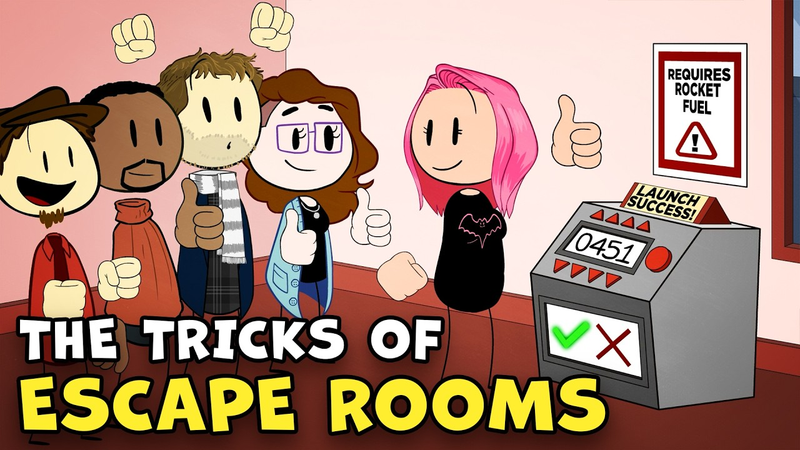
Escape Rooms: Manipulation for Fun and Profit! | Extra Credits Gaming
Modern escape rooms function as sophisticated psychological environments designed to immerse participants in a narrative while guiding their behavior through subtle game design techniques.
- The modern escape room industry originated with Takao Kato’s company SCRAP in 2007, and has since expanded to an estimated 50,000 rooms across at least 44 countries.
- Designers utilize the 'magic circle' concept to foster immersion, employing themed introductions and 'endowments'—such as specific titles or physical props—to help players adopt a role and suspend disbelief.
- Lighting is used as a non-verbal tool to guide player movement and focus, such as dimming lights in one area to encourage migration to a brighter room or using soft pulses to highlight puzzle components.
How the Switch 2 eShop Changes Discoverability
The primary focus of this analysis is the evolution of game discoverability on the Nintendo Switch 2 eShop, specifically examining how interface changes and algorithmic updates influence how players find and purchase titles.
- The Switch 2 eShop introduces a 'For You' section that uses personalized algorithms—factoring in user history, genre preferences, and social connections—to surface game recommendations.
- Nintendo continues to utilize a three-day revenue-based metric for its best-seller charts, which inherently favors higher-priced titles over lower-priced, discounted games.
- The Wish List page has been elevated to a primary navigation item, reflecting a strategic shift toward prioritizing user intent and long-term engagement.
What Grow a Garden's 8.9 Million CCU Tells Us About Game Discovery
The Roblox gardening simulation Grow A Garden recently achieved a record-breaking 8.9 million concurrent users (CCU), highlighting the massive scale and distinct dynamics of the Roblox ecosystem compared to traditional PC and console gaming.
- The Roblox title Grow A Garden reached a record-breaking 8.9 million concurrent users (CCU) through a combination of a limited-time event and an accessible, non-competitive core design.
- Successful Roblox titles are increasingly driven by professional studios that acquire early-stage projects and implement rigorous live-service strategies, such as weekly content updates, to scale engagement.
- Long-term game health is better measured by hours played and consistent engagement metrics rather than fleeting peak concurrent user counts.

Blue Prince: Can a Random Puzzle Game Actually Work?
Blue Prince explores the design tension between traditional puzzle-solving mechanics and procedural generation.
- The core design conflict in Blue Prince stems from blending logic-based adventure puzzles with procedural generation, which can prevent necessary components from appearing in a single session.
- Reliance on random number generation (RNG) creates player frustration by decoupling the possession of a solution from the ability to implement it due to restrictive room layouts.
- Procedural generation successfully increases replayability, novelty, and spatial puzzle-solving depth, effectively preventing the stagnation common in static adventure game designs.
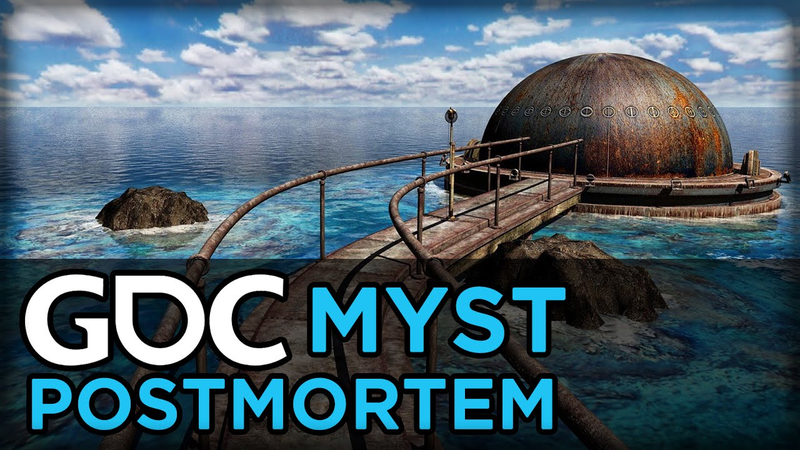
Classic Postmortem: The Making Of Myst
The development of Myst represents a foundational shift in interactive entertainment, prioritizing player agency and environmental immersion over traditional gaming conventions.
- The development of Myst prioritized environmental immersion and player agency over traditional gaming conventions, successfully targeting a broad, non-traditional audience.
- The team utilized a hub-and-spoke 'Ages' structure to manage the severe data constraints of early CD-ROM technology.
- Technical limitations regarding character interaction were addressed through creative narrative framing, such as using books to justify one-way communication.
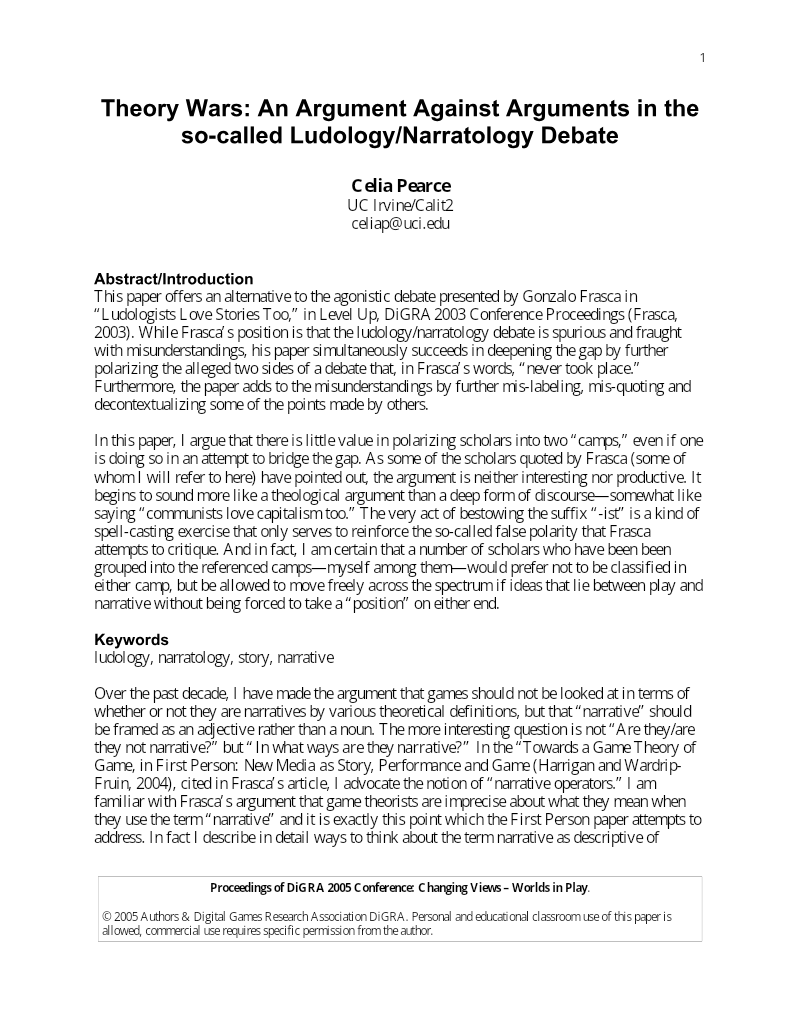
Theory Wars: An Argument Against Arguments in the So-Called Ludology/Narratology Debate
Celia Pearce's paper "Theory Wars" responds to Gonzalo Frasca's 2003 essay "Ludologists Love Stories Too," which argued that the ludology/narratology debate was largely a misunderstanding.
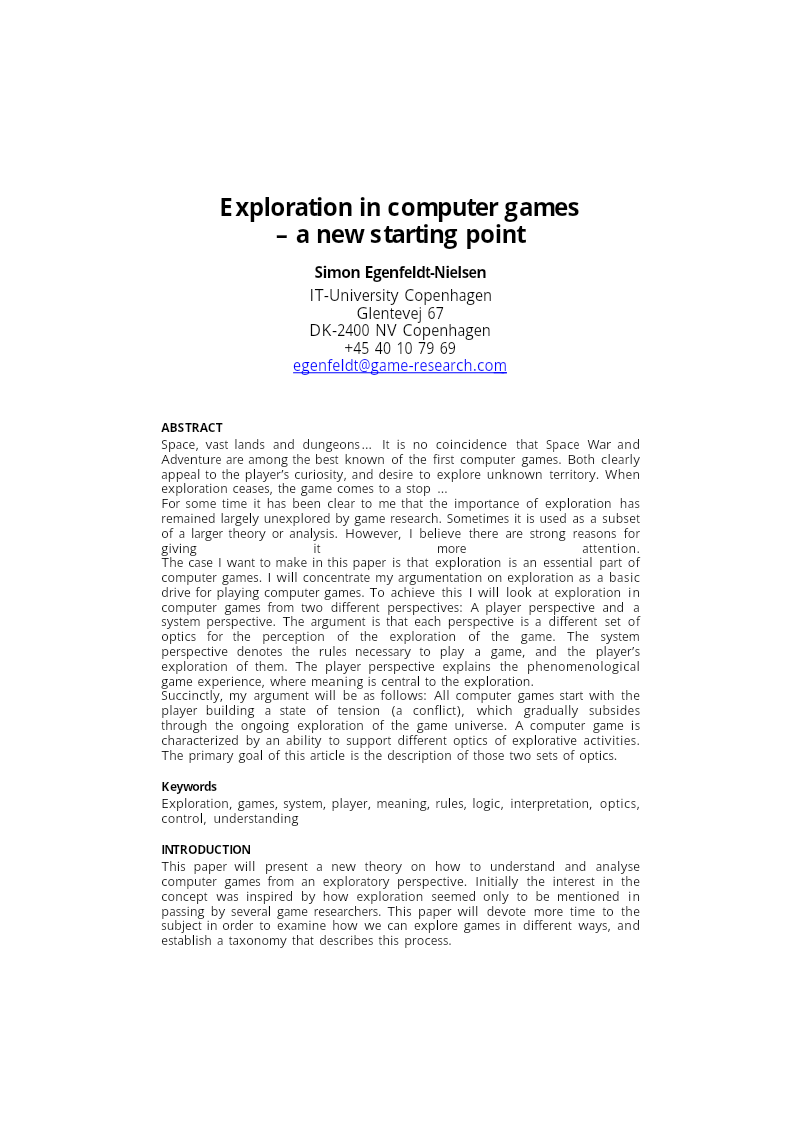
Exploration in Computer Games: A New Starting Point
Egenfeldt-Nielsen's paper argues that exploration is a foundational drive in computer games and proposes a framework for analyzing it through two complementary optics.
- Egenfeldt-Nielsen frames exploration as a foundational drive in computer games and analyzes it through two complementary optics: the 'system position' (rules and logic, where exploration ends once rules become predictable) and the 'player position' (games as subjective sites of meaning, where exploration stays open-ended).
- Drawing on George Kelly's 'man-as-scientist' theory, the paper argues games act as safe environments for testing and revising mental constructs, and that every game begins with a tension that gradually subsides through play.
- Players construct their experience by reinterpreting the tension set up by a game's rules, setting, and story; meaning-oriented exploration is illustrated by Myst, while rules-oriented exploration is illustrated by chess and Age of Empires II.
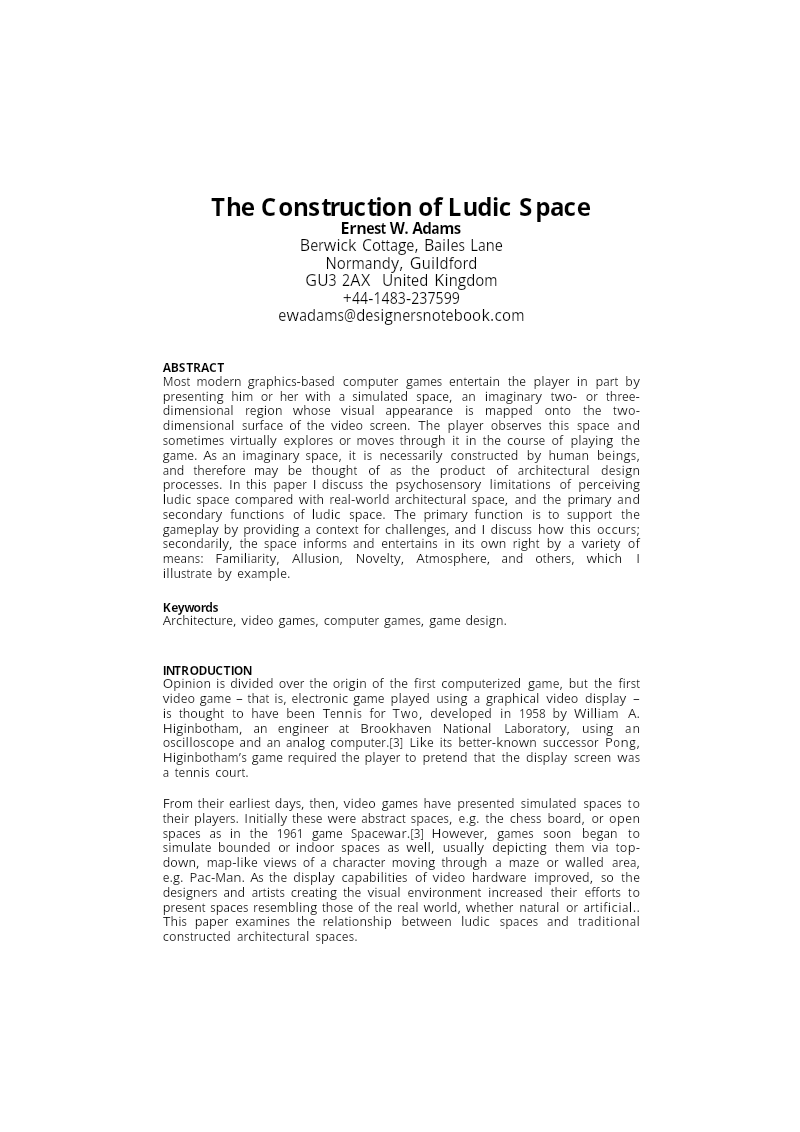
The Construction of Ludic Space
Ernest W. Adams's "The Construction of Ludic Space" argues that video game spaces constitute a distinct form of imaginary architecture, shaped less by the physical laws governing real buildings than by the constraints of display hardware and the economics of production.
- Video game spaces are shaped more by display hardware and production economics than by real-world physical laws: a monitor offers roughly a 40–60 degree visual angle and about 255 light levels, versus a ~120-degree binocular field and far greater dynamic range in human vision.
- Ludic architecture need not obey real-world rules of scale, engineering, or habitability, so game buildings are selectively translated from physical counterparts and often function as metaphors rather than efficient structures.
- Production costs directly shape game design: in 3D games, polygon budgets make curves expensive and rectilinear forms cheap, while 2D games are limited by the volume of artwork that can be created.