
Divinity: Original Sin
GameBy Larian Studios · Released Jun 30, 2014
Gather your party and get ready for a new, back-to-the-roots RPG adventure! Discuss your decisions with companions; fight foes in turn-based combat; explore an open world and interact with everything and everyone you see.
Connections
Each row is a game or company named alongside Divinity: Original Sin, each column a document, oldest first. A mark means that document names it. Select a row to see those documents.
About the game
- Released
- Jun 30, 2014
- Developer
- Larian Studios
- Genres
- Puzzle, Role-playing (RPG), Turn-based strategy (TBS), Adventure, Indie
- Platforms
- PC (Microsoft Windows), Mac
- Links
- Wikipedia
Game data from IGDB.com
Documents about Divinity: Original Sin

The Miraculous Story Behind Baldur’s Gate 3
The development and release of Baldur’s Gate 3 represents a significant anomaly in the modern video game industry, characterized by a complex history of licensing, financial instability, and creative perseverance.
- Larian Studios' success with Baldur's Gate 3 is attributed to its status as a rare, large-scale, privately owned developer, which allows it to avoid the short-term pressures of quarterly earnings and investor demands faced by publicly traded companies.
- The development of Baldur's Gate 3 required a massive scaling effort, with the studio growing its workforce from 140 to 450 employees to manage the complex production pipeline required for full cinematic integration.
- Baldur's Gate 3 has achieved significant commercial success, selling over 20 million copies and winning multiple Game of the Year awards despite facing major external challenges, including the COVID-19 pandemic and the forced relocation of staff due to the 2022 Russian invasion of Ukraine.
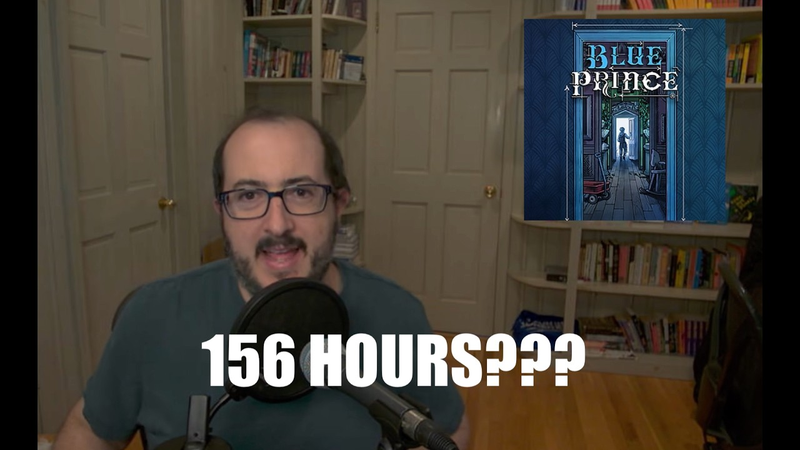
The 10 Games I've Played Most On Steam
This analysis examines the personal gaming habits of a prominent industry commentator, focusing on the ten most-played titles on their Steam account.
- Larian Studios' titles Baldur's Gate 3 and Divinity: Original Sin II are highlighted for their high-quality, non-filler combat systems and their ability to 'say yes to the player' through deep, interlocking mechanics.
- CrossCode, a Zelda-like RPG, is noted for its brilliant concept of an MMO-within-a-game, earning 155.1 hours of playtime across multiple playthroughs.
- Hundred Line Last Defense Academy is described as an extreme example of a slow-burn narrative, where the initial 30-hour playthrough functions primarily as a prologue to the actual game.
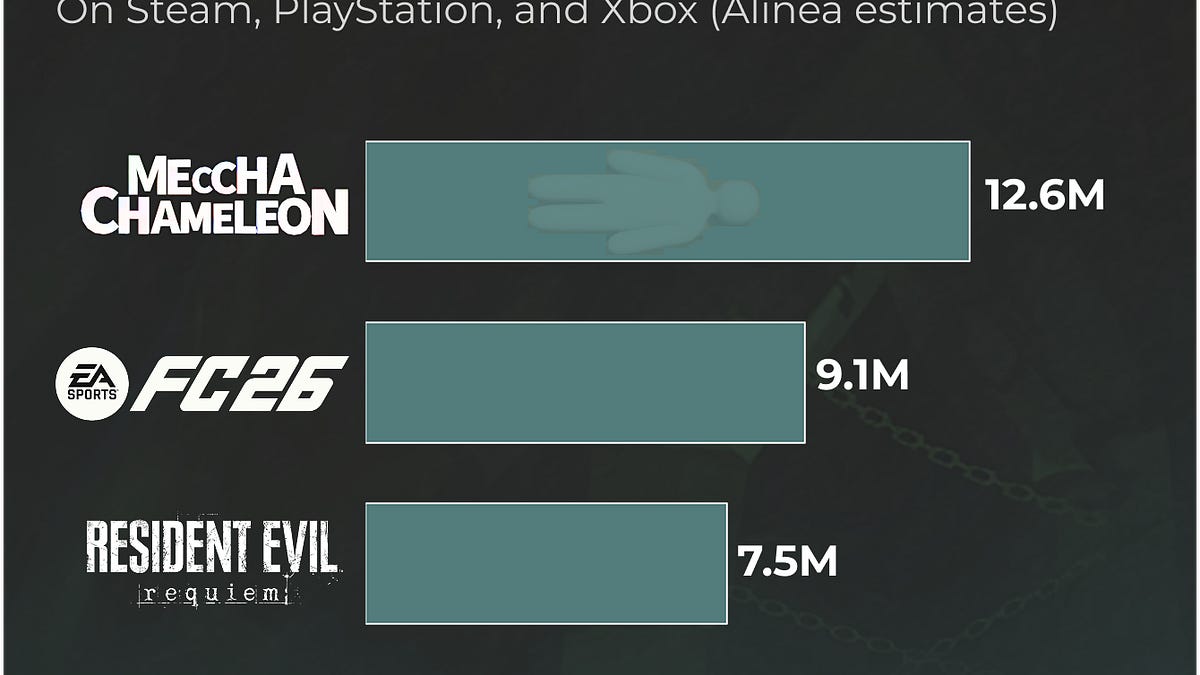
Top Games by Copies Sold: H1 2026
Alinea Analytics' mid-year estimates of 2026's best-selling games across Steam, Xbox, and PlayStation put Meccha Chameleon in first place.
- Meccha Chameleon is 2026's top game by copies sold across Steam, Xbox, and PlayStation combined, with nearly 13 million units sold despite being Steam-only and launching three weeks ago. Its $5 launch price (later $6) resulted in over $58M in gross revenue, making it the #18 game by Steam revenue this year.
- Sony has announced that new PlayStation games will be digital-only starting January 2028, eliminating physical discs. This move is driven by Sony's desire for greater control over pricing and revenue, as disc resales and rentals do not generate income for the platform holder.
- Resident Evil Requiem has sold 7.6 million copies across PS5 (46%), Steam (45%), and Xbox (9%), nearing half a billion dollars in gross revenue. It continues to sell well, with almost 400,000 copies sold last month alone, contributing to Capcom's catalog revenue.
Why aren’t more game developers using Kickstarter?
Kickstarter continues to serve as a vital, evolving mechanism for video game development, functioning less as a primary funding source and more as a sophisticated community-building and marketing instrument.
- Kickstarter is shifting from a primary funding source to a strategic marketing tool, with over 440 successful projects raising $26 million in the most recent annual cycle.
- Developers must treat Kickstarter as a community-building instrument, as the platform typically provides only 30 percent of a project's total backer base.
- Activity on the platform is projected to grow by 10 percent in 2025 as developers increasingly use it to secure final-stage capital and improve project visibility.
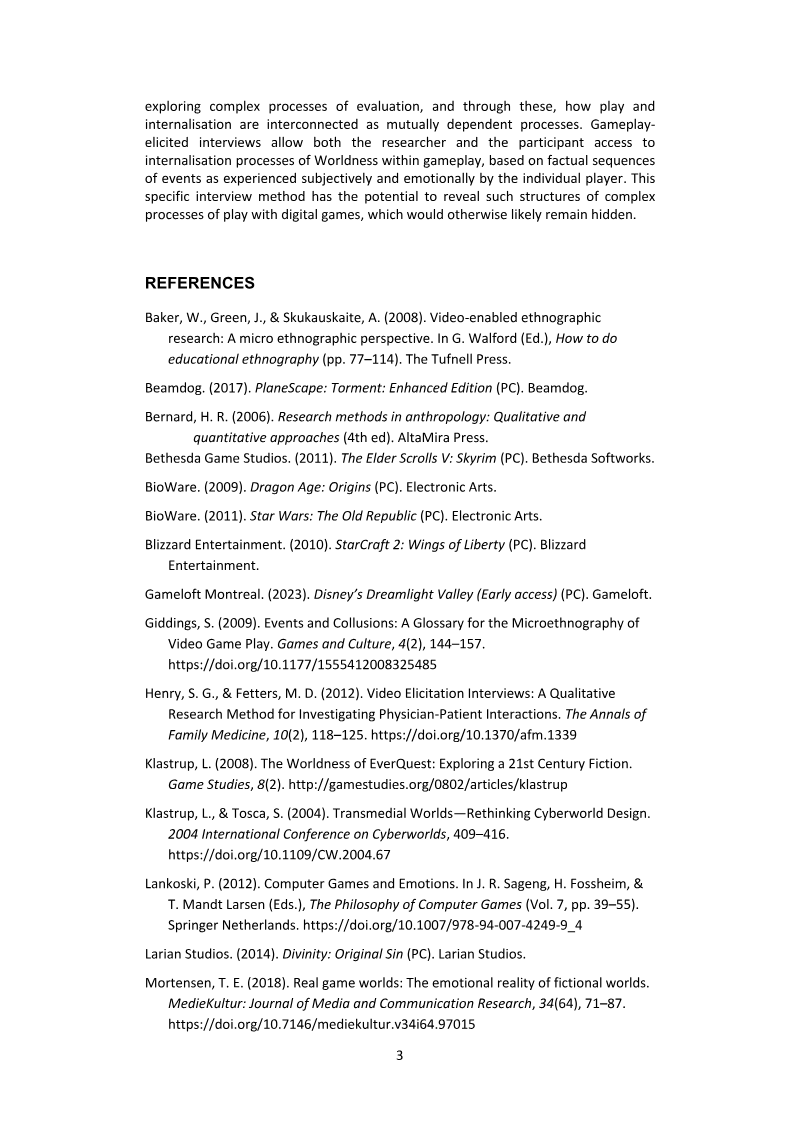
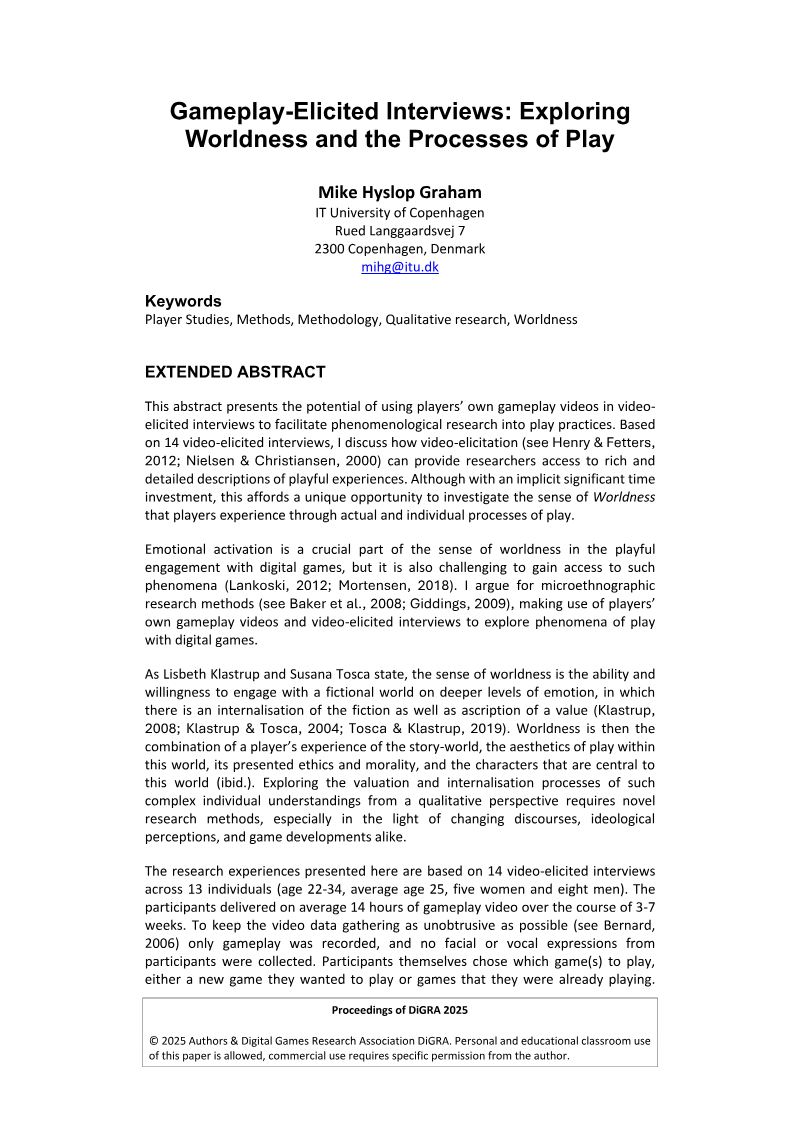
Gameplay-Elicited Interviews: Exploring Worldness and the Processes of Play
This paper argues that players' own gameplay videos, used as prompts in video-elicited interviews, offer a productive method for phenomenological research into how people play digital games.
- Players' own gameplay videos used as prompts in video-elicited interviews offer a productive phenomenological method for studying how people play digital games, revealing internal emotional and evaluative processes that are otherwise hard to access.
- The paper's central theoretical construct is "worldness," defined as the degree to which a player emotionally engages with a fictional world, internalises its fiction, and assigns it value, combining story-world experience, play aesthetics, ethics and morality, and central characters.
- The study drew on 14 interviews with 13 players aged 22 to 34, with each participant contributing about 14 hours of screen-only gameplay video recorded over three to seven weeks.
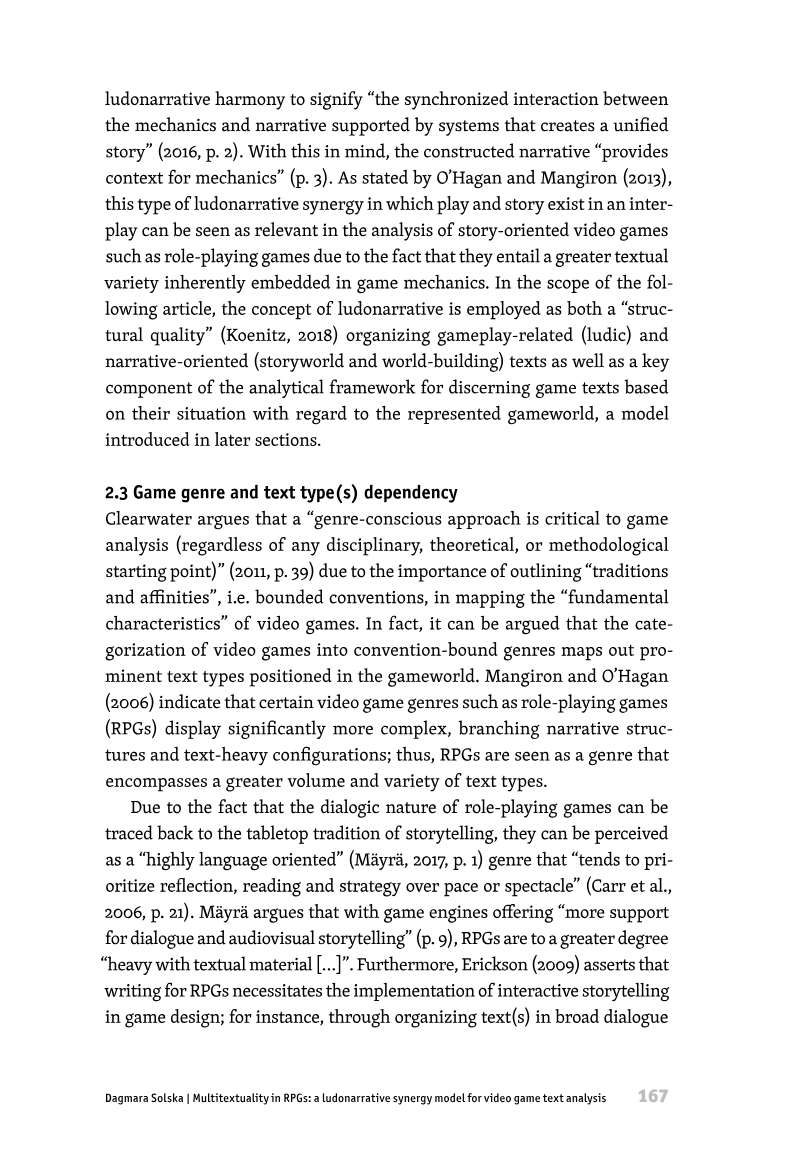
Multitextuality in RPGs: A Ludonarrative Synergy Model for Video Game Text Analysis
Solska's paper proposes a ludonarrative synergy model for analyzing the textual material of role-playing video games, extending Galloway's distinction between diegetic and non-diegetic elements into a categorization of game text types.
- The paper proposes a ludonarrative synergy model that classifies video game text as diegetic (fictional world, narrative and world-building) or non-diegetic (mechanical framework of play, ludic and interface content), extending Galloway's distinction.
- The central thesis is that RPGs such as Divinity: Original Sin 2 contain a greater volume and variety of textual material than other genres, and this multitextuality can be systematically classified.
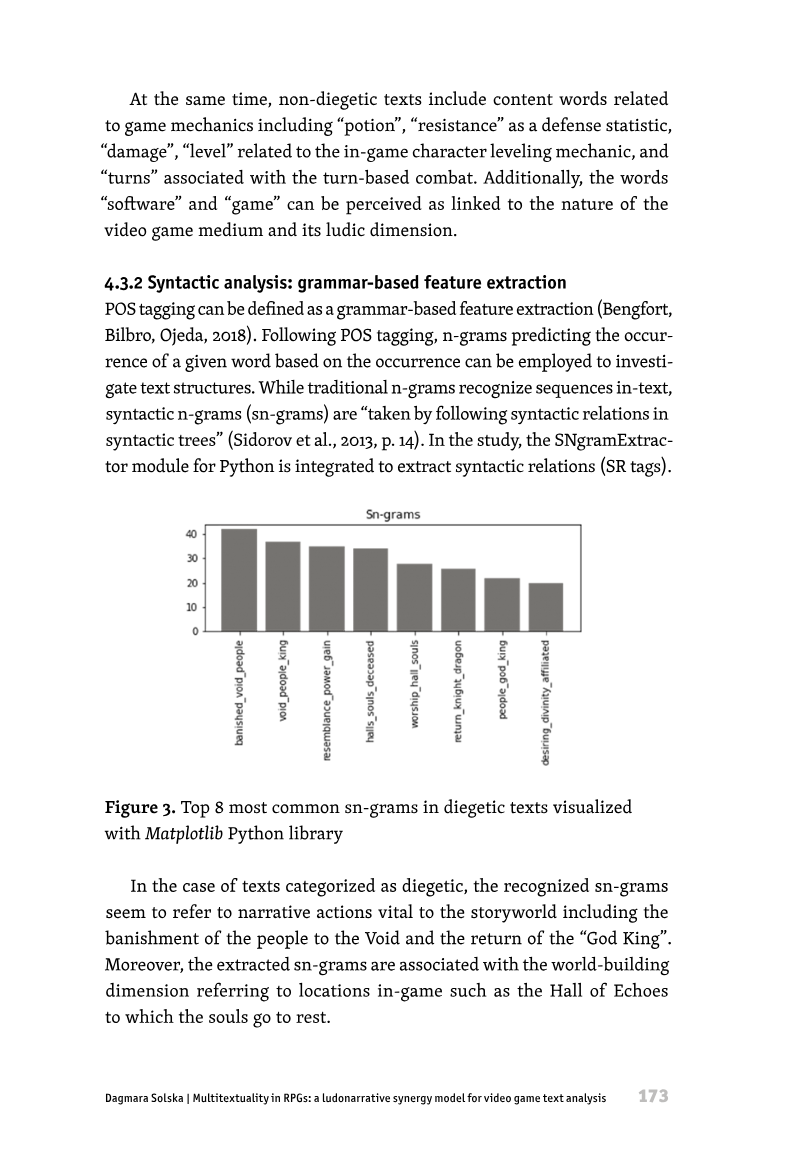
- The method combines micro-level lexical and syntactic analysis (TF-IDF and syntactic n-grams) with macro-level K-means clustering (k=2) in a two-level Python-based pipeline.
The Rogue Needs a City: Role-Playing Game Cities and Their Literary Background
The paper examines how literary depictions of the rogue and the city shaped the design of role-playing game cities, tracing a lineage from Spanish picaresque fiction through early tabletop supplements to contemporary digital RPGs.
- The paper traces a lineage from Spanish picaresque fiction (16th–17th centuries), with its marginal urban settings and witty criminal protagonists, through early tabletop supplements such as Thieves' Guild, The Free City of Haven, and Thieves' World, to modern digital RPGs.
- The central claim is that rogue-oriented city design is a two-way process: cities are built to host roguish activities like pickpocketing, shoplifting, and scamming, and those activities in turn generate mechanics (such as percentage- or skill-based thieving systems), NPCs, shops, and narrative branches.
- The author argues that narrative concepts can motivate roguish mechanics, not only the reverse, so story can drive how thieving systems and urban spaces are designed.
Select Your Instrument: Musical Character Customization in Divinity: Original Sin II
This work-in-progress paper by Ragnhild Solberg examines the musical character customization feature in Divinity: Original Sin II (Larian Studios, 2017), in which players select a lead "origin instrument" during character creation.
- The paper argues that the musical origin-instrument choice in Divinity: Original Sin II (Larian Studios, 2017) is more than cosmetic: it shapes world-building, the characterization of the player's avatar, and the player's sense of identity.
- The four selectable instruments are the bansuri, cello, oud, and tambura, each analyzed for its historical and geographical context and its traditionally associated styles, moods, and keys.
- The instrument-choice mechanic reflects the game's narrative of individuals ascending toward godhood, while the pastoral, bard-like associations of the melodic material cast the player character more as a storyteller than a deity.
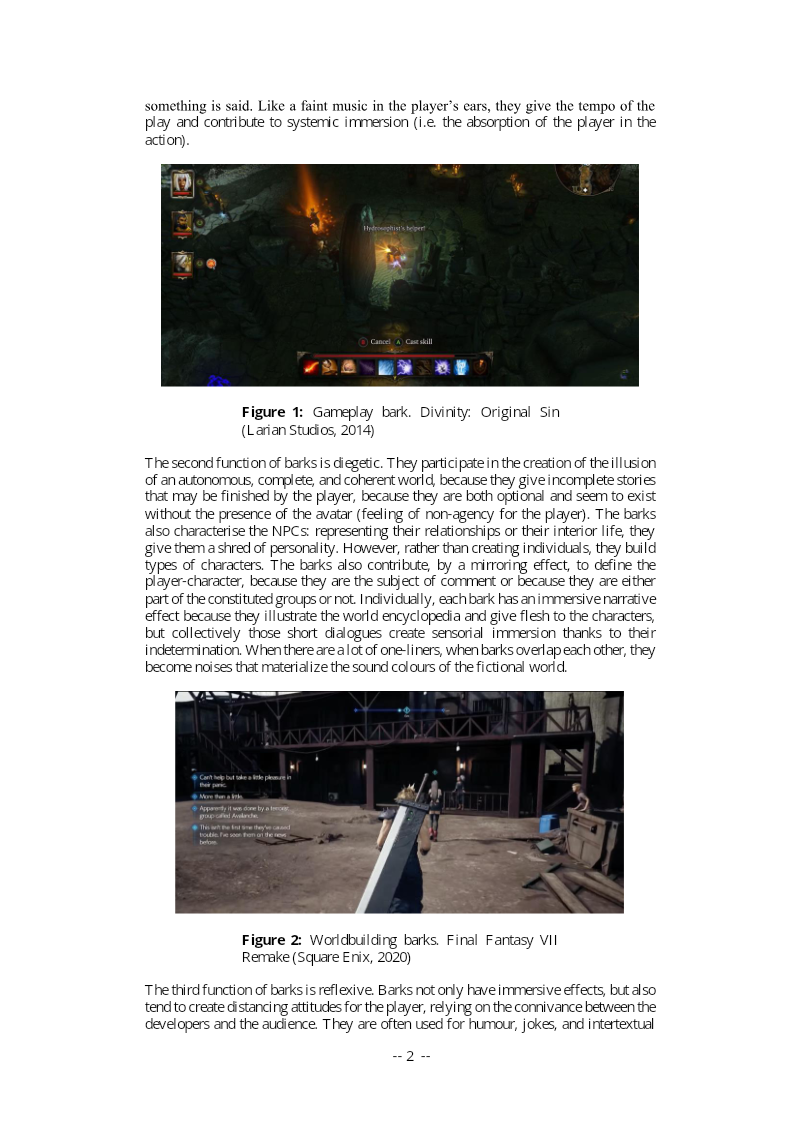
Functions and Powers of Barks in Video Games: Reclaiming the Margins of Video Games Narrativity
This paper examines video game barks, the short, unanswerable lines spoken by non-player characters during routine moments such as walking or fighting, which game designers and critics have long treated as peripheral to narrative.
- Video game barks, the short unanswerable lines NPCs speak during routine actions like walking or fighting, are often treated as peripheral to narrative, yet they are costly to write and are repeatedly heard by players, making them a productive lens on how narrative margins are negotiated by creators and audiences.
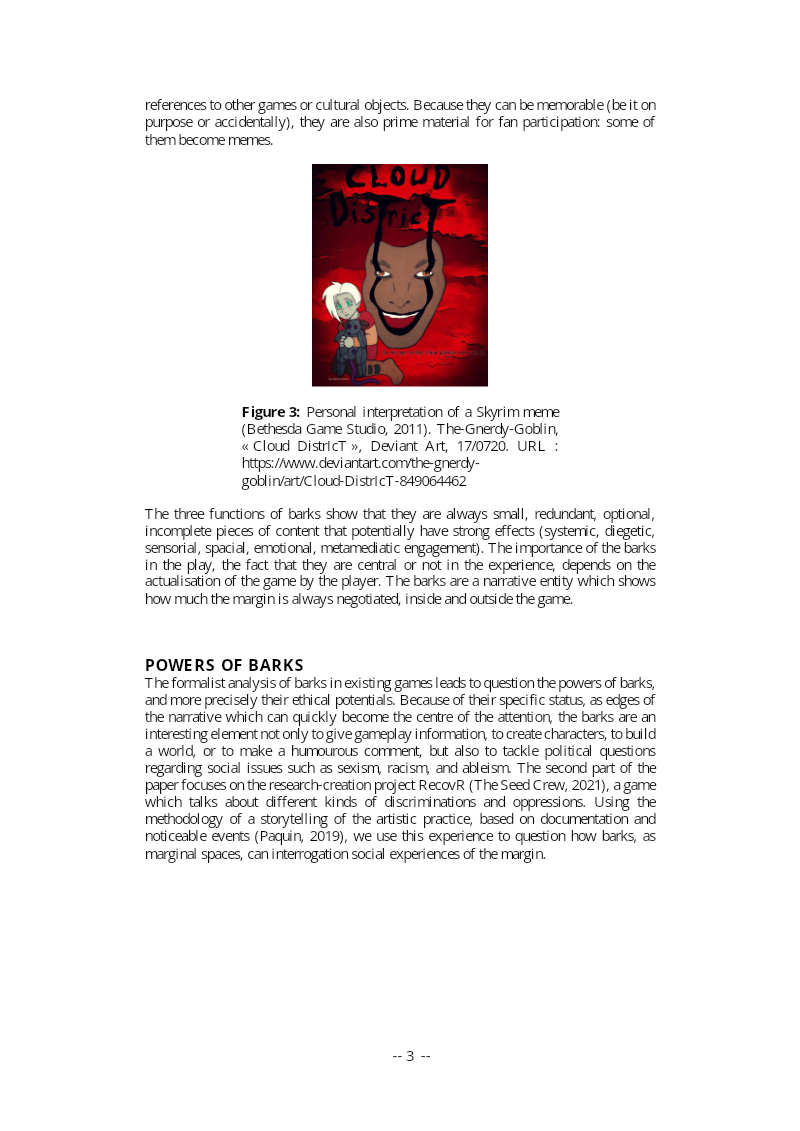
- The study's formalist analysis of a corpus of six contemporary role-playing games (including Skyrim, The Witcher III, Divinity: Original Sin, Dishonored, Final Fantasy VII Remake, and Tales of Berseria) identifies three non-exclusive functions of barks: gameplay, diegetic, and reflexive.
- Gameplay barks provide redundant instructional cues that shape play rhythm and contribute to systemic immersion, while diegetic barks build the impression of an autonomous world by suggesting incomplete stories and typologically characterising NPCs.
The Making of Divinity: Original Sin 2
The development of Divinity: Original Sin 2 represents a pivotal transition for Larian Studios, as the company scaled from a single 40-person team in Belgium to a 200-employee international operation.
- Larian Studios scaled from a single 40-person team to a 200-employee international operation, necessitating a 'follow-the-sun' workflow to maintain productivity and reduce crunch.
- The 'n+1' design philosophy, which required the game to account for every possible player action including the killing of essential NPCs, resulted in a script exceeding one million words.
- The studio transitioned from a decentralized, overly collaborative leadership model to a centralized review process to resolve conflicting documentation and scope creep.
Companies behind it

As the documents state it.