
Divinity: Original Sin
GameBy Larian Studios · Released Jun 30, 2014
Documents about Divinity: Original Sin
Whitepaper4 pages
Gameplay-Elicited Interviews: Exploring Worldness and the Processes of Play
This paper argues that players' own gameplay videos, used as prompts in video-elicited interviews, offer a productive method for phenomenological research into how people play digital games.
- Players' own gameplay videos used as prompts in video-elicited interviews offer a productive phenomenological method for studying how people play digital games, revealing internal emotional and evaluative processes that are otherwise hard to access.
- The paper's central theoretical construct is "worldness," defined as the degree to which a player emotionally engages with a fictional world, internalises its fiction, and assigns it value, combining story-world experience, play aesthetics, ethics and morality, and central characters.
- The study drew on 14 interviews with 13 players aged 22 to 34, with each participant contributing about 14 hours of screen-only gameplay video recorded over three to seven weeks.
DiGRAJun 2025
Whitepaper18 pages
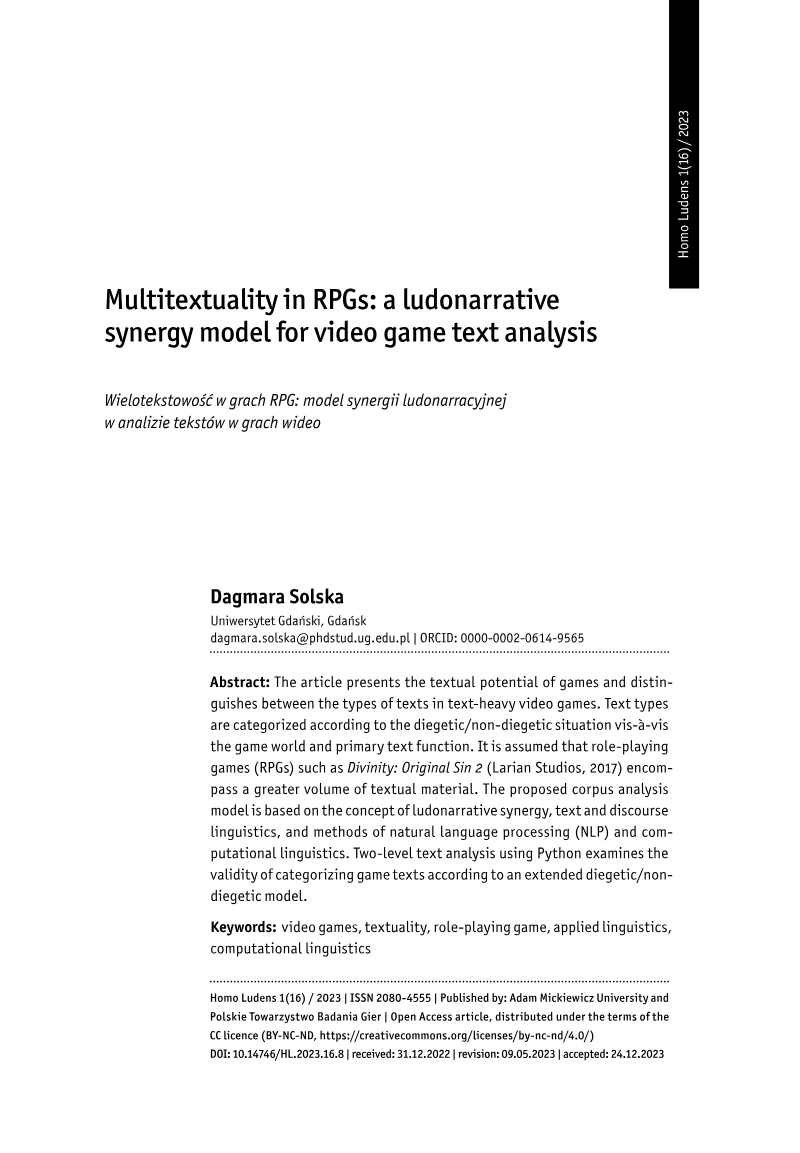
Multitextuality in RPGs: A Ludonarrative Synergy Model for Video Game Text Analysis
Solska's paper proposes a ludonarrative synergy model for analyzing the textual material of role-playing video games, extending Galloway's distinction between diegetic and non-diegetic elements into a categorization of game text types.
- The paper proposes a ludonarrative synergy model that classifies video game text as diegetic (fictional world, narrative and world-building) or non-diegetic (mechanical framework of play, ludic and interface content), extending Galloway's distinction.
- The central thesis is that RPGs such as Divinity: Original Sin 2 contain a greater volume and variety of textual material than other genres, and this multitextuality can be systematically classified.
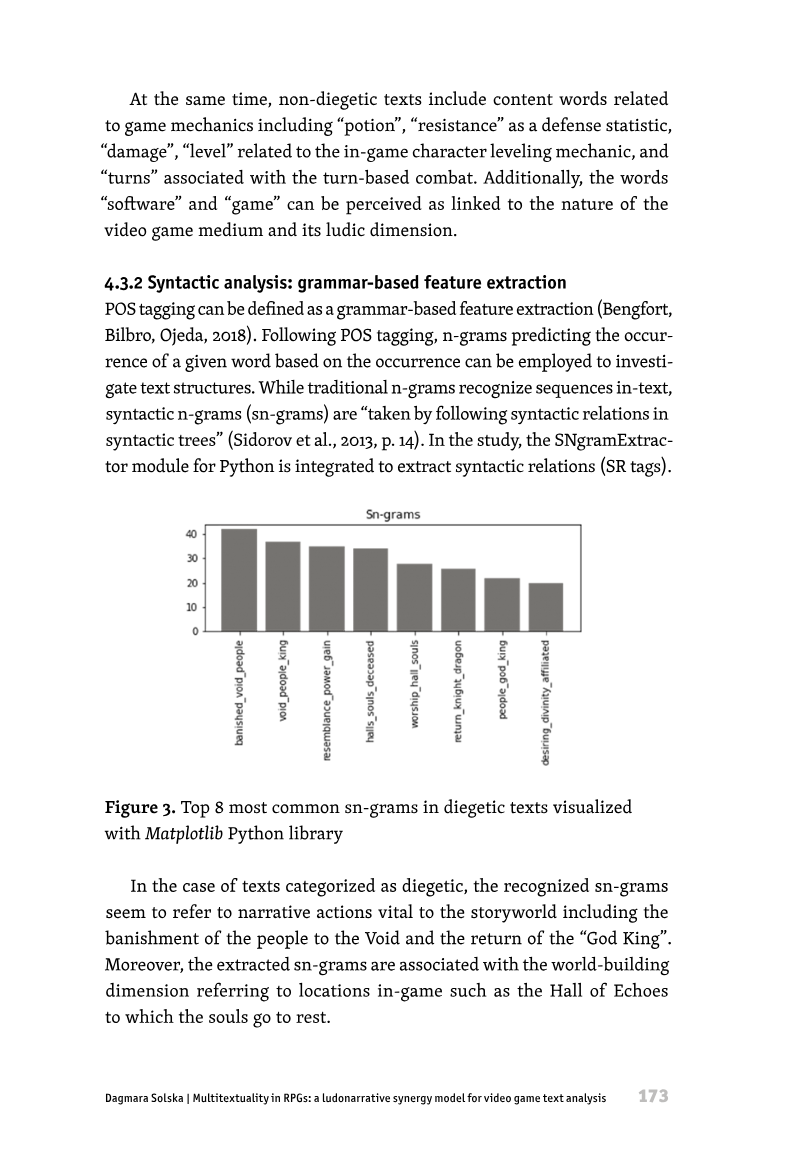
- The method combines micro-level lexical and syntactic analysis (TF-IDF and syntactic n-grams) with macro-level K-means clustering (k=2) in a two-level Python-based pipeline.
Homo LudensNov 2024
Whitepaper5 pages
Functions and Powers of Barks in Video Games: Reclaiming the Margins of Video Games Narrativity
This paper examines video game barks, the short, unanswerable lines spoken by non-player characters during routine moments such as walking or fighting, which game designers and critics have long treated as peripheral to narrative.
- Video game barks, the short unanswerable lines NPCs speak during routine actions like walking or fighting, are often treated as peripheral to narrative, yet they are costly to write and are repeatedly heard by players, making them a productive lens on how narrative margins are negotiated by creators and audiences.
- The study's formalist analysis of a corpus of six contemporary role-playing games (including Skyrim, The Witcher III, Divinity: Original Sin, Dishonored, Final Fantasy VII Remake, and Tales of Berseria) identifies three non-exclusive functions of barks: gameplay, diegetic, and reflexive.
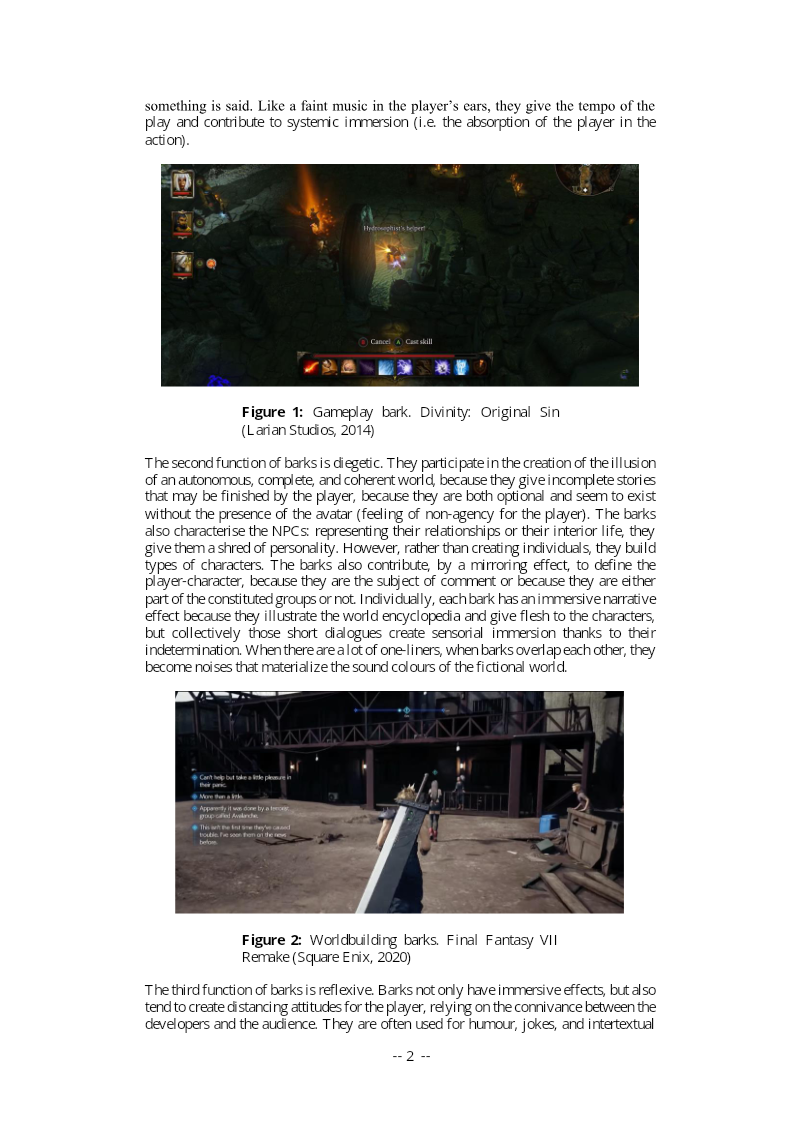
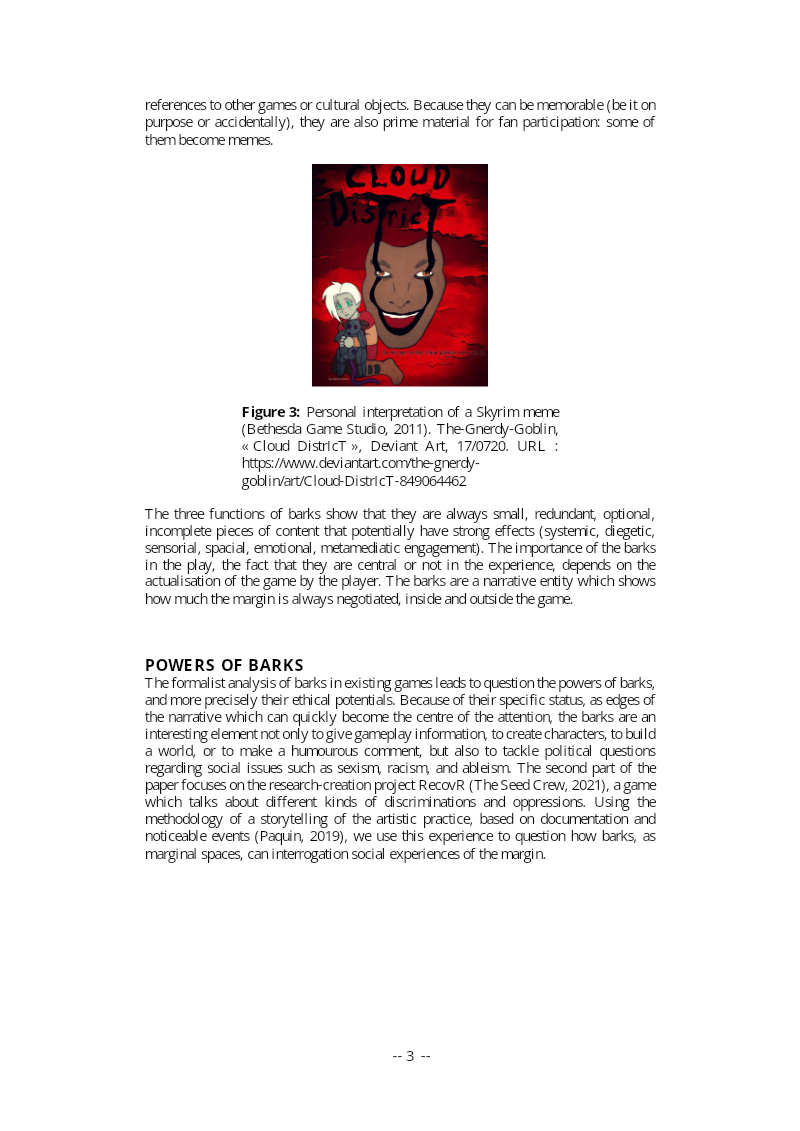
- Gameplay barks provide redundant instructional cues that shape play rhythm and contribute to systemic immersion, while diegetic barks build the impression of an autonomous world by suggesting incomplete stories and typologically characterising NPCs.
DiGRAJun 2023
Companies behind it

As the documents state it.