Cookie Clicker
Game
11 documents in the library are about Cookie Clicker, from writers such as DiGRA, GameDiscoverCo and AppMagic. Each has a summary and key insights with the page they come from.
Connections
Each row is a game or company named alongside Cookie Clicker, each column a document, oldest first. A mark means that document names it. Select a row to see those documents.
Documents about Cookie Clicker
Number Go Up Featuring Orb of Creation 1.0 | Design Club
Incremental games, often categorized as idlers or clickers, are defined by a core design loop centered on the optimization of systems to achieve exponentially increasing values.
- Incremental games shift the player's role from a passive clicker to a manager of complex, interdependent systems by prioritizing the optimization of exponentially increasing values.
- Orb of Creation distinguishes itself within the genre by requiring active, strategic input across multi-layered systems like alchemy, gardening, and combat rituals rather than relying on passive idling.
- Long-term engagement in incremental games depends on balancing accessible early-game loops with high-complexity thresholds that prevent optimization traps and time-based penalties.
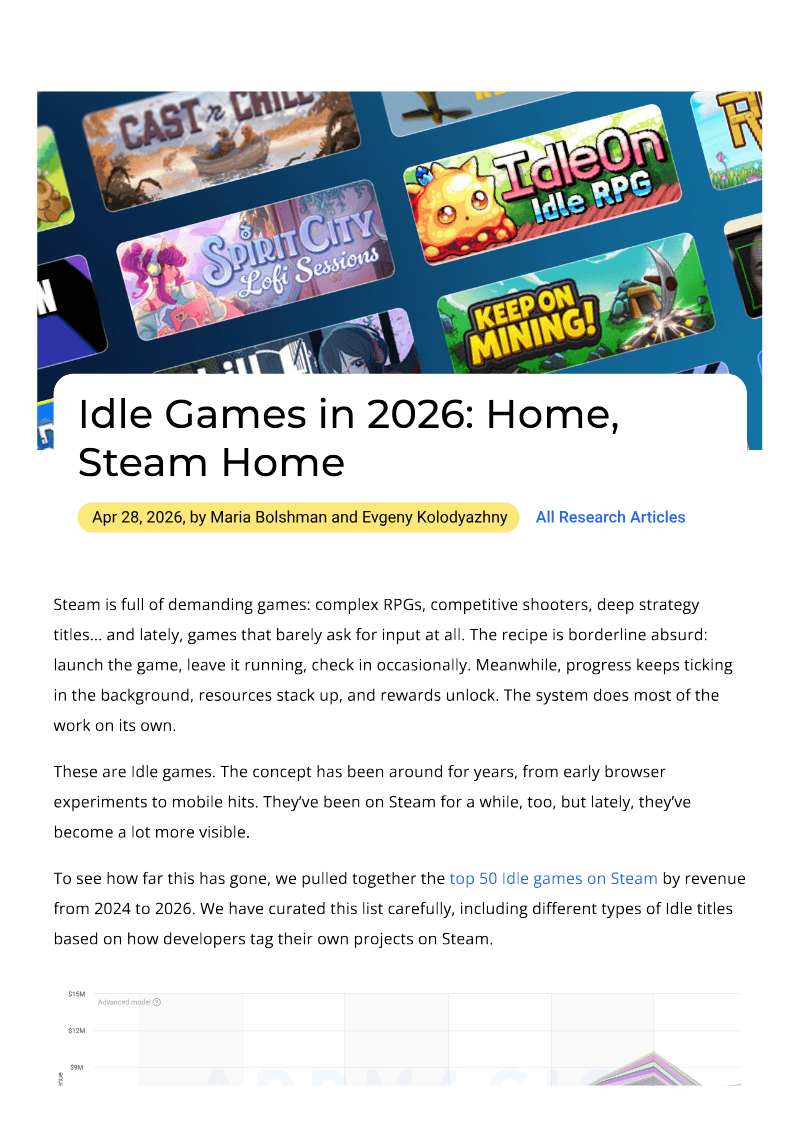
Idle Games in 2026: Home, Steam Home
The idle game genre has undergone a significant transformation between 2024 and 2026, shifting from its origins as simple browser-based clickers to a sophisticated category of system-driven experiences on Steam.
- Idle games have become a major revenue driver on Steam, led by titles like IdleOn, which generated over $22 million in 2025 and has reached nearly $59 million in total revenue.
- The 'Idle' category on Steam is increasingly defined by player behavior rather than genre purity, with successful titles like Spirit City: Lofi Sessions and Cast n Chill earning over $5.3 million each by functioning as background productivity companions.
- Monetization strategies on Steam vary significantly, ranging from low-cost premium titles priced between $3 and $15 to free-to-play models that leverage long-term progression and microtransactions.

This New Genre For Game Devs Is A Gold Rush...
The current landscape for independent game development is characterized as a golden age, defined by the simultaneous emergence of multiple highly profitable, accessible genres.
- The current indie game market is experiencing a 'Golden Age' characterized by the simultaneous success of five to six distinct, high-performing genres that can be developed within a short 4-to-6-month timeframe.
- Friend-slop games are a major trend featuring small-scale, cooperative multiplayer experiences—distinct from party games—where players work toward a single shared goal, often with intentionally 'janky' aesthetics.
- Incremental or 'idle' games, such as clicker-based city builders and civilization simulators, are seeing a surge in popularity as developers apply the core mechanic to diverse themes.
Games That Are Selling: 2025 Q2
This analysis examines the performance of indie games on the Steam platform during the second quarter of 2025, specifically focusing on titles that achieved at least 1,000 user reviews.
- Successful games on Steam do not grow slowly; every game that reached 1,000 reviews in 2025 achieved at least 715 reviews within its first month.
- The idle game genre is experiencing a significant boom, with 12 titles hitting the 1,000-review milestone in the first half of 2025, compared to only 3 in all of 2022 and 2023.
- Contrary to the assumption that idle games must be free, 9 of the 12 hit idle games in 2025 were paid titles with an average price of $3.89.

The Idle Joys of Games You Don't Play
The rise of desktop idle games represents a shifting trend in independent game development, where creators prioritize simple, low-overhead concepts that cater to specific player engagement patterns.
- Independent developers are increasingly adopting low-overhead, UI-heavy idle game designs to ensure sustainable, solo-led production cycles.
- The genre has shifted from early parodies like Progress Quest to commercially viable titles that function as passive, desktop-integrated digital toys.
- Niche, low-cost titles can achieve significant market traction without traditional marketing, as evidenced by Cornerpond securing over 270 reviews in its first few days.
Plus: Arise, Life Is Strange, and Get Webbed
This analysis evaluates the performance and market potential of upcoming and recently released video games across major digital platforms, including Steam, Xbox, Nintendo Switch, and the Epic Games Store.
- Japanese publishers are increasingly prioritizing PC releases, evidenced by Tales of Arise securing over 500,000 Steam wishlists prior to its launch.
- High-budget titles and niche indie games are both seeing strong market performance, with Pathfinder: Wrath of the Righteous reaching 36,000 concurrent users on Steam.
- Low-priced, well-executed titles maintain high demand, as demonstrated by the idle game Cookie Clicker reaching 40,000 concurrent users.
Plus: How Does 'Long Tail' Differ for Year-Old Games?
Analysis of Steam data from September 2021 reveals significant variance in the "long tail" performance of games one year after launch.
- Top-performing Steam games see a median review multiplier of 3.1x between their first week and their first year, though extreme outliers pull the average up to 5.66x.
- Aggressive discounting and subscription integration are primary drivers of long-tail growth, exemplified by FIFA 22 achieving a 29.6x multiplier through 84% discounts and EA Play inclusion.
- Niche titles with high price points and minimal discounting experience significantly lower long-tail performance, as seen with Melty Blood: Type Lumina’s 2.16x multiplier.
How Not to Play the Game?: Disinvolvement and the Philosophical Analysis of Inaction in Computer Games
This paper, presented as an extended abstract at DiGRA 2020 by Alina Latypova and Alexander Lenkevich, proposes a philosophical framework for analyzing inaction in computer games.
- The paper argues that games increasingly foreground non-action, contemplation, and "disinvolvement" over active play, and asks whether inaction offers players critical distance or has become a mechanism of control within a market that demands constant engagement.
- The authors propose developing an "apraxeology," a theory of inaction, and ground it in philosophers including Agamben (humanity's capacity for its own inability), Arendt (labor, work, and action), Benjamin (contemplative painting vs. immersive cinema), and Bataille (ecstasy).
- Inaction-oriented games are classified into three types: reflective games that break the fourth wall (The Stanley Parable, The Beginner's Guide), contemplative games that minimize player activity (Dear Esther, Mountain), and zero-player or idle games (Game of Life, Cookie Clicker).
Non-Human Gaming: Video Games for the Post-Anthropocene
Dr Paolo Ruffino's extended abstract, presented at DiGRA 2018, argues that video games are increasingly designed to play themselves or to operate with limited human involvement, and that this trend, which he terms Non-Human Gaming, responds to anxieties about a possible mass extinction and a coming Post-Anthropocene.
- Dr Paolo Ruffino's DiGRA 2018 extended abstract argues that games designed to play themselves or run with minimal human involvement form a long-standing presence in the medium, which he terms Non-Human Gaming rather than an anomaly or passing fashion.
- The paper frames Non-Human Gaming as a response to anxieties about a possible mass extinction and a coming Post-Anthropocene, and claims existing game studies frameworks built around human agency, interactivity, and skill have largely failed to address it.
- Examples cited include idle games such as Cookie Clicker and AdVenture Capitalist that progress after minimal input, No Man's Sky's algorithmically generated environments, and Screeps, where players program AI agents that act for them while offline.
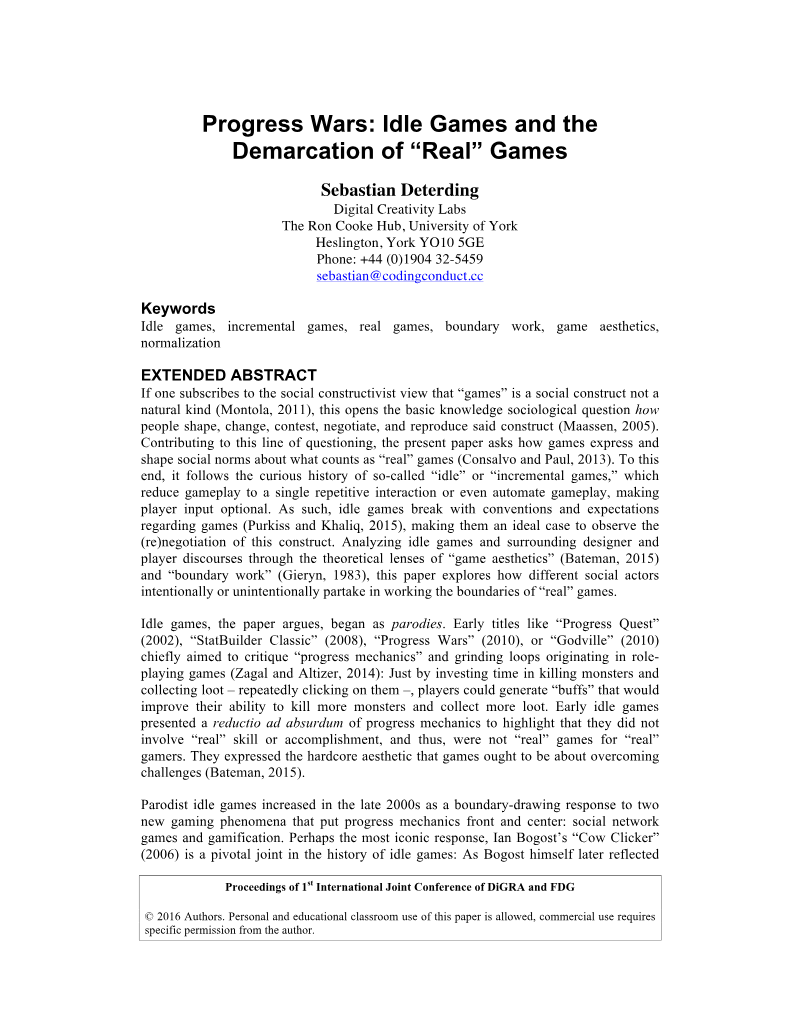
Progress Wars: Idle Games and the Demarcation of "Real" Games
This paper examines how idle games, which reduce gameplay to a single repetitive interaction or automate it entirely, have served as a site for negotiating what counts as a "real" game.
- The paper argues that the category of "real" games is not a natural given but is actively produced through contested practices of designers, players, and critics, drawing on social constructivist views of games.
- Idle games began as parody: titles like Progress Quest (2002), StatBuilder Classic (2008), Progress Wars (2010), and Godville (2010) used reductio ad absurdum on RPG grinding mechanics to argue such progress involved no real skill.
- Ian Bogost's satirical Cow Clicker (2006) unexpectedly became hugely popular, revealing an absorptive "being in the zone" appeal that its critical intent had not anticipated.
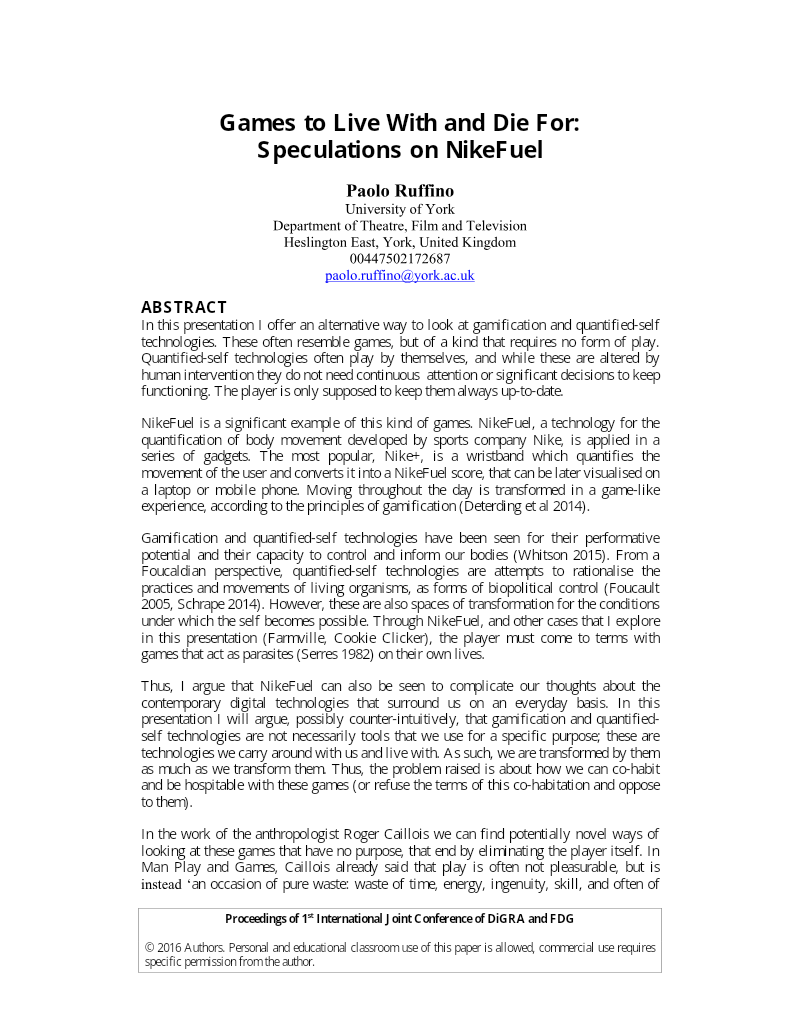
Games to Live With and Die For: Speculations on NikeFuel
This paper examines NikeFuel, a movement-quantification technology developed by Nike and embedded in wearables such as the Nike+ wristband, as an example of gamification and quantified-self technology that resembles play without requiring it.
- The paper treats NikeFuel, a movement-quantification technology built into Nike+ wearables, as an example of gamification that resembles play without requiring it, running largely on its own and needing only that the user keep it updated.
- Its central thesis is that such playful systems erase the player and the sense of agency as human and machine assimilate, with the paper arguing they transform the user as much as the user transforms them.
- The author combines Foucauldian biopolitics, which frames quantification as control over living bodies, with Roger Caillois's anthropology of play as pure waste and mimicry as a self-dissolving instinct.