
Yuga Labs
CompanyUnited States · Founded 2021
Documents about Yuga Labs

Yuga Labs and the Future of the Yugaverse
This Naavik deep dive, written by Abhimanyu Kumar and published May 22, 2022, examines Yuga Labs, the Miami-based company behind Bored Ape Yacht Club (BAYC) and its related projects.
- Yuga Labs raised a $450M seed round at a $4B valuation, led by a16z alongside other investors.
- The April 30, 2022 Otherside land sale sold 55,000 plots at $6,100 each, resulting in about $330M in additional revenue for the company.
- BAYC accounts for more than 90% of PFP sales volume, according to the author's analysis of trading data.

Unlikely Story
Nathan Brown's May 2022 newsletter argues that the game industry's rush into NFTs, blockchain and the "metaverse" has become a refuge for fading stars and struggling companies, one that increasingly resembles an elephant's graveyard.
- Saudi Arabia’s Public Investment Fund has acquired a 5% stake in Nintendo, making it the company's fifth-largest shareholder.
- Improbable has pivoted to the metaverse through its new entity, M2, which secured $150 million in funding from Andreessen Horowitz to develop 'Otherside' in partnership with Yuga Labs.
- Improbable’s previous cloud-computing platform, SpatialOS, struggled with scalability and high costs, with one developer estimating server maintenance at $5 per user per month.
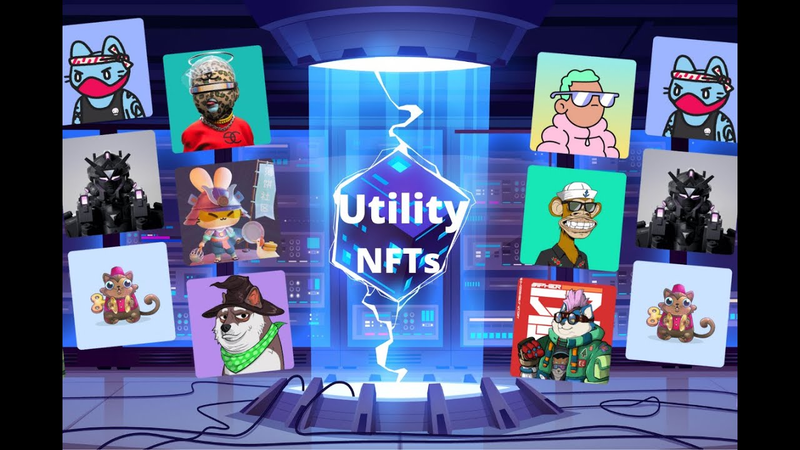
Tokenomics #8 Premium Utility NFTs and How to Build a Tokenized Community
Tokenized communities represent a fundamental shift in digital business models, moving away from traditional ad-supported revenue toward high-value membership structures.
- Tokenized communities shift business models from ad-supported revenue to high-value membership structures, as demonstrated by Moonbirds generating hundreds of millions of dollars through NFT access passes.
- Utility-driven NFT frameworks—including gated content, exclusive events, and governance rights—leverage behavioral economics to foster deeper user-developer engagement than traditional subscription models.
- Large-scale NFT implementations like the Yuga Labs Otherside land sale reveal critical infrastructure limitations, including network congestion, high transaction fees, and poor user experiences.
Square Enix’s Western Studios ‘Only’ Cost $300M? - The Metacast by Naavik
The gaming industry is currently navigating a period of significant structural realignment, characterized by both the volatile emergence of Web3 projects and the strategic consolidation of established intellectual property.
- Embracer Group acquired Square Enix’s Western studios for $300 million, taking control of major franchises like Tomb Raider and Deus Ex to bet on the long-term value of single-player narrative IP.
- Square Enix divested its Western studios to reduce operational costs and refocus resources on its core Japanese development strengths.
- Yuga Labs’ Otherside metaverse project generated $300 million in revenue but suffered from significant technical failure due to an Ethereum gas war, highlighting the risks of poor infrastructure planning.

Sony's Epic Strategy
Sony's $1 billion investment in Epic Games, alongside an equal contribution from LEGO parent Kirkbi, values Epic at $31.5 billion and brings Sony's total commitment to $1.45 billion across three rounds (2020, 2021, and 2022) for roughly a 3% stake.
- Sony invested $1 billion in Epic Games, bringing its total stake to $1.45 billion and valuing the company at $31.5 billion to secure a 3% share.
- The partnership centers on integrating Sony’s intellectual property into Fortnite and leveraging Unreal Engine 5’s technical features, such as Lumens, Nanite, and MetaHumans, to improve production efficiency.
- Sony is shifting its business model from hardware-dependent sales to a service-based ecosystem, aiming to increase user lifetime value through a diversified portfolio of interrelated properties.

TWIG #175 Bored Ape Yacht Club raises $450M for an MMO 🤯
The global gaming industry is currently navigating a period of significant structural transition, marked by aggressive capital investment, technological shifts, and evolving operational models.
- Yuga Labs secured $450 million for a metaverse project, while FRVR raised $76 million for browser-based gaming, signaling continued investor appetite for large-scale digital ecosystems.
- The removal of IDFA and other tracking identifiers has rendered traditional mobile user acquisition methods ineffective, forcing developers to prioritize organic growth and broader market appeal to combat rising costs.
- Studios are facing significant operational challenges, with skepticism surrounding the ability of teams to manage complex MMO macroeconomics or successfully pivot to live-service models.

Tokenomics #6 The Bored Apes $450M Pitch Deck for an MMO
Yuga Labs is aggressively pivoting from its origins as a luxury NFT brand toward the development of a mass-market metaverse and gaming ecosystem.
- Yuga Labs is pivoting from a luxury NFT brand to a mass-market gaming developer, utilizing the Bored Ape Yacht Club IP to anchor its Otherside MMO project.
- The company is integrating ApeCoin and play-to-earn mechanics into titles like Benji Bananas to shift from a speculative investment model to a sustainable gaming ecosystem.
- Strategic partnerships, most notably with Animoca Brands, are being leveraged to expand the project's reach within the digital asset market.

Elden Wrung: It Hurts so Good
This March 2022 edition of a games-industry newsletter argues that gaming's traditional business models and labor practices are under pressure as the sector becomes mainstream and faces competition from adjacent industries.
- Elden Ring achieved significant commercial success by selling over 12 million units within its first three weeks, proving the continued viability of high-difficulty, premium-priced titles.
- The video game industry is experiencing a 'talent war' as traditional publishers lose leverage to Big Tech and crypto firms, forcing a reevaluation of compensation and labor practices regarding workplace toxicity and crunch.
- Sony is aggressively pivoting toward live-service multiplayer expertise through the strategic acquisitions of Haven Studios and Bungie to future-proof its portfolio.
Hidden Discovery Insight: Analyzing Player Review Word Length
This GameDiscoverCo newsletter from March 2022 examines whether the word length of Steam reviews can reveal how casual a game's audience is.
- Review word length serves as a reliable metric for player persona, as casual games generate a higher frequency of one-word reviews compared to complex, niche titles.
- Long-form reviews are strongly correlated with 'core' player behavior, characterized by larger Steam library sizes and higher average in-game playtimes.
- Tencent’s global gaming investment strategy reached a massive scale of $32.4 billion in 2021.
The Metaverse, Blockchain Gaming, and NFTs: Navigating the Internet’s Uncharted Waters 2022
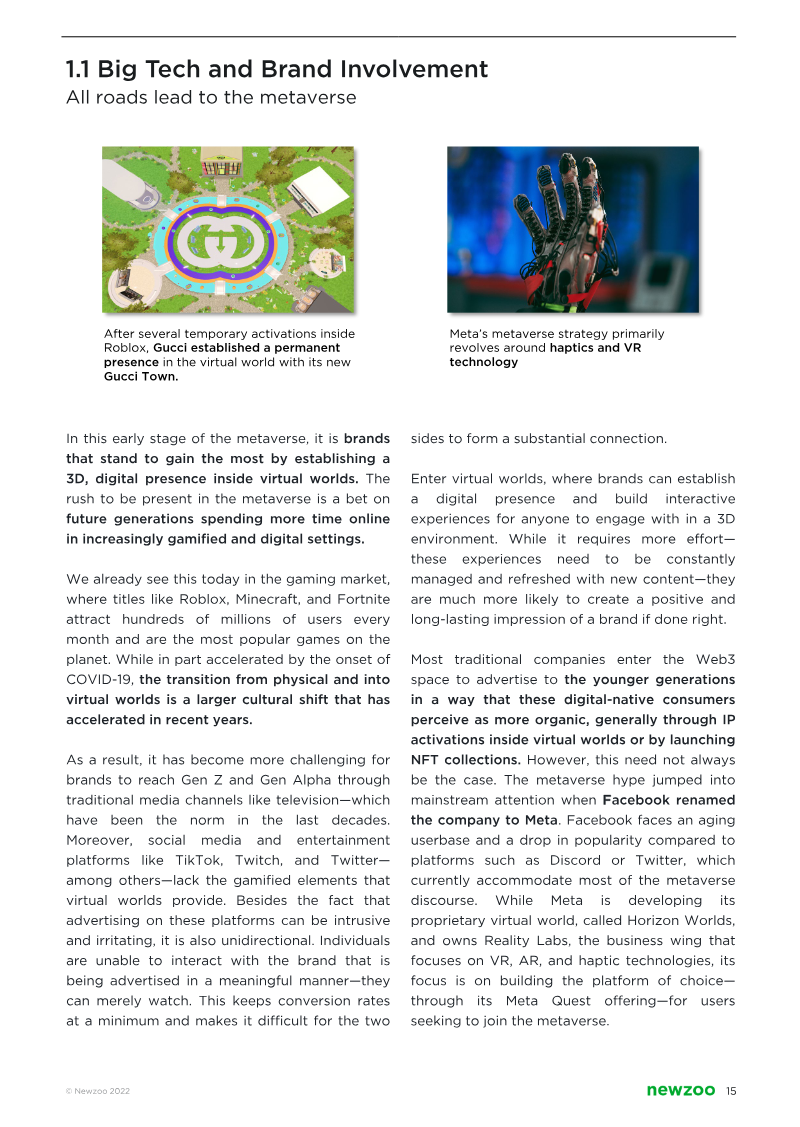
Newzoo's 2022 trend report examines the metaverse, blockchain gaming, and NFTs, identifying ten prevailing trends in these spaces.
- Roblox developers retain up to 28.1% of the total earnings their experiences generate, while the platform takes a much higher fee, close to 75%, from game developers building on it.
- P2E guilds lend in-game assets to scholars, who usually retain between 50% and 70% of the resulting revenue.
- The early blockchain game market is dominated by financially oriented P2E titles whose core focus is on economics rather than gameplay.
The Metaverse, Blockchain Gaming, and NFTs: Navigating the Internet’s Uncharted Waters
Newzoo's 2022 Trend Report examines the metaverse, blockchain gaming, and NFTs, identifying ten prevailing trends across the metaverse, blockchain gaming, and NFT space.
- Newzoo reports Roblox reached over 53.1 million DAUs on average in 2021, and that developers building on Roblox retain only just above 25% of the revenue they generate.
- The report states that the early market for blockchain games is overrun by titles with rudimentary gameplay and no sustainable economies.
- According to the report, NFT trading volume reached $18.3 billion in 2021, up from $82 million in 2020.


Gaming Deals Activity Report H1'22
InvestGame's Gaming Deals Activity Report for H1 2022 tracks closed transactions in the Video Games industry, with target companies having core business operations related to the Video Games market, excluding pure gambling, betting, and non-gaming blockchain/Web3 companies.
- Closed deals totalled $43.3B in H1 2022, and $113.6B including announced deals, which the report calls a new industry record.
- M&A deal value rose 36% YoY to $31.1B even as closed M&A deal count fell 21%.
- Almost 71% of H1 2022 M&A deal value came from five mega-deals, including Zynga, Asmodee, Nintendo, Playtika, and Sumo Group.