InvestGame
Investment79 documents
Documents

Report17 pages
The Future of Gaming Infrastructure: 2026-2028
The gaming industry is currently undergoing a critical architectural transition as live-service titles face a trilemma of escalating operational demands: the need for sub-10ms AI-driven decision-making, strict regulatory compliance, and rising cloud egress costs. The primary thesis is that legacy, fragmented backend architectures—which rely on separate databases, caches, and search layers—are no longer capable of supporting modern, high-velocity live-ops. To remain competitive, studios must shift toward unified, AI-native data planes that co-locate compute and data to ensure deterministic performance.
Key findings indicate that optimizing real-time matchmaking through low-latency infrastructure can drive a 4% to 15% uplift in player retention. However, achieving this requires moving away from asynchronous batch processing toward millisecond-level inference. This shift is further necessitated by the 2027 EU Data Act, which mandates the removal of cloud switching fees, and the EU AI Act, which classifies algorithmic matchmaking and personalization as high-risk systems requiring transparency, explainability, and immutable audit logs. Currently, only 5% of studios successfully implement player-facing AI, largely due to the latency bottlenecks inherent in traditional, multi-hop network architectures.
The industry is responding by adopting hybrid deployment models that combine self-hosted infrastructure with cloud resources to stabilize operating margins against unpredictable egress fees. By collapsing fragmented stacks into a single, coherent execution layer, studios can eliminate redundant systems and network round-trips. This consolidation allows for atomic, event-driven transactions that satisfy both performance requirements and emerging regulatory mandates.
Spanning the 2026–2028 period, this analysis highlights a fundamental shift in infrastructure strategy. As decision-making complexity grows—with matchmaking engines now processing hundreds of thousands of micro-decisions per second—the ability to execute logic directly on the data plane has become a primary competitive advantage. Studios that fail to modernize their backends risk both top-line revenue losses from poor engagement and bottom-line margin erosion caused by inefficient, legacy cloud consumption.
- Studios must transition from fragmented legacy backends to unified, AI-native data planes that co-locate compute and data to overcome latency bottlenecks and support high-velocity live-ops.
- Optimizing real-time matchmaking through low-latency infrastructure can increase player retention by 4% to 15%.
- Regulatory compliance with the 2027 EU Data Act and EU AI Act requires studios to implement immutable audit logs and transparent, explainable algorithmic systems for matchmaking and personalization.
- Only 5% of studios currently implement player-facing AI successfully, primarily due to latency issues caused by traditional, multi-hop network architectures.
- To stabilize operating margins against rising cloud egress costs, studios are increasingly adopting hybrid deployment models that combine self-hosted infrastructure with cloud resources.
+2
InvestGame

Report42 pages
For the Game: Data Fusion Sheds a New Light on Players
Gaming is projected to reach 3.5 billion players and generate over US$225 billion in revenue by 2025, establishing the medium as a mass‑scale platform with extensive brand opportunities. Dentsu’s data‑fusion approach merges a 420,000‑respondent consumer panel with GWI gaming insights across 21 markets to create high‑fidelity gamer portraits that link lifestyle, media habits and in‑game behaviors. This methodology enables brands to segment audiences by motivation rather than device or genre, a strategy shown to produce the most authentic and attention‑driven brand experiences.
Key demographic insights reveal that 57 % of gamers are female, with gaming serving as a tool for identity reinvention and social bonding. Shooters dominate play preferences (63 %), while sports and puzzle/strategy titles attract 16 %. Device usage is nearly evenly split among console, handheld, and a growing smartphone/tablet share. Community engagement is strong: 40 % of U.S. gamers play to belong, and 63 % rely on friends for game information, with platforms such as Discord, Reddit, and Twitch amplifying fandoms.
Commercially, 71 % of gamers consume gaming content across multiple devices and 55 % of esports fans welcome sponsorships, underscoring high engagement. Brands that add genuine value—through exclusive rewards, immersive metaverse experiences, or AR scavenger hunts—achieve near‑perfect ad completion rates (96 %) and significant click‑throughs. Successful activations require clear brand rules, diversity inclusion, strategic partnerships with publishers or esports teams, and a focus on authentic integration rather than intrusive advertising. The analysis spans 22 global markets, including Australia, Brazil, Canada, China and the United States, offering a comprehensive framework for brands to identify entry points and growth opportunities within the evolving gaming ecosystem.
- The global gaming market is projected to reach 3.5 billion players and generate over US$225 billion in revenue by 2025.
- Brands that integrate value-add experiences like exclusive rewards or AR scavenger hunts achieve a 96% ad completion rate.
- Gamer demographics show that 57% of players are female, with 40% of U.S. gamers citing social belonging as a primary motivation for play.
- Shooters remain the dominant genre at 63% of play preferences, while sports and puzzle/strategy titles account for 16%.
- Consumer engagement is high, with 71% of gamers using multiple devices and 55% of esports fans expressing openness to brand sponsorships.
+3
InvestGame

Report4 pages
Is There a Shift from Content to Tech Startups Among Gaming VCs?
The analysis examines venture capital activity in the gaming sector from 2020 to early 2024, focusing on whether investment priorities are shifting from traditional content creation and publishing toward technology‑driven startups. Data show that, across all stages, content creators and publishers continue to dominate VC allocations, representing over half of both capital deployed (≈$1.76 billion) and the number of deals in early‑, mid‑, and late‑stage rounds. However, a closer look at seed and Series A financing reveals a notable trend: PC and console studios now secure more funding than mobile startups, indicating a pivot toward higher‑budget, platform‑centric projects.
In the last twelve months, gaming‑focused VC funds have increased their exposure to technology and platform companies. Capital deployed by select funds such as VENTURES, BEHOLD Venture, and Lightspeed Lvp. rose from roughly $1.3 billion in early 2020 to over $2.4 billion by H1 2024, while the number of rounds led by these funds grew from 67 to 289. This shift is evident across multiple funds, with several moving a larger share of their capital into tech‑centric ventures rather than pure content studios.
Geographically, the data encompass global markets with a concentration in North America and Europe, covering all major gaming segments—mobile, PC, console, and emerging platform technologies. The methodology aggregates publicly disclosed VC‑led rounds from 2020 through H1 2024, using capital deployed and round counts as primary metrics. The findings suggest that while content remains the core focus, gaming VCs are progressively allocating more resources to technology and platform innovations, reflecting an evolving investment landscape in the industry.
- Content creators and publishers remain the primary focus of gaming VC, accounting for over half of all capital deployed (approximately $1.76 billion) and the majority of deal volume across all stages.
- Gaming-focused VC funds, including VENTURES, BEHOLD Venture, and Lightspeed Lvp., significantly increased their activity between 2020 and H1 2024, with capital deployed rising from $1.3 billion to over $2.4 billion.
- The number of VC-led funding rounds grew substantially from 67 in early 2020 to 289 by H1 2024, reflecting an overall increase in investment activity.
- While content dominates total funding, there is a clear strategic pivot among VCs toward technology and platform-centric startups, particularly within seed and Series A financing.
- Within the content sector, investment is shifting toward higher-budget, platform-centric projects, as evidenced by PC and console studios now securing more funding than mobile startups.
+3
InvestGame

Report10 pages
Europe’s Gaming Consolidators: The Magnificent Seven Post-M&A Rush
The analysis examines the surge of M&A activity among European gaming publishers between 2020 and 2024, highlighting a capital deployment of $19 billion across more than 140 deals. Seven leading consolidators—mienn Easybrain Group, Stillfront, Keywords, Multiplay Media, Management Studios, The Label Yippee!, and SoftWare—dominated the market, with mienn Easybrain Group alone executing 78 deals worth $14.1 billion and acquiring studios such as Ashodee, CrazyLabs, and Aspyr. The largest individual acquisitions include Asmodee Group’s $3.145 billion purchase of a target in March 2022 and Plarium MO’s $620 million deal for SoftWare in November 2024.
Revenue growth data reveal that reported year‑over‑year increases were largely driven by inorganic expansion, with average revenue growth rates ranging from 21 % to 66 %. In contrast, organic growth remained modest; only a handful of firms maintained double‑digit positive trajectories without M&A. Adjusted EBITDA minus CAPEX (AEBITDAC) trends show a decline for many PC and console publishers, reflecting high‑budget projects that failed to deliver expected returns.
Share price performance indicates a post‑pandemic correction: most acquirers’ stocks fell 30–70 % from December 2019 levels, and the aggregate market cap of the seven firms peaked at $25.5 billion in April 2021 before stabilizing around $5.4 billion after share issuances financed acquisitions. Valuation multiples peaked during the 2020 bull market (EV/NTM revenue up to 30×) and subsequently contracted as investors shifted focus toward profitable organic growth.
Overall, the report underscores that aggressive inorganic strategies during low‑interest periods did not generate sustainable shareholder value, prompting leadership changes, layoffs, and restructuring initiatives across the sector.
- Between 2020 and 2024, seven major European gaming consolidators deployed $19 billion across over 140 deals, with mienn Easybrain Group accounting for 78 deals totaling $14.1 billion.
- Aggressive inorganic growth strategies failed to deliver sustainable shareholder value, as evidenced by a market cap collapse from a $25.5 billion peak in April 2021 to approximately $5.4 billion.
- Share prices for the primary acquirers corrected significantly, falling 30–70% from December 2019 levels as valuation multiples contracted from highs of 30× EV/NTM revenue.
- Revenue growth was primarily driven by M&A activity, with inorganic expansion rates ranging from 21% to 66%, while organic growth remained modest and rarely reached double digits.
- Financial performance metrics show a decline in AEBITDAC for many PC and console publishers, largely due to high-budget projects failing to meet return expectations.
+1
InvestGame

Report6 pages
The Alumni Effect: Studios Founded by Ex-Activision, Blizzard, and King Employees
The analysis examines venture capital activity directed toward studios founded by former Activision Blizzard employees between 2020 and 2024. It identifies 30 such startups that secured a total of approximately $0.7 billion across 45 VC‑led funding rounds, compared with 27 alumni studios from Riot Games that raised $0.5 billion in 38 rounds. Funding is concentrated in early‑stage rounds, with an average check size of $15.8 million for ex‑Activision studios versus $13.1 million for ex‑Riot ventures, and a notable skew toward PC & console and multiplatform projects. Web3 gaming represents a smaller share of the portfolio.
The study highlights a “first‑round momentum” effect: ex‑Activision studios are roughly twice as likely to secure a second round of financing within the same calendar year as other VC‑backed gaming startups. In 2021, 43 % of ex‑Activision studios raised a subsequent round versus only 9 % of peers; by 2023 the gap narrowed to 33 % versus 8 %. This pattern suggests stronger investor confidence in alumni teams during the 2021‑2022 peak.
Key investors include gaming‑focused funds such as GRIFFIN, PARTNERS COLLECTIVE, and SSSU, which together accounted for more than half of the capital deployed. Notable portfolio companies include Mythical Games (Series C, $262 million), Second Enap (Series B, $100 million), and TheoryCraft (Series A, $87.5 million). While many projects remain in development, releases such as Marvel Snap and Stormgate demonstrate commercial viability, whereas titles like Lightforge’s Project O.R.C.S. were shut down due to lack of traction.
Overall, the report underscores a robust investment climate for studios led by former Activision Blizzard talent, driven by early‑stage funding success and a higher likelihood of follow‑on rounds compared to broader gaming startup cohorts.
- Between 2020 and 2024, 30 studios founded by former Activision Blizzard employees secured approximately $0.7 billion in venture capital across 45 funding rounds.
- Ex-Activision studios demonstrate a 'first-round momentum' effect, being roughly four times more likely than peer startups to secure a second round of financing within the same calendar year.
- Investor confidence in alumni teams peaked in 2021, when 43% of ex-Activision studios raised a subsequent round compared to only 9% of broader gaming startups.
- Funding for ex-Activision alumni is primarily concentrated in early-stage rounds for PC, console, and multiplatform projects, with an average check size of $15.8 million.
- GRIFFIN, PARTNERS COLLECTIVE, and SSSU are the primary investors in this sector, collectively deploying more than 50% of the total capital.
+2
InvestGame

Report9 pages
Corporate Overhaul: Why Does CVC Play a Bigger Role Than Ever?
The analysis demonstrates that corporate venture capital (CVC) has become the dominant force in gaming investment from 2020 to 2024, accounting for more than half of all capital raised in the sector. CVC‑led rounds total $4.0 billion across 93 deals, while VC‑only and joint VC‑CVC rounds raise $3.5 billion in 80 deals, indicating a strategic shift toward co‑investment models that spread risk and access higher‑profile startups. Geographic focus is heavily weighted toward Asian strategics, with South Korean and Japanese firms such as Riot, NetEase, and Gigaom leading the pack; these investors collectively completed 105 deals worth $1.8 billion, surpassing Western peers in volume but not always in value.
The largest disclosed CVC‑led investments target mature gaming studios and multiplatform developers, with EPIC Games securing $2.0 billion in April 2022 and Roblox raising $150 million in February 2020. In contrast, VC‑CVC co‑investments concentrate on platform and technology (“picks and shovels”) startups, exemplified by GreenOak’s $500 million Series I in September 2021 and Samsung‑backed CENVID’s $113 million Series C in July 2021. Mobile segments have seen a decline, with CVC interest shifting toward PC and multiplatform titles; mobile deals now represent only 10–15 % of total CVC activity.
Methodologically, the study aggregates public funding announcements from 2020‑2024, categorizing deals by investor type (CVC only, VC only, or joint), segment (studio, platform/tech, mobile, PC/console), and geographic origin. Deal counts and capital raised are sourced from press releases, regulatory filings, and secondary databases, providing a comprehensive view of investment flows. The findings suggest that corporates are increasingly willing to share risk with traditional VCs, enabling larger funding rounds for gaming studios while maintaining strategic alignment and access to emerging technologies.
- Corporate venture capital (CVC) has become the dominant force in gaming investment from 2020 to 2024, accounting for over half of all capital raised with $4.0 billion across 93 CVC-led deals.
- Investment strategies have shifted toward co-investment models between CVCs and traditional VCs, which collectively raised $3.5 billion across 80 deals to spread risk and access high-profile startups.
- Asian firms, specifically from South Korea and Japan, are the most active investors, completing 105 deals worth $1.8 billion and surpassing Western peers in total deal volume.
- CVC-led investments prioritize mature studios and multiplatform developers, highlighted by major capital injections such as the $2.0 billion raised by Epic Games in April 2022.
- VC-CVC co-investments are primarily focused on 'picks and shovels' platform and technology startups, exemplified by the $500 million Series I round for GreenOak in September 2021.
+2
InvestGame

Report12 pages
The Great Mobile Reversal: Why Buyers Pay Billions for What VCs Abandoned
The analysis examines the evolution of mobile gaming investment and M&A activity from 2020 through the first half of 2025. Mobile platforms have dominated the sector, accounting for 61 % of total gaming deal value (excluding ATVI) and nearly all first‑half 2025 volume, driven by strategic and private‑equity deals. Venture capital enthusiasm peaked in 2021 with 137 rounds totaling $2.2 B, but post‑2021 the focus shifted toward profitability and sustainable unit economics, leading to a sharp decline in mid‑core deals—from 49 in 2021 to only eight by H1 25—while casual studios captured 65 % of all deals due to faster iteration and broader audience reach.
Geographically, Turkey led casual gaming with 27 % of deals, whereas Europe and Asia dominated mid‑core, contributing 66 % of transactions in 4X, RPGs, and shooters. Early‑stage activity remained steady at pre‑seed/seed levels, yet Series A and later rounds became rarer as scaling challenges intensified. Median early‑stage check sizes hovered around $10 M, with notable large rounds such as Spyke’s $55 M seed and Scopely’s $340 M Series E.
Strategic buyers intensified their presence, executing $7 B in mobile M&A across six deals within a year. The largest acquisitions include Af’s $12.7 B purchase of 2yga (casual) and Scopely’s $4.9 B takeover of GamesGroup (mid‑core). Overall, the data illustrate a market shift from VC‑led growth to strategic consolidation, with casual titles and recurring revenue models becoming the primary drivers of investment value.
- Mobile gaming accounted for 61% of total gaming deal value (excluding ATVI) between 2020 and H1 2025, with strategic buyers and private equity firms driving nearly all deal volume in the first half of 2025.
- Strategic consolidation has replaced VC-led growth, highlighted by $7 billion in mobile M&A activity across six major deals, including Af’s $12.7 billion acquisition of 2yga and Scopely’s $4.9 billion purchase of GamesGroup.
- Venture capital interest has shifted heavily toward casual gaming, which now captures 65% of all deals due to its broader audience reach and faster iteration cycles.
- Mid-core gaming investment has collapsed, with deal volume falling from 49 rounds in 2021 to only eight by H1 2025 as investors prioritize sustainable unit economics over high-growth scaling.
- While early-stage funding remains stable with median check sizes around $10 million, Series A and later-stage rounds have become increasingly rare due to heightened scaling challenges.
+3
InvestGame

Report7 pages
Public Mobile Gaming Publishers: Resilience & Adaptation in a Shifting Landscape
The analysis examines the post‑IDFA mobile gaming landscape, focusing on revenue dynamics, user acquisition spending, profitability trends, and market valuation shifts across key publishers. Data reveal that annual reported revenue growth has slowed markedly, with many companies experiencing negative organic revenue and overall declines in 2023‑24. User acquisition expenses have surged, reaching peaks of $40 million for some firms, yet returns from these campaigns have weakened, driving higher operating expenses and compressing EBITDA margins. Consequently, publishers are pivoting from aggressive scaling toward profitability, reflected in tighter cost controls and a renewed emphasis on player retention and lifetime value.
Daily active user metrics illustrate the broader market contraction, with average DAU figures falling across the sector. Valuation impacts are stark: aggregate market capitalisation for major publishers has fallen by more than 50 % since January 2022, and most stocks remain below their pre‑IDFA peaks. An exception is MTG, whose disciplined mergers and acquisitions strategy and operational efficiency yielded 9 % organic growth in Q4 2024, translating into a 50 %+ share price increase and outperforming the S&P 500.
The study covers global mobile gaming publishers over a 2022‑2025 timeframe, drawing on quarterly financial statements and market data. Methodology includes analysis of reported revenue, user acquisition spend, EBITDA adjustments for capitalised development costs, and market cap changes. The findings underscore a sector in transition, where resilience hinges on profitability focus, retention strategies, and disciplined capital allocation.
- Aggregate market capitalization for major mobile gaming publishers has plummeted by more than 50% since January 2022, with most stocks remaining below pre-IDFA valuation peaks.
- User acquisition costs have surged to as high as $40 million per firm, while diminishing returns on these campaigns have compressed EBITDA margins and forced a shift toward cost control.
- MTG outperformed the broader market with a 50%+ share price increase and 9% organic growth in Q4 2024, driven by disciplined M&A and operational efficiency.
- Annual revenue growth across the sector has slowed significantly, with many publishers reporting negative organic revenue and overall declines throughout 2023 and 2024.
- The mobile gaming sector is experiencing a broad contraction in engagement, evidenced by a decline in average daily active user (DAU) metrics across the industry.
+3
InvestGame

Report23 pages
Mobile Gaming by Genre: Midcore
The analysis demonstrates that midcore mobile games—those offering depth while remaining accessible on handheld devices—are experiencing a post‑pandemic rebound, with Q1 2025 downloads and revenue surpassing 2024 levels. Five‑year data (2020‑2024) reveal a temporary decline during the pandemic, followed by a steady uptick in 2024 and forecasts that growth will continue into 2025. The primary thesis is that monetization success in this segment hinges on data‑driven ad integration and player‑centric design.
Key findings show that midcore titles command higher eCPMs than casual games, yet player retention and in‑app purchase (IAP) conversion rates are sensitive to ad placement. A phased, A/B‑tested approach—beginning with limited rewarded videos and expanding based on performance metrics such as retention, playtime, and IAP conversions—maximizes revenue while preserving engagement. Case studies illustrate tangible benefits: Bytro Labs’ rewarded video strategy lifted average revenue per daily active user (ARPDAU) by 32.9 %, increased Day‑3 retention on iOS by 6.1 %, and achieved eCPMs of 23 (iOS) and 25 (Android). These results confirm that well‑timed ads can rival or complement IAP revenue when aligned with player incentives.
The scope covers the global midcore mobile market, focusing on 2025 performance and projecting trends through 2026. It emphasizes long‑term player value, streamlined gameplay, social hooks, and frequent content updates as critical success factors. The conclusions underscore that responsive development cycles, continuous data analysis, and fair live‑service practices are essential for sustaining growth in the competitive midcore landscape.
- Midcore mobile gaming is experiencing a post-pandemic rebound, with Q1 2025 revenue and download figures exceeding 2024 levels.
- Strategic rewarded video integration can significantly boost performance, as evidenced by Bytro Labs increasing ARPDAU by 32.9% and Day-3 iOS retention by 6.1%.
- Midcore titles achieve higher eCPMs than casual games, with Bytro Labs reaching eCPMs of 23 on iOS and 25 on Android through optimized ad placement.
- Monetization success in the midcore segment requires a phased, A/B-tested approach to ad integration to protect retention and in-app purchase conversion rates.
- Long-term growth in the midcore landscape depends on responsive development cycles, frequent content updates, and the implementation of social hooks.
+5
InvestGame
Report31 pages
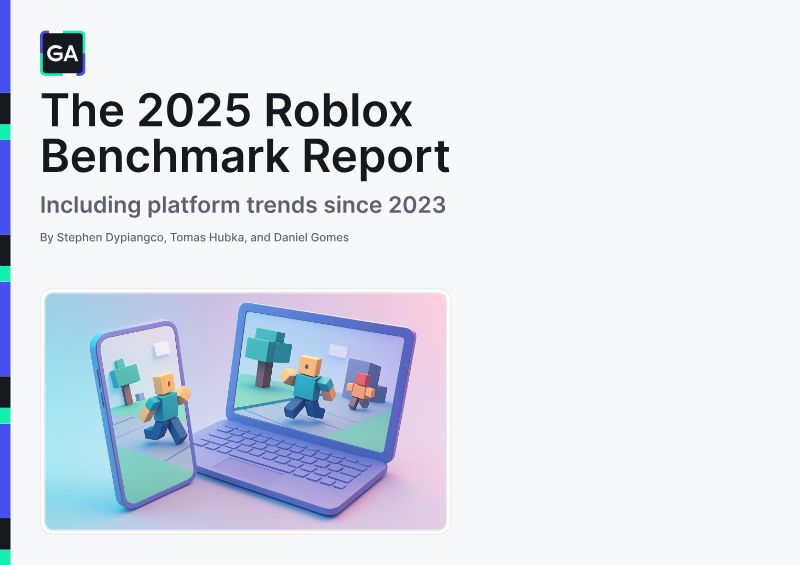
The 2025 Benchmark Report: Roblox Platform Trends
The report establishes that Roblox’s player base is sharply divided between casual users who spend only a few minutes per session and core players who log in multiple times daily, often exceeding 30‑minute sessions. Across 2023‑2025, titles that sustain longer playtimes achieve double‑digit retention rates and significantly higher monetization; the top 5 % of games generate over $20 per day from a single player. In contrast, games with median sessions under six minutes exhibit negligible Day‑1 retention (≈6 %) and ARPPU below $1, indicating that brief curiosity rarely translates into repeat play or meaningful spend.
Cross‑device usage remains high, with nearly 40 % of players alternating between PC and mobile. Daily session frequency has risen by roughly one third among the most active users, while median session length has fallen from 36 to 26 minutes. These dynamics underscore the importance of seamless PC‑mobile experiences and micro‑sessions that incorporate strong re‑entry hooks to capture the growing multi‑session behavior.
Platform discovery mechanisms reward repeat spending and long‑term engagement. Games that maintain 7‑day spend per user climb recommendation rankings, while low‑engagement titles (0–3 min) suffer from poor retention (<5 % Day 1, <2 % Day 7) and modest ARPPU (<$1). Conversely, higher‑engagement games achieve Day‑30 retention above 1 % at the upper percentiles and ARPPU exceeding $6, with average transaction values reaching $3–$4. These findings demonstrate that sustained engagement directly fuels higher per‑payer revenue and larger purchase sizes.
The overarching thesis is that success on Roblox follows a systematic progression rather than chance. Developers must align their game’s current stage with benchmark metrics, prioritizing clear early hooks, repeat‑play incentives, and engagement‑driven spend such as quests, streaks, or battle passes. Leveraging analytics tools like GameAnalytics to track custom events and player behavior enables studios to refine strategies, move from fragile prototypes toward million‑player hits, and capitalize on the platform’s reward structure for long‑term growth.
- Games with median session lengths under six minutes suffer from negligible Day-1 retention of approximately 6% and ARPPU below $1, while top-tier titles achieve ARPPU exceeding $6 with average transaction values of $3–$4.
- The top 5% of Roblox games generate over $20 per day from a single player, demonstrating that sustained engagement is the primary driver of high-value monetization.
- Platform discovery algorithms prioritize games with consistent 7-day spend and high engagement, causing low-engagement titles to fall below 5% Day-1 and 2% Day-7 retention.
- While median session lengths have decreased from 36 to 26 minutes between 2023 and 2025, daily session frequency among the most active users has increased by roughly one-third.
- Nearly 40% of the player base alternates between PC and mobile, necessitating seamless cross-device experiences to support the growing trend of multi-session play.
+3
InvestGame
Report9 pages
The Rise of the Financial Kingmakers: Private Equity’s $21B+ Bet on Gaming
The analysis demonstrates that private equity (PE) has increasingly positioned itself as a decisive force in the gaming sector, channeling more than $21 billion into acquisitions and growth investments from 2018 through the first half of 2025. Annual deal values consistently exceeded $1 billion, underscoring the industry’s institutional maturity and attracting a broad spectrum of PE participants. Control acquisitions dominate, accounting for roughly 60 % of total capital deployed, with notable deals such as Scopely’s $4.9 billion purchase of Games Group and ESL’s $1.5 billion takeover of Facet Games Group. Minority stake purchases, while smaller in dollar terms, remain significant for content and ecosystem players, exemplified by Vungle’s $0.8 billion control of an ecosystem firm.
Geographically, the focus is global but heavily weighted toward North America and Europe, with a growing presence in mobile and PC/console segments. The data reveal that content creation—particularly studios with strong IP portfolios—is the most attractive segment, receiving 42 of the 68 PE‑led deals. Ecosystem investments, including platform and service providers, constitute a substantial share of growth capital, reflecting PE’s strategy to build scalable ecosystems around core IP.
Methodologically, the study aggregates publicly disclosed transactions from 2018 to mid‑2025, classifying deals by type (control acquisition, minority stake, growth investment, add‑on) and segment. Deal values are sourced from press releases, SEC filings, and reputable financial databases, with exit returns estimated where available. The findings illustrate a shift toward platform‑building and ecosystem consolidation as the default PE playbook, positioning financial investors as key enablers of scale in a structurally fragmented gaming market.
- Private equity firms deployed over $21 billion into the gaming sector between 2018 and mid-2025, with annual deal values consistently surpassing $1 billion.
- Control acquisitions represent the primary investment strategy, accounting for approximately 60% of total capital deployed in the sector.
- Content creation studios holding strong IP portfolios are the most targeted assets, securing 42 of the 68 total private equity-led deals identified.
- Notable high-value transactions include Scopely’s $4.9 billion acquisition of Games Group and ESL’s $1.5 billion takeover of Facet Games Group.
- Private equity strategy is shifting toward platform-building and ecosystem consolidation to scale fragmented gaming markets, supported by minority stake investments in service and platform providers.
+2
InvestGame

Report8 pages
The Take-Two Diaspora: Why Alumni Win Big in Mobile, Not AAA
The analysis examines the investment trajectory of companies founded by former senior executives from Take‑Two Interactive and its subsidiaries. From 2020 to the present, alumni have launched 23 startups that collectively attracted $1.2 billion in capital across 43 deals, with the most substantial transaction being Dream Games’ $2.5 billion sale in July 2025. The portfolio spans mobile casual titles, instant‑play games, sports apps, and publishing ventures, but shows a pronounced skew toward mobile platforms rather than AAA titles.
Key financial metrics reveal that alumni‑led firms secured an average early‑stage check of $12 million, with mobile projects commanding the largest median ($22.6 million) and multiplatform deals following closely. In 2021–2022, the cohort’s subsequent‑round funding rate was nearly four times the industry average, and 60 % of companies raised a second round within a year versus 20 % for comparable VC‑backed gaming startups. The most active investors include Dream Ventures, Balderton Capital, and LORIC, each contributing between $40 million and $575 million across multiple alumni deals.
Geographically the activity is concentrated in North America, with notable studios such as Dream Games (San Francisco), Build a Rocket Boy (London), and Spyke Games (Los Angeles). The time frame covers 2020–2025, covering both pre‑pandemic and post‑pandemic market dynamics. Methodologically, the study aggregates venture, corporate, and strategic investment data from public filings, press releases, and proprietary databases, focusing on firms whose founders held senior roles at Take‑Two or its subsidiaries. The findings underscore a robust pipeline of mobile‑centric startups emerging from the Take‑Two alumni network, delivering high valuation exits and rapid follow‑on funding relative to broader gaming benchmarks.
- Former Take-Two senior executives founded 23 startups between 2020 and 2025, securing $1.2 billion in capital across 43 deals.
- Dream Games, a prominent alumni-led studio, achieved a $2.5 billion exit in July 2025, highlighting the high valuation potential of these ventures.
- Alumni-led firms significantly outperform industry benchmarks, with a 60% rate of raising a second funding round within one year compared to the 20% industry average.
- Investment is heavily skewed toward mobile platforms, which command the highest median early-stage funding at $22.6 million per deal.
- Between 2021 and 2022, the alumni cohort secured subsequent-round funding at nearly four times the rate of comparable VC-backed gaming startups.
+2
InvestGame