Niantic
Company
Documents about Niantic
Apple app review woes, EA job cuts, Supercell, Monopoly Go and more
The mobile gaming industry is currently navigating significant operational shifts, ranging from platform-level bottlenecks to major corporate restructuring.
- Apple’s App Store review times have extended from 24–48 hours to several weeks due to a surge in AI-generated submissions, disrupting developer roadmaps while Google Play remains unaffected.
- Scopely emerged as the top-earning U.S. publisher in Q3 with $507 million in revenue, bolstered by Monopoly Go, which generated $41 million in Q3 licensing earnings for Hasbro.
- Electronic Arts is cutting 400 jobs, representing 3% of its global workforce, as part of a restructuring plan following its transition to private ownership.
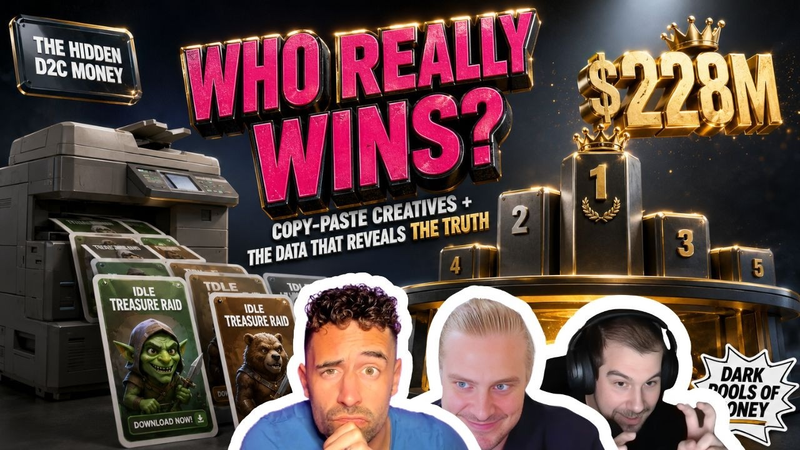
🧠 The Creative trends nobody wants to admit! (July 2026 trends)
The mobile gaming industry is currently defined by a pervasive reliance on iterative, copy-paste creative strategies that prioritize proven mechanics over innovation.
- The mobile gaming market is experiencing a disconnect between high user acquisition spending and actual engagement, with major titles like Monopoly GO! and Coin Master seeing declines in daily active users and revenue.
- Publishers are increasingly shifting focus toward direct-to-consumer web shops to bypass app store metrics, making off-platform revenue tracking the primary competitive advantage in the current market.
- Creative strategy is currently defined by a reliance on AI-generated, iterative content—such as hotel simulations and freezing family themes—to maintain market presence through rapid asset scaling.

Xbox's big reset | Week in Mobile Games podcast
Xbox is currently executing a fundamental strategic pivot, moving away from an aggressive focus on scaling the Game Pass subscription service toward a broader objective of engaging one billion players.
- Microsoft is undergoing a major restructuring involving 3,200 staff layoffs and the divestment of five studios, including management buyouts for Compulsion Games and Double Fine and the sale of Ninja Theory and Undead Labs.
- Microsoft has set an ambitious goal to engage one billion daily active users, a target that industry analysts view as highly challenging given that current console markets are largely flat and the company's total monthly active user base across its gaming division was reported at 500 million in 2024.
- Pokémon Go has generated over $9 billion in lifetime revenue across the Google Play Store and Apple App Store during its 10-year history, with player spending peaking during the pandemic.
🚨📢 BREAKING NEWS: Xbox Layoffs, Niantic rebrand, New Turkish puzzle studio
The gaming industry is currently navigating a period of significant structural change, marked by large-scale workforce reductions and shifts in corporate strategy.
- Microsoft is restructuring its gaming division with 3,200 layoffs and the spin-out of four console studios, including Double Fine and Ninja Theory, to prioritize mobile growth and P&L efficiency.
- The Chinese mini-game market is projected to reach nearly $10 billion in revenue by 2025, supported by a 34% year-over-year growth rate and 1.2 billion monthly active users.
- M&A activity in the second quarter of 2026 reached $2.3 billion, marking the highest deal volume recorded since 2022.
King and the Xbox cuts, Meta's 'TikTok for games', alot of Scopely news, game closures, MTG, more
The mobile games industry is currently navigating a period of significant structural realignment, marked by major workforce reductions at Xbox and a strategic pivot toward mobile-first engagement.
- Microsoft is cutting 3,200 jobs across its Xbox division, with 1,600 layoffs announced immediately and the remainder occurring throughout the financial year, primarily impacting PC and console operations.
- Meta has soft-launched 'Pocket,' an app that utilizes AI prompts to generate a TikTok-style feed of interactive mini-games, marking the company's latest attempt to enter the 'TikTok for games' market.
- Pokémon Go has generated approximately $6.37 billion in lifetime in-app purchase revenue over its 10-year history, with 39% of revenue originating from the U.S. and 30% from Japan.
Only XBOX Can Kill Xbox, Unreal 6's AI Update & Pokémon Training Drones | Games For Breakfast
The gaming industry currently faces a period of profound instability characterized by corporate mismanagement, ethical controversies, and a shift toward aggressive, often alienating, monetization strategies.
- Microsoft has closed multiple game studios despite a five-year investment of over $20 billion in content and hardware, during which annual revenue declined by nearly half a billion dollars.
- Microsoft is facing internal pressure to improve efficiency, with the company reporting a 3% accountability margin and a need to pivot its strategy to address declining financial performance.
- The gaming industry is increasingly grappling with the integration of AI tools in development, raising concerns regarding the protection of intellectual property and the legal status of AI-generated assets.
Supercell buys Metacore amid brutal layoffs, Second Dinner cuts, inside Scopely x Niantic, more
The mobile games industry is currently navigating a period of significant restructuring and strategic consolidation.
- Supercell has acquired Metacore in a deal involving a €180 million investment, resulting in the layoff of 160 staff members—over half the company—as the studio pivots to focus exclusively on Merge Mansion.
- Marvel Snap developer Second Dinner has laid off 16 employees, though the company confirmed that development on its current roadmap and an unannounced second game remain unaffected.
- Scopely and Niantic executives revealed that their partnership, which has significantly improved revenue performance for titles like Pikmin Bloom, involved intense integration efforts and complex technical collaboration.
Xbox's weird 'North Star', Sybo and Subway Surfers, App Store emulators, Peridot's death, more
The mobile games industry is currently navigating a period of strategic realignment, marked by shifting corporate priorities and evolving platform dynamics.
- Xbox has adopted 'daily active players' as its new core metric, yet the company's recent strategic communications largely ignore its mobile gaming division despite mobile likely representing the majority of its active player base.
- Subway Surfers developer Sybo is shifting its revenue strategy for the new title Subway Surfers City, aiming for a higher ratio of in-app purchases compared to the original game, which currently relies on ad revenue for 80% to 85% of its income.
- Apple's App Store has seen over 60 million downloads of game emulators, but developers report that Apple's backend tools remain dated and fail to provide a developer experience commensurate with the high commission fees Apple collects.
Pokemon Go owner: There’s less of a need for new games
Scopely co-CEO Javier Ferreira provides an analytical overview of the current mobile gaming landscape, emphasizing that while the market has reached unprecedented scale, the requirements for success have shifted significantly.
- The mobile gaming market has shifted from rapid user acquisition to a focus on longevity, with 80% of Scopely’s revenue now generated by players who have engaged with their titles for over a year.
- Scopely has reached $15 billion in lifetime revenue and 2 billion downloads, anchored by six distinct billion-dollar franchises including the recent hit Monopoly Go.
- Market maturity has reduced the demand for new, transient game titles, placing a higher premium on the development of exceptional, long-term player experiences.
How mobile devs use AI and Pikmin Bloom blossoms | Week in Mobile Games podcast E75
The mobile gaming industry is currently defined by a shift toward massive marketing expenditures, with budgets frequently surpassing $50 million to secure user acquisition.
- Pikmin Bloom has reached $100 million in lifetime revenue, with 2025 marking its most successful year to date at $34.8 million in revenue despite only having one month remaining in the year.
- Pikmin Bloom's monthly installs have approximately doubled between 2022 and 2025, while its revenue has more than quadrupled in the same period, indicating improved monetization efficiency.
- Industry experts at the Wiggin Games Summit suggest that the term 'casual' is increasingly inaccurate for mobile games like Royal Match or Candy Crush, as their player bases often exhibit high-engagement, 'hardcore' behavioral patterns.

Where Do Geogames Go After Niantic’s $3.5B Exit with Lauren Steidl, CEO of Integrated Reality Labs
The evolution of location-based gaming is shifting away from the augmented reality-heavy geocaching models of the past toward proximity-based, real-world social interaction.
- Location-based gaming is shifting from AR-heavy models to proximity-based social interaction, utilizing sensor fusion (GPS, Bluetooth, and ultra-wideband) to achieve centimeter-level precision for real-time multiplayer gameplay.
- Current platforms are achieving strong engagement metrics with minimal paid acquisition, including over 60,000 monthly active users and Day 1 retention rates exceeding 50 percent.
- High-frequency engagement is driven by a viral flywheel effect, with users opening these applications more than ten times per day.

Pocket Gamer Reacts: Breaking down Scopely's blockbuster $3.5bn deal for Niantic's games business
Scopely’s acquisition of Niantic’s games business for $3.5 billion represents a major consolidation within the mobile gaming sector, signaling a strategic pivot for both organizations.
- Scopely has acquired Niantic’s games business for $3.5 billion, taking over the development and live-service operations for titles including Pokémon GO, Monster Hunter Now, and Pikmin Bloom.
- Pokémon GO remains the primary financial anchor of the deal, having generated over $8.5 billion in lifetime gross revenue.
- Niantic is pivoting to focus on geospatial AI technology, supported by a $250 million funding round that includes a strategic investment from Scopely.
