Metacore
Company
Documents about Metacore

EA shuts down BioWare and Supercell buys Metacore | Week in Mobile Games
The mobile gaming industry is currently navigating a period of significant structural change, characterized by studio closures, strategic acquisitions, and a shift in how developers approach user acquisition and market viability.
- Electronic Arts is closing BioWare and laying off approximately 400 employees to prioritize established live-service franchises like Apex Legends and Battlefield over high-budget single-player projects.
- Supercell has fully acquired Metacore, the developer of Merge Mansion, to bring the title under direct management following a long-standing financial partnership.
- Mika Games has launched a $10 million funding initiative specifically designed to support mobile studios during the soft-launch phase by financing user acquisition testing.

🚨📢BREAKING NEWS: BioWare Shutdown 😱, PEGI 16 rating on lootboxes, Griffin Gaming film studio
The current landscape of the gaming industry is marked by significant structural shifts, including major corporate restructuring, regulatory tightening, and evolving investment strategies.
- Electronic Arts has initiated a major restructuring that includes the closure of the BioWare studio following the underperformance of Dragon Age: The Veilguard.
- Apple’s App Store review process is facing significant delays, with wait times extending to several weeks due to an influx of over 50,000 AI-generated submissions per day.
- The Pan European Game Information (PEGI) agency has implemented a new policy requiring a 16+ rating for games featuring paid loot boxes, a mandate that now applies to titles like Pokémon TCG Pocket.

Apple app review woes, EA job cuts, Supercell, Monopoly Go and more
The mobile gaming industry is currently navigating significant operational shifts, ranging from platform-level bottlenecks to major corporate restructuring.
- Apple’s App Store review times have extended from 24–48 hours to several weeks due to a surge in AI-generated submissions, disrupting developer roadmaps while Google Play remains unaffected.
- Scopely emerged as the top-earning U.S. publisher in Q3 with $507 million in revenue, bolstered by Monopoly Go, which generated $41 million in Q3 licensing earnings for Hasbro.
- Electronic Arts is cutting 400 jobs, representing 3% of its global workforce, as part of a restructuring plan following its transition to private ownership.

A lot of App Store news, NC’s $300m mobile push, Overwatch, Metacore, Yahoo Games and more
The mobile games industry is currently navigating significant shifts in platform policy, corporate consolidation, and evolving monetization strategies.
- Apple’s App Store revenue is facing a downturn, with Sensor Tower reporting a 6% decline in US consumer spending for Q2 and App Figures estimating an 18% contraction in US commission revenue, largely driven by legal rulings forcing the allowance of external payment methods.
- Korean MMO giant NC (formerly NCsoft) has invested $300 million in mobile studio acquisitions and aims to grow its mobile casual division into a $5 billion business by 2030, targeting established studios with live titles generating $50–$100 million annually.
- Supercell will finalize its acquisition of Metacore by the end of September, officially bringing the 'Merge Mansion' title into its portfolio following significant restructuring and layoffs at Metacore.

TWIG #388: Xbox's Spinout Plan, Metacore's Mass Layoffs and Netflix's FIFA Flop
The gaming industry is currently navigating a period of intense structural realignment, characterized by aggressive cost-cutting, leadership turnover, and a pivot toward profitability over creative expansion.
- Xbox is pivoting toward a distribution-heavy model focused on daily active users, signaling a potential strategic spin-off from Microsoft following significant studio closures and leadership turnover.
- Mobile gaming studio Metacore has implemented workforce reductions of up to 70% after failing to successfully diversify its portfolio beyond a single declining asset.
- The gaming industry is increasingly prioritizing short-term profitability and cost-cutting over creative expansion, driven by rising customer acquisition costs and the limitations of web shops as revenue stopgaps.

Summer Game Fest thoughts, Supercell kills US projects, Xbox chat, EA's mobile misstep, more
The mobile games industry currently faces a significant disconnect between its massive market dominance and its lack of visibility at major industry events.
- Supercell has effectively wound down its US-based game development operations, with the team behind a project in development for three and a half years disbanded and the remainder of the 2022-announced US team no longer with the company.
- Metacore, the developer of Merge Mansion, is cutting 159 jobs in Helsinki and closing its offices in Germany and Sweden as part of a major restructuring.
- Xbox Chief Strategy Officer Matthew Ball acknowledged that mobile is the largest and most valuable segment of the gaming industry, yet confirmed the company's primary focus remains on the console business, which he noted has the least growth potential.

The Console War returns - The Game Business Micro
The current landscape of the video game industry is defined by a strategic pivot toward platform exclusivity, a resurgence in large-scale industry events, and shifting profitability models for major intellectual properties.
- Xbox is pivoting back to a strategy of console exclusivity for major titles like Gears of War: E-Day and Clockwork Revolution to drive hardware engagement, despite its concurrent role as a multi-platform publisher.
- Summer Game Fest engagement grew significantly year-over-year, reaching 3.6 million peak viewers, a 30% increase in total hours watched, and a 37.9% rise in editorial coverage.
- IO Interactive’s 007: First Light has sold between 2.7 and 3 million units with an 88 Metacritic score, with the developer planning a long-term content support model similar to the Hitman series.
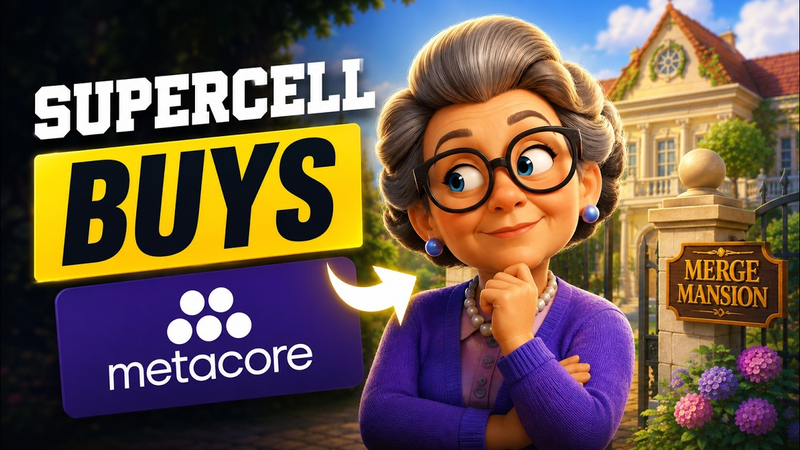
The Truth Behind Supercell’s Metacore Deal
Supercell’s full acquisition of Metacore, the Finnish studio behind the hit title Merge Mansion, marks a significant shift in mobile gaming strategy, transitioning from a growth-oriented venture to a focus on long-term, predictable cash flow.
- Supercell has fully acquired Metacore, the developer of Merge Mansion, to transition the studio from a growth-oriented venture into a model focused on long-term, predictable cash flow.
- The acquisition involves significant restructuring, with up to 70% of Metacore’s 230-person workforce facing layoffs to prioritize profitability and operational efficiency.
- Despite generating approximately $150 million in annual revenue, Metacore struggled with mounting debt and declining revenue-per-head metrics by 2024.

Supercell reboots Mo.co, Fortnite is back on iOS, Nintendo's next mobile game, Embracer, Wooga, more
The mobile gaming industry is currently navigating a period of strategic pivots, legal challenges, and financial recalibration.
- Embracer Group has written down the value of its mobile division—comprising CrazyLabs, A Thinking Ape, and Deca—by $192.4 million following a 57% year-on-year decline in net sales to $244.9 million.
- Supercell has rebooted its monster-hunting title 'Mo.co' with a new season pass structure, though the game continues to rely exclusively on cosmetic monetization, raising concerns about its long-term viability compared to the discontinued 'Squad Busters'.
- Fortnite has returned to the iOS App Store worldwide (excluding Australia), a move Epic Games is using to force transparency regarding Apple's commission structures and fee-related legal challenges.

🚨📢 BREAKING NEWS: Applovin Record Revenue, More Layoffs, EvE online sold back
The gaming industry is currently experiencing a period of significant corporate restructuring, marked by record financial performances for some entities and aggressive downsizing for others.
- AppLovin reported record Q1 revenue of $1.84 billion, a 25% year-over-year increase, while Unity posted a $347 million loss despite a 17% revenue increase to $508 million.
- CCP Games is being sold back to its CEO by Pearl Abyss for $120 million, a significant drop from its $425 million valuation in 2018.
- Supercell acquired Metacore, resulting in a 30% workforce reduction at the studio as part of a strategic shift in the merge-game genre.

TWIG #382: Merge Mansion Falls, Xbox Fires the Wrong People, and the Math That Killed Gaming VC
The gaming industry is undergoing a fundamental structural transition, moving away from the high-growth, venture-backed models of the past decade toward a landscape defined by operational efficiency, asset-focused management, and lean production cycles.
- The gaming industry is shifting from high-growth, venture-backed models to a focus on operational efficiency, fiscal discipline, and long-term cash flow optimization.
- Venture capital investment in gaming has plummeted due to compressed valuation multiples and a shrinking pool of potential acquirers, signaling the end of the mobile free-to-play era's explosive growth.
- Studios are increasingly adopting a 'band model' that utilizes small core teams supplemented by freelancers, outsourcing, and AI to mitigate the rising costs of traditional development.

Supercell buys Metacore amid brutal layoffs, Second Dinner cuts, inside Scopely x Niantic, more
The mobile games industry is currently navigating a period of significant restructuring and strategic consolidation.
- Supercell has acquired Metacore in a deal involving a €180 million investment, resulting in the layoff of 160 staff members—over half the company—as the studio pivots to focus exclusively on Merge Mansion.
- Marvel Snap developer Second Dinner has laid off 16 employees, though the company confirmed that development on its current roadmap and an unannounced second game remain unaffected.
- Scopely and Niantic executives revealed that their partnership, which has significantly improved revenue performance for titles like Pikmin Bloom, involved intense integration efforts and complex technical collaboration.