Transcript
[music]
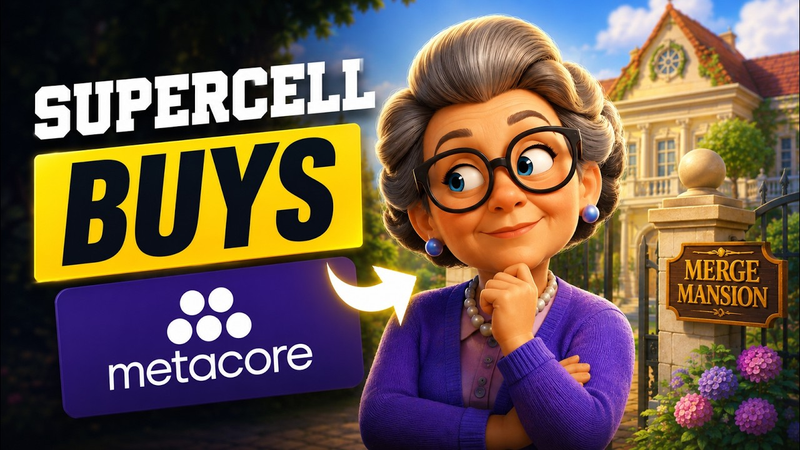
So, let's jump in into the news. I think the biggest one in couple of days has been this news with the title that Supercell to fully acquire Merge Mansion maker Metacore. So, in the news, Supercell bailed out Metacore as the studio goes through massive layoffs with up to 70% of the company's employee possibly being laid off. So, in the Finnish law, you have to inform the people who are under a threat of layoffs. Like it's not set that 70% will be laid off, but up to 70% of the employees could be laid off. So, what we see on the screen are basically the financials of the company. The revenues were above 150 million in 2024. So, the 2025 numbers should be coming in any day now. These are official in Finland every company has to show. The operating profit, as you can see from the dip in 2021 when they went to almost 60 million
minus, grew to about 15 million a year and has been growing quite steadily year over year. They became profitable in 2023 and I assume that they were profitable in 2025. For sure they were in 2023 and 2024. The equity ratio is minus 139. So, they have a lot of debt. And their head count had been growing steadily from the early stages when they launched the game with about 10 people to up to 230 people. It was their head count in 2024 and I assume it kind of stayed in that same level. So, those are the financials of the company. So, turned profitable couple of years ago. This company, Metacore, actually started as an Apple Watch company back in 2015. So, they've been going at it. Five years in, they pivoted to making mobile games and that was a great pivot because they built Merge Mansion and that game essentially invented the whole merge two genre and became an instant smash hit.
2021, Supercell has been investors since the beginning, but in 2021, Supercell gave them unco-horted credit of 180 million to support the scaling of Merge Mansion and that brought Supercell's total investment to Metacore to around 200 million dollars. So, this was in '21, midst of COVID. At the peak in 2023, Metacore ran the celebrity campaigns and they even acquired Supercell's Everdale game, if you guys remember, the sort of 4X heyday.
Kathy Bates, correct.
Exactly. And then they were feeling themselves, they were really confident in their live ops. They acquired Supercell like, let us show you how to run games and turns out in the end that live ops became their actually Achilles' heel. So, by the end of the same year, 2023, they lost the leadership position in the genre they have created. So, that's when Travel Town came in and the company invested massive sums overall into the celebrity ad campaigns, hired
intensively, really tried to catch up to keep their position. They expanded with a studio in Berlin all while the Israeli and the Chinese competitors excelled in live operation and pragmatism and arguably arguably, I don't know, I I don't have the numbers, but I would assume worked more hours than their Finnish counterparts. So, in the slides I just put in here is like you can see the launch of Merge Mansion in in the first one and then the competitors start coming in and they scale faster and faster over Merge Mansion. It's like they have the playbook and Merge Mansion is not growing, but the category is ballooning in revenues because Gossip Harbor is the biggest casual game in in-app purchase. Not the big Is it biggest? But like among the biggest, if not the biggest game at the moment. So, that's my take and Josh, I'm curious, how do you read this? I think it's interesting that install charts tell a slightly different story. You can see through 2024, 2025, you know, downloads
were down. And so, yeah, that it means that they cut UA, right? So, 2024, they were able to generate the 10-15 million in profit off of dramatically lower UA spends. That means that the users that they bought in prior years are still there, but they're not investing in future cohorts anymore. What's also interesting is downloads in March and April of this year, 2026, they were up for what appears to be like over 100% from December. Uh but despite that, revenue is still down year over year. My best guess is that for Metacore, you know, Q1 may have been that final push to find growth before the board just concluded it wasn't possible. CEO himself said that their growth ambitions, you know, didn't materialize as expected. I've had those shitty
meetings before where you decide on a test with the leadership team with, you know, predetermined actions based on the outcome. You scale spends. You watch the cohorts. ROAS doesn't follow. You make the call. It sucks. That's what this looks like to me. And this isn't just what triggered the layoffs. It probably triggered the acquisition. You know, reading the Supercell CEO's quotes, I'm not going to try to say his name cuz I can't say it. He's not saying like, we need to inject fresh capital. He's saying turning it around. He's talking about Supercell's capabilities in live operations and user acquisition. And he's saying scaling it back into a leading position. That's not the language you use if you're bailing somebody out that it's a language that you use when you've decided it's time to take the reins. So, that's my take. If you look at the head count they've effectively they've nearly doubled head count year-over-year and revenue dipped.
So, as a health metric revenue or EBITDA per head has gone down quite dramatically and that's a bad situation from a financial health perspective. I agree with what Josh said as well around the UA side of things. It looks like there was a period they were in the battle. And because of competition CPMs and CPIs have gone up, they probably can't compete at the same sort of unit economics anymore. And it comes down to that that previous year's cohorts cuz the games like this people stay around for a year or, you know, around that. So, you're going to get that halo effect and that shadow. And then it seems like the last 6 to 12 months things have just gone very badly. Microfun have just like rewritten the the playbook on this stuff and they're kind of bringing out a new game after new game and yeah, they're just continuing to grow the town but also cannibalize the remaining players. So, you know, Metacore in this example I think have have just just lost the battle and I don't think they can can afford to
to continue in the same capacity. The CEO just quit. Like what happened? It still makes almost $30 million a month. Like I guess Supercell have decided that they are better at
[snorts]
you know, live operations and and managing, you know, forever games and they'll use the internal capabilities and systems that they already have. And they'll drop OPEX by cutting 70% of the team and they'll double down on EBITDA and profitability. So, essentially what you're saying is Supercell is a majority owner, they own 70% of this company is laying off 70% of the employees and taking in their asset and essentially killing the company. They want their money back. They're doing like 25, 30 million a month, but what's the incremental impact of investing in live operations? Is that moving that needle? What's the incremental impact of investing in UA? Is that moving that needle? I think that we're being told the answer is not right now. Wouldn't you guess if looking at
that head count chart, you would guess that they were a big part of that was new games to develop? Right? That it couldn't have been all on Merge Mansion. They had to have been developing trying to develop the next thing and probably coming to the conclusion that whatever they were working on was not going to be the next big hit. Yeah. And you were only trying to make a big game. They were doing solitaire game, right? The grandma solitaire. But essentially what could have happened is that they had a board meeting and they told the CEO Mika is like, "Listen, man, you've been hitting your head against the wall for long enough. How about we just close your company and take your game?" The company wasn't losing money. That's what I'm trying to say. Like it was actually making money. It was profitable, but it still closed. That was the most confusing thing for me. You know, like a very well-managed game sunset especially if you're starting at a 20 to 30 million dollars a month or whatever it is, like that can
throw off millions and millions in profit over, you know, the next decade if it's really well-managed. And so if they stop looking at Metacore as a growth asset but instead almost like if you're Warren Buffett, like a chain of gas stations cut everything that's not running the, you know, the chain of gas stations and keep that audience fed for as long as possible and add predictable revenue to the Supercell balance sheet, which, you know might make sense in a world where they haven't been in the find the next awesome
is private equity now, essentially.
Yeah, think of it as asset management, right? Like they were looking at this asset, it was under management by Medical and they feel like the asset could be managed better by them. And I as Ethan said over that 10-year period, they believe that they'll have, you know, double digits or triple digits impact on the potential outlook. I'm not saying it's a wrong wrong approach. I'm just trying to explain that this was pretty brutal what
happened. If what happened is that they essentially shut down the company and took their key title. It's smart. Yes, of course, from a business perspective, it's the smartest move and any business person would say this is bold, smart, and just the way you should approach your investment. But from a company image perspective, it's very different than you would assume. Yeah, maybe the Q1 was that bad. Like Q1 we've seen CPIs rising everywhere, like 40% in my own studio. And maybe these, you know, are where they are. And so maybe again it just got even worse this time, you know? Like maybe Q1 was so bad they were like, "Right, this is never going to turn around. We have to do something drastic." We have to close the company and take the game. Very drastic.
[laughter]
Another read on it is that I think Ethan made a good point, where was that head count going? They were building a lot of new games. They weren't succeeding.
And then on the growth side as well, as far as I can see the team was very focused on like new user acquisition, especially last couple of months. If what you're actually saying is actually we're just going to live off this title, what you need is people that do live ops, not new games on the dev side. And what you need people is you could you need people on the UA side that can then run a re-engage portfolio. Not a new user acquisition portfolio. So it may have been that they just had the wrong kind of talent left over. Why do you think Supercell took the game? Like, is this a win or loss or like, what does it do for Supercell? Yeah, another forever game in their portfolio. It compounds with the rest of the catalog. This is like a back cat acquisition that you would see in PC console. You know, the game's making money. You you buy, maximize what it is, and you look on it as long as you can whilst it's making a profit. 100 mil, 100 some into your cash flow.
Exactly, right. Per year. The value of a well ASO'd game with tons of reviews in this mature mobile market cannot be overstated. You know, this could just be a one-off. How do we make the best out of this situation? It could be a sign of Supercell adapting their goalposts to the current market. And maybe thinking, "Hey, not everything has to be a billion-dollar a year game, and actually we'd be really happy with a hundred million dollars a year for the next seven to ten years on a well-managed headcount operating expense. Maybe that's the new Supercell." There were no buyers in the market. Nobody wanted to buy it for whatever price was being asked, and they essentially went to Supercell because they couldn't sell it to anybody else, and they clearly wanted out of the business if they were selling it around. That's another option. So, I don't want to paint a picture that Supercell is
this evil owner. It could be that they saved the company because nobody else wanted it. I've never had a strategic investor, so Mishka, you might know this better than me. Yeah. In a standard strategic investor agreement, do they get like rights of like first refusal and last refusal on acquisition? I don't think there's any kind of standard type of deals, but the why strategic investors are problematic for a VC for any type of a company is because they want you to do really well but not increase your value so that they can buy you before you increase your valuation. So they want you to succeed but just not get expensive. And that is against any kind of a like goal of any kind of a founder because you would assume those two things go hand in hand. So that's typically why you don't want strategic investors and that's why VCs don't want to be in the same cap table with a strategic investor because their goal is opposite from each other. So that's why
VCs would always say, "Hey, don't take strategic not right now." Again, if you're a B2B company, yes, it makes sense, but having one strategic that is just holding you down can be problematic. And they will buy you at a discount, which might have happened here. What about the brand piece, guys? What do we take on that? Because, you know, Supercell has been expanding as a brand business. There's been talks about, you know, Netflix shows and there was also similar rumors about merch mansion becoming like a TV show and Netflix all this stuff and obviously that the brand is quite recognizable like the grand mar all of that stuff has been well developed over the last couple of years. Do we think that again you know, Supercell are thinking this is another brand asset we own the IP now, we can do spin-offs, we can do this, we can do that. Whereas Metal Corp maybe don't have the same resources and and expertise to execute on a multi-faceted approach. I would think they're probably just looking at the cash flow and the Angry Birds of it all. Yeah. Right? Like the
Angry Birds movies work really well. Obviously, Sonic and Mario are monsters. What other games have that sort of cachet to actually be a revenue generating asset at the box office and not like a prestige asset like Arcane. And Fallout for being an amazing TV show might also be a prestige asset more than anything in terms of the TV show. So, like I'm not talking about the transmedia piece. I'm talking about just different genre of games yeah. So, sequels or maybe they want to do a match free with the IP. I don't know. I think we're beating the horse to death like good on good on them. Like whatever happened whether this was Supercell getting a an important acquisition or whether this was Supercell actually saving a company that was looking for an acquirer but couldn't find an exit. I'm sure the founders did well. The valuations were very high so the secondaries must have flown in nicely. I know employees did really well the ones who were early so good on them and most importantly there's ton of talented
people. I know many people who worked in Metacore that are very good. So, hopefully they are able to find their next job whether that is in games which is in trouble especially in Finland or outside games where there's plenty of really cool companies that are most likely in need with a type of a talent that that this company leaves behind.
Auto-generated captions from YouTube — names and numbers may be misheard.




















Comments