indie
CompanyUnited States
Documents about indie
PMP Best Practices for Game Development
The provided text argues that indie game studios often mistakenly reject formal project management methodologies, such as those promoted by the Project Management Institute (PMI), due to a perceived incompatibility between rigid corporate processes and the creative, iterative nature of game development.
- Game studios should adopt project management principles selectively, focusing on the underlying logic of risk, scope, and communication rather than the rigid, bureaucratic documentation associated with the full PMBOK framework.
- Risk management should move from reactive worrying to a proactive habit where teams identify, rate, and document risks—specifically product, scope, funding, people, and technical risks—at the start of every project phase.
- To prevent scope creep, studios should utilize a Work Breakdown Structure (WBS) to map out all necessary deliverables, ensuring that every proposed addition is evaluated against its impact on the project's cost and schedule.
Leadership in Game Development: What It Is and What Its Absence Costs
Effective leadership is a critical, often overlooked component of successful game development, particularly within indie studios.
- Leadership is a discipline of creating conditions for others to succeed, rather than a personality trait or a title-based role, and it must be treated as essential infrastructure for creative work.
- The absence of leadership causes four primary costs: reduced velocity due to poor coordination, lower quality from lack of shared standards, declining morale, and the erosion of team trust.
- Indie studios often suffer because founders view operational structure as a threat to creative independence, leading to a lack of the cadences and behaviors required to sustain high-quality output.
Indie Game Funding: What You're Actually Signing Up For
The primary purpose of this guide is to educate indie game studio founders on the long-term implications of various funding models.
- Funding is not neutral; every source carries specific trade-offs, such as bootstrapping trading speed, grants trading administrative overhead, and equity-based funding trading control.
- Founders must align their studio's ambition—whether boutique, creative, or venture-scale—with the appropriate capital source to avoid long-term conflicts regarding return expectations and time horizons.
- Publisher deals often require recouping the full advance before profit sharing begins, creating significant cash flow risks if the game underperforms.
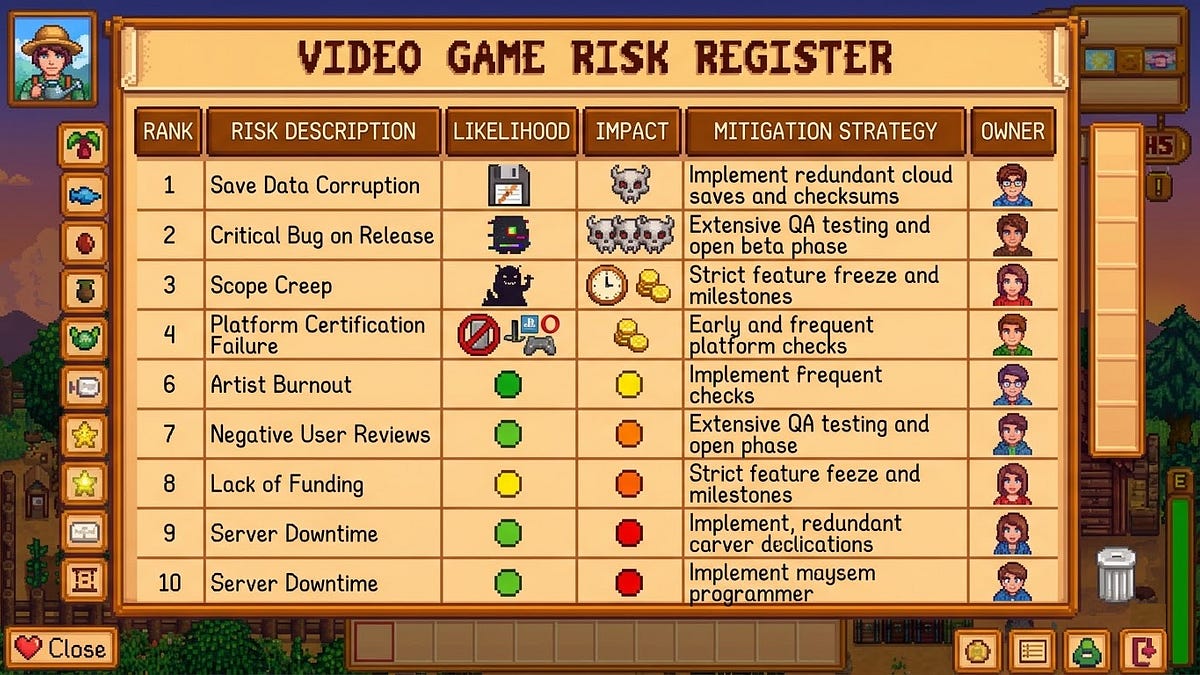
Risk Registers for Indie Game Studios
Small indie game studios often struggle with unmanaged risks that manifest as missed milestones, burnout, and project failure.
- A risk register is a simple, shared document that forces clarity on project uncertainties, preventing them from becoming unmanaged, expensive surprises like missed milestones or burnout.
- To be effective, each risk entry must define five elements: the risk description, likelihood, potential impact, mitigation strategy, and the specific team member assigned as owner.
- Studios should limit their register to five to ten well-defined risks, as an inability to identify the top five is itself a sign of poor project visibility.
Why a Clear Vision Is Your Game’s Secret Weapon
A clear, shared vision serves as the primary operational foundation for indie game studios, preventing the common pitfalls of scope creep, aimless pivoting, and fragmented development.
- A clear game vision is an operational necessity that prevents scope creep, constant pivoting, and morale decline by providing a 'north star' for decision-making.
- Vision should be defined as a concrete, written document covering five areas: the game description, target audience, unique value proposition, creative pillars, and explicit exclusions.
- Founders must distinguish between the intent of the vision, which should be defended, and the execution, which should be adjusted based on playtest feedback.
Hiring for Indie Game Studios: Why Skill Isn't Enough
Small indie game studios often struggle when hiring because they prioritize technical skill over interpersonal and behavioral traits.
- Small indie studios often fail by hiring exclusively for visible technical skills, neglecting the critical need for adaptability and team alignment in high-pressure, ambiguous environments.
- Hiring for 'attitude' should be defined by measurable traits: ownership of outcomes, adaptability to changing project scopes, and high learning velocity, rather than subjective 'culture fit'.
- In teams of 5 to 15 people, individual interpersonal behavior is magnified, making it dangerous to retain high-skill contributors who erode team trust or exhibit toxic behavior.
China Drove Nioh 3’s Promising Start
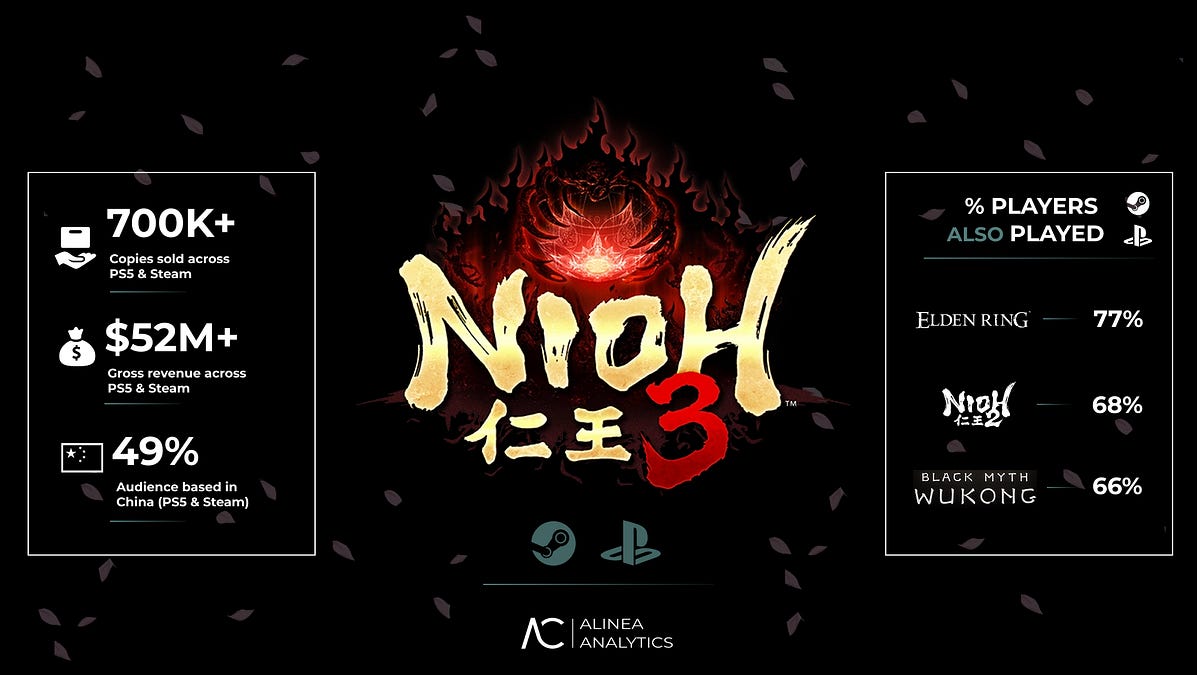
Nioh 3 has achieved a strong commercial launch, recording over 700,000 units sold across PlayStation and Steam within four days of its February 2026 release.
- Nioh 3 sold over 700,000 copies across Steam and PlayStation within four days of its February 6, 2026, launch, generating more than $50 million in gross revenue.
- Steam accounted for 56.1% of Nioh 3 sales (395,000 units), while PlayStation 5 accounted for 43.9% (309,000 units).
- East Asia, including China, Japan, and Taiwan, represents nearly two-thirds of the Nioh 3 player base, with 71.3% of the Steam audience having previously played Black Myth: Wukong.
How LORT Rode the Chaos to a Top 5 Steam Launch in 2026
The analysis examines the successful early 2026 Steam launch of the co-op action roguelite LORT, while contextualizing broader industry trends through the Game Developers Conference (GDC) 2026 State of the Game Industry survey.
- Big Distraction’s co-op roguelite LORT achieved a top-five Steam debut in early 2026, selling 281,000 units within its first two weeks of Early Access.
- The industry is experiencing significant volatility, with 50% of companies conducting layoffs in the last 12 months and 28% of professionals reporting job losses over the past two years.
- LORT’s commercial success was driven by a strategic $10 price point and a low-six-figure investment in targeted influencer marketing campaigns.
DunDev: The Springboard to Success
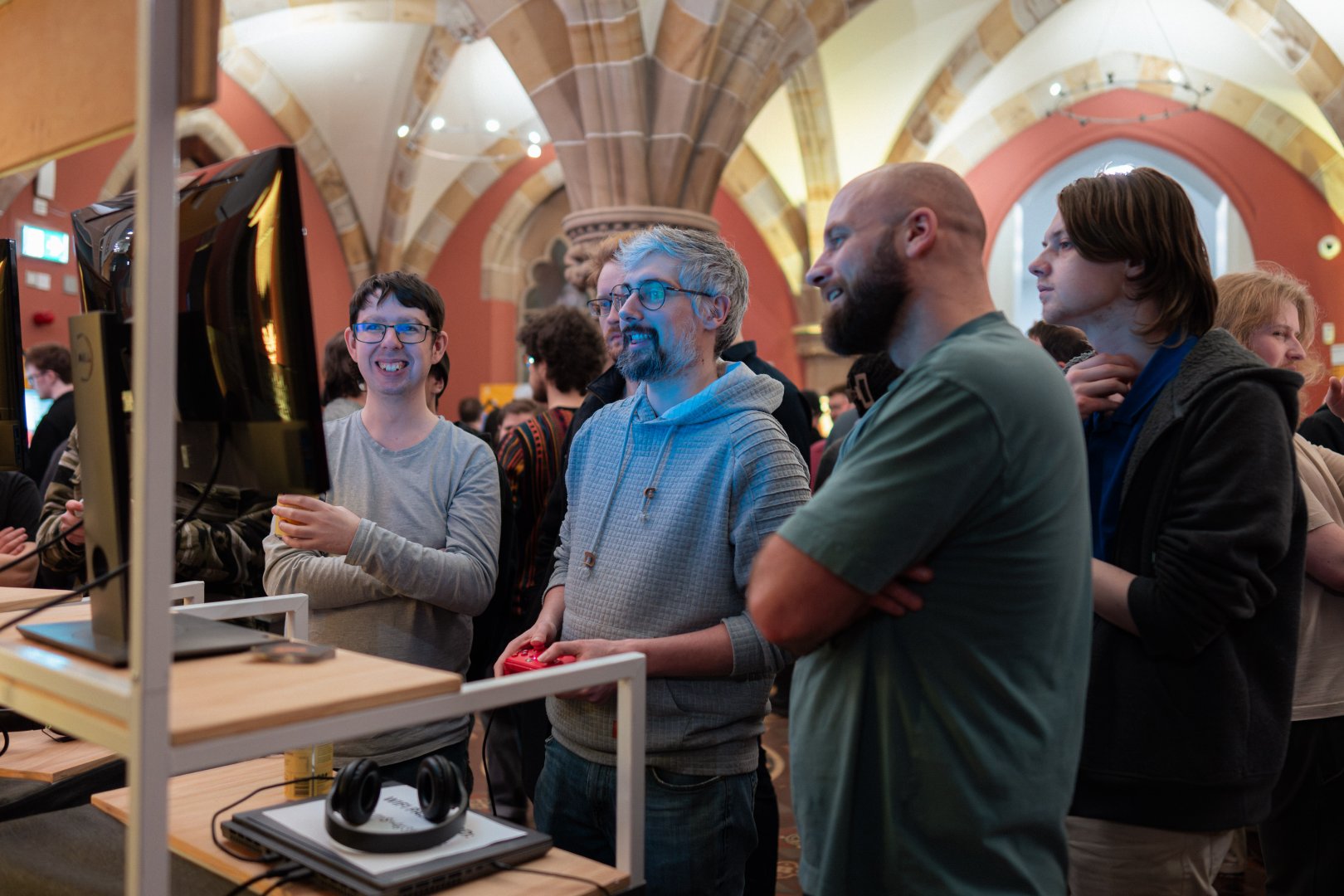
The DunDev residential program serves as a strategic accelerator for early-stage independent game development studios in the United Kingdom.
- The 2026 DunDev residential program provided a four-week intensive accelerator in Dundee for four early-stage UK indie studios: Nostalgicat, Mothlight Studio, MVGIE Studios, and Jardus Games.
- The program curriculum focused on bridging the gap between creative design and commercial viability through mentorship, expert-led workshops, and industry networking.
- Participating studios engaged in public play-testing at Dundee Contemporary Arts and private pitch sessions with publishers to stress-test game concepts and business strategies.
Should You Keep Your Demo Up Post Launch?
The decision to maintain a game demo post-launch is a common point of contention for developers, particularly those working on linear or narrative-driven titles.
- Keeping a demo live post-launch significantly increases average review scores by over 5.5 points (89.83 with demo vs. 84.22 without demo) for games with 1000+ reviews.
- Approximately 21% of successful indie games (those with 1000+ reviews in 2025) still had their demo live post-launch.
- Souls-like games had the highest percentage of post-launch demos, followed by City Builders and Rhythm games at 50%.

Why 'How Many Dudes?' Gets Pre-Release Discovery Right!
The analysis examines effective pre-release discovery strategies in the modern video game industry, using the indie title How Many Dudes? as a primary case study.
- A public Steam demo acted as the primary catalyst for growth, driving over 100,000 wishlists in a single month after reaching 3,000 concurrent users.
- High-concept, viral-ready premises—such as the 'how many people to defeat a gorilla' debate—are essential for breaking through in the saturated 2026 PC and console market.
- Game design should prioritize shareable, streamer-friendly loops, as seen in the autobattler mechanics of 'How Many Dudes?' that facilitate audience participation.

2026 Independent Games Festival Awards Finalists
The 2026 Independent Games Festival Awards finalists highlight the most significant achievements in the global indie development scene, focusing on innovation and creative excellence across various design categories.
- The title 'Baby Steps' leads the 2026 Independent Games Festival Awards with five total nominations, highlighting industry interest in physics-based movement and unconventional narrative design.
- The 2026 Independent Games Festival Awards ceremony is scheduled to take place on March 11, 2026.
- The awards ceremony will be held as a central component of the GDC Festival of Gaming.