Key insights
6 slides
The core finding
Toxicity remains a significant barrier to women's engagement.
51% of all women report negative experiences. This figure spikes to 79% among Gen Z players.
What changed
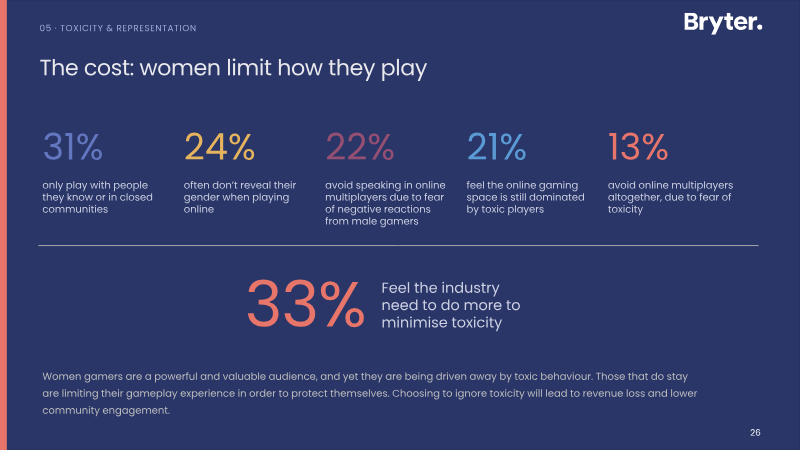
Women hide their gender or opt out of voice chat.
To avoid harassment, many women are actively hiding their gender. They are also opting out of voice chat entirely.
Platform shift
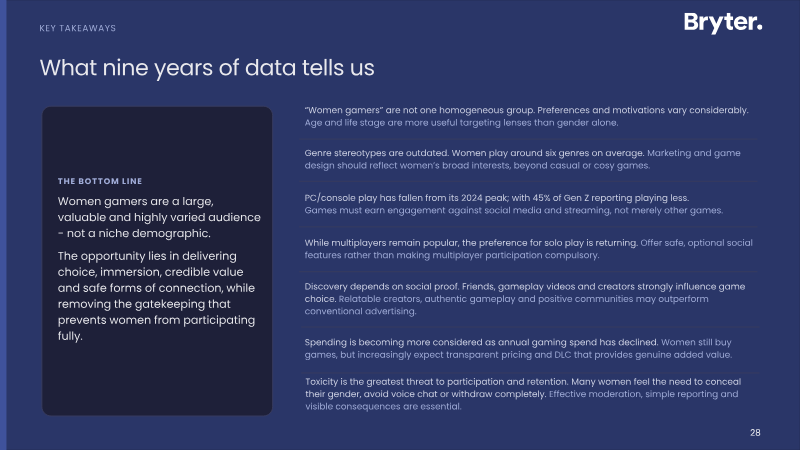
PC and console playtime has plateaued since 2024.
Engagement on PC and console platforms has plateaued since 2024. Gen Z players increasingly prioritize social media over traditional gaming.
Spending caution
Annual gaming expenditure is declining as spending becomes selective.
Consumer spending is becoming more selective, characterized by a decline in annual gaming expenditure. There is also growing skepticism regarding the value proposition of DLC.
Discovery split
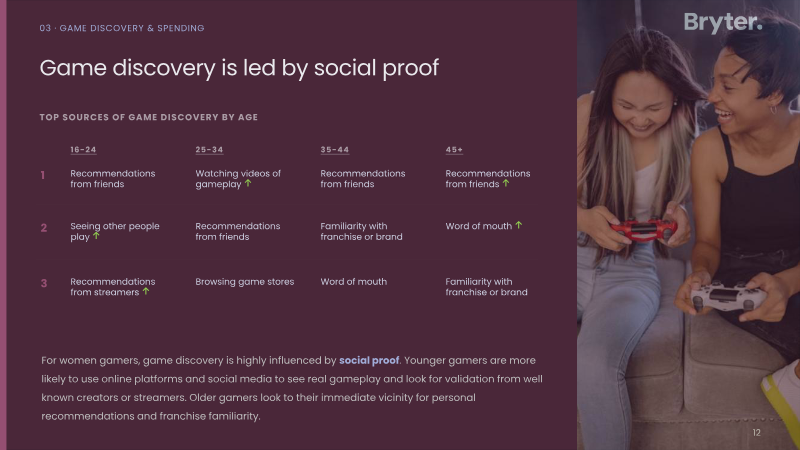
Discovery methods are bifurcated by age among women gamers.
Younger players rely on streamers and creators for social proof. Older demographics prioritize personal recommendations and brand familiarity.
Industry direction
The industry should focus on life-stage motivations and moderation.
The industry is encouraged to move beyond gender-based generalizations. It should focus on life-stage motivations and robust moderation to foster safer environments.
1 / 6
Ask AI about this report