Creative
Company
Documents about Creative

Session: The Future Is Agentic: Unlocking Creative Research With AI - Robert Huynh, Reforged Labs.
The future of mobile game user acquisition (UA) is increasingly agentic, characterized by the integration of artificial intelligence to automate and enhance the labor-intensive process of creative research.
- Reforged Labs utilizes AI-driven creative tagging and semantic search to automate the manual process of analyzing competitor video ads across different networks and geographies.
- AI analysis can identify granular performance drivers, such as specific facial expressions in 'king in peril' ad tropes, which differentiate top 10% performing creatives from the bottom 10%.
- The platform correlates creative elements with internal performance metrics like retention and monetization (e.g., Day 7 metrics) to determine which ad concepts effectively drive user acquisition.
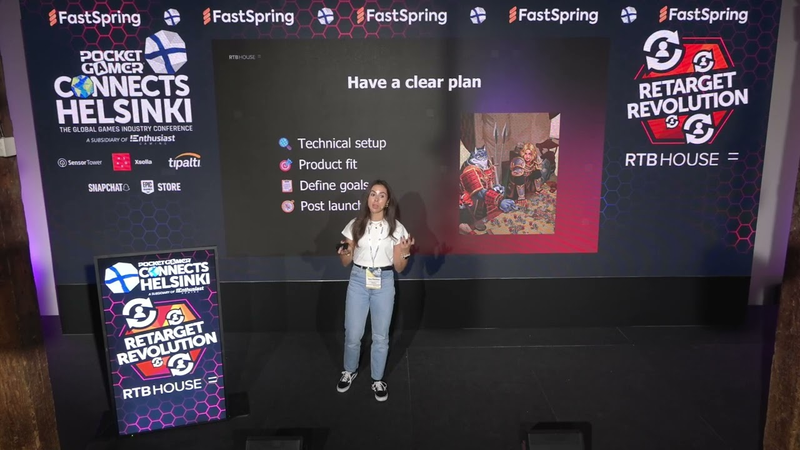
Session: Successful Retargeting - The Essentials -Vera Manhoso, RTB House.
Retargeting serves as a critical, yet underutilized, strategy for mobile gaming studios to combat high user churn.
- User retention is a critical challenge for mobile gaming, as 77% of users are lost within three days of installation and 90% churn before reaching day 30.
- Retargeting campaigns should be segmented into two distinct strategies: retaining recent installs from user acquisition efforts and re-engaging lapsed users who have not played for an extended period.
- Technical readiness for retargeting requires an MMP (Mobile Measuring Partner) integration, consistent tracking of postback events, and a clear data-sharing agreement with partners to ensure user data remains secure and siloed.

📊 Creative Optimization Masterclass: Creative ROI & Scaling Across Networks
The primary objective of modern user acquisition (UA) is to shift focus from vanity metrics, such as install volume and click-through rates, toward creative-level return on investment (ROI) and lifetime value (LTV).
- Shift user acquisition focus from vanity metrics like install volume and click-through rates to creative-level ROI and long-term ROAS.
- Evaluate campaign success based on high-quality user milestones, such as tutorial completion or reaching level 15, rather than cost-per-install (CPI).
- Implement unified dashboards to map creative assets directly to in-app events and revenue data across networks including Facebook, TikTok, Google, AppLovin, and Moloco.

Masters of Publishing 4: One Viral Ad Won’t Save You (Karen Levy, Creative Operations)
Sustainable growth in the hybrid casual gaming sector relies on a sophisticated, data-driven approach to user acquisition that prioritizes long-term retention over short-term traffic spikes.
- Integrating creative teams into the early development process allows for marketability testing that can reduce cost-per-acquisition by 30% to 40%.
- Sustainable growth in hybrid casual gaming requires aligning marketing creative with authentic gameplay to ensure long-term retention and higher lifetime value.
- Successful user acquisition relies on a dual-track methodology that balances high-volume, AI-assisted testing with high-quality production.

TWIG #350 Supercell Leaks! Staff Reveal What’s Really Happening
Supercell currently faces a critical juncture as it struggles to launch a sustainable new hit, relying instead on aggressive user acquisition to revitalize legacy franchises like Clash Royale and Brawl Stars.
- Supercell is struggling to develop sustainable new hits, relying on aggressive user acquisition to maintain legacy titles like Clash Royale and Brawl Stars while internal leadership silos hinder innovation.
- Epic Games plans to integrate direct in-game microtransactions into its Fortnite Creative ecosystem by late 2025 to replicate the Roblox business model.
- The industry is shifting toward gamified betting and predictive markets as primary user acquisition funnels, highlighted by Allwyn’s acquisition of PrizePicks.

📊 Creative Optimization Masterclass: The Secret DNA of winning ads
The primary challenge for user acquisition (UA) managers in the mobile gaming industry is the inability to determine why specific advertisements succeed or fail.
- Transitioning from manual, spreadsheet-based analysis to AI-powered, frame-by-frame creative dissection is essential for identifying the specific drivers of ad performance.
- UA managers can move beyond file-name tracking by tagging creative assets based on granular variables such as tone, format, scene, and character appearance.
- Automated creative optimization allows teams to isolate and compare the effectiveness of specific visual styles and elements to determine what consistently drives conversions.

📊 Creative Optimization Masterclass: All your ads in ONE Dashboard?!
The primary challenge for User Acquisition (UA) managers in the mobile gaming industry is the fragmentation of performance data across multiple advertising networks, such as Meta, Google, TikTok, and AppLovin.
- Unifying performance data from Meta, Google, TikTok, and AppLovin into a single dashboard eliminates operational friction caused by disparate naming conventions and inconsistent reporting metrics.
- Automated creative optimization tools group assets by visual similarity, allowing for accurate performance tracking across networks and regions regardless of inconsistent file naming.
- Centralized dashboards enable real-time monitoring of key performance indicators, including CTR, CPI, and ROAS, from day zero through day 30 across all geographic markets.

🤯 Creative trends July 2025: Jonas Brothers, LEGO + Gucci in Mobile Ads? Yes, Really.
The mobile gaming industry in July 2025 is defined by a hyper-aggressive, scale-at-all-costs approach to user acquisition.
- Major publishers like iKame are achieving annual run rates exceeding $200 million by prioritizing high-volume, AI-driven creative experimentation over traditional production standards.
- The mobile gaming industry is shifting toward a model where success is defined by the ability to scale aggressive, high-frequency ad formats rather than original intellectual property or technical polish.
- Publishers are increasingly utilizing controversial and bizarre hooks—such as 'childhood trauma' tests, bait-and-switch tactics, and ASMR puzzles—to maximize immediate user engagement.

State of the Brutally Honest UA by Matej Lancaric
The 2025 user acquisition landscape is defined by a fundamental shift toward creative-led strategies, where the ability to produce high-volume, iterative content determines market success.
- Creative production is now the primary driver of UA performance, requiring teams to generate at least five new videos per week to combat rapid audience fatigue.
- 68% of industry professionals now utilize AI for tasks including scriptwriting, thumbnail optimization, and the generation of synthetic user-generated content.
- The UA manager role has fundamentally shifted from manual campaign administration to a hybrid function focused on creative prompt engineering and data analysis.
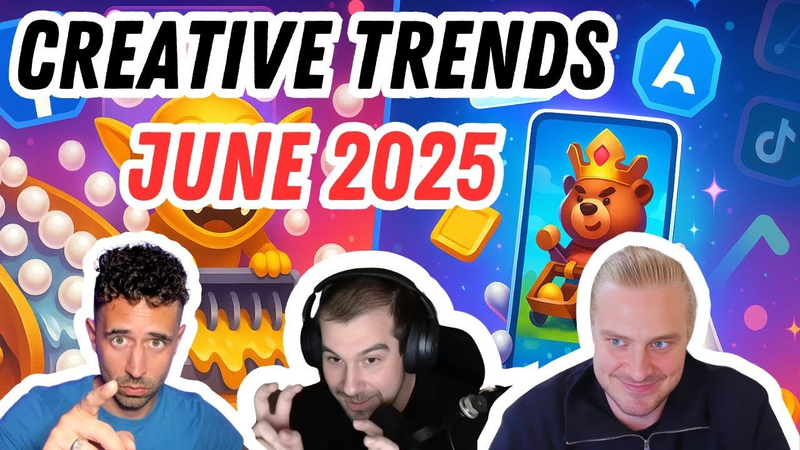
🎬 Creative Trends June 2025: Why AI, ASMR & Copy-Paste Are Redefining Mobile Ads
The mobile gaming advertising landscape in mid-2025 is defined by a strategic shift toward long-form video content and the aggressive iteration of proven creative concepts.
- Mobile gaming ads are shifting toward long-form content ranging from 50 seconds to five minutes to improve user pre-qualification and secure better auction placement.
- AI tools like Topaz AI are now the primary engine for mobile ad production, enabling rapid generation and upscaling of assets to mimic user-generated content styles.
- Developers are increasingly utilizing a 'copy-paste' strategy by re-skinning proven mechanics like resource management and character-saving puzzles to minimize innovation risk.

MAU'25 Live Special: The Bold New Era of Rewarded Gaming & UA in 2025
The rewarded gaming landscape is undergoing a significant transformation as platforms transition from traditional Android-centric models to more complex, multi-platform ecosystems.
- Rewarded gaming strategy for 2025 is shifting from Android-centric models to iOS expansion, requiring a move away from last-touch attribution toward rigorous incrementality testing.
- Measurement frameworks now rely on a triangulation strategy that combines last-touch data with causal incrementality testing and self-reported user insights to validate growth.
- Successful geographic expansion, particularly in competitive markets like South Korea, now mandates deep culturalization through local staffing and region-specific reward structures.

🔥 The Art of Scaling Applovin UA & Admon: A Deep dive
AppLovin’s Axon 2 algorithm represents a fundamental shift in user acquisition, moving away from manual optimization toward a sophisticated, data-driven black box model.
- AppLovin’s Axon 2 algorithm functions as a black box that requires stable data inputs; changing ROAS goals every 2–3 days prevents the system from calibrating, as it forces the algorithm to constantly re-target different user segments.
- For IAP-based games, D28 ROAS campaigns are recommended over shorter windows because they yield higher-quality, higher-retention users, even if initial D0 metrics appear significantly lower.
- Campaigns require a minimum of 10–14 days to calibrate on a specific ROAS goal before any adjustments should be made to the target.