Reports in the Country & Regional Reports category.
Mobile game downloads across Southeast Asia grew by 3.4 % in the first half of 2024, reaching 4.2 billion installs, with Google Play accounting for 91 % of the volume. In‑app purchase revenue rose by 3.4 % to $1.16 billion, a slight decline of 3 % from the previous half‑year; Google Play contributed 57 % of total revenue. From January to August, mid‑core genres such as simulation, arcade, puzzle and lifestyle led download growth (11 %–14 %), while sports titles experienced a 39 % revenue surge, representing 9 % of total IAP income. Strategy and RPG games dominated downloads (47 %) but saw modest revenue declines of 3 %–9 %.
Indonesia remains the largest market, with a 10 % download increase and 41 % of regional downloads; Thailand follows as the highest‑earning country, adding $400 million in revenue. The top ten download leaders are dominated by Garena Free Fire, Mobile Legends: Bang Bang and Roblox, with Garena Free Fire maintaining a 54 % growth rate. In revenue terms, Mobile Legends: Bang Bang leads with $1.16 billion, followed by eFootball™ 2024 and Garena Free Fire; Roblox and Coin Master also show strong growth, with Roblox’s revenue rising 90 %.
The case study of Honor of Kings illustrates rapid penetration after its Southeast Asian launch in June 2024, achieving a 175 % month‑over‑month spike in Indonesia and capturing the top download spot in July. By August, Honor of Kings generated $1.7 billion in IAP revenue for the period and accounted for 51 % of its global downloads from Indonesia alone. The report relies on Sensor Tower’s estimated download and IAP data from the App Store and Google Play, excluding pre‑installs, duplicate downloads, ad revenue, third‑party sales, and direct developer payments.
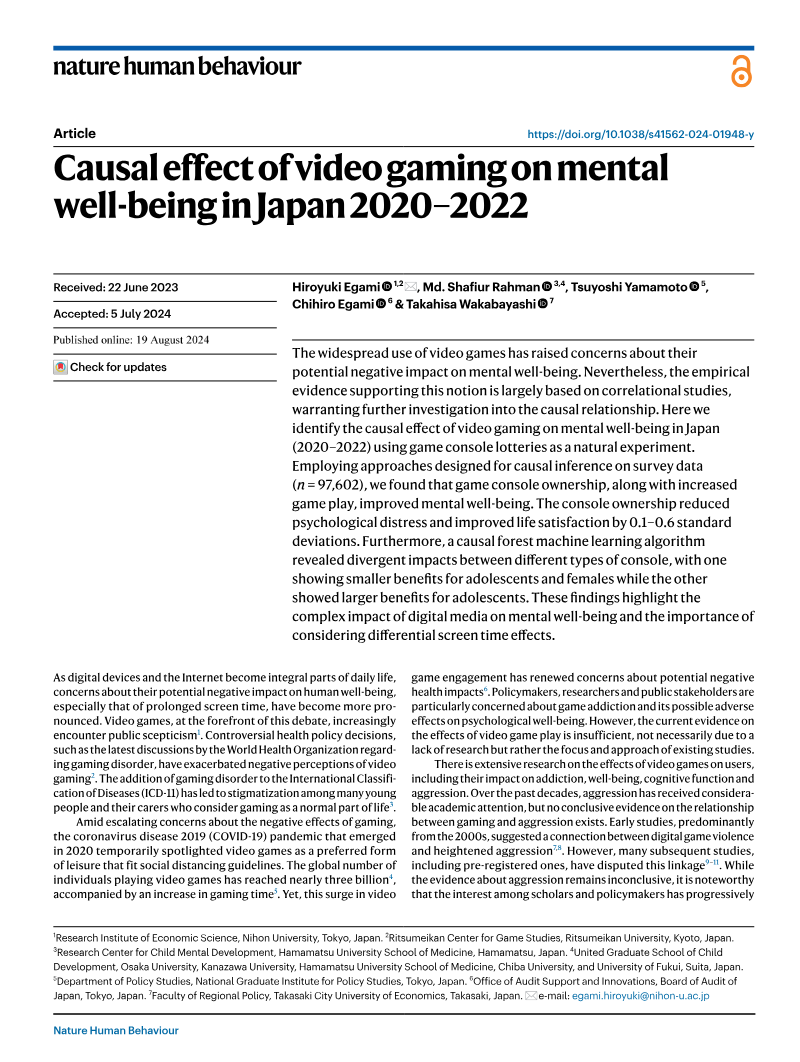
Evidence from a natural experiment conducted in Japan between 2020 and 2022 demonstrates that video game ownership and increased play time exert a positive causal influence on mental well-being and life satisfaction. By leveraging the unique lottery-based distribution of gaming consoles during pandemic-related supply shortages, researchers analyzed data from over 97,000 respondents to isolate the effects of gaming from self-selection bias. The findings indicate that winning a console lottery reduced psychological distress by 0.1 to 0.6 standard deviations, directly challenging traditional correlational studies that often associate gaming with negative mental health outcomes.
The magnitude of these psychological benefits varies significantly across different demographic groups and hardware platforms. Machine learning analysis reveals that the Nintendo Switch offers more pronounced well-being improvements for adolescents and female users, whereas the PlayStation 5 provides stronger positive effects for adult males and dedicated gamers. While the overall impact of gaming remains positive, the data suggests a threshold of diminishing returns, as the benefits to mental health and life satisfaction begin to decline after three hours of daily play.
The scope of this research is specifically focused on the Japanese market during the COVID-19 pandemic, a period characterized by heightened social isolation and restricted physical activity. These environmental factors may have amplified the observed positive effects, as gaming served as a primary tool for digital engagement and stress mitigation. Despite these contextual considerations, the use of instrumental variable causal forests and propensity score matching provides a rigorous statistical foundation for the conclusion that moderate video game consumption serves as an effective intervention for improving psychological health.
The 2023 Serbian gaming industry assessment quantifies the sector’s rapid expansion, maps its ecosystem, and evaluates the conditions shaping future growth. Drawing on a 97‑question survey that reached 80 % of the domestic ecosystem and validated financial data for the 21 leading firms, the analysis establishes a clear upward trajectory for Serbia’s game development landscape.
Total industry revenue reached €175 million, a 17 % year‑on‑year increase, while the workforce nearly doubled to roughly 4,300 professionals. The market now hosts 38 active studios producing 81 titles, with mobile‑first games still dominant but ceding share to core and original‑IP projects. Talent inflows from Russia, Ukraine and Belarus, together with 70 % of respondents expressing optimism, underpin this momentum, and a quarter of companies are planning foreign offices despite lingering concerns over tax incentives and regulatory red tape.
The ecosystem comprises more than 140 companies and over 500 regional stakeholders, featuring high‑profile successes such as Foxy Voxel’s “Going Medieval” (850 k+ copies), GameBiz Consulting’s $250 million revenue from 80+ global studios, Onyx Studio’s 57 million monthly players, and Sozap’s NASDAQ listing with 30 million downloads. Collaborative ties with DICE/EA, Microsoft, Google and Epic Games, alongside mentoring programmes, Gamescom exposure, and the Shift2Games and Playing Narratives initiatives, reinforce Serbia’s emergence as a European development hub. At the same time, the rollout of generative‑AI tools raises IP, privacy and deep‑fake risks, prompting EU‑wide regulatory scrutiny.
Overall, the sector is maturing into a diversified, internationally connected hub with strong growth prospects. Realising its potential will require addressing regulatory and fiscal barriers, leveraging AI responsibly, and sustaining education and mentorship programmes that nurture talent and support SMEs in scaling their operations.
The U.S. video game industry has evolved into a mainstream, multigenerational pastime that encompasses 190.6 million weekly players. Findings indicate that 61% of the American population plays at least one hour of video games per week. The demographic profile of the average player has shifted significantly over the last two decades; the average age is now 36, compared to 29 in 2004. This aging player base has fostered a strong culture of family gaming, with 83% of gaming parents playing alongside their children to strengthen bonds and improve communication.
Technological advancements have fundamentally altered how and where Americans engage with games. Mobile devices are now the primary platform, used by 78% of players, a dramatic increase from 33% in 2012. Furthermore, the rise of internet connectivity has transformed gaming into a social hub, with 88% of players engaging in online gameplay and 72% agreeing that video games create a sense of community. Beyond entertainment, players report significant mental health and cognitive benefits, with over 75% of adults agreeing that games provide stress relief, mental stimulation, and joy.
Economically, the industry remains a powerhouse, contributing nearly $66 billion to the U.S. GDP in 2023 and supporting over $101 billion in total economic impact. Total consumer spending reached $57.2 billion during the same period. The data, gathered by YouGov via a survey of 5,000 respondents and supplemented by qualitative ethnography, highlights that 63% of players view video games as providing the highest value for their money compared to other entertainment media. This comprehensive look at the 2023-2024 landscape confirms that video games are an inclusive, essential component of American social and economic life.
The study investigates the emerging video‑game ecosystem in West Africa, focusing on Senegal, Côte d’Ivoire and Cameroon, to assess current player demographics, awareness of locally produced titles, and the factors shaping market potential. By surveying 785 gamers between July and August 2023, the research aims to inform development initiatives such as the Game Hub Senegal incubator, which seeks to nurture talent, provide mentorship and financing, and foster a community around African‑themed games.
Findings reveal a heavily male‑skewed player base—approximately 80 % men—and a concentration of respondents aged 19‑25, who together account for roughly 45 % of participants in each country. Android devices dominate, with over 80 % of gamers using this platform, and most players engage in one to two sessions per day. Despite this activity, exposure to African‑origin games is minimal: 60‑66 % of respondents have never played a locally developed title, and more than 82 % report never having heard of such games. Among the few who have, evaluations are generally positive, describing the experiences as “good” or better.
Motivations for playing centre on “challenges and evolution,” cited by about 37 % of respondents, followed by social interaction with friends (16 %) and graphics quality (8 %). Financial barriers are pronounced; roughly 51 % lack a bank card, limiting their ability to spend on games. For those who do make purchases, the primary drivers are acquiring the game itself (≈ 42 %) and unlocking new levels (≈ 18 %).
Overall, the data suggest that while payment infrastructure and awareness of African‑produced games constrain current consumption, the region’s youthful, mobile‑centric audience and strong appetite for challenging content position the market for rapid expansion in the near term.
The analysis presents a forward‑looking assessment of the global gaming market with a particular focus on the MENAP region, outlining the strategic opportunities that are reshaping the industry in 2024 and beyond. Central to the outlook is the rapid convergence of emerging technologies—virtual reality, artificial intelligence, mobile platforms, quantum computing, GPU‑as‑a‑Service, and cloud gaming—which together are accelerating content creation, distribution, and consumption across diverse consumer bases.
Investment activity is framed around a thesis that prioritises three core pillars: high‑value content and intellectual property, software efficiency solutions that lower development costs, and user‑generated‑content ecosystems that drive engagement and monetisation. Funding targets range from pre‑seed to Series A rounds, with typical ticket sizes of $1 million to $8 million, reflecting confidence in early‑stage ventures that can capitalize on the identified technology trends. The outreach strategy includes participation in high‑profile events such as the World Gaming Conference in Abu Dhabi (15‑16 February) and LEAP 2024 in Riyadh (4‑7 March), complemented by a dedicated “Gaming Investor” newsletter, a GameON podcast, and sponsorship opportunities for research partners.
Overall, the findings underscore a vibrant growth trajectory for gaming in both established and emerging markets, driven by technological innovation and a robust pipeline of investable startups. Stakeholders are encouraged to engage through subscription services, collaborative research, and direct investment to capture value in this rapidly evolving sector.
This analysis examines the state of the global and MENAP (Middle East, North Africa, and Pakistan) gaming sectors during the third quarter of 2023. The primary thesis suggests that while the global industry is undergoing a period of "cautious recalibration" characterized by significant layoffs and a shift toward profitability, the MENAP region remains a resilient growth outlier. The scope covers global investment trends, game engine pricing shifts, and emerging market demographics, with specific deep dives into the Egyptian and Jordanian markets.
Key findings indicate that the global gaming market exceeded $250 billion with a 9.9% CAGR, yet Q3 2023 saw over 2,000 industry layoffs driven by M&A activity and a focus on operational efficiency. Despite these global headwinds, the MENA region grew by 6.9% year-over-year, reaching a market size of $5 billion. This growth is fueled by a youthful demographic where 70% of the population is under 30. In Egypt, the largest regional market by population, 60% of top-performing games are casual or hyper-casual, though a significant challenge remains as 40% of gamers are unbanked, necessitating innovation in fintech and alternative payment infrastructures.
The investment landscape shows a return to pre-pandemic levels, with $454 million in global venture capital secured in Q3, primarily in early-stage deals. Asia led transaction volume with 39 deals, while Jordan emerged as a regional leader in funding, securing 30% of MENA deals. The report concludes that the future of the industry will be defined by the integration of Generative AI—expected to impact over 50% of the development process within a decade—and a strategic pivot toward emerging markets to offset rising talent costs in Western territories. Methodology relies on data from partners including AppMagic and Konvoy, alongside internal venture capital tracking.
The analysis quantifies the scale and momentum of the worldwide gaming ecosystem while spotlighting the rapid evolution of the MENAP (Middle East, North Africa, and Pakistan) mobile‑gaming sector. Globally, the market is valued at roughly $201 billion, expanding 9 percent year‑over‑year, with PC and console platforms together contributing about 40 percent of total revenue. Mobile gaming dominates the growth narrative, as 2021 recorded 232 billion downloads and $168 billion in consumer spending, underscoring its central role in the industry’s expansion.
Within MENAP, mobile adoption has entered a maturation phase. In‑app‑purchase revenue reached $374 million in 2023, and advertising expenditures surged, climbing 33 percent to a level that now represents 247 percent of a prior benchmark, indicating a pronounced shift toward ad‑supported monetisation. These figures illustrate both heightened consumer engagement and an increasingly sophisticated revenue mix in the region.
The report also introduces SHFT, Shorooq’s advanced gametech platform, which operationalises a partnership‑investment model designed to accelerate studio growth across MENAP. Since launch, SHFT has assembled a network of 27 partner studios that have delivered approximately 150 titles, while its dedicated gametech fund has allocated about $15 million in financing. The platform delivers comprehensive services—including data‑analytics dashboards, reporting tools, capital provision, and market‑entry assistance—aimed at enhancing commercial outcomes for developers in the region. Collectively, these insights affirm the global market’s robust health, the MENAP region’s accelerating mobile‑gaming trajectory, and the strategic value of integrated gametech solutions in fostering sustainable industry development.
Japan is rapidly evolving from a video game superpower into a significant esports market, overcoming historical regulatory and cultural hurdles. While the country previously lagged behind China and South Korea due to strict anti-gambling laws that capped prize pools and a lack of domestic titles in popular esports genres like MOBAs, recent policy shifts have transformed the landscape. Following the 2019 removal of most legal restrictions and the formation of the Japan Esports Union (JeSU), the market grew by 11% to reach $77 million in 2022.
The ecosystem is characterized by a unique "watching but not playing" culture, where livestreaming and content creation drive engagement among both gamers and non-gamers. This has led to the rise of prominent organizations such as Crazy Raccoon, DetonatioN FocusMe, FENNEL, SCARZ, and ZETA DIVISION. These teams increasingly operate as lifestyle brands, generating revenue through traditional sponsorships, merchandise, and specialized content partnerships. Notably, non-endemic brands like Nissin Foods have entered the space, with sponsorship fees reportedly increasing tenfold over the last five years.
Despite this momentum, the industry faces challenges, including a "Galapagos syndrome" where domestic game preferences differ from global trends, and a power imbalance where publishers maintain strict control over tournament formats. However, the outlook remains optimistic. Industry leaders anticipate further consolidation and professionalization, mirroring the evolution seen in Western markets a decade ago. As teams seek international expansion and venture capital, Japan is positioned to become a major hub for esports talent and tourism in Asia.
The Middle East and North Africa (MENA) gaming market is experiencing a period of rapid expansion, characterized by significant government investment, a growing base of digital natives, and an increasing emphasis on cultural localization. As of 2022, the MENA-3 region—comprising Saudi Arabia, the United Arab Emirates, and Egypt—generated $1.8 billion in revenue and supported 67.4 million gamers. This growth is underpinned by a strong mobile-first ecosystem and a burgeoning esports sector that benefits from high engagement rates and substantial public sector backing, most notably through Saudi Arabia’s National Gaming and Esports Strategy.
The industry’s trajectory is heavily influenced by the necessity of localized content. Data indicates that 86.6% of regional gamers prioritize language localization, and successful titles like PUBG Mobile have demonstrated that integrating regional celebrities, cultural themes, and Arabic-language support is essential for market penetration. Beyond content, the region is actively fostering a domestic development pipeline through workforce training, educational initiatives, and high-profile mergers and acquisitions, such as those led by the Savvy Games Group. These efforts aim to transition the region from a consumer market into a global hub for game development and esports.
Esports serves as a primary driver of engagement, with 73% of regional gamers participating in competitive gaming. The rise of local influencers and streamers, coupled with massive prize pools and the development of dedicated infrastructure like esports cities, has created a self-sustaining cycle of fan engagement and corporate sponsorship. Furthermore, the market is increasingly viewed as a strategic partner for international firms, particularly those from China, which have successfully utilized the region as a growth market. By leveraging social gaming trends—where voice chat and online socialization are central to the player experience—and prioritizing gender-inclusive gaming spaces, the MENA region is positioning itself as a significant, high-growth player in the global gaming landscape.
The bulletin delivers a data‑driven assessment of the five most influential mobile game genres in Asia and MENA for 2022, combining a 9,000‑respondent survey from Niko Partners with AppMagic’s analytics of Apple and Google Play stores. The analysis covers China, India, Indonesia, Japan, Korea, Malaysia, Philippines, Saudi Arabia, Singapore, Thailand, UAE, Vietnam and Egypt, providing a comprehensive view of regional spending patterns, download volumes, and player demographics.
RPGs dominate the market, generating 50 % more revenue than the other four genres combined and achieving the highest monetization score (7.7) thanks to strong spend in East Asia. Strategy games rank second in revenue and third in downloads, yet exhibit the lowest engagement score (5.2) due to shorter play sessions and lower player longevity. MOBAs deliver the second‑highest revenue per download (5.4) and lead in average weekly playtime, but their esports engagement is modest. Puzzle titles enjoy the largest download base (highest engagement score of 6.0) but suffer from low monetization and esports relevance. Battle Royale games, while generating the lowest total revenue, excel in esports metrics (score 9.5) and maintain high engagement levels.
The methodology blends survey‑derived player profiles with AppMagic’s download, revenue, and esports viewership data across 21 metrics, weighted into four categories—monetization, engagement, esports appeal, and overall genre score. The resulting scores (1–10) rank RPG as the top genre overall, with Battle Royale leading in esports influence and Puzzle offering the broadest download reach. The bulletin concludes that developers targeting these markets should tailor monetization strategies to RPG’s high spend, leverage MOBAs’ loyal user base, and capitalize on Battle Royale’s esports traction.
The report argues that the MENAP region is poised to become a major hub for gaming, driven by rapid mobile‑gaming adoption, esports growth and an expanding local startup ecosystem. It identifies talent development, IP creation and cross‑industry collaboration as key levers for sustained expansion, while noting challenges such as technical upskilling, content localisation and stakeholder coordination.
Globally, the gaming market is shifting toward cloud‑based development and AI‑powered tools, with 68 % of studios already using AWS for Games and a projected $7.1 bn market by 2032. Generative AI is expected to reach a $7.1 bn valuation in gaming by 2032, growing at 23.3% CAGR, and private deals now account for 68 % of total investment activity. In MENAP, the market is projected to hit $2.8 bn by 2026 at a 10% CAGR, underpinned by mobile adoption and esports expansion.
Mobile‑first development dominates, with 70 % of developers prioritising data analytics and 50 % investing in AI tools. In‑app purchases, advertising and subscriptions drive revenue, with IAP rising 28 % YoY to $374.1 million and ad revenue up 6.1%. Platform shifts such as iOS SKAN 4.0 and Android privacy changes are reshaping monetisation strategies, while cloud‑gaming infrastructure is projected to grow 250 % by 2030.
Investment flows reflect these trends: seed‑stage funding in MENAP has reached $15 million across 20+ startups, and international firms target the region for free‑to‑play and Web3 opportunities. Funds like SHFT’s $15 million Gametech Fund aim to provide capital, expertise and networking to help local studios compete globally. The overall outlook indicates a 6.1% YoY revenue growth for global and MENAP gaming, with a 15 % rise in mobile gaming and a 43 % share captured by platform‑based titles.