Reports in the Country & Regional Reports category.
India’s mobile‑gaming ecosystem is experiencing rapid expansion, with a projected market value of $8.6 billion by 2027 and more than 600 million active users. Growth is fueled by affordable smartphones, low data costs, and a pandemic‑accelerated surge in casual, hyper‑casual, and real‑money titles. Install rates spiked up to 90 % during lockdowns, while in‑app purchase revenue is expected to reach $284 billion by 2026. To sustain this momentum, brands must deploy comprehensive customer‑engagement platforms that provide real‑time analytics, segmentation, and personalized push campaigns to enhance retention and monetization.
Push notifications and in‑app messaging prove critical for user engagement. Data shows a 3.34 % click‑through rate and up to 91 % delivery success for push alerts, while in‑app campaigns achieve 15–44 % conversion rates and a 38 % average on one million impressions. Segmentation techniques such as RFM, affinity profiling, and predictive AI models (e.g., Sherpa) enable targeted, omnichannel flows that reduce churn and lower acquisition costs—new customers cost five times more than retaining existing ones. App Store Optimization tools like AppTweak further amplify visibility; for instance, RummyCircle’s keyword strategy increased visibility by 14.2 % and drove a 200,000‑download spike after A/B testing.
Despite the market’s growth, brands face declining installs, stickiness, and revenue. The solution lies in data‑driven engagement: hyper‑personalized messaging powered by AI unlocks deeper customer insights, improves retention, and provides a competitive advantage. Platforms such as MoEngage, already trusted by Fortune 500 and internet‑first brands worldwide, offer the scalability required for publishers to thrive in India’s dynamic mobile‑gaming landscape.
This analysis provides a comprehensive overview of the European video game sector in 2023, detailing market health, player demographics, and regulatory priorities. The industry demonstrated resilience with annual revenues reaching €25.7 billion, representing a 5% year-on-year increase. Employment also saw significant growth, with the workforce expanding by nearly 7% to reach approximately 115,000 people across Europe.
The data reveals that video games are a mainstream cultural fixture, with 53% of the European population aged 6–64 identifying as players. Contrary to youth-centric stereotypes, the average player age is 31.4 years, and 75% of the gaming population are adults. Women represent 43.5% of the total player base, averaging 6.7 hours of play per week. While smartphones remain the most popular platform (68%), consoles (56%) and PCs (46%) maintain significant engagement. Despite the rise of digital media, average weekly playtime has remained stable for over a decade at approximately 8.9 hours.
A central thesis of the findings is the industry’s commitment to social responsibility and self-regulation. The Pan European Game Information (PEGI) system celebrated 20 years of operation, with 79% of parents aware of its ratings and 62% actively using parental tools to manage gameplay. Furthermore, the industry is increasingly focused on sustainability and diversity, noting that 44% of new hires in regions like Sweden are women and highlighting energy-saving agreements that have saved 54 TWh of electricity over the lifetime of major consoles.
The geographic scope covers the European Union and broader European markets, utilizing data from Ipsos, GameTrack, and Games Sales Data (GSD). Methodology includes online polling of 60,000 individuals across major markets, calibrated by nationally representative face-to-face surveys. Looking forward, the industry advocates for EU policy that recognizes video games as unique creative works, supports a robust talent pipeline through STEAM education, and maintains a fair regulatory framework that avoids distorting the single market.
The Australian Game Development Survey: FY2023 Industry Snapshot reveals a sector experiencing significant maturation and financial expansion. During the 2023 fiscal year, the local industry generated $345.5 million in revenue, marking a 21% increase over the previous year. This growth is mirrored in the workforce, which expanded by 17% to reach 2,458 full-time equivalent employees. The industry remains heavily export-oriented, with 87% of revenue derived from markets outside of Australia.
The data indicates a diverse ecosystem where 32% of studios have operated for over a decade, while 45% are relatively new, having existed for five years or less. Despite the presence of established firms, the sector is primarily composed of small businesses, with 79% of studios employing fewer than 20 people. Geographically, Victoria remains the primary hub, accounting for 29% of studios and 41% of the total workforce. Diversity metrics show a shift in the labor force, with women representing 26% of employees and gender-diverse individuals making up 5%.
Conducted by Bond University on behalf of the Interactive Games & Entertainment Association (IGEA), the survey gathered voluntary data from 111 Australian development studios between September and November 2023. The findings suggest that growth is heavily underpinned by government support, such as the Digital Games Tax Offset (DGTO) and state-level rebates, with 49% of respondents receiving some form of government funding.
While 68% of studios predict continued income growth, the industry faces notable headwinds. The primary challenges identified include difficulty hiring staff with specialized skills, attracting early-stage development funding, and securing international publishing deals amidst tightening global economic conditions. Nevertheless, the sector maintains a cautiously optimistic outlook, with 63% of studios planning to hire additional staff in the coming year.
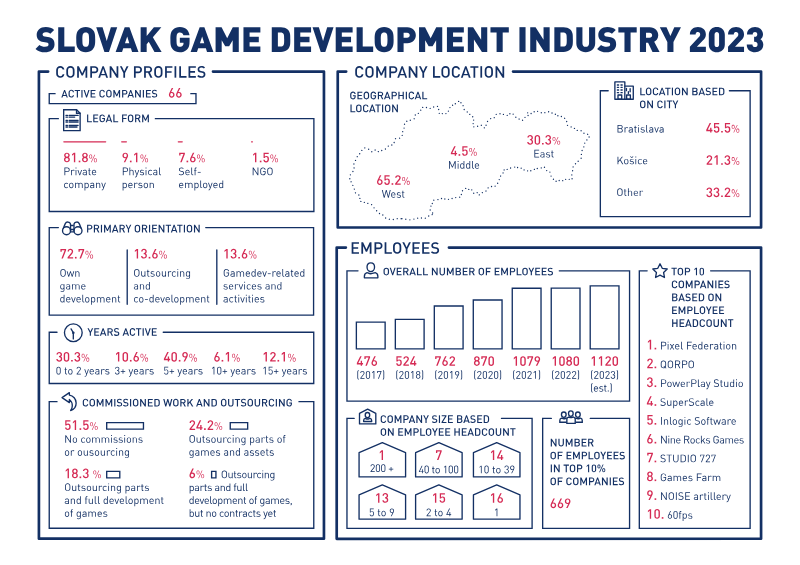
The Slovak game development industry in 2023 is characterized by a stable ecosystem of 66 active companies, primarily concentrated in the western region of the country. The sector is dominated by private entities, with 72.7% focusing on core game development and the remainder providing outsourcing or specialized services. While the industry features a mix of experience levels, over 40% of companies have been active for more than five years. The workforce has seen consistent growth, rising from 476 employees in 2017 to an estimated 1,120 in 2023. However, the industry exhibits significant centralization, with the top 10% of companies employing approximately 60% of the total workforce and generating 84.6% of the annual turnover.
Financial data indicates a mature but plateauing market, with an overall turnover of €77.1 million in 2022 and a nearly identical estimate of €76.9 million for 2023. Pixel Federation, SuperScale, and Inlogic Software lead the market in both headcount and revenue. Development is largely self-funded, though 37.9% of companies utilize public funding. PC remains the primary target platform for development, followed by mobile and consoles. Notably, half of all projects remain unpublished, while those that reach the market are predominantly self-published via digital storefronts like Steam, Google Play, and the App Store.
The labor market reveals a workforce with a median age of 30, where women represent 19% of the total headcount, primarily occupying roles in graphic arts and community management. Recruitment remains a challenge for specialized roles, particularly for programmers and game designers. To address talent shortages, nearly half of Slovak firms employ international staff, largely from Czechia and Ukraine. Operational trends show a decisive shift toward flexible work arrangements, with over 89% of companies utilizing remote or hybrid office models. Industry stakeholders express a strong desire for increased state support, specifically through tax incentives and improved education for the digital arts.
The Swedish games industry reached a significant financial milestone in 2022, with domestic revenues rising 13% to €3.1 billion and total global revenue, including foreign subsidiaries, surging 40% to €8.1 billion. This growth is characterized by a massive international footprint, as Swedish-owned companies now operate nearly 400 studios across 59 countries. Large-scale acquisitions, such as Embracer Group’s multi-billion euro purchase of Asmodee, have shifted the employment landscape, resulting in Swedish firms employing nearly twice as many people abroad as they do domestically. Within Sweden, the number of active companies grew by 20% to 939, supported by a maturing ecosystem of regional hubs and specialized educational programs.
Despite this commercial success, the industry faces a critical production capacity bottleneck driven by a chronic shortage of skilled labor. While domestic employment grew to over 8,400 positions and diversity improved—with women accounting for over 44% of new entrants—the sector remains heavily dependent on foreign recruitment to sustain its trajectory. Furthermore, Swedish startups face a competitive disadvantage due to a lack of formal financial support structures compared to other European nations, forcing many to rely on organic growth or early acquisition rather than domestic venture capital.
The sector is also navigating complex structural and environmental challenges. Sustainability efforts are increasingly focused on Scope 3 emissions, which represent over 99% of the industry’s carbon footprint, while legal and ethical concerns regarding generative AI and online radicalization have emerged as new operational risks. Geopolitical instability, particularly the war in Ukraine, continues to impact global workforces. Nevertheless, the integration of the Swedish E-sports Association into the Swedish Sports Confederation and the continued dominance of major entities like King, Mojang, and Stillfront Group underscore Sweden’s position as a premier global hub for game development and digital entertainment.
Female gamers represent a primary engine of growth within the Asian interactive entertainment market, accounting for 35% of the region's 1.46 billion total gamers as of 2021. This demographic is expanding at a faster rate than the general gaming population, with a year-over-year growth of 7.6% compared to the total market increase of 5.0%. The scope of this analysis covers China and the Asia-10 markets, which include Chinese Taipei, India, Indonesia, Japan, Korea, Malaysia, Philippines, Singapore, Thailand, and Vietnam. Data was derived from a 2021 survey of over 6,500 randomized respondents who identified as active gamers across mobile, PC, and console platforms.
Mobile gaming is the dominant platform for this demographic, utilized by 95% of female gamers, while 60% engage with PC games and 17% use consoles. In terms of genre, female players in Asia show a strong preference for role-playing, racing, and strategy games. Discovery of new titles is primarily driven by social recommendations from friends, followed by the visual quality of graphics and core gameplay mechanics.
Monetization trends indicate that female gamers are highly engaged with in-game economies, with 84% of those willing to spend making in-game purchases. They are particularly inclined toward purchasing cosmetic items and participating in gacha mechanics. In 2021, female gamer spending reached $13.07 billion in China and $5.52 billion across the Asia-10 for mobile titles, while PC game spending reached $9.70 billion and $3.93 billion in those respective regions. These findings suggest that gender inclusivity and targeted development for diverse interests are essential for capturing the full economic potential of the Asian games industry.
The 2022 Turkish gaming market represents a landscape of significant resilience and structural transition. Despite facing substantial economic headwinds, including currency depreciation and a contraction in total revenue to $625 million, the industry solidified its position as a major global hub for mobile development and esports. The primary thesis of the market’s evolution is a strategic pivot away from the rapid, volume-based "gold rush" of hyper-casual gaming toward sustainable, high-quality production, intellectual property creation, and diversification into PC, console, and hybrid-casual projects.
The sector’s maturity is evidenced by record-breaking investment activity, with over $424 million raised across 23 deals, positioning Istanbul as a top-tier global city for gaming capital. This financial influx supports a robust ecosystem of nearly 6,000 publishers and a growing network of entrepreneurship centers and academic programs. While the number of new startups declined by 48% compared to the previous year, the remaining entities are increasingly focused on long-term viability through technological integration, including AI and gamification, as well as a professionalized esports infrastructure that saw the Turkish Esports Federation gain official status.
Geographically and demographically, the market remains highly engaged, with 44 million players and a notable shift toward high-income consumer segments. While traditional physical venues like internet cafes have contracted due to rising operational costs, the digital infrastructure remains strong, supported by widespread social media penetration and a sophisticated network of payment institutions. Moving forward, the industry’s trajectory is defined by a need for better alignment between academic curricula and commercial requirements, alongside a continued focus on global expansion and the development of specialized talent to maintain Türkiye’s competitive edge in the international gaming arena.
India’s mobile ecosystem in 2021 experienced a surge of activity, with total app downloads reaching 26.7 billion—a 41 % increase from the previous year—and Android users spending an average of 4.7 hours per day on apps, up 27 % from 2019. Consumer spend hit $417 million, positioning India as a dominant force in global downloads (10 % of worldwide figures) and driving significant growth in finance (+27 %) and medical (+38 %) categories. The country’s high usage time and spend levels make it a key growth engine for advertisers and developers.
Gaming shifted sharply toward hyper‑casual titles, which now dominate worldwide downloads. In 2021, hyper‑casual action and puzzle games generated over $5 billion in consumer spend, while strategy‑based “4× March‑battle” games captured nearly $10 billion in revenue. These trends highlight a pivot toward low‑friction, highly engaging experiences that accelerate user acquisition and monetization.
Food & drink apps saw explosive growth, with user sessions rising 33 % YoY to 12.1 billion in Q4 2021 after a pandemic dip. Rapid‑delivery services such as Zepto, Getir, Gorillas and Flink experienced double‑digit download surges, driven by international expansion and hyper‑fast grocery models. Brand‑centric searches dominate India’s market, while generic terms (“food”, “delivery”, “coffee”) rise in emerging regions, indicating a blend of branded and discovery‑driven usage.
Travel and rideshare apps rebounded strongly in H2 2021. India alone accounted for 259.5 million travel‑app downloads, up 15 million from H2 2020, while global downloads approached pre‑pandemic levels at 1.95 billion versus 2.08 billion in H2 2019. Rideshare demand recovered sharply, with rider sessions outnumbering driver sessions by roughly 3:1 in key markets such as the US, UK, and India. Travel apps and on‑demand transport services are regaining traction, with India playing a pivotal role in the global rebound.
In 2021, the most downloaded and highest‑spending apps in India included Google Pay, Instagram, Flipkart, Jio MyJio and Hotstar. In gaming, Free Fire (Tencent), Call of Duty: Mobile (Activision Blizzard) and Gardenscapes – New Acres (Playrix) led downloads, with Free Fire and Call of Duty: Mobile also topping spend charts. These figures underscore India’s status as a leading mobile market across diverse verticals and user segments.
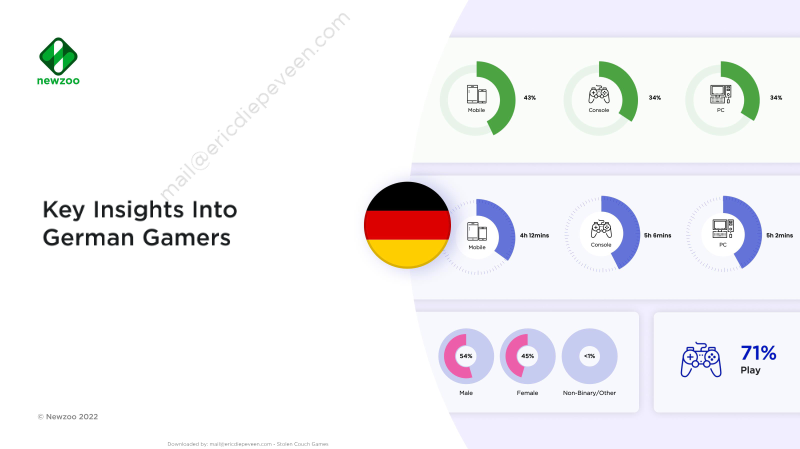
Germany represents a significant pillar of the global gaming industry, ranking as the largest games market in the European Union and the fifth largest worldwide by revenue. As of 2022, the German gaming landscape is characterized by a high level of engagement, with 71% of the online population aged 10 to 65 identifying as game enthusiasts. This engagement extends beyond active play to include viewing gaming video content, social interaction, and community participation.
The demographic profile of German players is nearly balanced by gender, consisting of 52% males and 48% females. While gaming is popular across all age groups, the 21-35 age bracket represents the largest segment at 31%. Motivation for play is primarily driven by the desire to relax and unwind, followed by the pursuit of achievement and social connection. Among the various gamer personas, Time Fillers and Mainstream Gamers are the most prevalent, reflecting a mix of casual mobile play and more dedicated multi-platform engagement.
Platform preferences show that mobile gaming has the highest reach, utilized by 43% of the online population, followed by console and PC at 34% each. Despite the higher reach of mobile, PC and console players demonstrate higher average weekly play times, exceeding five hours. Popular titles in the market include Minecraft, Roblox, and Grand Theft Auto V, with Adventure and Action genres leading in popularity.
Monetization remains strong, with 63% of players spending money on games. The primary driver for spending is the availability of sales or special offers, though a significant portion of consumers also pays to unlock exclusive content or to personalize their in-game experience. These findings are based on a 2022 survey of 2,057 online consumers in Germany, forming part of a broader global research initiative covering 36 markets.
The European video game industry serves as a significant economic and social pillar, generating €23.3 billion in annual revenue while supporting a workforce of nearly 100,000 professionals across 4,600 studios. As of 2021, the sector reached a broad audience of 124.8 million players, representing 52 percent of the total European population. This demographic is increasingly diverse, with women accounting for nearly half of all gamers and the 45–64 age bracket emerging as the fastest-growing segment. Beyond its financial contributions, the industry functions as a vital social and mental health resource, fostering connectivity and engagement across age groups.
Commitment to consumer safety and ethical standards remains a core operational priority. The industry maintains rigorous oversight through the PEGI rating system and comprehensive parental controls, ensuring that gameplay environments remain responsible and age-appropriate. These efforts are complemented by a broader push toward social responsibility, including the integration of gaming into educational frameworks and the promotion of diversity initiatives within the workforce.
Environmental sustainability has also become a central strategic objective for the European market. Major industry bodies, including the ISFE and EGDF, are actively coordinating efforts to achieve climate neutrality. This transition is evidenced by the widespread adoption of carbon measurement and offsetting practices, with a substantial majority of companies in key markets like Germany already implementing formal sustainability programs. Supported by a robust network of national trade associations, the industry continues to leverage its collective influence to drive policy development and long-term growth within the European digital ecosystem.
The analysis focuses on Latin America’s mobile ecosystem from July 2020 to June 2021, revealing a region that has accelerated digital adoption and monetization amid the pandemic. Mobile downloads surged 76 % year‑on‑year, reaching roughly 21 billion across iOS and Google Play, while consumer spend climbed 26 % to $2.9 billion. Android dominates downloads (≈89 %) yet iOS retains a higher spend share, commanding 56 % of total consumer expenditure. Brazil and Mexico together generate 73 % of regional downloads, with Brazil’s per‑capita income lower than Uruguay’s but still driving significant spend growth.
Gaming remains a key driver, accounting for 50 % of LATAM consumer spend—below the global average of 68 %. Brazil leads in both downloads (4.6 billion) and revenue ($557 million), with Chile showing a strong spend‑to‑download ratio. Non‑gaming verticals such as Finance, Shopping, and Entertainment also expanded; finance apps grew 36 % YoY in Brazil, while shopping app downloads rose 30 %. Entertainment became the largest spend category in four of six major markets, reflecting limited Smart TV penetration and a shift to mobile streaming.
User engagement metrics underscore high daily time spent, with Brazil averaging 5.4 hours per user and Mexico 4.8 hours—up 32 % and 36 % respectively from two years prior. Social, tools, and business categories saw the largest increases in sessions and minutes, indicating opportunities for productivity and contactless payment solutions. Demographic analysis shows a youthful audience: 61 % of shopping app users in Brazil are Millennials, and Gen Z dominates photo‑video and entertainment segments.
Overall, the report highlights LATAM as a high‑growth mobile market with distinct platform dynamics, strong gaming and finance opportunities, and an emerging preference for mobile‑first entertainment and productivity apps.
The Finnish game industry solidified its position as a cornerstone of the national economy in 2020, maintaining a turnover exceeding €2 billion for the sixth consecutive year. Despite a slight contraction in the total number of active studios to approximately 200, the sector experienced a maturation phase characterized by increased revenue stability and a rise in high-performing firms. With 46 studios now generating over €1 million annually and a collective net profit surpassing €500 million, the industry demonstrated remarkable resilience against the operational disruptions of the COVID-19 pandemic. This economic strength is supported by a workforce of 3,600 professionals, with a persistent demand for hundreds of additional hires, reflecting a healthy, expanding ecosystem.
The industry is currently undergoing a strategic transformation driven by technological shifts toward cloud gaming, artificial intelligence, and Games as a Service models. While developers benefit from a robust network of public funding, private investment, and professional associations, they face mounting pressures from market consolidation, rising user acquisition costs, and regulatory fragmentation. To remain competitive in a saturated global market, Finnish studios are increasingly prioritizing data-driven design, social integration, and the development of strong intellectual property. This shift is accompanied by a positive trend in workforce diversification, with female representation reaching 22 percent.
The Finnish landscape remains defined by a diverse array of entities, ranging from global mobile giants like Supercell and Rovio to specialized indie developers and B2B service providers. These companies successfully balance creative autonomy with sustainable business practices, leveraging both original IP and work-for-hire models. By integrating emerging roles such as content creators and streamers into the development lifecycle, the industry continues to evolve, ensuring that Finnish studios maintain their significant footprint in the global digital entertainment market through innovation in mobile, console, and emerging technology platforms.