Slovak Game Development Industry 2023
20234 pages~4 min full read
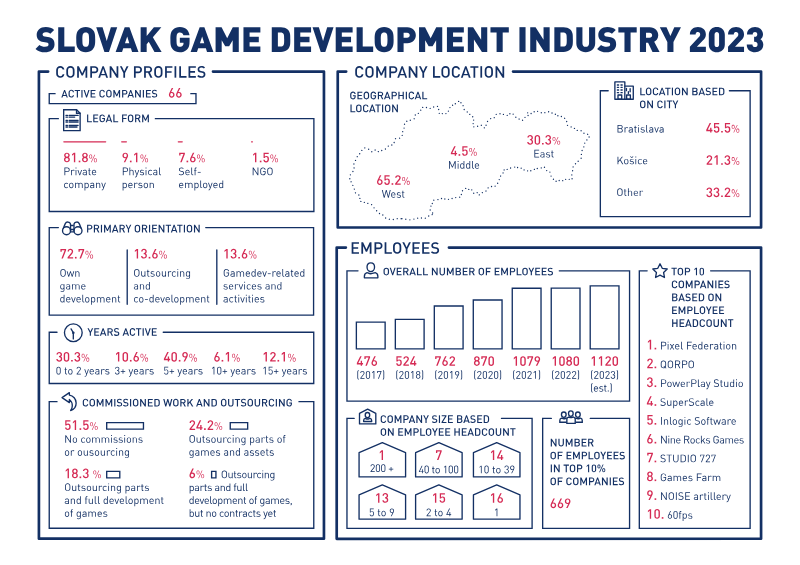
The Slovak game development industry in 2023 is characterized by a stable ecosystem of 66 active companies, primarily concentrated in the western region of the country. The sector is dominated by private entities, with 72.7% focusing on core game development and the remainder providing outsourcing or specialized services. While the industry features a mix of experience levels, over 40% of companies have been active for more than five years. The workforce has seen consistent growth, rising from 476 employees in 2017 to an estimated 1,120 in 2023. However, the industry exhibits significant centralization, with the top 10% of companies employing approximately 60% of the total workforce and generating 84.6% of the annual turnover.
Financial data indicates a mature but plateauing market, with an overall turnover of €77.1 million in 2022 and a nearly identical estimate of €76.9 million for 2023. Pixel Federation, SuperScale, and Inlogic Software lead the market in both headcount and revenue. Development is largely self-funded, though 37.9% of companies utilize public funding. PC remains the primary target platform for development, followed by mobile and consoles. Notably, half of all projects remain unpublished, while those that reach the market are predominantly self-published via digital storefronts like Steam, Google Play, and the App Store.
The labor market reveals a workforce with a median age of 30, where women represent 19% of the total headcount, primarily occupying roles in graphic arts and community management. Recruitment remains a challenge for specialized roles, particularly for programmers and game designers. To address talent shortages, nearly half of Slovak firms employ international staff, largely from Czechia and Ukraine. Operational trends show a decisive shift toward flexible work arrangements, with over 89% of companies utilizing remote or hybrid office models. Industry stakeholders express a strong desire for increased state support, specifically through tax incentives and improved education for the digital arts.
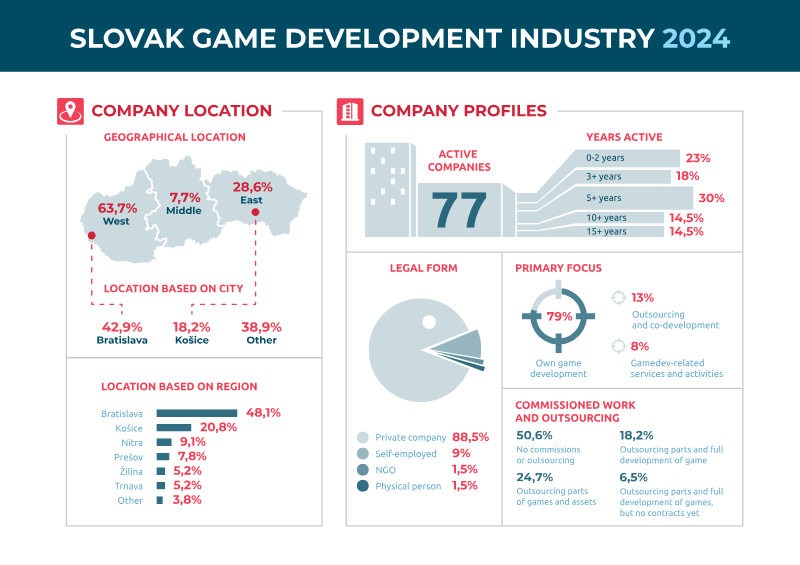
Slovak Game Developers Association · 2024
Slovak Game Developers Association · 2022
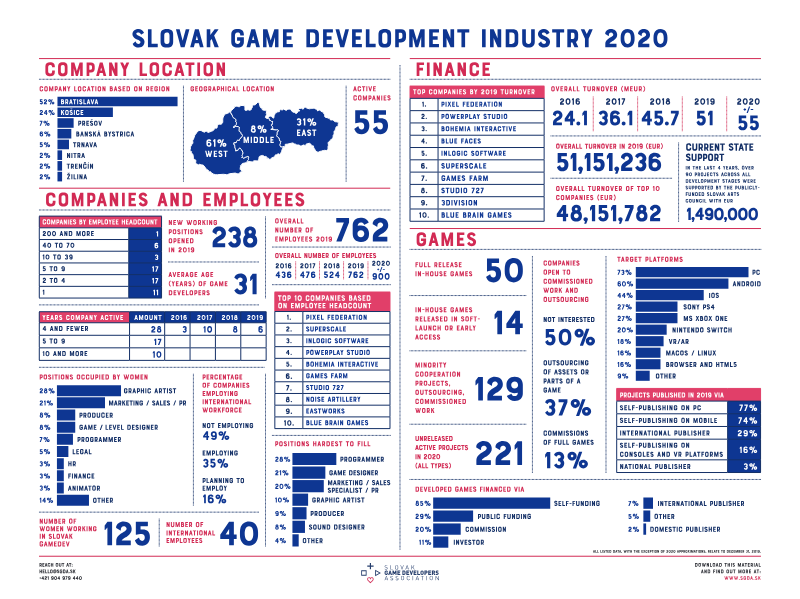
Slovak Game Developers Association · 2020
Slovak Game Developers Association · 2019
8Bit · 2026
Values Value · 2026
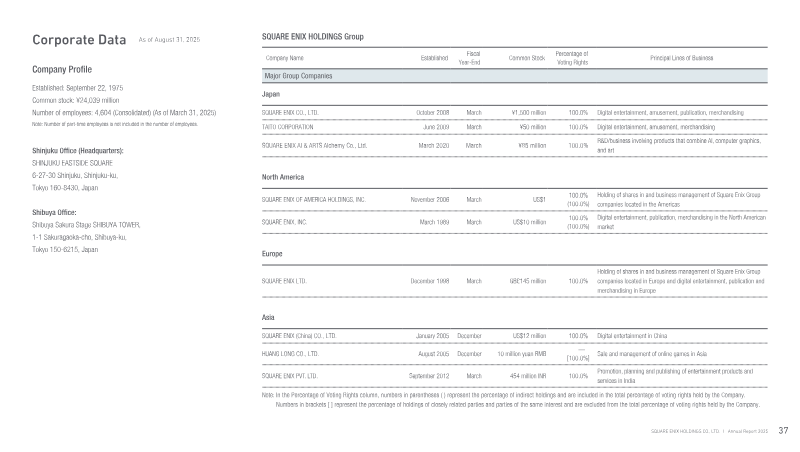
Square Enix · 2025
Game Developers Conference · 2025
InGameJob · 2025
InGameJob & Values Value · 2025
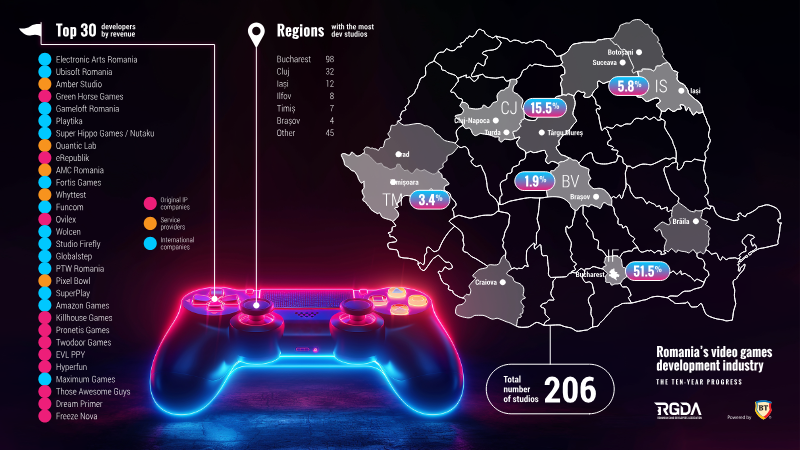
RGDA – Romanian Game Developers Association · 2025
PCF Group · 2024
International Game Developers' Association · 2024

ESAC – Entertainment Software Association of Canada · 2024
Dutch Games Association · 2024

ESAC – Entertainment Software Association of Canada · 2024