Country & Regional Reports·Updated Apr 8, 2026 by Sensor Tower
Report · January 1, 2024
Published by Sensor Tower
Mobile game downloads across Southeast Asia grew by 3.4 % in the first half of 2024, reaching 4.2 billion installs, with Google Play accounting for 91 % of the volume. In‑app purchase revenue rose by 3.4 % to $1.16 billion, a slight decline of 3 % from the previous half‑year; Google Play contributed 57 % of total revenue. From January to August, mid‑core genres such as simulation, arcade, puzzle and lifestyle led download growth (11 %–14 %), while sports titles experienced a 39 % revenue surge, representing 9 % of total IAP income. Strategy and RPG games dominated downloads (47 %) but saw modest revenue declines of 3 %–9 %. Indonesia remains the largest market, with a 10 % download increase and 41 % of regional downloads; Thailand follows as the highest‑earning country, adding $400 million in revenue. The top ten download leaders are dominated by Garena Free Fire, Mobile Legends: Bang Bang and Roblox, with Garena Free Fire maintaining a 54 % growth rate. In revenue terms, Mobile Legends: Bang Bang leads with $1.16 billion, followed by eFootball™ 2024 and Garena Free Fire; Roblox and Coin Master also show strong growth, with Roblox’s revenue rising 90 %. The case study of Honor of Kings illustrates rapid penetration after its Southeast Asian launch in June 2024, achieving a 175 % month‑over‑month spike in Indonesia and capturing the top download spot in July. By August, Honor of Kings generated $1.7 billion in IAP revenue for the period and accounted for 51 % of its global downloads from Indonesia alone. The report relies on Sensor Tower’s estimated download and IAP data from the App Store and Google Play, excluding pre‑installs, duplicate downloads, ad revenue, third‑party sales, and direct developer payments.
SensorTower SRRT C SA AIOOO S o u t h e a st A s i a n Mobile Game Market Insights 2024
iew Sensor Tower Introduction/Overview — epth analysis of the This report provides an in-depth analysis App Store and Google Play mobile game markets of the App Store and 2024, covering the overall e in Southeast Asian in 2024, in these revenue and download trends in these genres, markets, revenue shares and trends across top game genres, download and revenue changes across different countries, as well as well Ar as top mobile games by revenue and downloads. Through case case study, this report will also help you decode how top games top games successfully penetrated the Southeast Asian markets. utheast Asian markets. Clarification on Revenue and Downloads Data Sensor Tower's revenue figures are derived from estimated in-app purchase (IAP) revenue on the App Store and Google Play, excluding d from estimated in-app purchase (IAP) revenue on ad revenue, revenue from third-party Android appstore sales, and direct payment revenue from developers’ websites and other channels. Unless explicitly stated as net revenue, the revenue figures shown represent gross revenue (before platform deduction). nue figures shown represent gross revenue (before Sensor Tower's downloads figures are derived from estimated downloads on the App Store and Google Play, excluding pre-installs, duplicate downloads, and downloads from third-party Android app-store. Google Play is not available in Mainland China. cate downloads, and downloads from third-party ble in Mainland China.
Contents Introduction/Overview 02 Overview of the Southeast Asian Mobile Game Market 04 Popular Mobile Games and Top Publishers in Southeast Asia 08 Case Study: Honor of Kings 13 Key Takeaways 19
In the first half of 2024, mobile game downloads in Southeast Asia increased by 3.4% compared to the previous half-year period, reaching 4.2 billion, with 91% coming from Google Play Note: Data as of June 2024. Source: Sensor Tower Store Intelligence Sensor Tower's download data is derived from estimated downloads on the App Store and Google Play, excluding pre-installs, duplicate downloads, and downloads from third-party Android app-store. Google Play is not available in Mainland China. During the first half of 2024, mobile game downloads in the Southeast Asian market rose In the first half of 2024, the IAP revenue of mobile games in the Southeast Asian market by 3.4% compared to the previous half-year, totalling 4.2 billion downloads, of which 91% decreased slightly by 3.0% compared to previous half-year to $1.16 billion, close to the were from Google Play. level in 2020H1. Google Play revenue accounted for 57% of the total. Mobile Game Downloads Trends in Southeast Asia Mobile Game IAP Revenue in Southeast Asia from 2020H1 to 2024H1 from 2020H1 to 2024H1 App Store Google Play App Store Google Play 4.5B $1.4B 3B $0.7B 1.5B 0B $0B 2020H1 2020H2 2021H1 2021H2 2022H1 2022H2 2023H1 2023H2 2024H1 2020H1 2020H2 2021H1 2021H2 2022H1 2022H2 2023H1 2023H2 2024H1
From January to August 2024, downloads of mid-core mobile games in the Southeast Asian market grew significantly, while revenue from sports mobile games increased by 39% period-over-period Note: Data as of August 2024. Source: Sensor Tower Store Intelligence Sensor Tower's download data is derived from estimated downloads on the App Store and Google Play, excluding pre-installs, duplicate downloads, and downloads from third-party Android app-store. Google Play is not available in Mainland China. Between January and August 2024, simulation, arcade, puzzle, and lifestyle mobile games On the revenue side, strategy and RPG mobile games collectively accounted for 47% of accounted for 67% of the total downloads in the Southeast Asian market. total, though they experienced period-over-period declines of 3% and 9%, respectively. Specifically, downloads of simulation, strategy, shooting, and RPG mobile games grew by Meanwhile, revenue from sports mobile games spiked by 39% period-over-period, 11%, 14%, 6%, and 7%, respectively. accounting for 9% of the total mobile game revenue in Southeast Asia. Mobile Games Downloads Share in Southeast Asia Mobile Game IAP Revenue Share in Southeast Asia by Genre (January-August 2024) Market by Genre (January-August 2024) Others Others 13% Simulation 8% Action 22% +11% YoY Puzzle Strategy -0.3% YoY 5% +6% YoY 8% 24% -3% YoY RPG Shooter +7% YoY 5% +0.5% YoY 8% Shooter S Downloads ower 0 Revenue +6% YoY 5% Downloads Sports +14% Strategy Arcade +39% YoY 9% YoY 5% 19% -4% YoY Lifestyle Simulation RPG +4% YoY 10% Puzzle +2% YoY 9% 23% -9% YoY
ion 8% Action 22% +11% YoY Puzzle Strategy -0.3% YoY 5% +6% YoY 8% 24% -3% YoY RPG Shooter +7% YoY 5% +0.5% YoY 8% Shooter S Downloads ower 0 Revenue +6% YoY 5% Downloads Sports +14% Strategy Arcade +39% YoY 9% YoY 5% 19% -4% YoY Lifestyle Simulation RPG +4% YoY 10% Puzzle +2% YoY 9% 23% -9% YoY 16% -6% YoY -14% YoY Casino 11%
The 2026 State of Gaming analysis demonstrates a shifting landscape in which mobile gaming remains the largest driver of downloads—approximately 50 billion in 2025—but its growth rate is slowing. Revenue, however, continues to climb as monetization models mature and lifetime value deepens, especially within hybrid‑casual titles that now generate the most incremental income. In contrast, PC and console platforms experience record revenue growth, with Steam’s premium segment up 32 % and blockbuster releases such as Battlefield 6 capturing significant market share from incumbents. Shooter downloads on these platforms have plateaued, suggesting new titles are primarily cannibalizing existing audiences rather than expanding the category. Genre‑specific dynamics reveal that strategy games are the only mobile genre to grow in downloads, driven by 4X titles from Eastern developers. Action and shooter games dominate PC/console gains, while hyper‑casual remains the largest download engine but shows a notable lift in time spent, particularly in Tier 2 markets. Casual titles face declining day‑7 retention, indicating a stickiness challenge that could erode long‑term player value. Live‑ops and acquisition strategies have evolved toward retention‑focused events, multi‑tier season passes, and expedition‑style rewards. These mechanisms now represent the most reliable revenue drivers across competitive genres such as RPG, action, and simulation. Advertising spend remains concentrated on social channels—YouTube, Facebook/Instagram—and high‑attention formats like video, playable, and rewarded ads. Battlefield 6’s pre‑launch spend surpassed Call of Duty titles, leveraging Facebook, Reddit, and desktop display, while its post‑launch strategy pivoted to YouTube with cinematic, celebrity‑hook creatives. Geographically, the U.S. market shows a skew toward lifestyle and puzzle categories despite lower IAP shares, whereas casino titles exhibit higher spend‑to‑revenue efficiency. Overall, the industry is moving from acquisition toward deeper monetization per user, with indie shooters and simulation titles gaining traction amid intense competition in the shooter segment.
The interim filing presents the fourth‑quarter 2025 financial results for a midcore‑casual gaming group, emphasizing a record‑setting revenue run and the successful execution of a transformation agenda that includes the integration of the Plarium acquisition and the rollout of a new district structure in early 2026. Revenue reached SEK 3,123 million, reflecting 108 % organic growth year‑on‑year and a 25 % increase on a constant‑currency basis, while adjusted EBITDA rose to SEK 717 million, delivering a 23 % margin that matches the full‑year figure. Unlevered free cash flow amounted to SEK 878 million, with a cash‑conversion rate of 66 % and a leverage ratio of five times EBITDA, underscoring robust liquidity and disciplined capital management. User‑acquisition spending accelerated, representing 38 % of quarterly revenue—up from 37 % in the prior quarter—and grew 76 % on a reported basis, driven by heightened investment in original studios, new casual titles, and the racing franchise. The direct‑to‑consumer channel expanded by 600 basis points to 32 % of total revenue, reflecting a strategic shift toward higher‑margin in‑app purchases. Across the fiscal year, the company posted a 9 % organic revenue increase, with word‑games, racing, and RAID franchises delivering the strongest quarter‑end performance. Operating cash flow for the quarter stood at SEK 840 million, while adjusted net income was SEK 1,390 million, translating to an adjusted EPS of SEK 11.33. The financial outcomes exceed guidance and position the firm to meet its medium‑term outlook, with a pre‑IPO study for PlaySimple concluded and the midcore transformation progressing as planned.
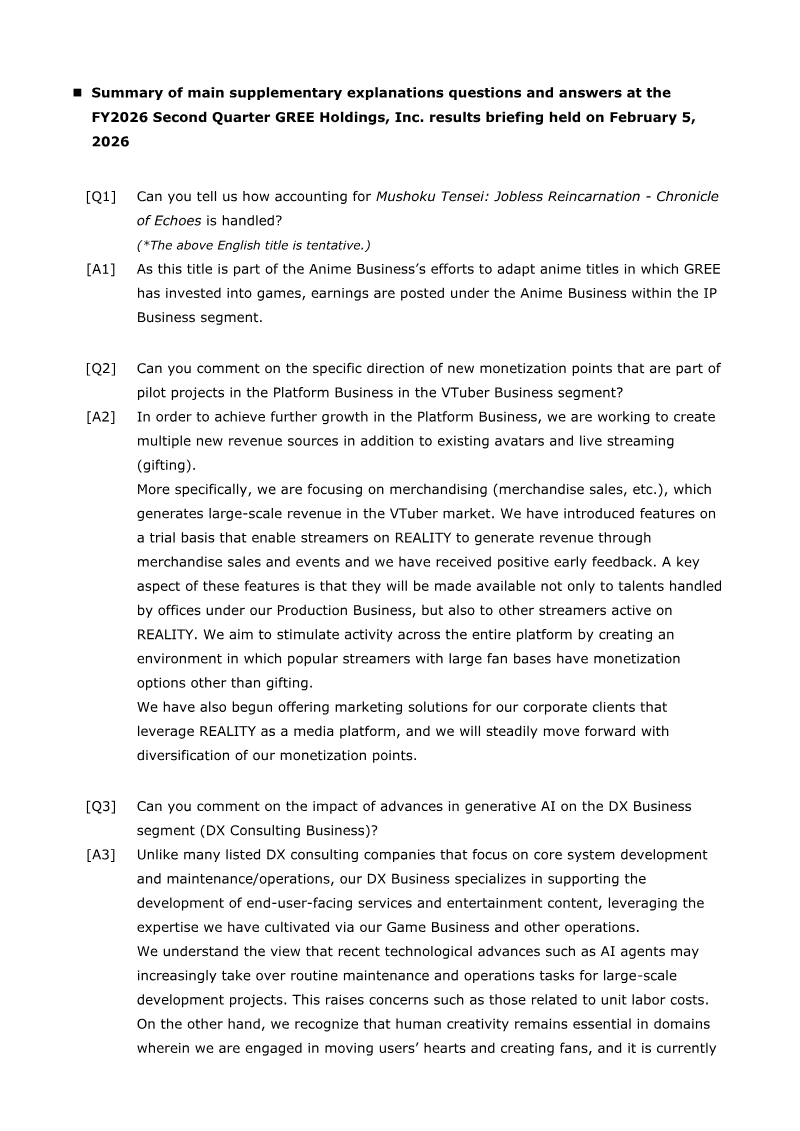
GREE Holdings, Inc. outlines its strategic direction and financial outlook following the second quarter of fiscal year 2026, focusing on a structural shift away from the volatile Game Business toward more stable, continuous growth segments. Despite a downward revision to the full-year earnings outlook for FY2026 due to the softening performance of existing game titles, the long-term medium-term targets for FY2028 remain unchanged. This stability is supported by the steady expansion of the IP, VTuber, and DX Business segments, which are intended to reduce the company's reliance on hit-driven gaming revenue. The IP Business is diversifying through the Anime Business, specifically by adapting invested anime titles into games. To strengthen this pipeline, there is a strategic goal to acquire in-house anime production capabilities or pursue M&A within the next two to three years. This move aims to provide greater control over production quality and timing, which are viewed as essential for creating popular intellectual property. Simultaneously, the VTuber Business is expanding its monetization beyond traditional gifting. Pilot projects on the REALITY platform are testing merchandise sales and event-based revenue for both in-house talent and independent streamers, alongside new marketing solutions for corporate clients. In the DX Business segment, the focus remains on high-value consulting for end-user-facing services and entertainment. While generative AI and automated agents are expected to impact routine maintenance and labor costs in the broader industry, the specialized nature of creating fan-driven content is seen as resilient to automation. Consequently, technological advances in AI are not expected to negatively impact the DX segment in the near term. Overall, the strategy emphasizes leveraging human creativity and platform diversification to ensure stable, long-term earnings growth across the global entertainment and digital transformation markets.
A well‑designed in‑game offer system is presented as the most potent driver of lifetime value and average revenue per paying user. By integrating a limited set of synergistic offer types—login bonuses, triggered prompts, endless streams, “1 + X” bundles, battle‑passes, stamp‑cards, and curated bundles—and optimizing their frequency, timing, pricing, segmentation, and economic balance, developers can achieve conversion rates as high as ninety‑six percent on login offers and lift repeat‑purchase value by roughly twenty percent through endless offers. Conversion is shown to be a function of repeated exposure rather than a single impression; players typically require about seven viewings before taking action. The most effective moments to surface offers are at login, during “out‑of‑currency” events, after level failures, or in high‑momentum gameplay phases. A dynamic, tiered pricing ladder that escalates after each purchase and regresses after periods of inactivity—exemplified by a seven‑tier structure ranging from under one dollar to ninety‑nine dollars—enables precise alignment with player spend propensity while avoiding both under‑monetization of high‑potential users and alienation of low‑spenders. Segmentation must extend beyond basic recency and frequency metrics to incorporate geographic tier, acquisition source quality, and player progression. Lower‑tier regions demand adjusted price ladders and reduced offer frequency, whereas high‑quality acquisition channels justify more complex bundles. Early‑game players respond best to inexpensive, simple offers, while mid‑ and late‑game users can be presented with higher‑value packages. Anchoring the entire shop around a stable, low‑priced entry pack establishes a reference point that shapes perceived value across all offers. Collectively, these principles apply to mobile and casual games operating globally, reflecting current industry practices and data from recent case studies. Implementing the outlined framework promises measurable improvements in monetization efficiency, player satisfaction, and overall revenue performance.