Country & Regional Reports·Updated Mar 17, 2026 by Dataspelsbranschen
Report · January 1, 2023
Published by Dataspelsbranschen
The Swedish games industry reached a significant financial milestone in 2022, with domestic revenues rising 13% to €3.1 billion and total global revenue, including foreign subsidiaries, surging 40% to €8.1 billion. This growth is characterized by a massive international footprint, as Swedish-owned companies now operate nearly 400 studios across 59 countries. Large-scale acquisitions, such as Embracer Group’s multi-billion euro purchase of Asmodee, have shifted the employment landscape, resulting in Swedish firms employing nearly twice as many people abroad as they do domestically. Within Sweden, the number of active companies grew by 20% to 939, supported by a maturing ecosystem of regional hubs and specialized educational programs. Despite this commercial success, the industry faces a critical production capacity bottleneck driven by a chronic shortage of skilled labor. While domestic employment grew to over 8,400 positions and diversity improved—with women accounting for over 44% of new entrants—the sector remains heavily dependent on foreign recruitment to sustain its trajectory. Furthermore, Swedish startups face a competitive disadvantage due to a lack of formal financial support structures compared to other European nations, forcing many to rely on organic growth or early acquisition rather than domestic venture capital. The sector is also navigating complex structural and environmental challenges. Sustainability efforts are increasingly focused on Scope 3 emissions, which represent over 99% of the industry’s carbon footprint, while legal and ethical concerns regarding generative AI and online radicalization have emerged as new operational risks. Geopolitical instability, particularly the war in Ukraine, continues to impact global workforces. Nevertheless, the integration of the Swedish E-sports Association into the Swedish Sports Confederation and the continued dominance of major entities like King, Mojang, and Stillfront Group underscore Sweden’s position as a premier global hub for game development and digital entertainment.
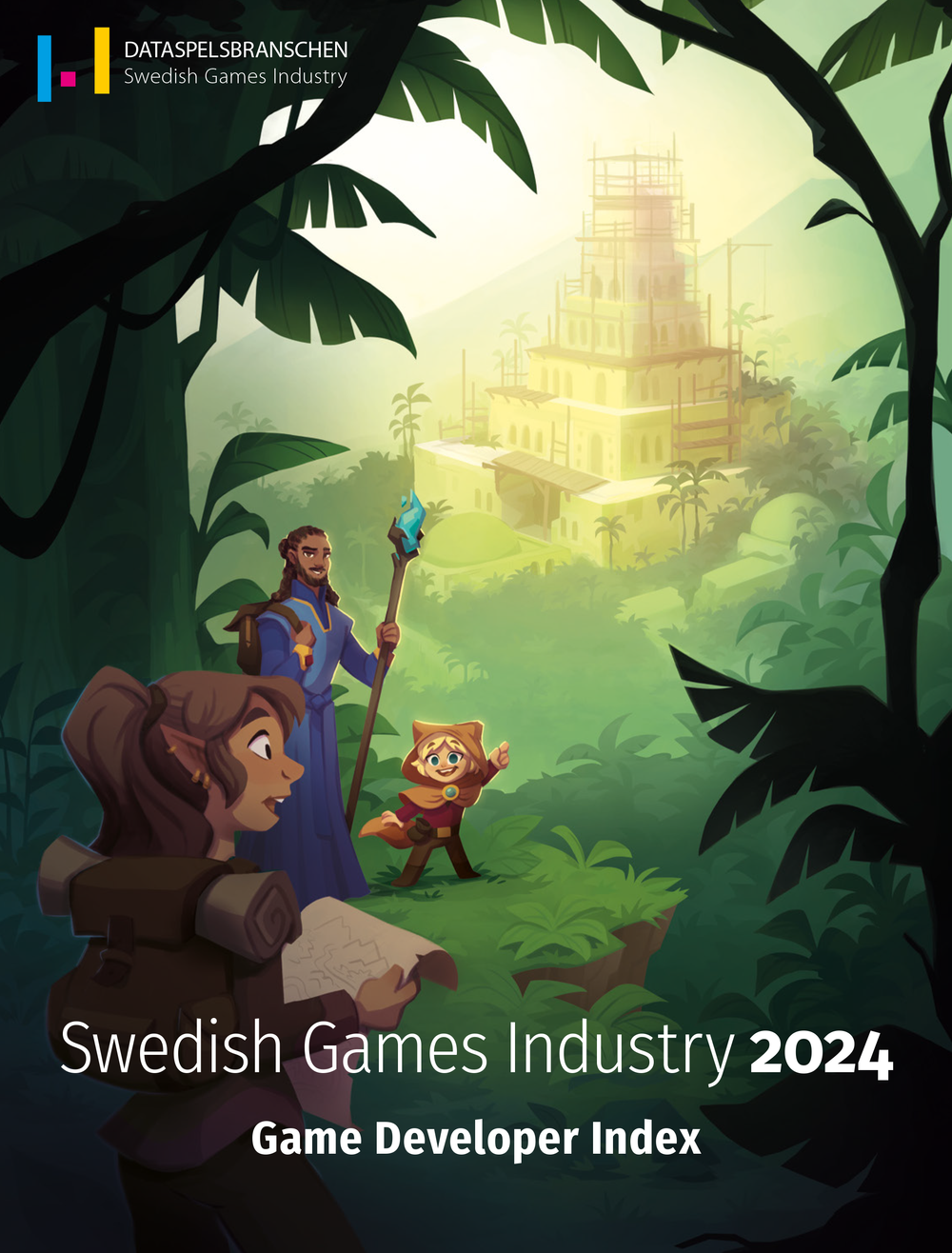
Perfect Rando Su # First edition October 2023 Published by The Swedish Games Industry Research & text: Alexander Milton, Elin Carlsson, Marléne Tamlin Translation: Alexander Milton Layout: Emilie Ihre Illustration, cover: Alice Persdotter Rydberg Editor: Johanna Nylander The Swedish Games Industry is the trade organisation for video games in Sweden. The organisation represents the industry as a whole through the industry associations Spelplan-ASGD (game developers, producers, education, academia and support members) and ANGI (publishers and distributors). Dataspelsbranschen | Swedish Games Industry Magnus Ladulåsgatan 3, SE-116 35 Stockholm www.swedishgamesindustry.com Contact: [email protected]
Table: Key Figures | Key Figures | 2022 | 2021 | 2020 | 2019 | 2018 | | --- | --- | --- | --- | --- | --- | | Number of companies | 939 (+20%) | 785 (+18%) | 667 (+14%) | 586 (+14%) | 513 (+16%) | | Domestic Net sales MEUR Swedish companies | 3,058 (+13%) | 2,713 (+28%) | 2,115 (+26%) | 1,682 (+21%) | 1,393 (+3%) | | Global Net sales MEUR Swedish companies | 8,136 (+40%) | 5,805 (+75%) | 3,312 (+43%) | 2,318 (+24%) | 1,872 (+33%) | | Net sales per employee in Sweden TEUR | 362 (+6%) | 342 (+7%) | 321 (+13%) | 284 (+8%) | 262 (-10%) | | Domestic Result Swedish companies MEUR | 1,818 (+532%) | 288 (-54%) | 630 (+71%) | 369 (+35%) | 273 (-37%) | | Result in Swedish companies globally MEUR | 1,859 | -123 (-117%) | 720 (+46%) | 493 (+47%) | 335 (-25%) | | Number of employees in Sweden | 8,445 (+6%) | 7,944 (+20%) | 6,596 (+11%) | 5,925 (+11%) | 5,320 (+14%) | | Of which men | 6,429 (76,1%) | 6,169 (77,7%) | 5,186 (78,6%) | 4,699 (79%) | 4,824 (80%) | | Of which women | 1,977 (23,4%) | 1,755 (22,1%) | 1,410 (21,4%) | 1,226 (21%) | 1,036 (20%) | | Number of employees in Swedish companies abroad | 16,494 (+48%) | 11,158 (+56%) | 7,177 (+121%) | 3,253 (+25%) | 2,604 (+290%) |
# Productivity and Skills Questions were mounting for 2022. Would players around the world choose other pastimes over games after the lockdowns? Would delayed game projects lead to reduced sales? Would the problems with global value chains hit companies' finances? When we add up this year's figures, we see that these problems did not hamper the progress of Swedish game developers. More companies, more revenue, more employees, more women. It is with pleasure and not without relief that we present this year's report. The biggest challenge facing Swedish game companies is the same as before: skills. Despite the high quality of Swedish game education programmes, it does not cover the needs. Compared to other creative industries, where there are usually more people being trained than the labour market can employ, the contrast is even greater. Despite recurring investments in education, not least in higher vocational education, the need is still great. Academic education also requires investment in research, so that education can rest on a scientific basis that is relevant to games. It takes a long time for educational initiatives to have an impact on the labour market: after all, it takes two to three years to complete an education. Another way to illustrate the skills shortage, in business terms, is production capacity. The demand is there, the channels are there, the production budgets are there, and there is no lack of international attention, but production capacity is the bottleneck. Apart from recruitment, companies have different strategies to deal with this problem. Many open offices or acquire companies in other countries, which is clearly reflected in the key figures in this report. There are many more employees in Swedish companies outside of Sweden than inside. Some of these jobs could have remained in the country. In addition, which we cannot measure, this means that investments by international companies are directed to countries other than Sweden. As is so often the case, the true number is higher. In addition to subsidiaries, many companies have consultants, freelancers and not least outsourced production (or "co-dev") to companies in other countries. Another strategy is to increase productivity through new technological solutions. Recently, technological leaps with generative artificial intelligence have gained attention in the public discourse. Game companies have experienced many technological advances despite the fact that the industry is relatively young. The move from two-dimensional graphics to 3D in the 1990s. Touch screens and smartphones in the 00s. The shift from
# Foreword # Table of Contents - Key Figures 3 - Foreword - Summary 6 - Revenue and Results 8 - Highlights 10 - Employees 14 - Number of Companies 16 - Inclusion and Gender Distribution 18 - Largest Companies 22 - Company Groups and the 24 Stock Exchange - Game Developer Map – Sweden 26 - Swedish Game Companies 34 Around the Globe - Game Developer Map – Global 36 - Acquisitions and Investments 38 - World Market 40 - Game Developer Educations 44 - Entrepreneurship and National 48 Collaborations - Key Events in Swedish Game Hubs 50 - The European Games Industry 54 - No Games on a Dead Planet 56 - Threats and Challenges 62 - Methodology 64 games as a product to a service in the ‘10s. Just to name a few examples. The productivity gains in terms of technology leaps are also numerous. In the past, every game company used to develop their own game engines. Looking at the last decade, more and more have switched to standardised game engines that are used in many more games and thus have a larger user base and more resources. Asset libraries make it possible to reuse, for example, graphics from other games. Motion capture enables more realistic animations. So have the productivity gains from these technological advances led to fewer jobs? The answer is in the key figures in this report. Game development is a team effort and the raw material is creativity. There you have it: two very human skills. With the right conditions, there will be even more jobs in future Game Developer Index. Overall, companies have many ways to increase their production capacity, but they need more. Players around the world want more and better games. And they deserve it. Stockholm, October 2023 # Per Strömbäck Head of Secretariat, Swedish Games Industry
# Summary The Game Developer Index maps, reports and analyses Swedish game companies' operations and international industry trends over the past year by compiling the companies' annual reports. The Game Developer Index maps, reports and analyses Swedish game companies' operations and international industry trends over the past year by compiling the companies' annual reports. Swedish game development is an export industry that operates in a largely global market. In a few decades, the games industry has grown from a hobby for enthusiasts to a worldwide industry with cultural and economic significance. The Game Developer Index 2023 compiles the Swedish companies' latest reported financial year (2022). The report in brief: - The Swedish game industry's revenue grew to EUR 3.1 billion in 2022, which is an increase of $1 3 \%$ in Swedishregistered companies. In total, including subsidiaries abroad, the Swedish industry had a revenue of EUR 8,1 billion, an increase of $4 0 \%$ . - A total of 1,977 positions at game companies in the country are held by women, representing a share of just over $2 3 \%$ . Among new entrants to the sector, $4 4 \%$ were women. - Swedish game companies are growing, employing 8,445 people in Sweden in 2022 and 16,494 people abroad. The global increase is mainly acquisition-driven, and in Sweden 501 people were hired, an increase of $6 \%$ . - 104 companies started in 2022. These, together with 50 newly added pre-existing companies that changed their activities to game development, result in a total of 939 active companies in December 2022, an increase o $2 0 \%$ compared to 2022. - In 2022, 31 investments and acquisitions were reported, of which six had a deal value over 100 million EUR. Swedish companies were buyers in 26 of the cases and sellers in nine of the deals. - The ten most profitable companies together paid about EUR 250 million in corporate taxes on their profits. - The ten largest employers paid a total of EUR 113 million in payroll taxes. - 23 Swedish companies are listed on the stock exchange in Sweden. Together they had a revenue of EUR 5.7 billion in 2022. Game development is a growth industry. Sixteen of the companies that exist today have been around since the 1990s, but almost half of all companies have been registered in the last five years. In 2022, 104 new companies were registered. The games are launched directly on an
international market with strong growth and the supply of skills is also largely based on a global labour market. Factors that point to continued growth are more investments in regional hubs with incubators, accelerators and training programmes, more veterans starting new companies, several major game launches in the near future, and the fact that we have not yet seen the effects of the several large investments and acquisitions made in recent years. During the year, several Swedish companies celebrated anniversaries. EA DICE celebrated 30 years at the end of 2022 and both Avalanche Studios Group and King turned 20 in 2023. Swedish game developers are characterised by versatility and quality. Sweden has world-leading developers in AAA, console, PC, mobile games, VR/AR, digital distribution and specialised subcontractors. The industry's main challenges are access to expertise and capital - the latter especially in the early stages - and laws and regulations on digital markets that are out of step with its expansion. The most important future issue is diversity, both among game creators and players. In # 44% # among new recruits were women 2022, the share of women among new hires increased to $4 4 \%$ , but much work remains to be done to achieve gender equality in the industry. In the longer term, video games have all the prerequisites for diversity and inclusion: games offer an opportunity to leave your everyday life and enter worlds where only your imagination sets the limits. The number of “second-generation companies” where experienced game developers have moved on to new projects of their own, or where entrepreneurs have created their second company, continues to grow, and much of the industry’s long-term growth happens through start-ups.
The analysis evaluates the health and trajectory of Sweden’s video‑game sector during 2023‑24, mapping its economic performance, creative output, ecosystem structure and emerging challenges. By quantifying sales, employment, investment and cultural impact, it argues that the industry remains a growth engine for the Swedish economy while confronting structural constraints that could limit future expansion. Domestic net sales rose 6 % to SEK 34.6 billion (≈ EUR 3 billion, USD 3.2 billion) and total global revenue reached SEK 90.4 billion, a 4.5 % increase. The number of registered firms grew by 108 to 1,010, and Swedish‑owned companies expanded overseas to 218 subsidiaries in 54 countries, employing 15,792 staff abroad, of whom 29.5 % are women. Major titles such as Helldivers 2 (12 million copies in three months) and Satisfactory (6 million copies and a console launch) reinforced Sweden’s market presence, while Steam and Twitch data showed Swedish games accounting for over 700 million streamed hours in 2023 and nearly 500 million from January‑October 2024. The ecosystem is heavily concentrated in Stockholm, home to 439 studios and 5,816 employees, with secondary hubs in Skåne‑Blekinge, Västra Götaland, Västerbotten‑Norrbotten and Östergötland. Educational provision spans bachelor, master and vocational programmes, serving roughly 700 students across multiple institutions. Inclusion initiatives have broadened participation, exemplified by a game‑developer camp for about 100 gender‑diverse teens and a network of scholarships and mentorships. Nevertheless, early‑stage capital has weakened, talent pipelines remain thin—with only 644 new hires in 2023 and rising work‑permit refusals—and public‑health screen‑time guidance remains ambiguous. Capital flows revived in 2023‑24, highlighted by Embracer’s SEK 4.9 billion sale of Gearbox to Take‑Two and EQT’s SEK 28.7 billion acquisition of
The Swedish games industry underwent a period of rapid expansion in 2021, characterized by a 22% increase in domestic revenue to €2.7 billion and a 43% surge in global revenue to €5.8 billion. This growth was fueled by a record-breaking year of international acquisitions, with 81 public transactions led by major groups such as Embracer and Stillfront. By late 2022, Swedish-owned entities operated 197 studios across 49 countries, employing approximately 28,000 people worldwide. This international footprint is reflected in consumer reach, as an estimated one in four players globally has engaged with a Swedish-developed title, and Swedish-associated games accounted for 6% of all Twitch watchtime in 2021. The domestic workforce grew by 17% to nearly 8,000 employees, with women representing 22.1% of the total staff and 26% of new hires. While gender diversity is improving—evidenced by 29 companies achieving at least 50% female representation—the industry continues to struggle with a severe domestic skills shortage. This talent gap has forced Swedish firms to expand their foreign subsidiaries aggressively, with over 11,000 staff members now based abroad. Although regional hubs in Stockholm and Skåne remain dominant, growth is increasingly supported by specialized educational clusters and post-secondary programs designed to cultivate local talent. Despite its commercial success and cultural influence, the sector faces structural hurdles that could impact future scalability. Critical challenges include complex work permit processes for international recruits and a lack of early-stage financing compared to other global markets. Methodological shifts in industry tracking now prioritize national group turnover to ensure better comparability with other sectors, revealing a robust ecosystem of 785 active companies. While the industry remains a powerhouse of the Swedish economy, its long-term sustainability depends on addressing recruitment barriers and maintaining the momentum of its global acquisition strategy.
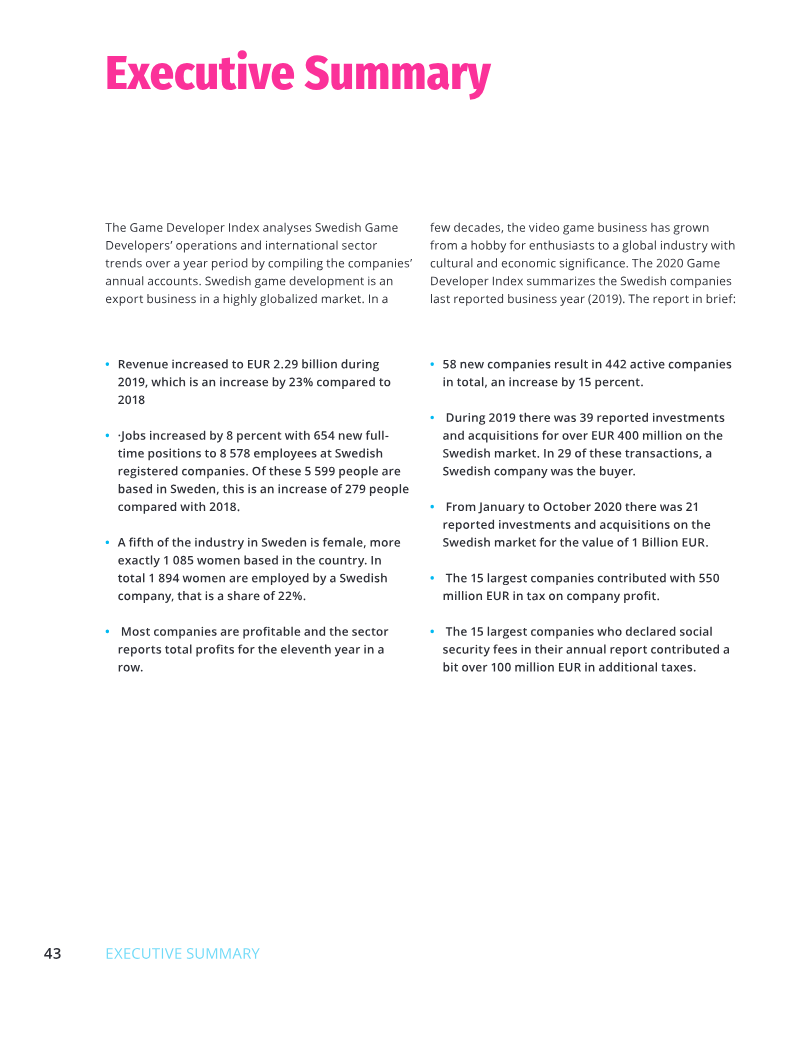
The Swedish games industry experienced a transformative period of growth in 2020, reaching a record revenue of EUR 3.3 billion. This 43% increase significantly outpaced global market trends, marking the sector's twelfth consecutive year of profitability. The landscape is increasingly defined by corporate consolidation and international expansion, with 667 active companies and 19 listed entities commanding a combined market capitalization of EUR 10.7 billion. Major players such as Embracer Group, King, and Mojang have transitioned Sweden from a target for foreign acquisition into a dominant global investor, with Swedish-owned firms now employing more personnel abroad than domestically across 126 international studios. Despite this commercial success, the industry faces a critical bottleneck regarding skilled labor. While domestic employment rose to over 6,500 positions, a severe talent shortage and a cumbersome work permit process hinder further expansion. These systemic issues are compounded by a lack of early-stage financing and tax incentives for smaller developers, who must also navigate digital regulations often tailored for larger tech platforms. Furthermore, while Swedish-developed titles like Minecraft and Candy Crush have achieved over six billion downloads, the sector continues to grapple with internal demographic challenges. Women currently represent only 21% of the workforce, and over 100 companies remain entirely male-operated, prompting a surge in diversity initiatives aimed at leveling the playing field. Geographically, while Stockholm remains the primary hub with over 4,000 employees, regional development clusters and educational programs are expanding throughout Sweden to support the growing ecosystem. The industry is also pivoting toward long-term sustainability, addressing workplace culture and the environmental implications of energy-intensive cloud gaming. As the sector matures, its primary challenges have shifted from achieving market viability to managing rapid globalization, securing specialized talent, and fostering a more inclusive and sustainable professional environment.
Published by the Swedish Games Industry Illustration, cover: Pontus Ullbors Text & analysis: Johanna Nylander The Swedish Games Industry is a collaboration between trade organizations ANGI and Spelplan-ASGD. ANGI represents publishers and distributors and Spelplan-ASGD represents Dataspelsbranschen Swedish Games Industry Magnus Ladulåsgatan 3, SE-116 35 Stockholm Contact: [email protected] KEY FIGURES 2018 2017 2016 2015 ...