
gamevironments
Open-access journal from the University of Bremen on video games, religion and culture, with articles, interviews and research reports.
Documents

Towards a Monopoly: Examining FIFA's Dominance in Simulated Football
FIFA's near-dominance of simulated football is examined in this analysis, which asks why Konami's Pro Evolution Soccer (PES) lost the market to Electronic Arts' FIFA despite broadly comparable critical reviews.
- The report argues that PES's decline against FIFA stems from financial and licensing factors rather than inferior gameplay, despite broadly comparable critical reviews of the two series.
- Sales figures show the divergence starkly: FIFA 17 sold 17.02 million copies in 2016 while PES reached only 1.26 million, and later reports suggest FIFA 19 outsold PES 2019 by roughly 22 to 1.
- Ultimate Team (FUT) became the franchise's centerpiece, holding a 64 percent player share in 2014 and growing 15 percent year-on-year in matches between 2018 and 2019 under a year-round, transaction-based live-service model.

Surveying the Frontier: Subjective Rendering and Occlusion in Open-World Westerns
Joshua D. Miner's article examines how real-time rendering techniques, including frustum and occlusion culling, level-of-detail management, mesh simplification, and draw distance, shape what players see in open-world western games.
- Joshua D. Miner argues that rendering optimizations such as frustum and occlusion culling, level-of-detail management, mesh simplification, and draw distance are not neutral technical necessities but subjective, culturally embedded practices that shape what players see.
- The article contends that these rendering pipelines create an illusion of fully realized, actionable space while encoding a "settler digitality" that can render Indigenous bodies and places marginal or invisible within the player's frame.
- Red Dead Redemption 2 largely confines its Wapiti reservation to linear, cutscene-driven interaction, keeping Indigenous spaces at the periphery of open-world exploration.
Playing America: An Introduction to American Culture through Video Games
"Playing America" is a work-in-progress textbook by Michael Fuchs and Stefan Rabitsch that uses video games as a medium for teaching American culture.
- The textbook "Playing America" by Michael Fuchs and Stefan Rabitsch uses video games to teach American culture, arguing that America functions as an imaginative construct drawing on Baudrillard's theory of hyperreality.
- The authors describe the United States as a "Gamer Nation," noting that video games are a dominant cultural force with nearly everyone under thirty playing digital games regularly.
- The book responds to the identity crisis of American Studies after the culture wars of the 1990s, offering an interdisciplinary, digitally literate entry point into national culture.
Nation(alism), Identity and Video Gaming
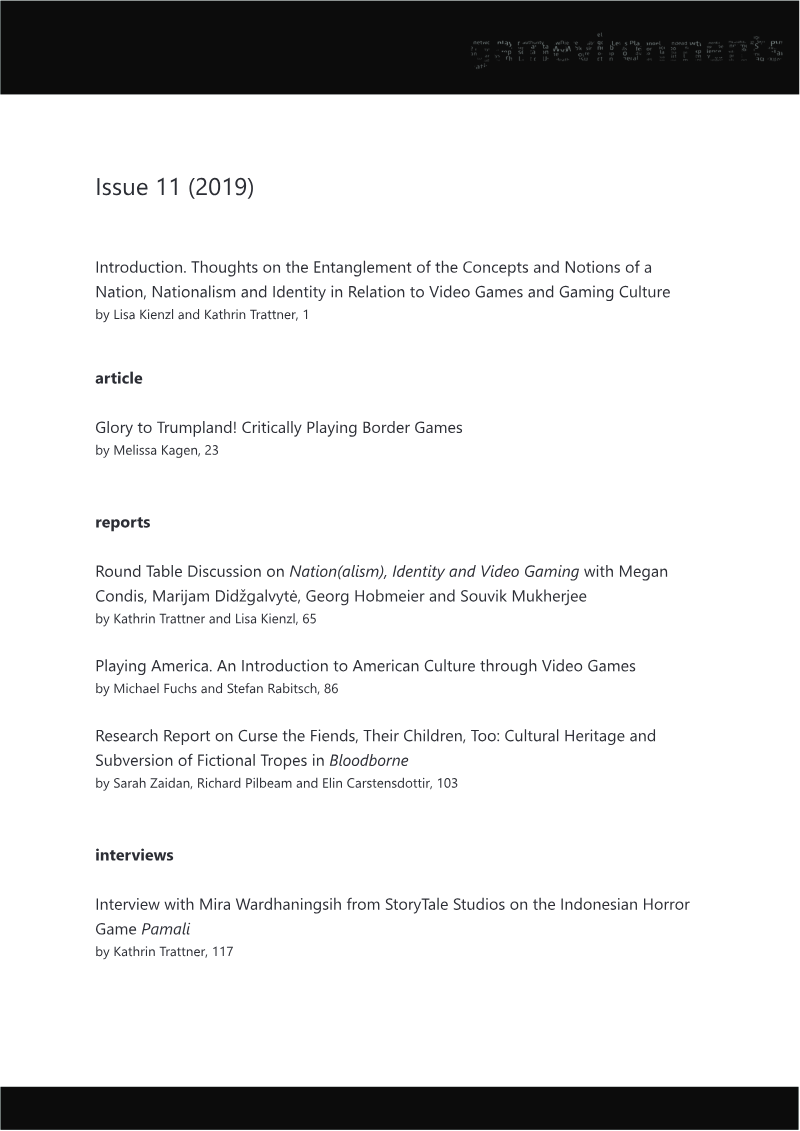
The document is a special issue of the academic journal gamevironments (Issue 11, 2019), edited by Lisa Kienzl and Kathrin Trattner, examining how nationalism, identity, and cultural narratives are shaped by and expressed through video games.
- The issue (gamevironments Issue 11, 2019, edited by Lisa Kienzl and Kathrin Trattner) frames video games as a medium where national and cultural identity is constructed, contested, and sometimes subverted.
- The featured interview covers Origin - the Rise of Dzitri (2019), a Togolese game built by a Lomé team formed in 2017 through Enter Africa, a network of 15 Goethe-Institutes across sub-Saharan Africa.
- Enter Africa connects interdisciplinary creative teams to produce geo-localized smartphone games addressing urban change, borders, and African history.
Nation(alism), Identity and Video Gaming
The document is a special issue of an academic journal titled Nation(alism), Identity and Video Gaming, edited by Lisa Kienzl and Kathrin Trattner and published in 2019.
- The report is a 2019 special issue of an academic journal, edited by Lisa Kienzl and Kathrin Trattner, examining how video games construct and contest national identity, cultural heritage, and ideology across multiple national and cultural contexts.
- Its central case study is Sarah Zaidan, Richard Pilbeam, and Elin Carstensdottir's analysis of From Software's 2015 action role-playing game Bloodborne, which uses Western Gothic iconography in a fictional Victorian-style city to explore Japanese concerns such as ultranationalism, xenophobia, and historical revisionism.
- The authors argue that Bloodborne deliberately sets the Gothic and the Weird, two opposing horror traditions, in tension rather than fusing them, drawing on the work of H. P. Lovecraft and China Mieville for the Weird.

How Video Games Changed My Life: Life-Changing Testimonies and The Last of Us
This study examines how players describe video games, particularly The Last of Us, as life-changing, treating their online accounts as testimonies that shape personal identity and foster community belonging.
- Players describe The Last of Us as life-changing and frame their accounts as personal life stories with testimonial qualities, treating players as active meaning-makers rather than passive audiences.
- The game's linear, non-branching narrative centred on the Joel and Ellie bond presents a moral and emotional dilemma that prompts players to reflect on their own lives.
- Four recurring themes appear across the testimonies: parenthood, not giving up on life, sexual identity, and self-acceptance, with the characters serving as normative reference points for a 'reformulation of the self'.

Indie and Dōjin Games: A Multilayered Cross-Cultural Comparison
Mikhail Fiadotau's study argues that Western "indie" games and Japanese "dōjin" games are frequently juxtaposed but have never been systematically compared, and it seeks to bridge English- and Japanese-language scholarship through a multilayered method examining conceptual, historical, media-ecological, and textual dimensions.
- Indie and dōjin games are often treated as equivalent, but they differ fundamentally in how they define themselves: indie is defined by creative independence from corporate mainstream production, while dōjin grows from communal, like-minded circles that do not oppose mainstream media.
- Dōjin games sit within a tightly interwoven transmedia continuum in which stories and characters regularly migrate into anime and manga, whereas indie games operate as separately evolving scenes with little cross-media exchange.
- Distribution patterns diverge sharply: dōjin games rely heavily on offline channels such as bookstores, specialty shops, and Comiket (about 35,000 circles and over half a million visitors in 2016), while indie games are primarily digital and have spread across consoles.

Interview with Matthias Kempke on Ken Follett's The Pillars of the Earth
This interview with freelance game writer and narrative designer Matthias Kempke, published in issue 10 of the gamevironments journal in 2019, centers on his work on the 2D adventure game Ken Follett's The Pillars of the Earth (2017/2018), developed by Daedalic Entertainment.
- Kempke restructured Ken Follett's novel so players control its three major characters, with branching choices whose consequences carry across the whole game.
- The adaptation deliberately moved away from the puzzle-heavy structure of classic adventure games, emphasizing emotionally grounded interactions and reduced trial-and-error friction, with Telltale Games cited as an inspiration.
- The monk Philip's faith is shaken and then restored over the story, a change Kempke frames as making religious questions accessible to both believers and non-believers.
Dying in the Game: A Perspective of Life, Death and Rebirth Through World of Warcraft
Wanda Gregory's essay, published in the 2018 gamevironments special issue on video gaming and death, examines how digital games represent mortality and how one player's experience of cancer reshaped her engagement with World of Warcraft.
- Wanda Gregory's 2018 essay, published in the gamevironments special issue on video gaming and death, argues that games typically reset, reboot, or soften the consequences of a character's death, unlike the lasting grief associated with deaths in books and film.
- The essay is an autoethnographic account of one player's cancer diagnosis, during which she came to see her World of Warcraft troll shaman, Tahara, as a mirror for her own fears of dying rather than a casual avatar.
- The author describes WoW's death mechanics in detail, including paying the Angel of Death for resurrection and travelling as a ghost to recover one's corpse, and says she first avoided risk by grinding at low levels.
Video Game Development in Asia: Voices from the Field
This special issue of the gamevironments journal, published in 2018 and edited by Gregory P. Grieve, Kerstin Radde-Antweiler, Xenia Zeiler and Christopher Helland, presents firsthand accounts from video game developers across several Asian countries, including India, Japan, Nepal and the Philippines.
- The report is a 2018 special issue of the gamevironments journal, edited by Gregory P. Grieve, Kerstin Radde-Antweiler, Xenia Zeiler and Christopher Helland, collecting firsthand accounts from independent and small-studio developers in India, Japan, Nepal and the Philippines.
- Its methodology is qualitative and exploratory, combining interviews, field reports and an ethnographic study rather than large-scale statistical measurement.
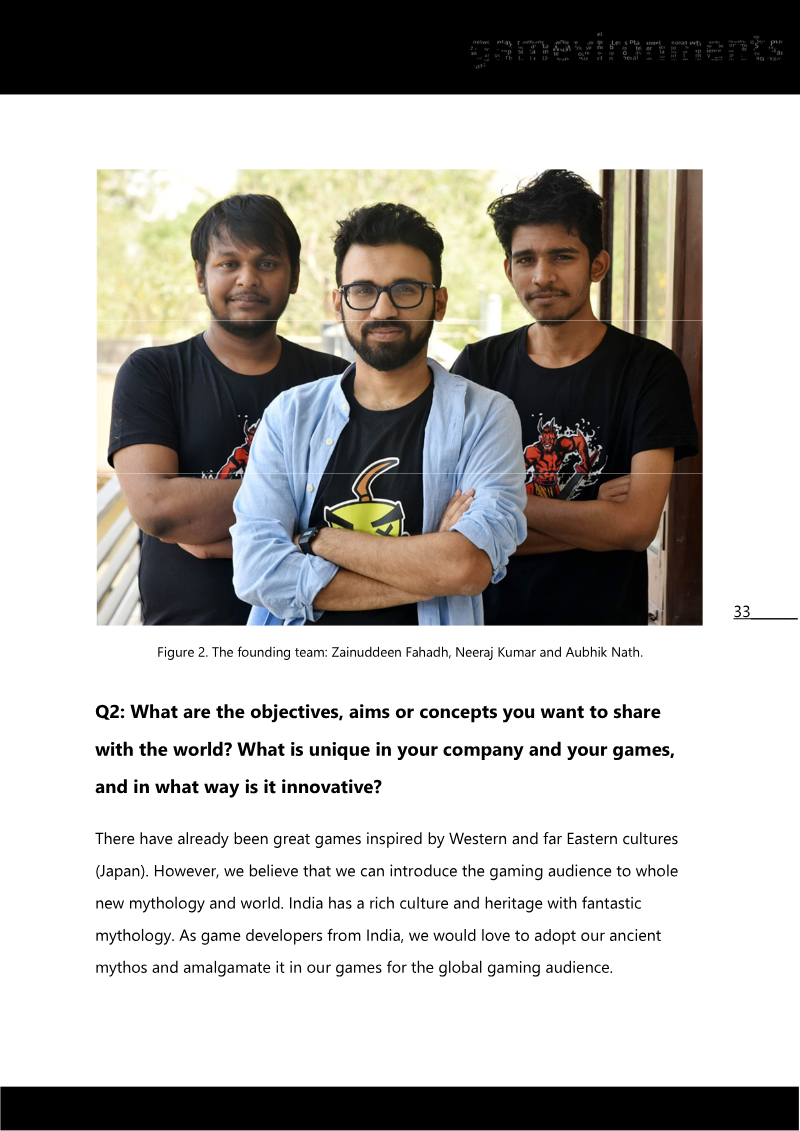
- The India section profiles Ogre Head Studio, a Hyderabad-based company founded in 2014 that aims to move beyond outsourcing and mobile-focused work toward original PC games.
Death Narratives: A Typology of Narratological Embeddings of Player's Death in Digital Games
Frank Bosman's study examines how digital games narratively frame the death of the player's avatar, arguing that most titles treat death as a trivial feedback mechanism while a smaller group embeds it within the fictional logic of the game.
- Bosman's study argues that most digital games treat player death as a trivial feedback mechanism, while only a smaller group embeds death within the fictional logic of the game.
- The proposed typology has three main types and seven subtypes: Type 1 covers narratively present deaths resolved by cloning, replacement, or avatar switching; Type 2 covers deaths circumvented through simulation or external help; Type 3 covers games with no explicit death narrative, including permadeath titles.
- Cloning and replacement mechanics nominally acknowledge the avatar's death but preserve near-unbroken player-avatar identification, rendering death narratively meaningless rather than truly preventing it.
No Sympathy for Devils: What Christian Video Games Can Teach Us About Violence in Family-Friendly Entertainment
Vincent Gonzalez's essay argues that the long-running debate over video game violence has stalled between critics and defenders, and that a more productive approach is to examine the enemies that these debates tend to overlook.
- The essay argues the video game violence debate has stalled between critics and defenders, and proposes shifting focus to the enemies that these debates overlook.
- The study analyses a bounded sample of fifty Christian video games with enemies, drawn from roughly one thousand Christian titles, covering 1982 to 2016.
- The sharpest finding is a division in treatment between humans and near-humans: Christian games typically convert humans rather than destroy them, while demons, mutants, and hybrids are almost universally eliminated, which the author interprets through Mary Douglas's concept of anomaly and ambiguity.