1 free read left. Create a free account for unlimited reading + AI research.
Create free accountArticle gamevironments
1 free read left. Create a free account for unlimited reading + AI research.
Create free accountArticlegamevironments
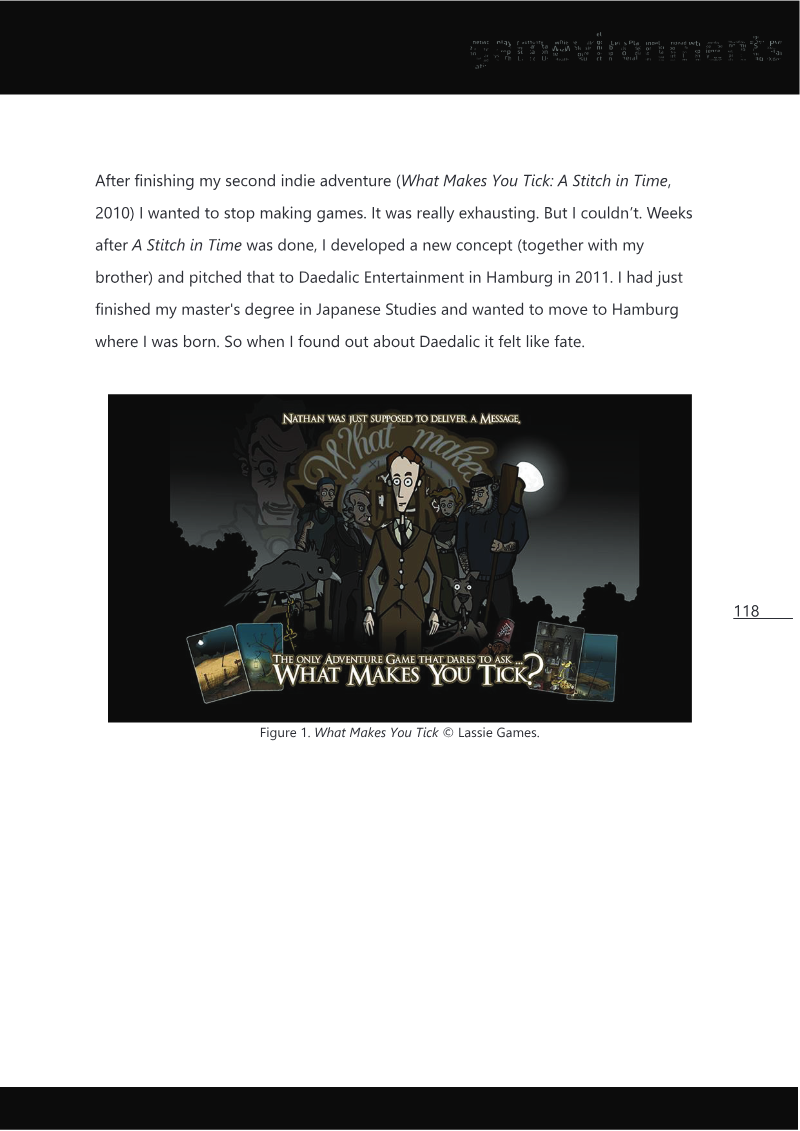
He made his own indie adventure What Makes You Tick in 2007, then became creative lead at Daedalic on The Night of the Rabbit.
This interview with freelance game writer and narrative designer Matthias Kempke, published in issue 10 of the gamevironments journal in 2019, centers on his work on the 2D adventure game Ken Follett's The Pillars of the Earth (2017/2018), developed by Daedalic Entertainment. Kempke traces his path from creating his own indie adventure games, beginning with What Makes You Tick in 2007, to his role as creative lead at Daedalic on The Night of the Rabbit, and then to his position as creative lead and lead writer and designer on the Follett adaptation. The conversation also covers his subsequent move into freelancing and upcoming projects, including the horror title Ad Infinitum.
The interview highlights several design decisions behind the Pillars adaptation. Kempke describes restructuring Follett's novel so that players control its three major characters and make branching choices with consequences that carry across the game. Rather than relying on the puzzle-heavy structure typical of classic adventure games, he and co-writer Kevin Mentz aimed for emotionally grounded interactions and reduced trial-and-error friction, drawing inspiration from Telltale Games. A notable narrative change involves the monk Philip, whose faith is shaken and then restored over the course of the story, a shift Kempke frames as presenting religious questions in a way accessible to both believers and non-believers.
As a primarily first-person account from a creative practitioner, the interview offers insight into development process and authorial intent rather than quantitative data, sales figures, or a systematic survey. Its scope is limited to one project and one developer's perspective, though it provides useful context on adapting an established literary property into interactive form, balancing artistic vision with the practical constraints of budget, team size, and engine limitations.
Each row is a game or company this document names, each column a document, oldest first. A mark means that document names it. Select a row to see those documents.
gamevironments · 2026
gamevironments · 2026
gamevironments · 2026
gamevironments · 2026
gamevironments · 2026
gamevironments · 2025
gamevironments · 2025
gamevironments · 2025
gamevironments · 2025
gamevironments · 2025
gamevironments · 2025
gamevironments · 2025
Thomas Brush · 2026