
gamevironments
Open-access journal from the University of Bremen on video games, religion and culture, with articles, interviews and research reports.
Documents
Video Gaming and Death: Introduction to a Special Issue
Video Gaming and Death: Introduction to a Special Issue examines whether a player's game avatar, or "game body," persists across in-game death, program termination, or hardware failure, and it approaches this question primarily through theology rather than empirical study.
- The paper is primarily a theological essay rather than an empirical study, applying Christian accounts of bodily identity (Athenagoras, Justin Martyr, Augustine, Thomas Aquinas, Joseph Ratzinger) to the question of whether a player's game avatar persists across death, shutdown, or hardware failure.
- Its central thesis is that continuity of a game body is most plausibly grounded in the player's mind, in the presentation and imagination layer, rather than in hardware or software.
- The game body is dissected into three layers: an electrical and memory pattern, a sensory representation, and the player's fictional identification with the avatar.
Perilous and Peril-Less Gaming: Representations of Death with Nintendo's Wolf Link Amiibo
Rex Barnes's study examines how death is represented in video games, arguing that while death is pervasive across the medium, it is typically framed as ludic failure rather than as a meaningful narrative or affective event.
- Rex Barnes argues that death in video games is typically framed as ludic failure rather than a meaningful narrative or affective event, and positions Nintendo's Wolf Link Amiibo in The Legend of Zelda: Breath of the Wild (2017) as a distinct alternative model.
- The Wolf Link Amiibo mitigates player elimination, allowing the avatar to be summoned back into play rather than leaving the player with a momentary setback.
- Wolf Link's summoning carries a 24-hour respawn timer, which turns mortality into a lasting consequence of play and introduces a time-based, ritual awareness of death.
Video Gaming and Death
The document examines video gaming as an especially fertile medium for the uncanny, using the 2010 creepypasta "Ben Drowned" as its central case study.
- Games are argued to be among the most uncanny media because they blend data with embodiment, familiar worlds with mechanical strangeness, and personal memory with networked circulation, drawing on Freud's theory of the uncanny.
- The central case study is the 2010 creepypasta "Ben Drowned," read as both a viral phenomenon and a ghostly informational simulacrum that blurs the boundary between organic and digital, living and dead.
- The physical Nintendo 64 cartridge, which stores save data, becomes a site of nostalgia, memory, and haunting, making hardware itself a vessel for the uncanny.
Win to Exit: Perma-Death and Resurrection in Sword Art Online and Log Horizon
Sword Art Online and Log Horizon both use gaming mechanics rather than Shinto or Buddhist beliefs to address death, dying, and the search for purpose, and this analysis argues that the two anime series reflect a broadly secular approach shaped by the "Win to Exit" trope.
- Sword Art Online depicts a VRMMORPG where death is permanent and players are trapped until the game is beaten, while Log Horizon's Elder Tale allows death with reincarnation and an open-ended, unexplained imprisonment.
- The analysis argues both series use gaming mechanics rather than Shinto or Buddhist beliefs to address death and the search for purpose, reflecting a broadly secular approach shaped by the "Win to Exit" trope.
- Because death is non-permanent in Log Horizon, non-player characters become "neighbors" rather than game objects, and the moral focus shifts from fighting monsters to harm between players, such as player-killing.
Interview with Joonas Laakso, Executive Producer at Next Games Oy, Finland
This interview, published in the 2017 issue of the gamevironments journal, features Joonas Laakso, Executive Producer at Next Games Oy, a Helsinki-based studio of roughly 120 people that develops mobile games built on established entertainment intellectual properties.
- Next Games Oy is a Helsinki-based mobile game studio of roughly 120 people, founded in 2013, that builds games on established entertainment IP and aims to be the preferred partner for bringing major entertainment brands into mobile gaming.
- Its flagship title, The Walking Dead: No Man's Land (2015), is followed by the upcoming augmented reality project The Walking Dead: Our World and a Blade Runner mobile game in development.
- Acceptable content varies sharply by region: blood, dead bodies, and religious symbols require careful handling, and South Korea imposes a strict age-rating barrier.
Video Game Development in Asia: A Research Project on Cultural Heritage and National Identity
This report, a 2017 collaborative study by Gregory Grieve, Christopher Helland, Kerstin Radde-Antweiler and Xenia Zeiler, examines how video game development in Asia engages with cultural heritage and national identity.
- The study addresses a research gap: while media-and-national-identity scholarship has focused on social media, radio, TV, and print, video games, a pervasive medium especially among younger audiences, have been largely overlooked.
- The authors frame games as "secondary worlds" in which national identities are imagined, histories reconstructed, and traditions reinvented.
- The Nepal case contrasts AAA title Far Cry 4 (2014), which presents Nepal as a romantic, timeless "Shangri-La," with the Nepali mobile game polyTricks (2016), which emphasizes natural beauty, economic development, and eco-political critique.
Global Conflicts, Episodic Framing and Attitude Change Towards the Israeli-Palestinian Conflict
This study, authored by Ronit Kampf and colleagues, examines whether the educational simulation Global Conflicts (2010) can shift attitudes toward impartiality in the Israeli-Palestinian conflict, and whether the framing of a game scenario matters.
- A study of 210 Israeli-Jewish and Palestinian undergraduates found that playing the Checkpoint scenario of the game Global Conflicts (2010), which used personal, human-interest episodic framing, significantly shifted attitudes toward impartiality for both groups.
- Israeli-Jewish participants showed larger shifts toward impartiality than Palestinian participants after playing the Checkpoint scenario.
- The group-framed Military Raid scenario and the no-scenario control produced no comparable attitude change, suggesting framing rather than violent or security content drove the effect.

You Can Be Anyone; But There Are Limits: A Gendered Reading of Sexuality and Player Avatar Identification in Dragon Age: Inquisition
Mohamed S. Hassan's 2017 analysis argues that Dragon Age: Inquisition markets itself as a breakthrough in character customization and LGBTQ+ representation, yet ultimately reinforces binary gender norms and stereotypes shaped by race and religion.
- Hassan's 2017 analysis argues that Dragon Age: Inquisition markets itself as a breakthrough in customization and LGBTQ+ representation but ultimately reinforces binary gender norms and stereotypes shaped by race and religion.
- The study treats the game's 'magic circle' as porous: players experience in-game choices as meaningful reflections of their real-world identities, and real-world religions mapped onto the game world determine which romance paths are open.
- A two-playthrough case study, supplemented by BioWare forum posts, shows that a player's religious and gender selections can restrict or unlock romantic options, reinforcing heteronormative and hegemonic gender expectations.

Accept Your Baptism, and Die! Redemption, Death and Baptism in BioShock Infinite
Frank Bosman's analysis examines the four baptism scenes in BioShock Infinite as a lens for understanding the game's treatment of redemption, sin, and death, situating these scenes within a broader critique of American religious exceptionalism.
- Frank Bosman's analysis uses the four baptism scenes in BioShock Infinite as a lens on the game's treatment of redemption, sin, and death, framed within a critique of American religious exceptionalism.
- Bosman argues the game fuses American nationalism with Protestant Christianity through Columbia's "shining city upon a hill" imagery, its sainted Founders, and its prophet figure Comstock.
- Three of the four baptism scenes involve drowning or near-drowning tied to death, and Bosman contends these moments often fail to deliver genuine cleansing.
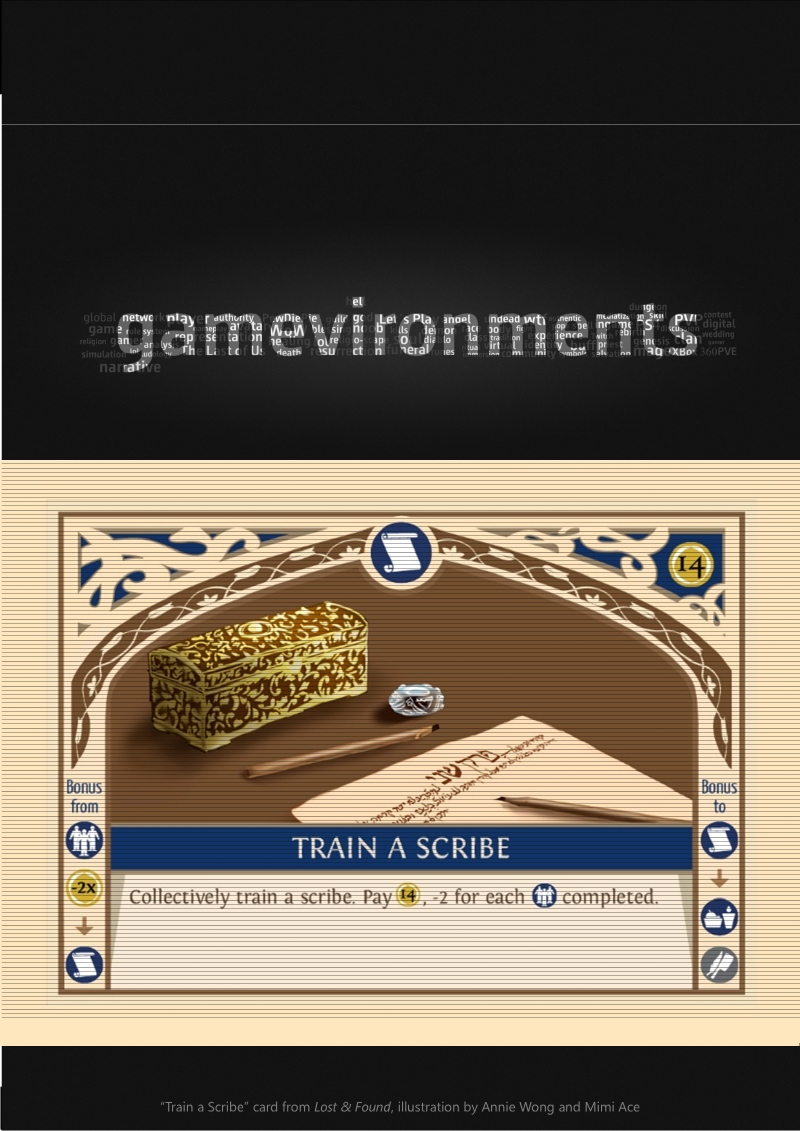
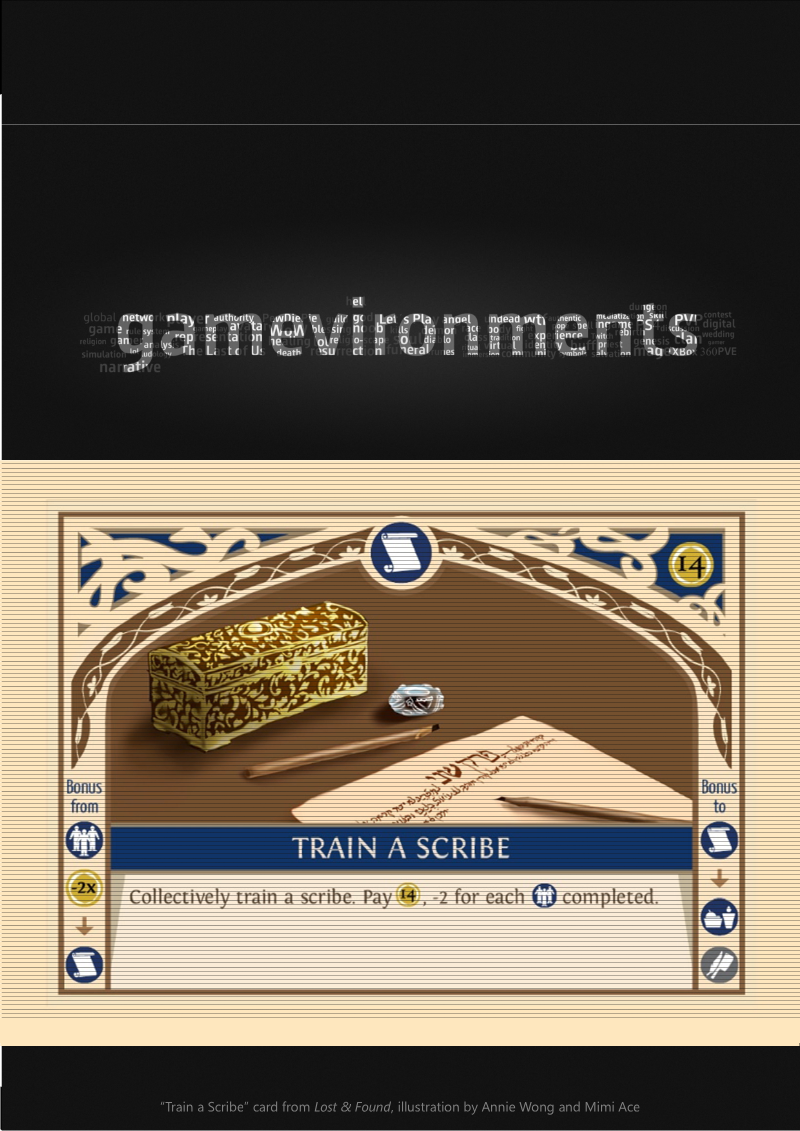
Finding Lost & Found: Designer's Notes from the Process of Creating a Jewish Game for Learning
Lost & Found is a cooperative-competitive strategy game, later paired with a party-game companion, designed to teach medieval Jewish law, specifically Maimonides' laws of lost property in the Mishneh Torah (1180) and related Talmudic sources such as Sanhedrin 17b and Kiddushin 29a.
- The game Lost & Found, developed by Owen Gottlieb through ConverJent at CLAL starting in 2011, teaches medieval Jewish law on lost property drawn from Maimonides' Mishneh Torah (1180) and Talmudic sources such as Sanhedrin 17b and Kiddushin 29a.
- The central design challenge was balancing the law's tension between communal obligation and protecting individuals from undue burden, which the team judged existing cooperative and 'coopetition' models such as Pandemic and Shadows Over Camelot could not adequately capture.
- Key mechanics included win conditions requiring cooperative construction of communal goals alongside individual family goals, hidden progress tracks, multiple win states including an all-lose outcome, and redefining winning as 'living a good life' through secret 'Acts of Meaning.'

Interview with Ricardo Ruiz from 3Ecologias
This interview, published in the 2016 issue of a games studies journal, profiles 3Ecologias, a Brazilian company founded by Ricardo Brazileiro and Ricardo Ruiz that develops open-technology solutions for education, culture, and sustainability, and focuses on its game project Contos de Ifá.
- 3Ecologias, a Brazilian company founded by Ricardo Brazileiro and Ricardo Ruiz with about fifteen employees, builds open-technology solutions for education, culture, and sustainability, named after Félix Guattari's three ecologies of mind, society, and environment.
- Its flagship game Contos de Ifá, in development since 2010 with the Coco de Umbigada Cultural Center in Olinda, Pernambuco, teaches Afro-Brazilian mythology (especially Candomblé) to counter religious prejudice, organizing play around the xirê order of orisha worship starting with Exú.
- As of the interview, the game offered four playable phases dedicated to individual orishas, with two more in development and a stated goal of 256 stories.

Interview with Shailesh Prabhu, Indian Game Designer
This interview, published in the 2016 issue of a game studies journal's interview section, features Indian game designer Shailesh Prabhu discussing his work and his upcoming two-player local multiplayer game Sky Sutra.
- Shailesh Prabhu runs a loosely organized, multicultural team spread across Sweden, France, India, and Copenhagen, and recently took a full-time game design job in Copenhagen while continuing independent work on his project.
- Sky Sutra is a two-player local multiplayer game with asymmetric design: one player steers a flying carpet that leaves a trail, while the other tries to stun and displace them, and it originated from a physics-inspired concept about players occupying different planes.
- Sky Sutra was shown at the Indie Game Shindig in Kerala in 2015 and at Now Play This in London in 2016, with generally positive audience reception.