
gamevironments
Open-access journal from the University of Bremen on video games, religion and culture, with articles, interviews and research reports.
Documents

Interview with Marcus Carter on Children's Play and Games Studies Discourse
In this interview, Dr. Marcus Carter, Senior Lecturer in Digital Cultures at the University of Sydney and co-director of the Socio-Tech Futures Lab, discusses his research on children's play and his critique of how gaming, particularly gaming addiction, is framed in mainstream media.

Holy Ocarina! Exploring Religion in/of/through The Legend of Zelda Series
Holy Ocarina! examines The Legend of Zelda series through a religious-studies lens, asking how religion appears within the games' fictional world, how real-world religious traditions have shaped the series, and how fan communities mirror religious practice.

Ghosts, Spooks, and Martyrs: Historical Hauntings in Tom Clancy's Ghost Recon Wildlands
Megan Ward's article examines Ubisoft's 2017 military shooter Tom Clancy's Ghost Recon Wildlands as a case study in how interactive media shapes historical memory.
- The article uses the 1985 murder of DEA agent Enrique "Kiki" Camarena, whose death carries alleged but unproven CIA entanglements, as its central lens on how interactive media reshapes historical memory of U.S. intervention in Latin America.
- The author argues Ubisoft's 2017 game Tom Clancy's Ghost Recon Wildlands presents Latin America as a "geography of chaos" that appears lawless and in need of outside intervention, framing U.S. involvement as justified.
- Claims of authenticity, including developer fieldwork with U.S. and Bolivian special forces and consultations with CIA, DEA, and JSOC personnel, lend the game credibility that the author sees as central to its persuasive reframing.

New Earth: Fantasy Pantheon Inspired by Afro-Brazilian Religion
Eliane Bettocchi's research report presents "New Earth," a fantasy role-playing game setting whose pantheon and faith systems draw on Afro-Brazilian religions, particularly Candomblé, Umbanda, and Tambor de Mina.

History Games for Boys? Gender, Genre and the Self-Perceived Impact of Historical Games on Undergraduate Historians
This study examines how historical video games shape the interest in and understanding of history among undergraduate history students, with particular attention to whether the perceived impact of games differs by player gender and game genre.
- Survey of 172 University of Winchester undergraduate history students over two academic years found that games are influential on historical interest and knowledge in an uneven, individual way rather than uniformly across a cohort.
- Among public-sphere sources surveyed, games ranked lowest on average in influencing both interest and knowledge, but showed a bimodal pattern where respondents were either strongly affected or barely affected.
- The clearest disparity was by gender: 52.4 percent of male respondents versus 29.5 percent of female respondents described games as highly influential on their knowledge.
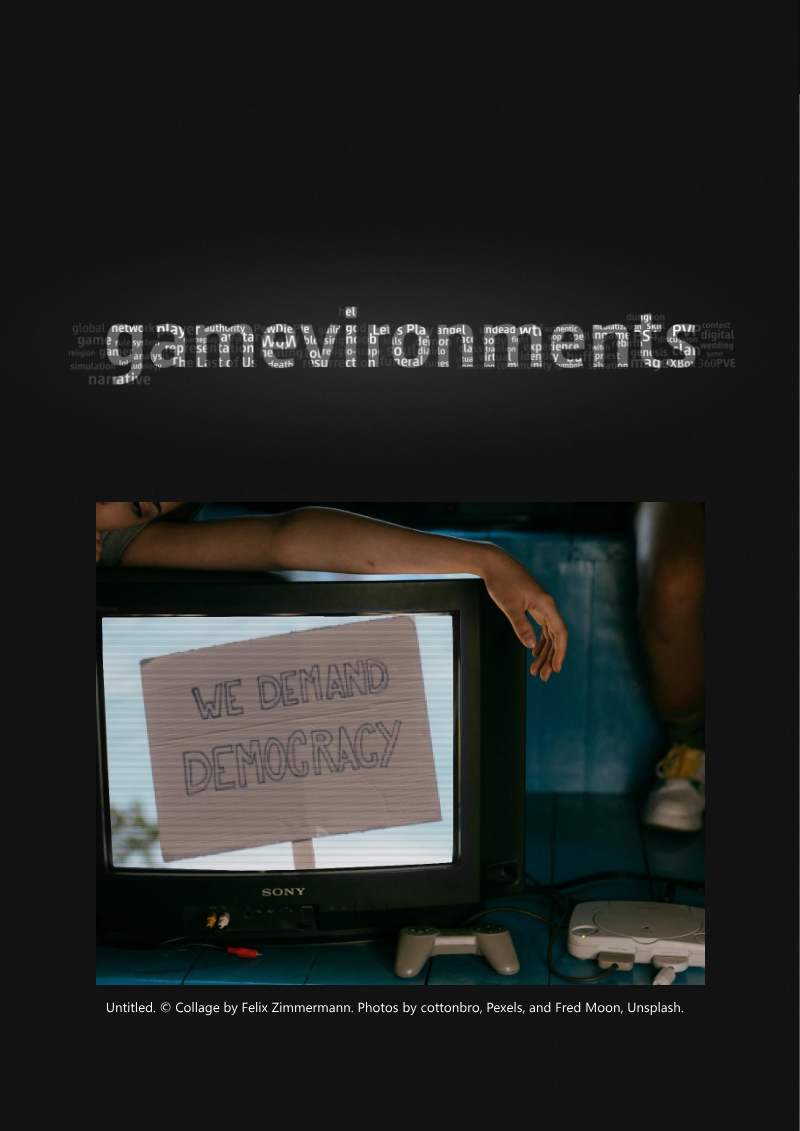
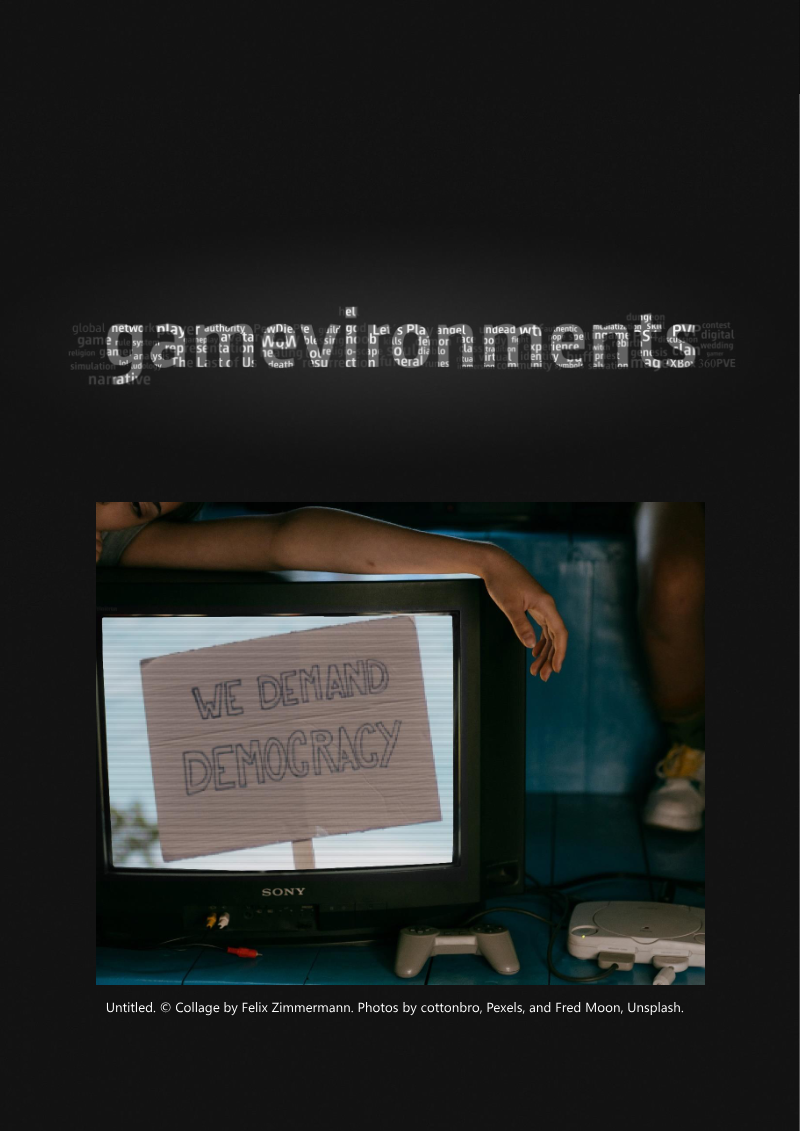
Democracy Dies Playfully: (Anti-)Democratic Ideas in and Around Video Games
This collection examines democracy, politics, and ideology in and around video games, with particular attention to Global South contexts.
- The central case study is the #TodosContraPLS383 Twitter backlash against Brazil's Senate Bill 383 (2017), which proposed regulating esports, with analysis of 180 coded tweets around the November 2019 public hearings.
- Anti-regulation discourse dominated the coded tweets, with the most frequent narrative (38 occurrences) portraying the State as incompetent and hostile to market actors, while players, teams, and companies argued the bill would add bureaucracy and taxes and was drafted without their input.
- An accompanying online poll reportedly showed 87.1% of roughly 49,000 votes opposing the bill, though the reported 438,125% increase is implausible and should be treated with caution.
Democracy Dies Playfully: (Anti-)Democratic Ideas in and Around Video Games
Projekt CH+ examines whether the mechanics that make video games engaging can help citizens navigate elections, and it situates this question within broader concerns about declining political participation.
- Swiss voter turnout has stayed below 50 percent since 1979, and non-voters are often described as content but disinterested, feeling incompetent, or socially isolated.
- The report argues that democratic participation lacks the clear goals, immediate personal feedback, and controllable choices that make video games compelling, while political communication tends to be slow, bureaucratic, and unemotional.
- The project built a playful prototype voting-support app with candidate swiping, ranking, and dynamic list creation, tested for the 2019 Swiss federal election and in a canton-wide trial in Uri in March 2020.
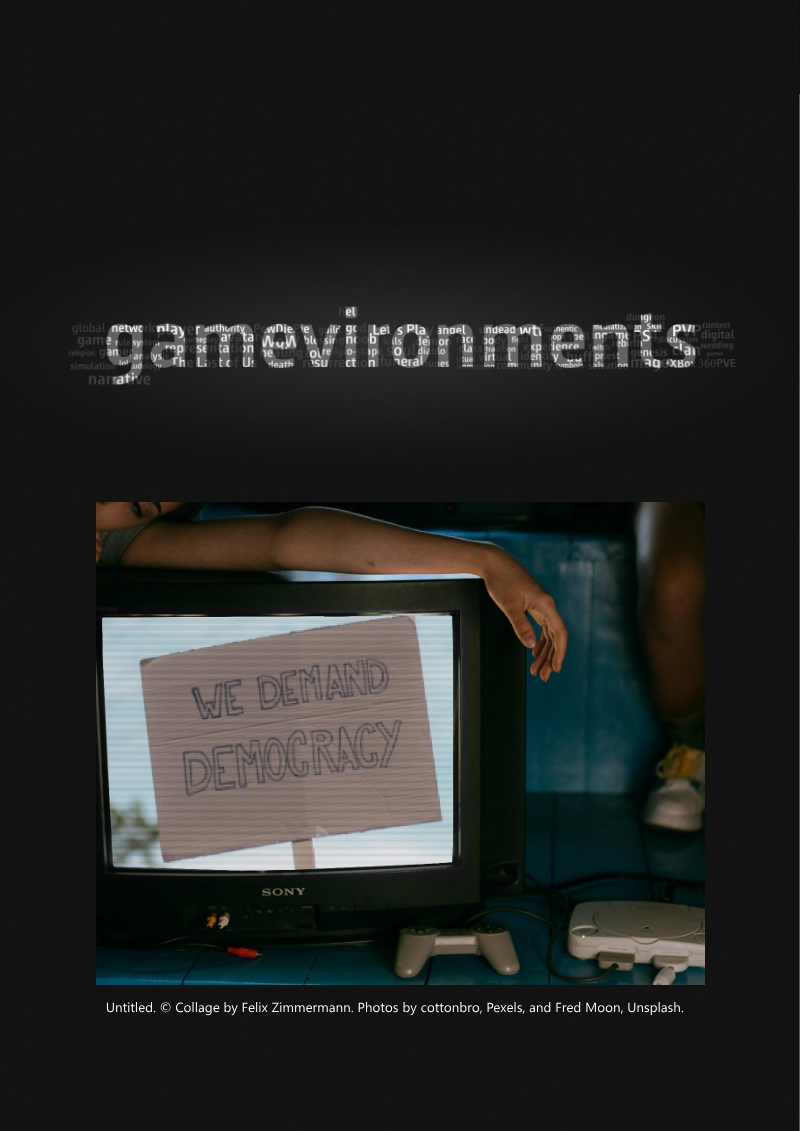
Democracy Dies Playfully: (Anti-)Democratic Ideas in and Around Video Games
Lars Dolkemeyer's analysis of Frostpunk (2018) examines how construction simulations shape the political subjectivity of players, using the game as a case study for the tension between autocratic management and shared responsibility.
- Frostpunk (2018) is analysed as a case study in how construction simulations shape players' political subjectivity, specifically the tension between autocratic management and shared responsibility.
- The author argues that Frostpunk reconfigures the autocratic logic of predecessors like Tropico, which abstract territory, economy, and population into objects of absolute, deterritorialized power, by using coldness aesthetics, a temporal structure with no final victory or defeat, and a community that acts as a collective agent.
- The player becomes simultaneously autocrat and ruled, and the game is better understood as a "management of demise" than as adaptation or conquest.

Politics at The Heart of Gaming: A Critical Retrospective of Gamescom 2019
This research report by Kathrin Trattner offers a critical retrospective of gamescom 2019, the world's largest gaming event held in Cologne, Germany, drawing on the author's one-day visit to the fair.
- Gamescom 2019 in Cologne drew roughly 373,000 visitors and over 1,100 exhibitors across 218,000 square meters, with its video content reportedly viewed more than 100 million times worldwide in the first days.
- The most visible political presence at the fair came from German state institutions, notably the German armed forces, whose recruitment booth featured a VR jet fighter simulator and drew criticism for conflating gaming with warfare.
- The Verfassungsschutz of North Rhine-Westphalia ran a provocative booth using burned flag imagery and satire about Islamist radicalization, prompting questions about a domestic intelligence agency conducting public education at a gaming fair and concerns that its satire relied on religious and racial stereotypes.

To Dream a Game
This document is an interview published in the 2020 issue of the gamevironments journal, in which Luis Wong of LEAP Game Studios discusses Tunche, an upcoming beat 'em up under development.
- LEAP Game Studios, founded in August 2012 by four friends in their early twenties, reached milestones including one of the first Peruvian console releases in 2015, a PlayStation Plus title, and a publishing contract for an original intellectual property.
- Tunche is a cooperative action beat 'em up for up to four players, set in the Amazon rainforest and rendered in hand-drawn animation, with combat-focused mechanics intended to differentiate it within its genre.
- Tunche's design draws on Amazonian myths and folklore, including the title creature and characters such as Rumi and the giant dolphin Boutu.

Paradise Lost: Value Formations as an Analytical Concept for the Study of Gamevironments
Grieve, Radde-Antweiler, and Zeiler's article argues that scholars studying religion and video games should replace "religion" as their primary analytic category with "value formations," defined as socially constructed, contested, and interdependent collections of values shaped by ethics, aesthetics, and norms.
- The authors propose replacing "religion" with "value formations" (socially constructed, contested, interdependent collections of ethical, aesthetic, and normative values) as the primary analytic category for studying religion and video games, arguing that religion-centered approaches have lacked clear definitions of religion.
- Players rarely recognize in-game religious elements as religious, which the authors cite as a key reason religion-centered frameworks fall short for analyzing gamevironments.
- A ludographic analysis of the Far Cry 5 mission "Paradise Lost" finds the game sets a positively coded "good religion" (voluntary, free, rational community) against a negatively valued cult, with "Bliss" operating as a judgmental, implicitly religious negative value conveyed through visuals, audio, haptics, and gameplay.

To Dream a Game: Dreams as Interactive-Narrative Devices in Digital Games
Frank G. Bosman's article "To Dream a Game" examines dreams and dreamlike phenomena as interactive-narrative devices in digital games, arguing that these sequences occupy a distinctive place where ludological and narratological functions converge.
- Dream sequences in digital games are almost always lucid because the medium's mandatory interactivity gives players control over dreamlike segments, with the exception of non-interactive cutscenes.
- Citing Gackenbach's research, the article reports that gamers, particularly hard-core players, tend to have more lucid and control dreams, more bizarre dreams, and more violent or nightmarish dreams, which they experience with less distress.
- Bosman proposes a working definition of dreams as a temporarily diminished-consciousness state experienced involuntarily, and applies it through close reading and game-immanent analysis of playable texts.