
G|A|M|E – The Italian Journal of Game Studies
Open-access peer-reviewed game studies journal published by the Italian cultural association Ludica since 2012, mostly in English.
Documents
De-framing Video Games from the Light of Cinema
Perron and Arsenault's 2015 essay, "De-framing Video Games from the Light of Cinema," argues that video game scholarship has been shaped too heavily by a cinema-centric framing that treats film as the default lens for understanding games.
- The essay argues that video game scholarship has been overly shaped by a cinema-centric framing that treats film as the default lens, and that this alignment is a cultural and historical construction rather than a natural fit.
- Its central thesis is methodological: games should be analyzed through their own traditions, including real-time animation, parallel projection, cartography, and text-based interactive fiction, along with ludic and computational dimensions that cinema-focused analysis underweights.
- Drawing on Gaudreault and Marion's theory, the authors call on scholars to use film theory with awareness of its limits rather than importing film assumptions wholesale.
'Tell No One': Cinema Auditorium as Game-Space: Audience Participation, Performance and Play
Kennedy and Atkinson's 2015 study examines Secret Cinema's immersive staging of Back to the Future as a hybrid form that combines film, game, and theatre.
- The study frames Secret Cinema's immersive staging of Back to the Future as a hybrid of film, game, and theatre in which audiences actively perform within the film rather than simply watch it.
- Based on participant observation and pre- and post-event questionnaires with 70 participants, the authors find the experience is shaped as much by play as by viewing.
- Pre-event in-fiction websites, assigned identities, and costume instructions, combined with on-site navigation of a recreated Hill Valley, encouraged roleplay and cosplay-like behaviour, with participants describing the experience as "live" and "in character."
Narrative Time in Video Games and Films: From Loop to Travel in Time
This paper argues that narrative time in video games cannot be analyzed with the same tools used for film, because the player's actions help shape the story itself.
- The paper argues video game narrative time cannot be analyzed with film tools because player actions help shape the story, and it introduces "participation time" as a third temporal layer alongside story time and discourse time.
- Participation time is the duration a player spends in an event, which can diverge sharply from story time; a Tomb Raider climbing sequence may last ten minutes or several times that depending on player skill.
- Flashbacks and flashforwards, routine in film, create temporal paradoxes in games because a player-controlled avatar cannot easily return to an earlier moment or act on future knowledge without contradiction.
Bad Object 2.0: Games and Gamers
Steve Anderson's peer-reviewed essay "Bad Object 2.0: Games and Gamers" examines how American film and television have depicted video games and their players over roughly four decades, from the 1970s through the 2000s.
- Steve Anderson's essay argues that American film and television depictions of video games and gamers moved from fascination and relative acceptance in the 1970s and 1980s to a dominant discourse of denunciation linking gamers to violence, addiction, and repressed sexuality, with notable exceptions.
- The study's central analytical focus is the cultural discourse Hollywood produced about games rather than games or gamers themselves, covering roughly four decades from the 1970s through the 2000s.
- The representational shift is argued to correlate with the games industry's economic fortunes, including a massive collapse in 1983, a home-console rebound in the 1990s, and by the 2000s console games posing a viable commercial threat to film and television.
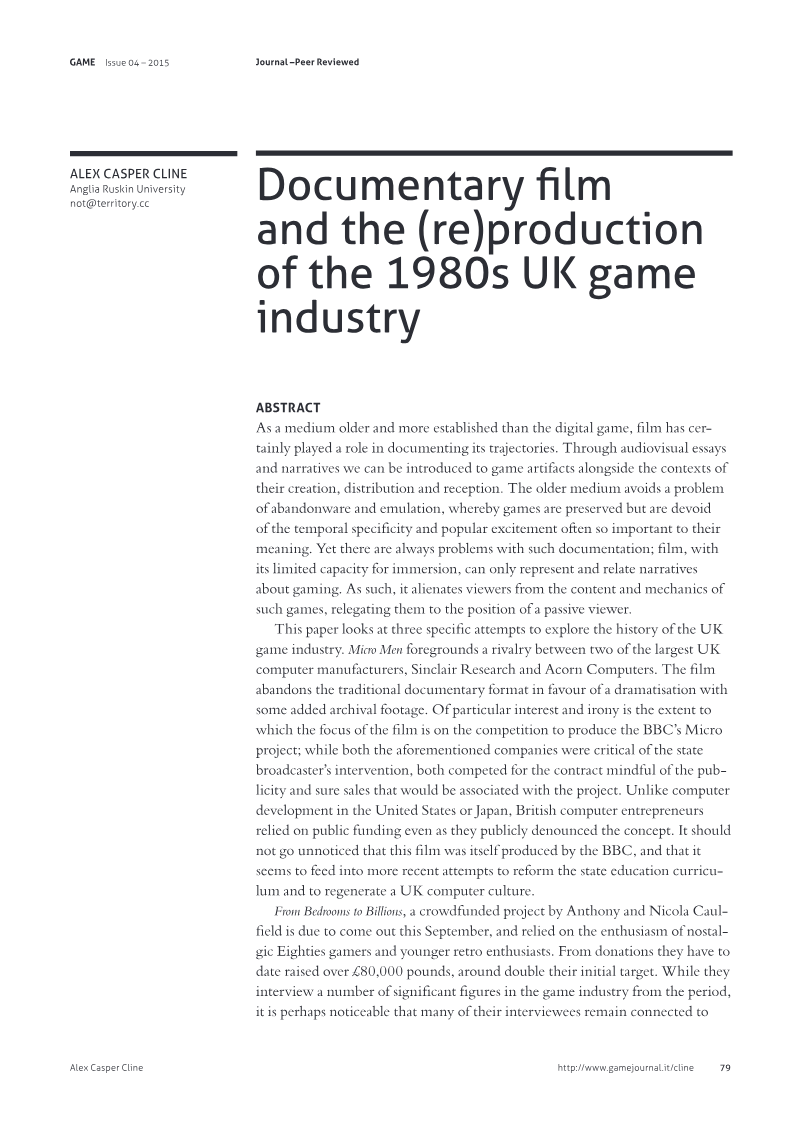
Documentary Film and the (Re)Production of the 1980s UK Game Industry
Cline's paper examines three documentary films about the 1980s UK games industry, Micro Men, From Bedrooms to Billions, and Spectrum Diamond, and argues that these works offer historical contextualisation that play and emulation cannot provide, yet are never neutral.
- The paper argues that documentaries about the 1980s UK games industry are not neutral records but active sites of historical construction, shaped by their funding, broadcaster decisions, and crowdfunding dynamics.
- Micro Men (a BBC-produced dramatisation) centres the Sinclair–Acorn rivalry and the BBC Micro contract, pushing a triumphal "Great People" narrative while downplaying the state funding the British computer industry relied on despite its rhetoric of independence.
- From Bedrooms to Billions, which was crowdfunded, frames the story around independent developers and the loss of UK ownership, citing a roughly 78% drop in UK-owned financial activity between 1993 and 1995.
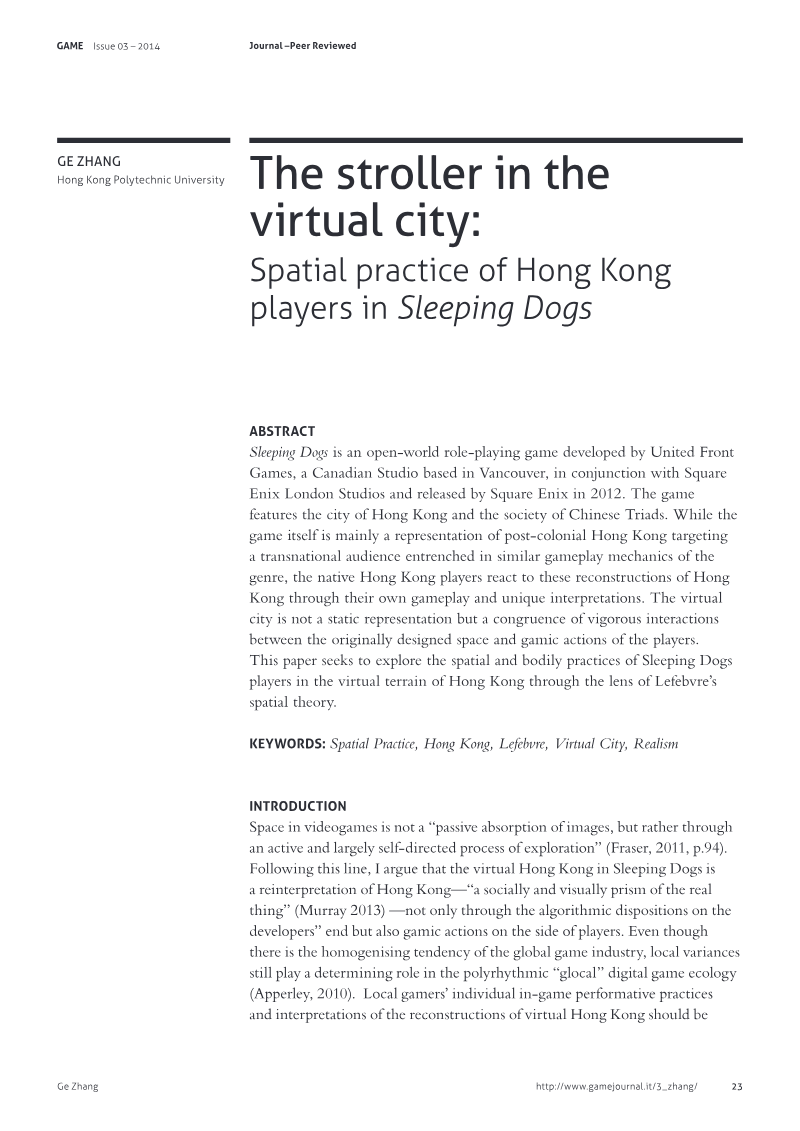
The Stroller in the Virtual City: Spatial Practice of Hong Kong Players in Sleeping Dogs
Ge Zhang's study examines how Hong Kong players engage with the virtual city of Sleeping Dogs (2012), arguing that the game's space is co-produced by developers' designs and players' everyday cultural practices rather than existing as a static representation.
- Ge Zhang's study frames the virtual city of Sleeping Dogs (2012) as co-produced by developers' designs and players' everyday cultural practices, drawing on Lefebvre's triad of conceived, perceived, and lived space.
- The research uses qualitative evidence from Cantonese online forums, five player interviews, and participant observation, centering native Hong Kong players who experience the game as both insiders and tourists rather than assessing its accuracy.
- Local players frequently objected to the game's representations, such as the depiction of Tin Hau Temple, the merging of Kowloon locations into Hong Kong Island, and the absence of realistic congestion, which developers avoided to preserve gameplay.
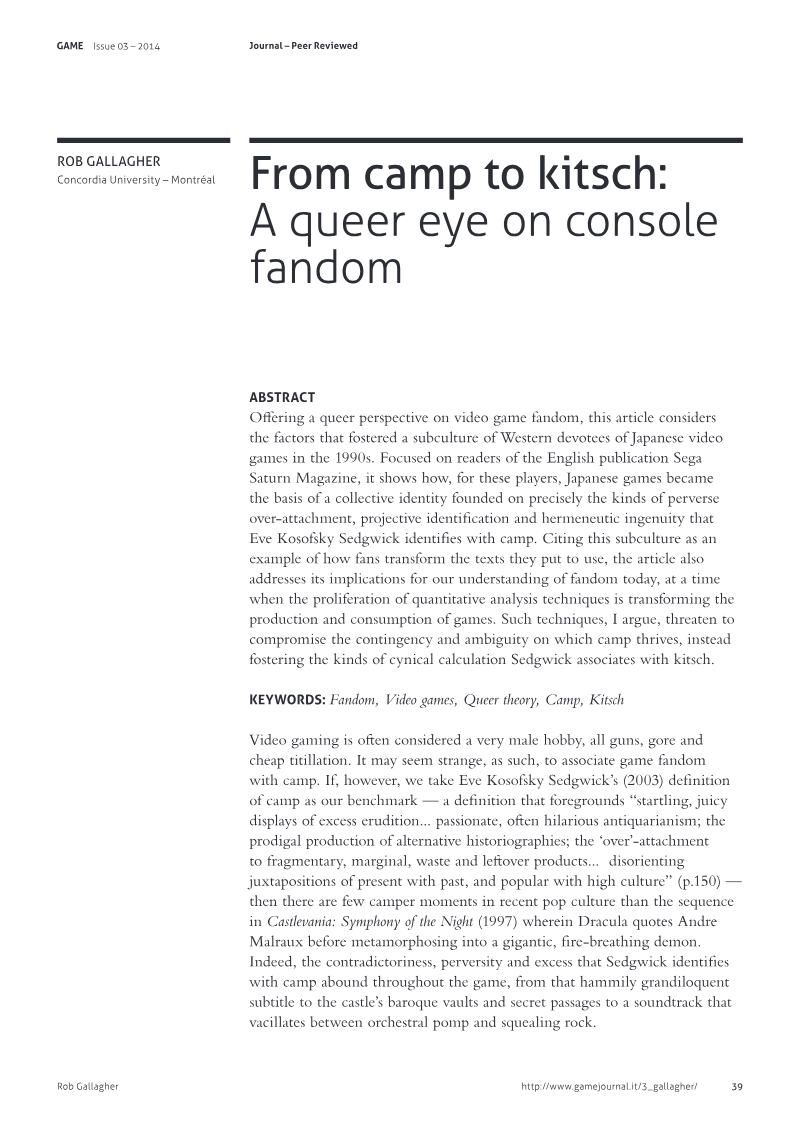
From Camp to Kitsch: A Queer Eye on Console Fandom
Rob Gallagher's study examines how Western console fans of Japanese games in the 1990s formed a camp subculture centered on import gaming, with Sega Saturn Magazine as a key node in constructing collective identity.
- Western console fans of Japanese games in the 1990s built a camp subculture around import gaming, with Sega Saturn Magazine acting as a key node in forming collective identity.
- Fans held Japanese titles in a mix of reverence and ridicule, using practices such as projective identification, over-attachment, and "felicitous mistranslation" to turn them into vehicles for identity and modest protest rather than mere exoticism.
- The study argues camp is giving way to kitsch as the Japanese industry declines and data-driven development dominates, since telemetric analytics screen out the ambiguity and irony that camp depends on.
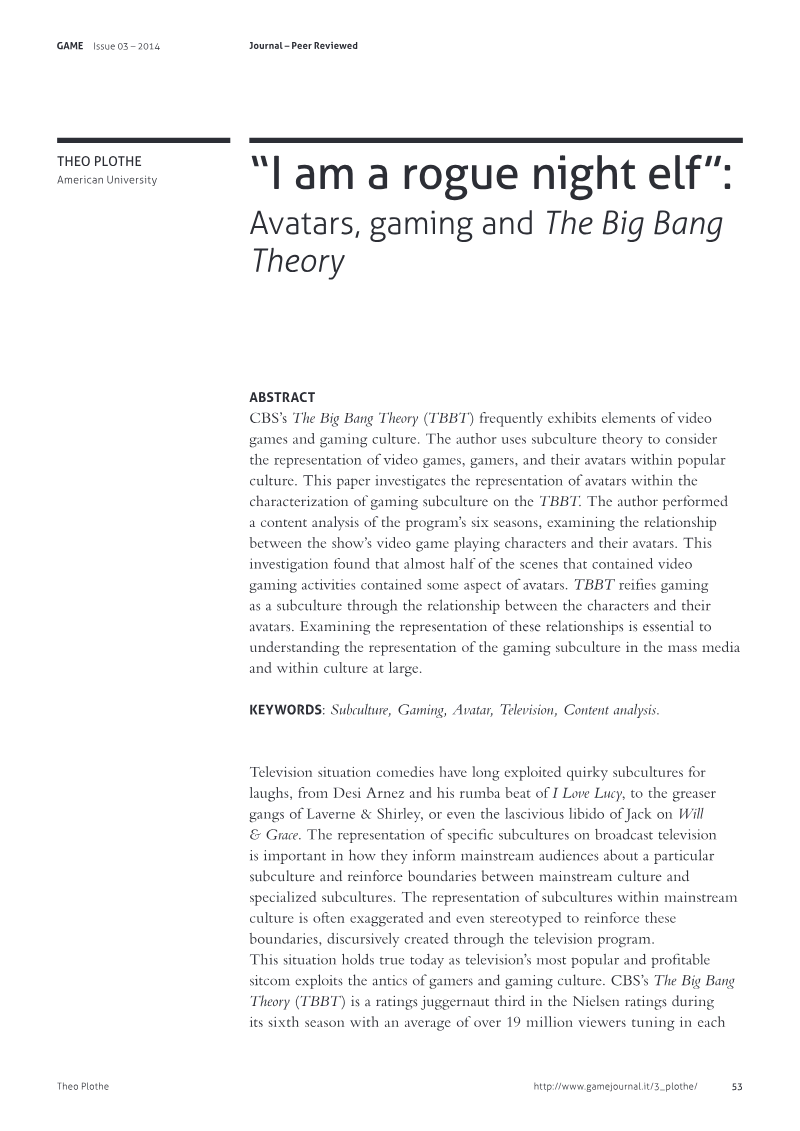
Avatars, Gaming and The Big Bang Theory
This study examines how the CBS sitcom The Big Bang Theory represents video gaming as a subculture, with particular attention to the relationship between gaming characters and their avatars.
- The study analysed the first six seasons (135 episodes) of The Big Bang Theory and found 79 scenes referencing gaming across 39 episodes, with 45.6 percent of those scenes involving avatars.
- The player-avatar relationship serves as a key marker distinguishing gaming subculture from mainstream culture in the show's portrayal of gamers.
- Gaming references declined sharply in later seasons, with only 18 scenes in Seasons 5 and 6, which the author attributes to the show's shift toward broader audience appeal and interpersonal relationships.
Playing New Music with Old Games: The Chiptune Subculture
Chiptune is a music subculture that repurposes the sound hardware of early computers and consoles, such as the Commodore 64, Amiga, and Game Boy, to create new electronic music.
- Chiptune is a music subculture that repurposes the sound hardware of early computers and consoles, such as the Commodore 64, Amiga, and Game Boy, to create new electronic music.
- Its roots lie in 1980s and 1990s tracker and demoscene practices, and it advanced in the late 1990s with tools like Nanoloop and Little Sound DJ, which linked Game Boys to studio workflows via MIDI.
- The subculture is defined more by its social dimension (live performance, a shared visual aesthetic, and a fan community identity) than by its sonic materials, and it deliberately stands as a counterpoint to mainstream culture.
Videorec as Gameplay: Recording Playthroughs and Video Game Engagement
Gabriel Menotti's paper argues that recorded video playthroughs are not a peripheral byproduct of game culture but an integral force shaping how games are played, improved, and developed.
- Gabriel Menotti argues that recorded video playthroughs are an integral force shaping how games are played, improved, and developed, not a peripheral byproduct of game culture.
- The paper traces machinima's origins to high-performance play, such as early speedrunning videos and Quake demo movies, rather than to narrative filmmaking.
- The analysis examines three practices: tool-assisted speedruns, let's play videos, and Minecraft documentation, which circulate creations, promote the game, and feed back into its development.
Twine's Revolution: Democratization, Depoliticization, and the Queering of Game Design
Harvey's analysis examines how Twine, a free and accessible tool for creating interactive stories, has opened game design to marginalized creators, including women, queer, trans, and people of color, who produce "personal games" that offer queer alternatives to mainstream conventions of difficulty, process, and content.
- Twine, a free and accessible interactive-storytelling tool, has enabled women, queer, trans, and people of color to produce "personal games" that offer queer alternatives to mainstream conventions of difficulty, process, and content, a movement the author calls the "Twine Revolution."
- The author argues this movement's disruptive potential is matched by serious vulnerabilities: its creators are often dismissed as producing "not even games" and their work is depoliticized through buzzwords like "diversity" and "innovation."
- The economy around this work is non-capitalist, sustained by donations, barter, crowdfunding, zines, and unconferences, which foster community but leave creators precarious and exposed to poverty and insecurity.
Assembling a Game Development Scene? Uncovering Finland's Largest Demo Party
Assembly, an annual LAN and demo party held in Helsinki since 1992, serves as the focal point of a study examining how Finland's demoscene and game development communities are intertwined.
- Assembly, an annual LAN and demo party held in Helsinki since 1992, has grown from roughly 700 attendees at its founding to around 5,000 today, and hardware sponsors and game and IT firms recruit directly at the event.
- The study presents Assembly as an early example of commercialization within Finland's demoscene, drawing on interviews, a 2011 visitor survey of 92 respondents, and decades of Helsingin Sanomat coverage.
- Assembly's identity has shifted toward that of a festival, with most attendees valuing social connection above gaming itself, although e-sports and game development programming have gained prominence.