
G|A|M|E – The Italian Journal of Game Studies
Open-access peer-reviewed game studies journal published by the Italian cultural association Ludica since 2012, mostly in English.
Documents
Participation at the Global Game Jam: A Bridge Between Consumer and Producer Worlds in Digital Entertainment
The Global Game Jam (GGJ), a 48-hour event in which developers and others prototype complete games around an annual theme, is examined here as a sociological phenomenon marking a shift from a developer-only gathering toward a participatory, prosumer-oriented ritual.
- The Global Game Jam, a 48-hour event where participants prototype complete games around an annual theme, is analysed as a shift from a developer-only gathering toward a participatory, prosumer-oriented ritual.
- The event grew from roughly 1,600 developers in 23 countries in 2009 to over 10,000 in 46 countries in 2012, and set a 2013 record as the largest game jam, with around 16,705 participants reported globally.
- The 2013 survey profile is predominantly young and male: women made up about 12.6 percent of respondents, over 80 percent were aged 18 to 29, and roughly half held a university degree.
Digital Aesthetic Forms Between Cinema and Television: The Need for New Research Directions
The paper argues that the visual conventions that structured twentieth-century cinema and television, shaped by their competitive coexistence, have been unsettled by digital media.
- Twentieth-century visual conventions of cinema and television, shaped by their competitive coexistence, have been unsettled by digital media, and Bolter and Grusin's early-digital concept of remediation no longer fully explains current media forms.
- Mainstream cinema and television have responded to digital disruption by investing heavily in high-definition, 3D, and augmented-reality technologies that reinforce a new aesthetic of definition and immersion.
- The authors argue that television's historically limited attention to aesthetics, due to low-resolution free-to-air broadcasting, shifted around 2005 as flat screens, broadband, pay-per-view, and HD made image quality a key cultural value.
Graphical Technologies, Innovation and Aesthetics in the Video Game Industry: A Case Study of the Shift from 2D to 3D Graphics in the 1990s
This study examines how graphical technologies shaped the video game industry during the 1990s, with particular focus on the transition from 2D to 3D graphics.
- The study's central argument is that graphical technology affects platform success only indirectly: visual innovations matter when tied to new gameplay possibilities rather than serving as superficial eye-candy.
- The authors identify a gap in scholarship on game innovation, noting that only a small fraction of papers at a major digital games conference address the topic.
- The Super NES favored refining proven genres such as platformers, role-playing games, and 2D action-adventures, using features like Mode 7 and layered backgrounds within familiar formulas.
Polygons and Practice in Skies of Arcadia
This paper examines the design history of Skies of Arcadia, Sega's 2000 Dreamcast role-playing game (released in Japan as Eternal Arcadia), with the aim of challenging technologically determinist accounts of three-dimensionality in games.
- The paper argues that three-dimensionality in games is a collaborative product of designers, players, business imperatives, and hardware, challenging technologically determinist accounts that credit graphics technology alone.
- Skies of Arcadia (Sega, 2000, Dreamcast; Eternal Arcadia in Japan) was commissioned as a showcase of the Dreamcast's polygon-processing power, as Sega needed the console to succeed after the commercial struggles of the Saturn.
- The game's setting shifted from traditional sword-and-sorcery to a sky-pirate world inspired by Hayao Miyazaki's films, chosen both for appeal to a teenage and anime-oriented audience and for the visual possibilities of airborne vantage points.
Reverse-Engineering Graphical Innovation: An Introduction to Graphical Regimes
Arsenault and Côté's 2013 paper argues that graphical innovation in video games should be understood through two intertwined dimensions, functional and aesthetic, with technology serving as a facilitating agent rather than the sole cause of change.
- Arsenault and Côté (2013) argue that graphical innovation in video games rests on two intertwined dimensions, functional and aesthetic, with technology acting as a facilitator rather than the sole cause of change.
- The authors introduce the 'graphical regime,' defined as the junction between gameplay and visual representation that persists independently of hardware, and argue that hardware capability alone does not explain platform success or design trajectories.
- The degree of control a player holds over camera, framing, and depth is treated as a central analytical variable, and the creative process they call 'mise-en-image' describes how gameplay, vision, and graphical style are articulated together.
A New Angle on Parallel Languages: The Contribution of Visual Arts to a Vocabulary of Graphical Projection in Video Games
This article argues that the video game field has under-developed its vocabulary for graphical projection, relying on loose terms such as "top-down view" and "isometric graphics" where a more precise, art-historical terminology would serve analysis better.
- The paper argues that game studies relies on loose labels such as "top-down view" and "isometric graphics" and proposes art-historical terminology, classified by underlying projection principles rather than by technology, as a sturdier analytical framework.
- Perspective (rooted in Alberti's treatise) simulates human vision through foreshortening, whereas parallel projection preserves relationships between axes; pictorial projection splits into oblique forms (cavalier, cabinet) and axonometric forms (isometric, dimetric, trimetric).
- Dimetric rendering with its 2:1 pixel ratio is far more common in practice than true isometric projection, a point the author uses to show that the popular label often misdescribes what games actually display.
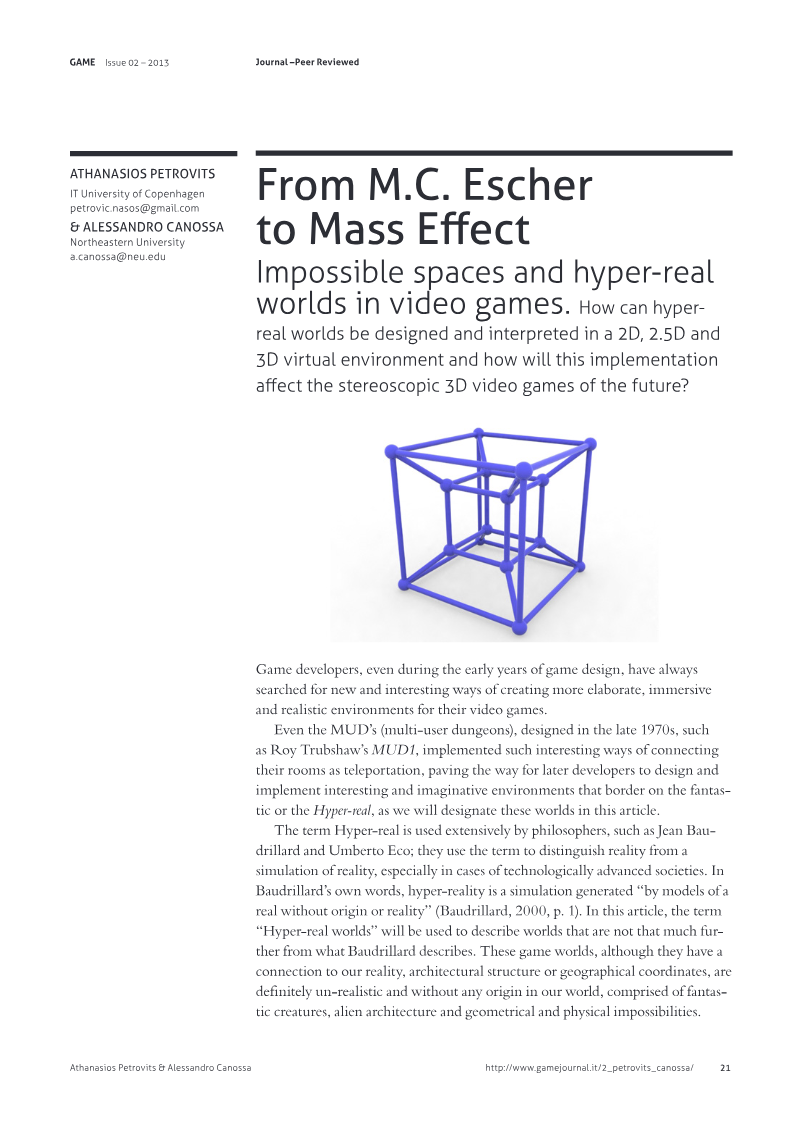
From M.C. Escher to Mass Effect: Impossible Spaces and Hyper-Real Worlds in Video Games
This peer-reviewed article by Athanasios Petrovits and Alessandro Canossa examines how impossible spaces and hyper-real worlds can be designed, interpreted, and implemented across 2D, 2.5D, and 3D video game environments, and what this means for the future of stereoscopic 3D games.
- The authors argue that game engines represent objects as Cartesian meshes, so a shape like the Penrose triangle cannot be consistently built in three dimensions, and a true four-dimensional coordinate system cannot exist in a 3D rendering space.
- The practical workaround is to fix an impossible object at a single viewing angle, preserving the illusion only so long as the player cannot move around it.
- Isometric and axonometric projections, used in titles such as Zaxxon, Populous, Diablo, and Civilization II, are presented as the most natural vehicles for impossible-space techniques.
Taking Space Literally: Reconceptualizing the Effects of Stereoscopic Representation on User Experience
Stereoscopic 3D in video games has produced inconsistent findings on user experience, with some studies reporting heightened presence and engagement alongside eye strain, and others finding no benefit at all.
- Stereoscopic 3D in games has produced inconsistent user-experience findings, with some studies reporting higher presence and engagement alongside eye strain, and others finding no benefit.
- The authors argue the inconsistency comes from studying stereoscopic output in isolation; it should be analyzed together with input modalities, especially natural user interfaces.
- Mental model theory frames the argument: players must build a new interaction model for each game, combining top-down prior knowledge with bottom-up event processing.
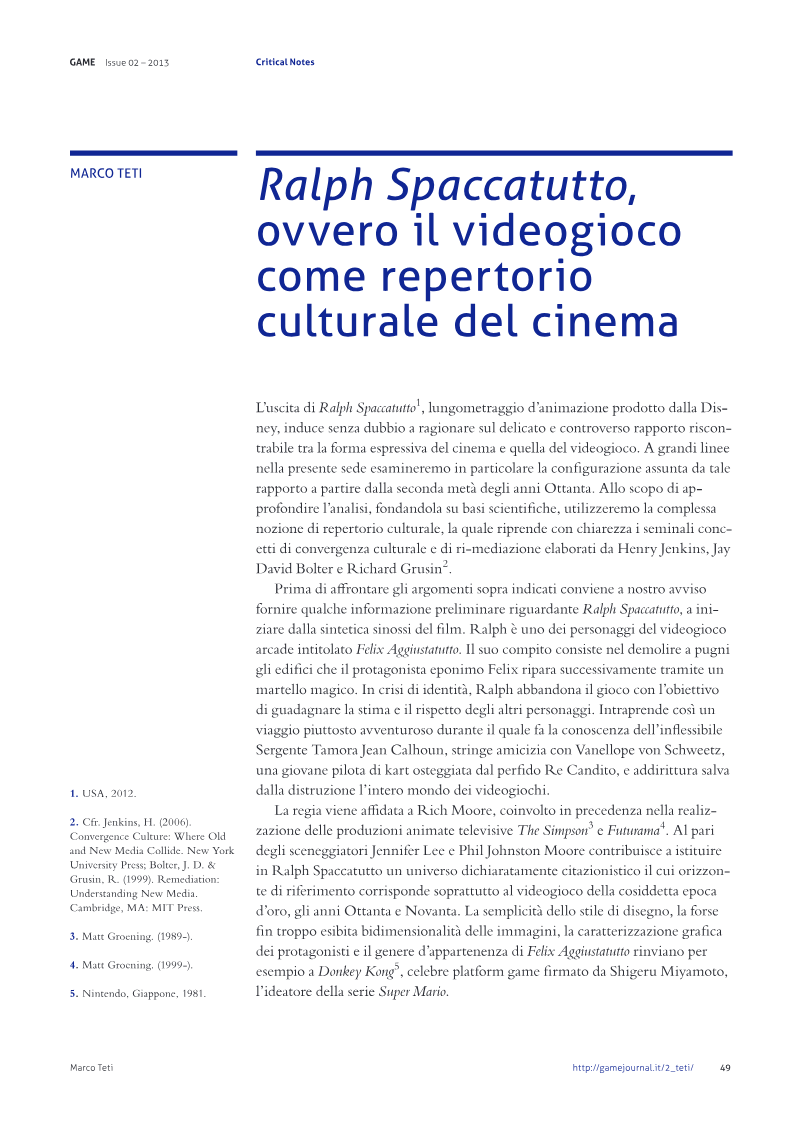
Ralph Spaccatutto, ovvero il videogioco come repertorio culturale del cinema
Marco Teti's essay, published in the second issue of a 2013 Italian game studies journal, uses Disney's animated film Ralph Spaccatutto (Wreck-It Ralph, 2012) to examine the relationship between cinema and video games, particularly from the late 1980s onward.
- Marco Teti's 2013 essay argues that from the late 1980s onward, the video game became cinema's principal cultural repertoire for figures, images, and aesthetics, framed through Jenkins's cultural convergence and Bolter and Grusin's remediation.
- The essay places Disney's Wreck-It Ralph (2012) within a long line of game-to-film adaptations, from Tron and The Wizard to The Matrix and eXistenZ, while noting that later works such as Super Mario Bros. and Resident Evil use game worlds more superficially to widen their audience.
- Teti's evidence rests on the film's dense references to classic arcade and console titles, including Donkey Kong, Sonic, Pac-Man, Halo, Street Fighter II, and Metroid, and on its protagonist Felix, modeled on Mario.

Global Game Jam 2013: Report
The document is a first-person report by Federico Fasce, a game designer and CEO of the Genoa-based independent studio Urustar, on his participation in the Global Game Jam held January 25–27, 2013.
- The Global Game Jam 2013 (January 25–27) drew 16,705 registrants who produced 3,248 projects across 319 venues in 63 countries, using a 48-hour format and the annual theme of a recorded heartbeat.
- The author, Federico Fasce, CEO of the Genoa-based independent studio Urustar, argues that the jam and similar short-form creation initiatives offer experimentation that mainstream commercial game production has largely abandoned.
- Retail shelves are increasingly dominated by sequels with declining impact, even though blockbuster titles still generate large revenues, and many veteran developers are founding independent studios as a result.
Union Yes? Computer Game Design, Management, and Labor Relations
This interview with game developer and project manager Joshua Peery, conducted by Judd Ethan Ruggill and Ken S. McAllister in 2011 and 2012, forms part of a broader multi-institutional project examining the political and interpersonal economies of computer game labor.
- The game industry's secrecy, driven by intellectual property protections and profit concerns, has left its working realities poorly understood, making this insider interview a rare perspective at a time of widespread assaults on organized labor in Europe and the United States.
- Joshua Peery's career moved through several studios, including Icarus Studios, Electrotank, and Carbine Studios, marked by layoffs, contract work, and sudden funding collapses.
- Peery argues that game labor increasingly resembles film industry patterns, and that practices such as unannounced crunch periods, salaried employees denied overtime, and no advance warning before layoffs make unionization sensible, with film and writers' guild models offered as possible templates.
Sognando Shadow Moses: Grafica, Gameplay e Reiterazione Come Strumenti Narrativi Metareferenziali
This Italian-language critical essay, published in the 2013 issue of an online game studies journal, examines the dream sequence set in the Shadow Moses base in Metal Gear Solid 4: Guns of the Patriots.
- The essay argues that the Shadow Moses dream sequence in Metal Gear Solid 4 (2008) is a metareflection on the video game medium, not merely a nostalgic homage, by placing the 1998 original's outdated graphics beside the sequel's far more realistic visuals to expose the game's artificiality.
- The author reads this technique as disrupting player immersion, exposing the synthetic nature of the medium itself.
- The essay situates the sequence within Hideo Kojima's career-long practice of metanarrative design, citing Metal Gear Solid 2 and 3, where the game addresses the player directly and blurs the boundary between avatar and user.