
G|A|M|E – The Italian Journal of Game Studies
Open-access peer-reviewed game studies journal published by the Italian cultural association Ludica since 2012, mostly in English.
Documents
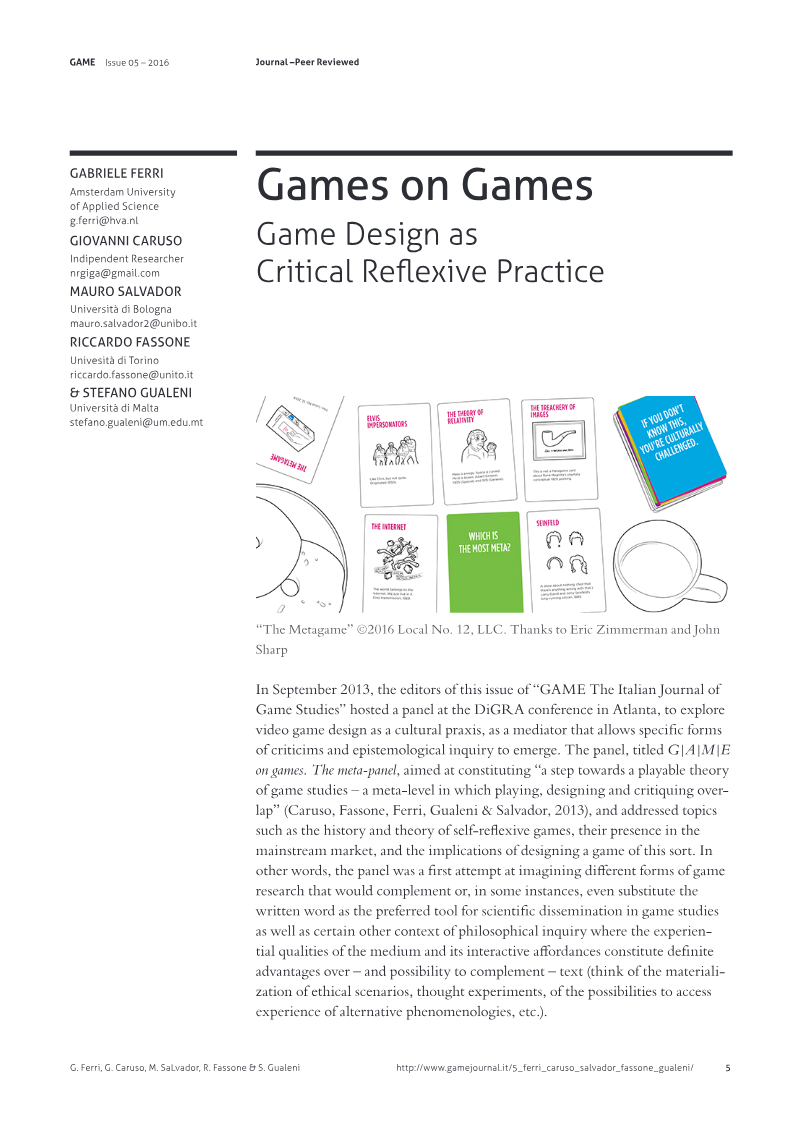
Games on Games: Game Design as Critical Reflexive Practice
This editorial introduction to Issue 05 of GAME, The Italian Journal of Game Studies (2016), argues that video game design can function as a legitimate form of critical and scholarly inquiry, a practice the authors term "research through design" or "critical making."
- The editorial argues that video game design can function as legitimate scholarly inquiry, termed "research through design" or "critical making," with games positioned as a possible epistemological vehicle comparable to papers, books, and conference presentations.
- The issue grows out of a 2013 DiGRA panel in Atlanta that explored self-reflexive games as a "playable theory" of game studies, and the editors present the publication as a provisional outcome of an ongoing informal research network.
- The authors document a marked rise in self-reflexive games in the three years after the 2013 panel, with independent designers producing games-on-games that critique design, development, and distribution practices.
Illusion Master: Extending Self-Presence and Challenging Immersion in and through Digital Games
Micallef's paper, "Illusion Master: Extending Self-Presence and Challenging Immersion in and through Digital Games," argues that players of digital games do not lose awareness of themselves as players once absorbed in a virtual world, and that existing theories of presence and immersion underplay this reflective dimension.
- Micallef proposes 'objective self-presence,' a state in which players stay absorbed in a game while remaining reflectively aware of their own involvement with the technology, arguing that existing presence and immersion theories wrongly assume total transport into the game world.
- The paper positions this concept against Salen and Zimmerman's critique of the 'immersive fallacy' and Vella's subjective/objective player-figure model, and surveys the overlapping and sometimes ambiguous terminology across presence, immersion, flow, and illusion literatures.
- The theory is tested through 'Illusion Master,' a short retro-styled casual platformer with a three-button control scheme, nostalgic aesthetics, positive fictions, and flow-based difficulty.
The Self-Reflexive Tabletop Role-Playing Game
Evan Torner's 2016 article, published in Analog Game Studies, argues that certain tabletop role-playing games are "self-reflexive": their rules and framing devices comment on the medium itself, exposing the performance, improvisation, and social dynamics of collaborative fiction while still functioning as playable games.
- Evan Torner's 2016 Analog Game Studies article argues that certain tabletop role-playing games are "self-reflexive," with rules and framing devices that comment on the medium itself while remaining playable.
- The article contends that studying these "games on games" matters beyond niche RPG theory because tabletop design principles have shaped video game development.
- Torner's analysis centers on three designs: What Is a Role-Playing Game? (a nano-game staging a farcical heist that enacts its own definition of RPGs), 1,001 Nights, and World Wide Wrestling.
Self-Reflexive Videogames: Observations and Corollaries on Virtual Worlds as Philosophical Artifacts
Stefano Gualeni's essay "Self-Reflexive Videogames: Observations and Corollaries on Virtual Worlds as Philosophical Artifacts" argues that certain videogames can function as philosophical artifacts in their own right.
- Gualeni argues that self-reflexive videogames, which expose their own artificiality through subversion and unfamiliarity, can function as philosophical artifacts that prompt critical reflection on both game conventions and modes of thought.
- The argument draws on modernist precedents including Brecht's epic theater, Surrealism, and the Russian Formalist concept of defamiliarization associated with Shklovsky and Pound.
- The essay's main case study, NECESSARY EVIL (2013), casts the player as a disposable minion of evil confined to a room with deliberately non-functional interactions, exposing the player-centric ideology behind many virtual worlds.
NorthPoint Courtesy Services Development and Design Summary
NorthPoint Courtesy Services is an experimental indie game and accompanying design essay by Daniel Cox and Matthew Beale of Old Dominion University, published in 2016 in a peer-reviewed games journal.
- NorthPoint Courtesy Services, a 2016 experimental indie game by Daniel Cox and Matthew Beale of Old Dominion University, inverts the first-person shooter by casting the player as a job applicant who is revealed to be an NPC awaiting execution by another player.
- The game critiques the ethics embedded in FPS design and the subservient, algorithmic position of the nameless enemies players routinely destroy, drawing on Miguel Sicart's writing on computer game ethics.
- The design privileges inaction over action, drawing on Alexander Galloway's concept of the "ambience act" and Mckenzie Wark's reflections on boredom to argue that most game code waits in a state of readiness for the player.
Critical Jostling
Pippin Barr's essay examines how videogames can function as critical objects by reconfiguring the design elements of existing games, arguing that this approach offers a distinctive form of critique within videogame criticism.
- Pippin Barr proposes "reconfiguring the remainder" as a critical method: shifting conventional design standards to expose what games omit or take for granted, while keeping the work functional and playable, drawing on Dunne and Raby's critical design and DiSalvo's adversarial design.
- Barr's Jostle Bastard reworks Hotline Miami by replacing killing with non-fatal "jostling" and adding social consequences such as arrest, job loss, eviction, and victim revenge, plus a mundane non-violent life option that makes violence feel unnecessary.
- Jostle Parent reworks the comic parenting scenario of Octodad: Dadliest Catch into an emotionally serious game by letting the player's children die permanently, recorded via gravestones and named children, removing the source's linear, consequence-free narrative.
Psicologia del Videogioco: Come i Mondi Virtuali Influenzano Mente e Comportamento
The document is a critical book review, published in 2015, of "Psicologia del videogioco: Come i mondi virtuali influenzano mente e comportamento" by Luca Argenton and Stefano Triberti, two psychology PhD researchers from Milan, published by Apogeo.
- The book "Psicologia del videogioco" (Apogeo, 2015) by Milan psychology PhD researchers Luca Argenton and Stefano Triberti offers a balanced synthesis of the scientific literature on games, neither condemning nor uncritically praising them, and avoids the sensationalist, moralizing tone common in earlier texts.
- The authors write as gamers themselves, which the reviewer credits with helping them move beyond common clichés about the medium.
- The book is organized around four themes: identity, immersion, emotion and cognition, and psychopathology.
Re-framing Video Games in the Light of Cinema
This editorial introduction to the fourth issue of the peer-reviewed journal G|A|M|E, published in 2015, examines the complex relationship between video games and cinema.
- The editorial argues that video games and cinema are linked through shared aesthetics and iconography, but also through production models, professional roles, consumption habits, and theory, making film theory a useful lens for game studies.
- The cinematic character of games extends beyond narrative and genre to interface design, framing, editing, and spectatorial practices such as YouTube walkthroughs and live streams.
- Game studies historically fought to establish independence from film-based frameworks, while film scholars were slow to engage with interactive media.
Play the Game in the Opening Scene: A Multidisciplinary Lens for Understanding (Video)Ludic Movies, Including Super Mario Bros., Resident Evil and Scott Pilgrim vs. the World
This study by Enrico Gandolfi and Roberto Semprebene, published in Game Journal in 2015, proposes a multidisciplinary framework for analyzing video game-to-film adaptations, often called "videoludic" movies.
- The authors propose a multidisciplinary framework for analyzing video game-to-film adaptations ("videoludic" movies), assessing each across four dimensions (production, agential, representational, economic/cultural impact) and four analytic bridges (narrative, aesthetic, encyclopaedic, dynamic) along continuums of coherence and dependency relative to the source game.
- The central argument is that a game adaptation's success hinges on balancing fidelity to the game's identity against accessibility for viewers who have never played it.
- Super Mario Bros. (1993) received the lowest coherence rating (C-) because its major departures from the source, including a cyberpunk New York setting and altered characters and goals, alienated general audiences despite the game's large player base.
It Wasn't Even Acceptable in the Eighties: Hotline Miami and Snuff Films
Hugo Gelis's article "It Wasn't Even Acceptable in the Eighties: Hotline Miami and Snuff Films" argues that Hotline Miami (2012) remediates the aesthetics and supposed production conditions of snuff films, the rumored genre of recorded murders, to create an unsettling undercurrent beneath its frantic, gory gameplay.
- Gelis argues that Hotline Miami (2012) remediates the aesthetics and rumored production conditions of snuff films, using pixelated visuals, simulated VHS artifacts, and CRT effects to create an unsettling undercurrent beneath its frantic gameplay.
- The article draws on Bolter and Grusin's concepts of remediation and hypermediation to show how the game borrows videotape conventions such as static, rewind sequences, and handheld camera tilts, with chunky, aliased graphics emphasizing the image's crudeness.
- The repeated quickload-style restarts and a rewind sequence marking a shift into flashback mirror the endless replaying of killings that defines snuff film lore.
Towards a Typology of Video Game Trailers: Between the Ludic and the Cinematic
Jan Švelch's paper, published in Issue 04 of Critical Notes in 2015, proposes a new typology of video game trailers grounded in their relationship to the ludic (rule-based, interactive) and cinematic (narrative, fictional) dimensions of games.
- Jan Švelch's 2015 paper in Critical Notes (Issue 04) argues that existing trailer classifications based on formal criteria are descriptive and inconsistently applied, and calls for a theory-driven typology that explains how a linear trailer represents a nonlinear game.
- The paper's proposed typology has three categories: performance trailers (staging player interaction to show possible gameplay in linear form), transmedia trailers (expanding a game's fictional world through cinematic footage as a tool of transmedia storytelling), and interface trailers (mimicking a game's interface to convey interactivity and creating two layers of paratextuality).
- Current publisher and press discourse classifies trailers by four overlapping criteria: content (gameplay footage, CGI, live action), date (teaser, reveal, announcement, launch), venue (e.g., E3, Gamescom, Tokyo Game Show), and focus (story, combat, multiplayer).
Understanding Machinima: Essays on Filmmaking in Virtual Worlds
This review examines Understanding Machinima: Essays on Filmmaking in Virtual Worlds, an anthology edited by Jenna Ng and published by Bloomsbury in 2013, which approaches machinima, video produced through real-time game graphics engines, from a Media Studies perspective.
- Understanding Machinima (Bloomsbury, 2013), edited by Jenna Ng, is an anthology of twelve chapters analyzing machinima, video made with real-time game graphics engines, from a Media Studies perspective, divided into "Thinking" and "Using" sections.
- The volume treats machinima as a native digital medium shaped by cinema, gaming, animation, and fandom, aiming to move beyond game-centered analysis and place it within a convergent mediascape.
- Recurring debates center on machinima's hybrid nature: whether it should be defined by its distinctions from other media or accepted as a fully hybrid form, and whether it should develop an independent visual language or accept a "minor" position within established media.