
DiGRA
The Digital Games Research Association: the international association of academics and professionals who study digital games. Its Digital Library holds the proceedings of the DiGRA conferences since 2002.
Documents

Beyond Paratexts, Towards Paratextuality: A Case for Granular Analysis of Video Game Paratextuality
This paper argues that the concept of paratextuality, as applied in game studies, has drifted from Gérard Genette's original 1982 formulation and should be reconceived rather than simply reapplied.
- The paper argues that 'paratextuality' in game studies has drifted from Gérard Genette's 1982 formulation, where it was only one relation within a broader system of transtextual relations, and has become a catch-all label for any secondary artifact of video games.
- It contrasts a reduced framework, which limits paratext to spatially bound verbal material, with an expanded framework associated with Mia Consalvo and Jonathan Gray that includes trailers, livestreams, walkthroughs, and tie-in novels regardless of authorship, and argues the expanded version reproduces the main-text/epiphenomenon hierarchy it claims to critique.
- The author proposes treating paratextuality as a granular quality linking any text, or part of a text, to its socio-historical context, so phenomena are analyzed by degree of paratextual features rather than classified categorically as paratexts.
Past Stories and Future Worlds: History and Popular Imagination in Fallout 4
This analysis examines how the video game Fallout 4 utilizes history and counterfactual narratives to create an engaging player experience and challenge assumptions about historical knowledge production.
- The paper argues that Fallout 4's interactive structure lets developer and player co-author historical narrative, allowing the game to challenge assumptions about what history is, who tells it, and for what ends.
- Fallout 4's Massachusetts setting, including Concord, Lexington, and Boston, anchors its story in an American narrative of optimism and renewal, which the postapocalyptic landscape of devastation sharply contrasts.
- By blending real historical elements with a fictional outcome in which the Cold War turns hot, the game is argued to unsettle the narrative neatness of popular histories that portray the Cold War as a settled victory for capitalism and American consumerism.

Projectuality in Digital Gameworlds
This paper explores the existential structure of player engagement with digital gameworlds through the philosophical concept of "projectuality," drawing primarily from the works of Martin Heidegger and Jean-Paul Sartre.
- The paper argues that a player's existential 'project' (an orientation toward an overarching goal) is what makes game entities appear as resources, obstacles, friends, or foes, constituting the gameworld as a meaningful world of possibility.
- Drawing on Heidegger and Sartre, the authors frame digital gameplay through the existential notion of the project, linking the playing individual's being within a non-actual gameworld to their broader life orientation.
- The authors propose a 'double perspectival structure' in which ludic subjectivity is nested within the individual's subjectivity in the actual world, which allows gameworld experience to acquire significance for the player.

Instantaneously Punctuated Picture-Music: Pilgrim in the Microworld and an Alternative Evaluation of Videogame Expression
The document, an extended abstract presented at DiGRA 2018, proposes an alternative framework for evaluating videogame expression, drawing primarily from David Sudnow's 1983 book, Pilgrim in the Microworld.
- The paper argues David Sudnow's 1983 book Pilgrim in the Microworld, about playing a simplified Atari 2600 port of Missile Command, offers a better framework for evaluating videogame expression than the dominant game studies models that emerged about fifteen years later.
- Sudnow located the core pleasure of videogames not in winning, narrative immersion, or sophisticated rules, but in becoming incorporated into an audiovisual spectacle where the player's bodily movements are reflected back as rhythmic lights and sounds.
- The author identifies a persistent tension in early game studies between mechanical, technical, and narrative essentialisms, and notes that videogames have repeatedly resisted the predictive models scholars built around them.
Implementing Intelligence: The Platform Culture of Intellivision
The document analyzes the "platform culture" of the Intellivision home game console, focusing on how the concept of "intelligence" was implemented and expressed throughout its design, marketing, and development.
- The paper argues that 'intelligence' was an aesthetic, pragmatic, and social principle underlying the Intellivision console (Mattel Electronics, late 1970s–early 1980s), not just a marketing slogan, despite the system lacking complex onboard AI.
- Intellivision's marketing used comparative framing and visual realism, with slogans urging consumers to 'compare' and positioning the system as the choice of sophisticated gamers, in contrast to rivals such as the Atari VCS.
- Mattel's modular, extensible design, including speech, keyboard, synthesizer, network, and cartridge-adapter peripherals, promoted an imaginary of augmented human intelligence.

Watching People Play: The Role of Spectatorship in Player Careers
This document examines the role of spectatorship in the player careers of adults, challenging the traditional view of games solely as an interactive medium.
- Game watching is treated as a substantial, socially meaningful part of gaming culture, challenging the assumption that games are only an interactive medium to be played rather than watched.
- The study is a preliminary qualitative project: ten semi-structured and biographical interviews with regular spectators aged 20 to 40 had been conducted, with twenty more planned, so findings remain subject to revision.
- The author frames a 'player career' as the succession of games and modes of play embedded in an individual's social, professional, and affective biography, using a symbolic interactionist understanding of career.
Consecutive Endings and the Aesthetic Potential of Cognitive Dissonance
This extended abstract examines "consecutive endings" in digital games, a phenomenon where an apparent game conclusion is revealed to be an interruption, allowing for continued play.
- Consecutive endings are a distinct phenotype of game closure in which a game signals that it has concluded yet permits play to continue, building on Riccardo Fassone's (2017) taxonomy of game endings.
- Unlike voluntary replay, consecutive endings create cognitive dissonance: a player facing an apparently final ending must decide whether to continue, weighing the costs of action against inaction and reinterpreting the game's nature in the process.
- The paper draws on Festinger's theory and psychological research on inaction and regret to explain why players experience this dilemma when an ending seems final but play remains possible.
Cause, Effect, and Player-Centric Time
The document explores how players perceive causality in video games through the lens of Leonard Talmy's theory of force dynamics.
- Players make sense of games by searching for causal relations, and the paper proposes Leonard Talmy's force dynamics theory (agonist and antagonist roles yielding causative, despite, and letting patterns) as a framework for how these causal intuitions form.
- The paper argues that the theory's cross-linguistic prevalence, resemblance to diSessa's phenomenological primitives, experimental evidence from Phillip Wolff, and similarity to pre-modern impetus physics together support its plausibility as a model of causal cognition.
- 'Triggers,' entities that initiate events only when the player interacts with them, make in-game time player-centric, so events that seem independent are actually caused by the player's presence, which players can detect and which makes time feel artificial.
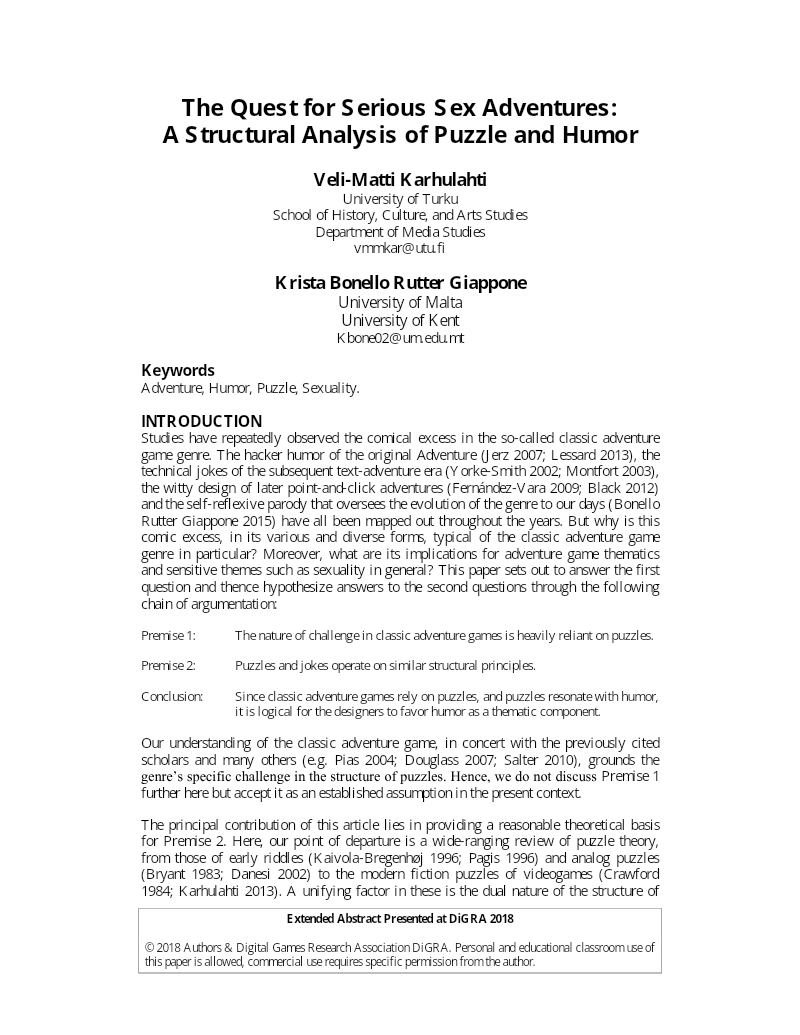
The Quest for Serious Sex Adventures: A Structural Analysis of Puzzle and Humor
Classic adventure games have long been observed to carry a strong streak of comic excess, from the hacker humor of the original Adventure to the technical jokes of text adventures, the witty design of point-and-click titles, and the genre's later self-reflexive parody.
- The paper argues that the comic excess of classic adventure games stems from a structural resonance between puzzles and jokes, both operating on a set-up/tension and resolution pattern.
- The authors contend that this shared structure explains why puzzle-heavy adventure designers often favor comedy as a thematic component.
- Common comic devices such as the rule of three, the "Pull Back and Reveal" formula, and resolving wordplay are shown to share the pivot-and-resolution pattern of riddles, and the satisfaction of a joke is compared to the cessation of a solved riddle.

Understanding Player Elimination in Boardgames as a Form of Permadeath
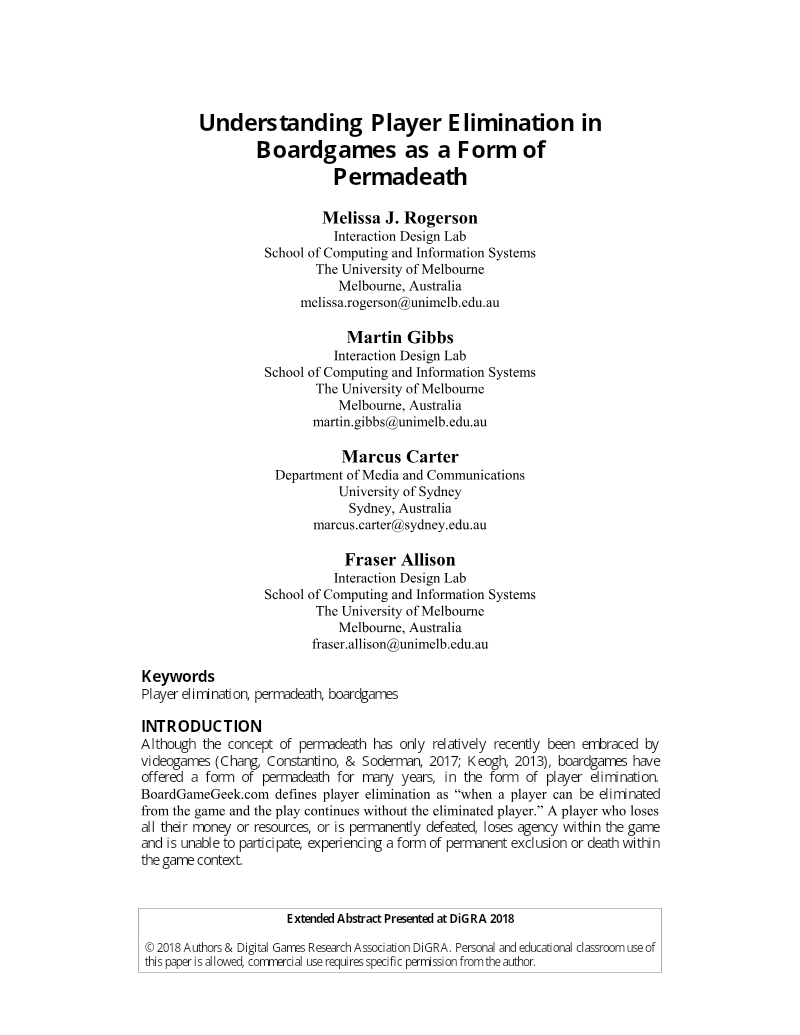
The document explores player elimination in boardgames as a form of permadeath, analyzing its types, consequences, and impact on player experience.
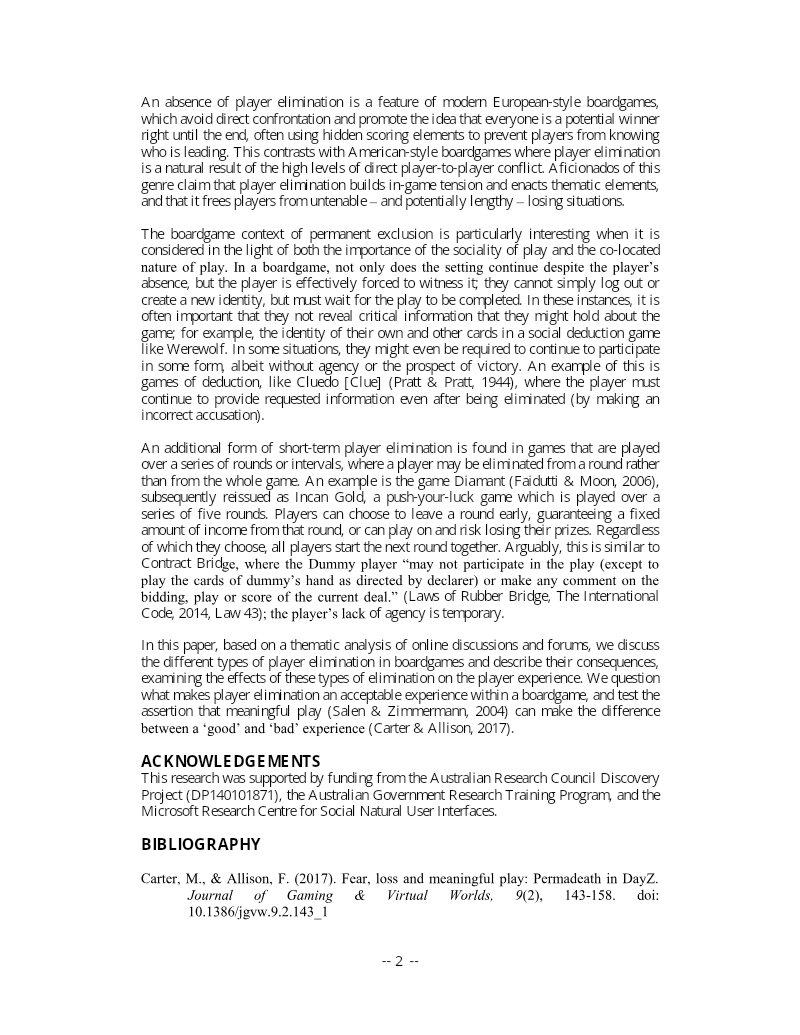
- Boardgames offered permanent and temporary player elimination well before videogames adopted permadeath, and the paper treats elimination as a loss of agency where the player must watch the game continue, unlike digital play where a player can log out or create a new identity.
- Permanent elimination appears in social deduction games and Cluedo, where eliminated players must still contribute information, while short-term elimination appears in round-based games such as Diamant (Incan Gold) and in Contract Bridge's dummy player, whose lack of agency is only temporary.
- Elimination is naturally prevalent in American-style games built around direct conflict and largely absent from modern European-style games, which emphasize indirect competition and hidden scoring.


Game Engines: Design, Labour, and Legality
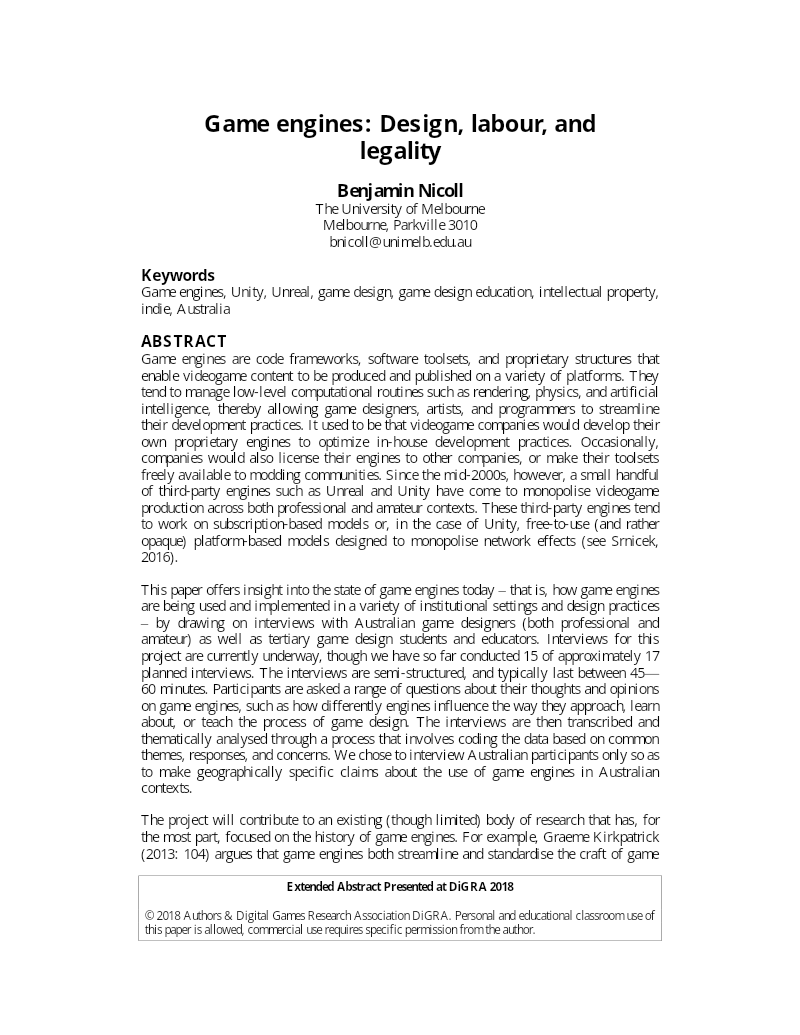
This paper investigates the contemporary landscape of game engine utilization, focusing on how these proprietary structures and toolsets are reshaping game design, labor practices, and legal frameworks within the Australian context.
- The shift from proprietary in-house engines to a few third-party platforms such as Unity and Unreal is reshaping game design as a technical, labour, and economic practice in Australia.
- The study is a preliminary, work-in-progress extended abstract from DiGRA 2018, based on semi-structured interviews of 45 to 60 minutes with Australian designers, amateurs, students, and educators, with 15 of a planned 17 interviews completed at the time of writing.
- Participants described engines less as contained toolsets than as networks mediating between people, particularly via Unity's asset store and online support forums.
Man Caves and the Fantasy of Homosocial Escape
Gaming "man caves" are theorized here as domestic enclaves of technomasculinity that promise both homosocial belonging and escape from everyday life.
- The paper analyzes posts from the "Post your setup" threads on NeoGAF, drawn from the 2007 and 2015 editions, to trace how depictions of domestic gaming arrangements shifted across the Xbox 360, Wii, and PlayStation 3 console generation.
- The authors frame the gaming "man cave" as a "media apparatus" whose staged images of shared play rarely reflect actual co-presence, suggesting the homosocial bonding it displays is largely virtual or aspirational.
- The masculine subject in these threads is argued to seek escape from domestic obligations, from the feminized home, and from diversity calls affecting technology and gaming culture.
Do you work at DiGRA? Get a free report of how these documents are read and cited here.