
DiGRA
The Digital Games Research Association: the international association of academics and professionals who study digital games. Its Digital Library holds the proceedings of the DiGRA conferences since 2002.
Documents
Production Pipelines as Actor-Networks: Rethinking the Game Studio as a Technological Platform
Game studios can be understood as technological platforms whose production pipelines shape the games that emerge from them.
- The paper reframes the game studio's production pipeline as an Actor-Network drawing on Bruno Latour, arguing that human and technological mediators (third-party engines, middleware, Lean management) actively transform the ideas and assets they carry rather than merely passing them along.
- The authors position the work as a bridge between production studies and platform studies, responding to calls within game studies for an approach that connects industrial context with platform analysis.
- Methodologically, the study combines production cultures research (drawing on John Caldwell and Sherry Ortner) with interviews with triple-A and independent designers and case studies of Alien: Isolation (Creative Assembly, 2014) and Everybody's Gone to the Rapture (The Chinese Room, 2015).
Bonding with Horses and Other Animals in Breath of the Wild
The document analyzes the mechanics designed to foster player bonding with non-human animals, particularly horses, in The Legend of Zelda: Breath of the Wild.
- Imperfect, variable animal behavior, such as a horse's delayed readiness for riding and unpredictable control responsiveness, gives animals a sense of personality, while fully trained, predictable behavior risks making them feel impersonal.
- Generic and repetitive animal mechanics strip creatures of subjectivity and expose the game's artificiality, undermining player attachment to non-human agents.
- Naming and accessory customization function as appropriation mechanics that let players project personality onto animals and support emergent, player-authored narrative.
Sense of Belonging: The Ideology of Chinese Educational Games
The document examines how the Chinese government utilizes online educational games to disseminate political ideology and foster a sense of belonging among its citizens.
- The paper argues that fostering a sense of belonging is the most important design factor in state-approved Chinese educational games, which it frames as a vehicle for disseminating political ideology rather than a space for diverse expression.
- Belonging is defined as accepting the nation's organization, policies, and protections while linking personal identity to protecting China's image, with patriotism and resistance to what is framed as liberal "invasion" as related goals.
- The author contends these games are more effective than traditional text-based or audiovisual media because they offer multiple paths to victory, subtly encouraging pride and loyalty rather than forcing particular choices.
Memory and Meaning in Analogue: A Hate Story and Nier: Automata
Save systems, usually classed as operator-level "gamic actions" outside a game's diegesis, can become meaningful in a richer interpretive sense when they shape a game's story, atmosphere, or themes.
- The paper argues that save and load systems in games can carry narrative, thematic, and interpretive meaning, not just serve as a gameplay mechanic, prompting reflection on how the past is stored, accessed, and remembered in digital culture.
- It frames its analysis through the concepts of "mechropolitics" (who lives and dies within a game's systems) and "mnemopolitics" (whose lives are remembered and how), drawing on theorists of archiving, difficult knowledge, and testimony.
- In Analogue: A Hate Story (2012), players cannot see every file in a single playthrough, so they must decide whom to believe and what to preserve, a choice tied to Leigh Gilmore's notion of the "adequate" versus "tainted" witness.
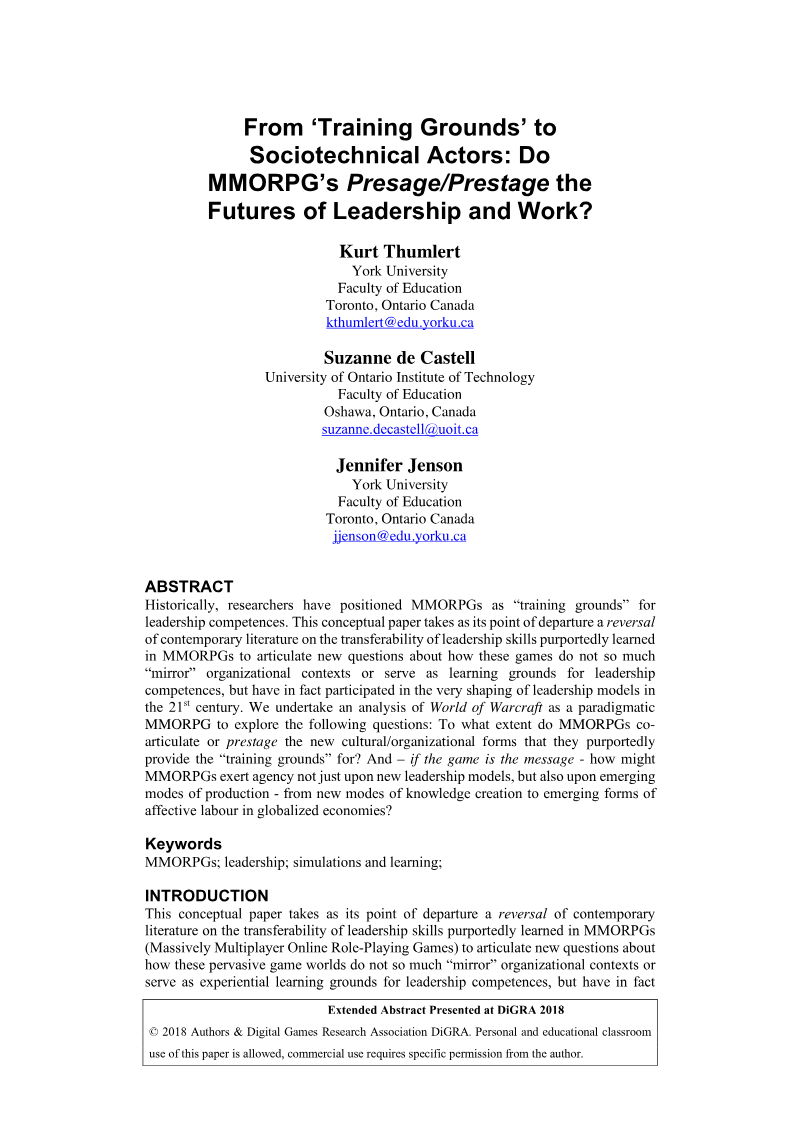
From ‘Training Grounds’ to Sociotechnical Actors: Do MMORPGs Presage the Futures of Work?
This conceptual paper, presented as an extended abstract at DiGRA 2018, challenges the prevailing view that massively multiplayer online role-playing games (MMORPGs) serve as "training grounds" for leadership skills that transfer to organizational settings.
- The paper reverses the common view of MMORPGs as 'training grounds' for workplace leadership, arguing instead that games like World of Warcraft are sociotechnical systems that actively shape 21st-century leadership models and forms of work.
- The authors frame their inquiry around whether MMORPGs prestage emerging cultural and organizational forms, and whether games exert agency over new modes of knowledge creation and affective labour in globalized economies.
- The paper situates its argument within a shift from command-and-control leadership toward distributed, networked, and heterarchical models emphasizing self-organizing teams, shared responsibility, and leadership exercised 'from the middle.'
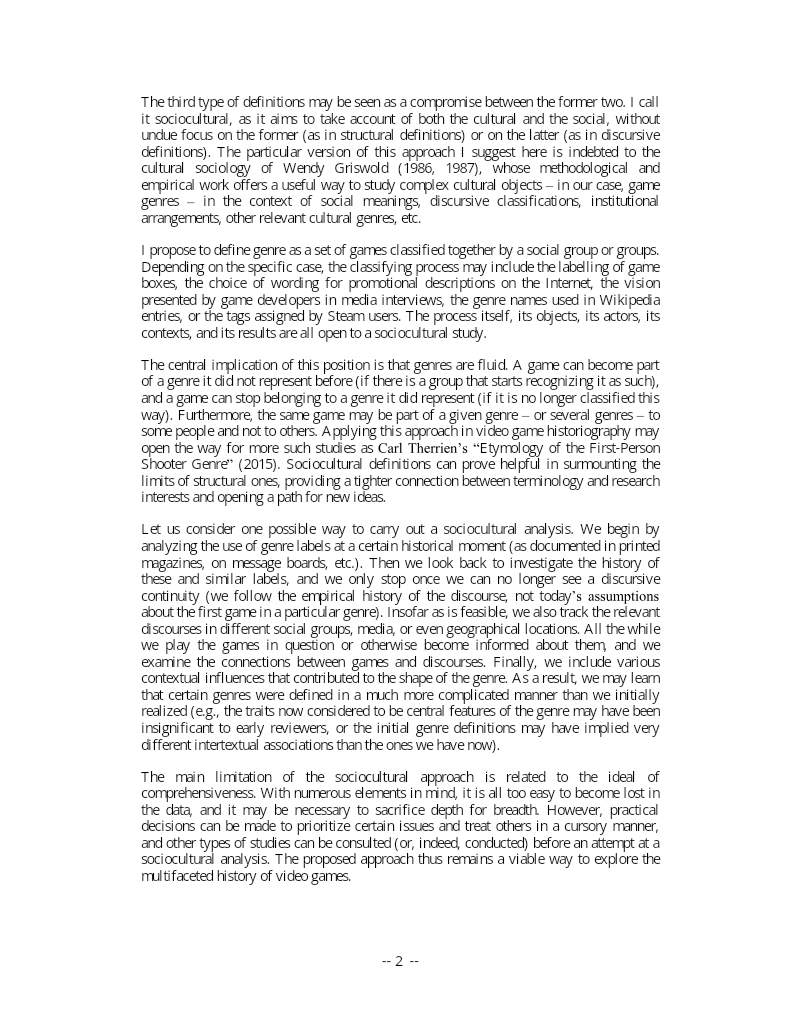
Defining Genre in Video Game Historiography: Structural, Discursive, and Sociocultural Definitions
The document, "Defining Genre in Video Game Historiography: Structural, Discursive, and Sociocultural Definitions," proposes a new framework for understanding video game genres, particularly for historical analysis.
- The paper identifies three types of video game genre definitions: structural (genre as inherent organization of games and play), discursive (genre as a way of using and relating texts), and sociocultural, which it argues best serves historical research.
- Structural definitions struggle to explain the divergent meanings players and critics assign to the same titles, while discursive definitions detach genre from the games themselves and so have limited practical use.
- The proposed sociocultural definition treats genre as a set of games classified together by one or more social groups, drawing on Wendy Griswold's cultural sociology.
"Travel Bugs": Toys Traveling Socially Through Geocaching
This study investigates emerging patterns of mobile and social play through the lens of "toy tourism," specifically focusing on Travel Bugs within the global game of geocaching.
- Geocaching's Travel Bugs are trackable metal tags attached to toys that move independently between geocaches around the world, with each journey documented on dedicated online pages, making toy tourism a form of mobile, social object play.
- The authors propose a conceptual framework linking the digital, physical, and social dimensions of toy tourism, showing how these practices become more gamified, goal-oriented, and measurable.
- The findings come from a qualitative case study based on an August 2016 internet survey of 45 geocachers recruited via Facebook groups, supplemented by stories from the Groundspeak Forum, so the conclusions are explicitly provisional given the small sample.
(Re)Play the Beginning of the End: 1988 as Prequel to Umbrella Movement in Hong Kong
This extended abstract examines the 2015 alternative history video game 1988 (光輝歲月), created by independent designer and political activist Cheng Lap, as an overlooked agent of digital activism in Hong Kong after the 2014 Umbrella Movement.
- The study treats 1988, a 2015 alternative history game by Hong Kong designer Cheng Lap, as a form of digital activism emerging from the aftermath of the 2014 Umbrella Movement, set a decade before the 1997 handover to China.
- The game places a teenage immigrant from mainland China against a hegemonic alliance of the Chinese Communist Party and real estate interests, and the author argues it actively constructs and circulates "Hong Kong local" identity as an emerging nationality.
- The analysis distinguishes two dimensions of "Hong Kongness": the richly detailed fictional Hong Kong built within the game, and the online community that treats playing and discussing it as a progressive political act.
Playing for Real
The document, "Playing for Real," explores the implications of gamification, specifically focusing on its application in non-game environments for real-world assessment.
- The paper is a conceptual, interpretive essay by Lyuba Encheva examining a single commercial case, Pymetrics, a recruitment company that combines computational neuroscience, artificial intelligence, and game design to assess job seekers' traits and match them to careers.
- Its central claim is that gamified assessments blur the boundary between virtual and embodied experience, reflecting Jean Baudrillard's concept of "integral reality," in which virtuality substitutes for and reorders the real.
- The author argues gamification functions as a symbolic strategy for managing the perceived illusoriness of the world, and that Pymetrics' games are designed to produce real-life consequences rather than remain confined to play.
Playing with a Brand: The Brazilian McDonald's Paper Tray Case
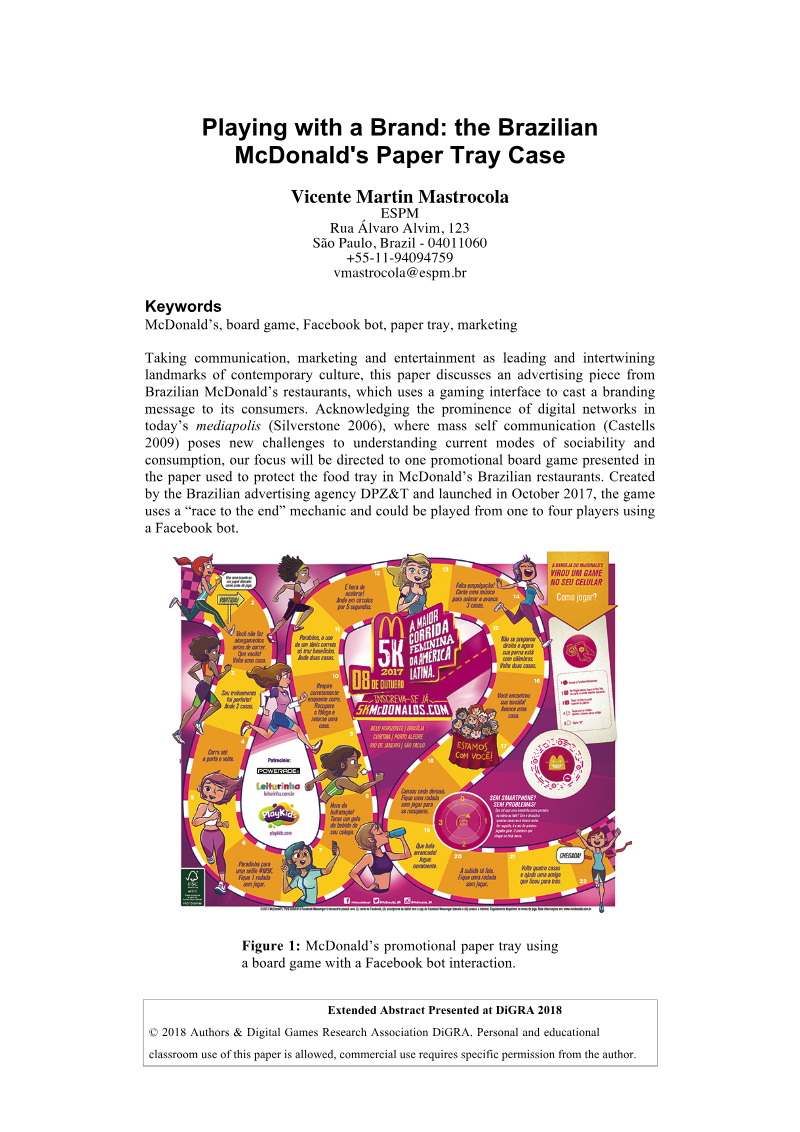
Brazilian McDonald's used a promotional board game printed on its food tray paper to deliver a branding message through a gaming interface.
- The case study examines a promotional board game printed on paper trays in Brazilian McDonald's restaurants, created by the ad agency DPZ&T and launched in October 2017.
- The game is a 'race to the end' for one to four players, where scanning a code activates a Facebook Messenger bot that delivers McDonald's quizzes, enigmas, and trivia, and correct answers advance player pawns.
- The winner earns a chance to receive a prize such as fries or ice cream, linking entertainment directly to a commercial incentive.
From Silent NPC to Active Consumer: Representing Female in Chinese Video Game Culture
This extended abstract examines how women have been represented in Chinese video game culture since the 1990s, arguing that female players have shifted from silent non-player characters to active consumers while stereotyping has persisted in subtler forms.
- The paper argues that female representation in Chinese video games moved through three stereotypes since the 1990s (women as male-desire objects or silent NPCs before the 2010s, prosumers of boys' love content in TANBI games from 2012–2016, and cash cows in mobile otome games), and that these stereotypes have not disappeared but become more subtle.
- Drawing on Stuart Hall's theory of representation, the author treats gender images as culturally constructed meanings shaped by industry, popular culture, and players rather than neutral reflections of players.
- The first stereotype was exemplified by titles such as The Legend of Sword and Fairy and the Dragon Oath series, where women appear as sexualized figures, devoted assistants to male heroes, or silent non-player characters.
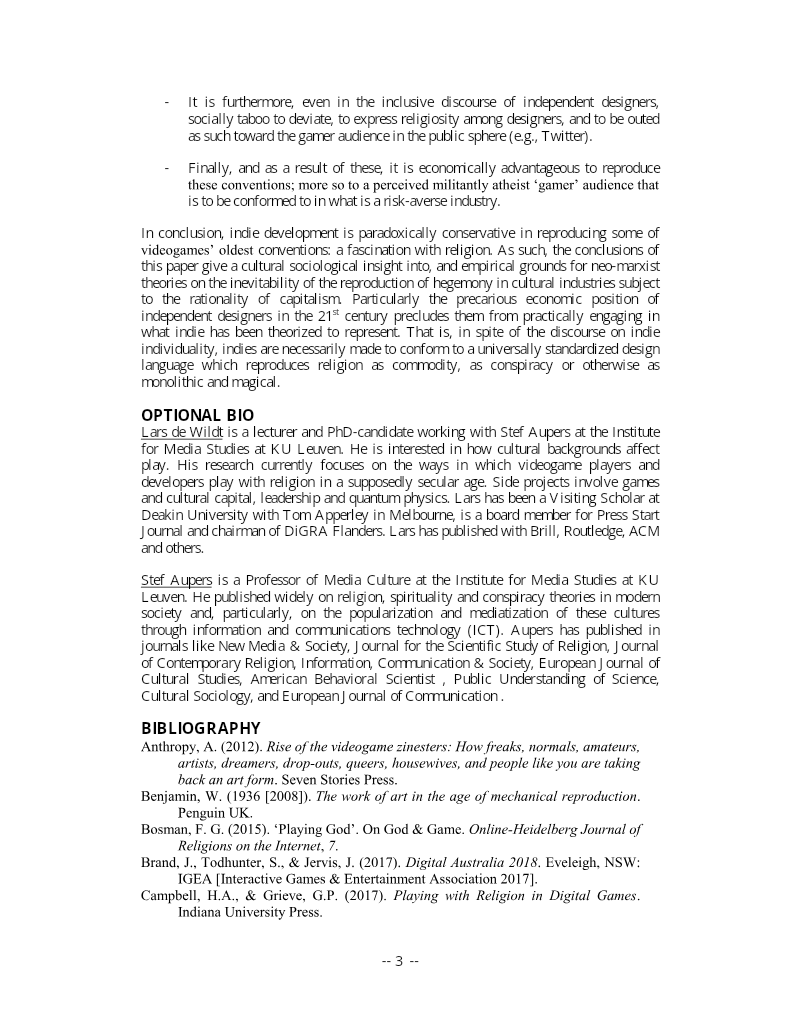
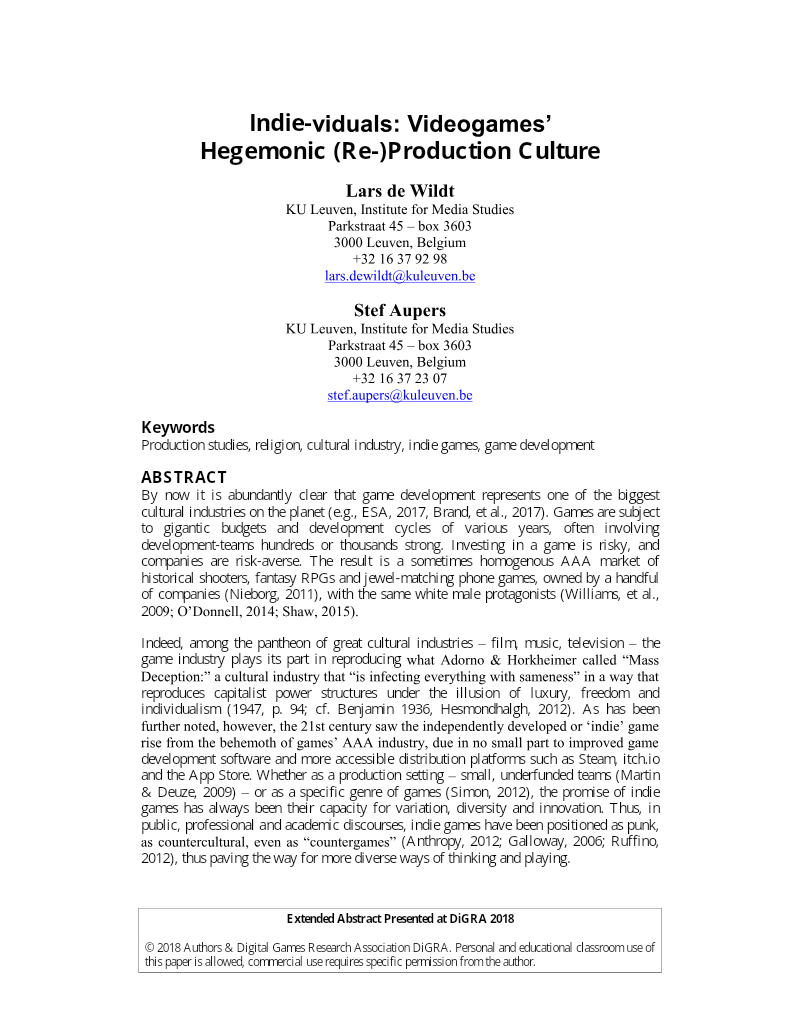
Indie-viduals: Videogames' Hegemonic (Re-)Production Culture
This DiGRA 2018 extended abstract, authored by Lars de Wildt and Stef Aupers of KU Leuven, examines whether independent game development escapes the commercial conformity of the AAA industry or instead reproduces its dominant conventions, with a particular focus on how religion is represented in games.
- Independent game development often reproduces rather than escapes the conventions of the commercial AAA industry, according to a qualitative study of 27 international developers by Lars de Wildt and Stef Aupers of KU Leuven.
- Non-religious developers tend to rely on stereotyped religious imagery, such as priests who heal simply because they are priests, as narrative shortcuts, while religious developers struggle to find room for their own convictions in their work.
- The authors argue that game design has become a universal language of tropes rooted in North American and Japanese development culture, which frames religion as commodity, conspiracy, or fantasy.
Do you work at DiGRA? Get a free report of how these documents are read and cited here.