
DiGRA
The Digital Games Research Association: the international association of academics and professionals who study digital games. Its Digital Library holds the proceedings of the DiGRA conferences since 2002.
Documents
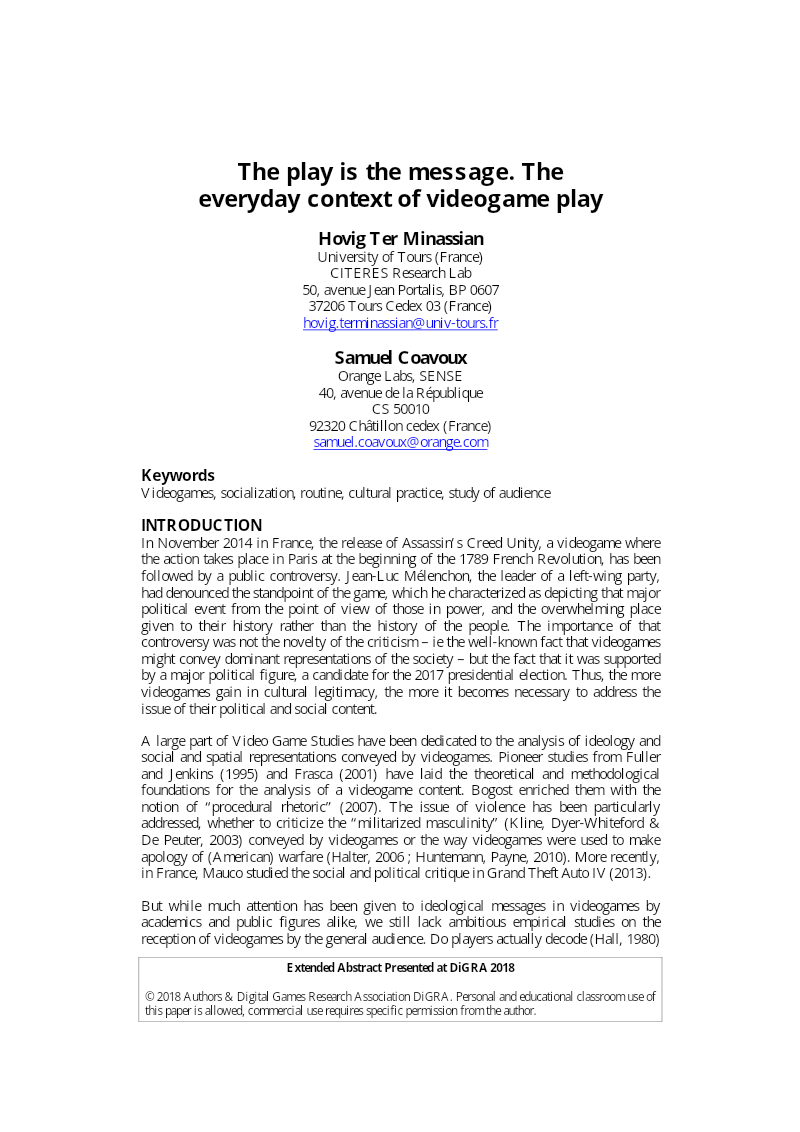
The Play Is the Message: The Everyday Context of Videogame Play
Game studies has devoted considerable attention to the ideology, social representations, and procedural rhetoric embedded in videogames, from violence and militarized masculinity to the portrayal of history, as in the 2014 French controversy over Assassin's Creed Unity's depiction of the Revolution.
- The meaning of videogame play is shaped more by the social and everyday contexts of play than by the ideological messages games carry, according to the authors' central thesis drawn from a 2012 French study.
- Players in France choose games according to how well they fit daily routines, leisure time, and social life, with casual and social games making up the largest share of play.
- Based on a 2012 phone survey of 2,542 French residents aged 11 and older, the most frequently played genres include solitary games, card games, browser games, and dance or music games.
Monetization is the Message: A Historical Examination of Video Game Microtransactions
This paper historically examines how video game microtransaction monetization methods fundamentally change game design and potentially players' experience with the medium, particularly focusing on the rise of "loot boxes."
- The paper's central thesis, framed through McLuhan's 'the medium is the message,' is that monetization is itself a formative force: microtransactions change what games deliver, so content can become a delivery mechanism for purchases rather than an end in itself.
- The lineage of microtransaction practices is traced to the early 2000s, when publishers such as EA and Square Enix embraced 'games as a service' with continual multiplayer content and downloadable additions sold via microtransactions.
- The paper credits the free-to-play Chinese MMO ZT Online with pioneering randomized 'virtual treasure boxes,' which later spread to mobile free-to-play titles, major franchises like Call of Duty and Destiny, and eventually primarily single-player games.
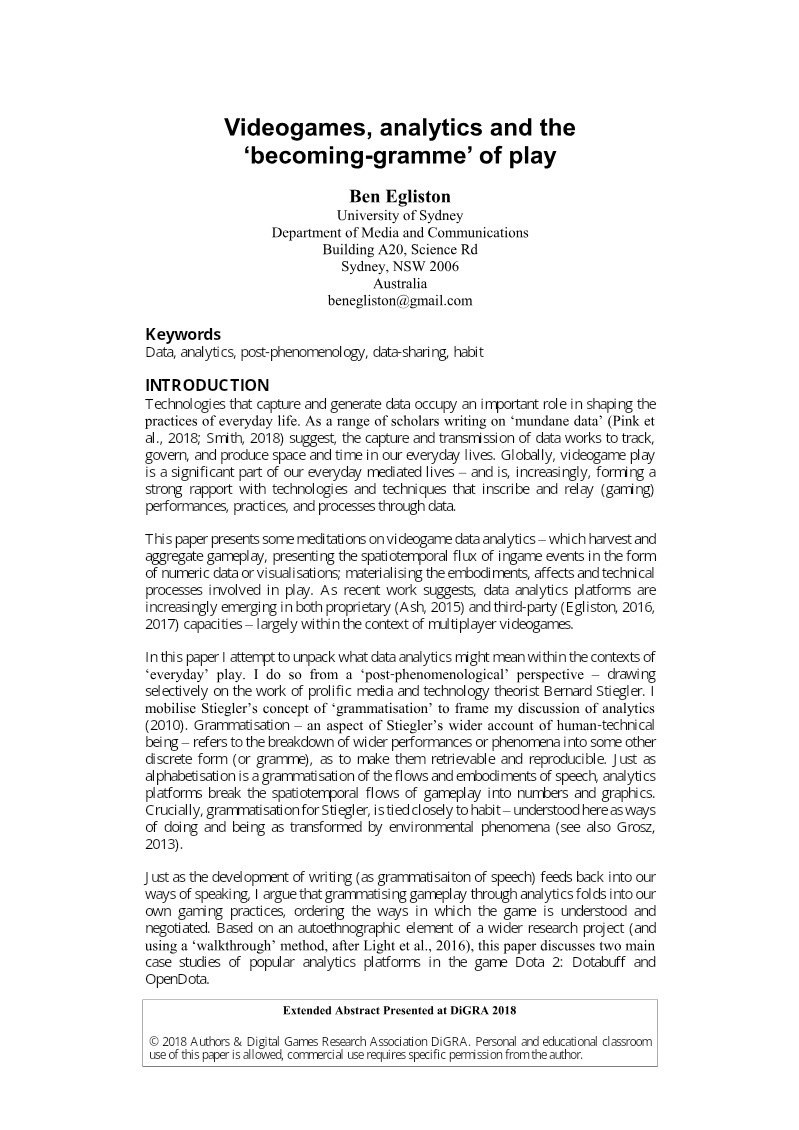
Videogames, Analytics and the 'Becoming-Gramme' of Play
Videogame data analytics, which harvest and aggregate gameplay and present in-game events as numbers and visualisations, are examined here as a growing part of everyday mediated life.
- The paper argues that the data-fication of gaming has become integral to how players experience videogames, which the author, Ben Egliston of the University of Sydney, theorises as a "becoming-gramme" of play.
- Drawing on post-phenomenology and Bernard Stiegler, the paper frames analytics as grammatisation: the breaking of spatiotemporal flows of play into discrete, retrievable forms, comparable to how alphabetisation reshaped speech.
- Using an autoethnographic "walkthrough" method within a wider research project, the analysis examines two Dota 2 analytics platforms, Dotabuff and OpenDota.
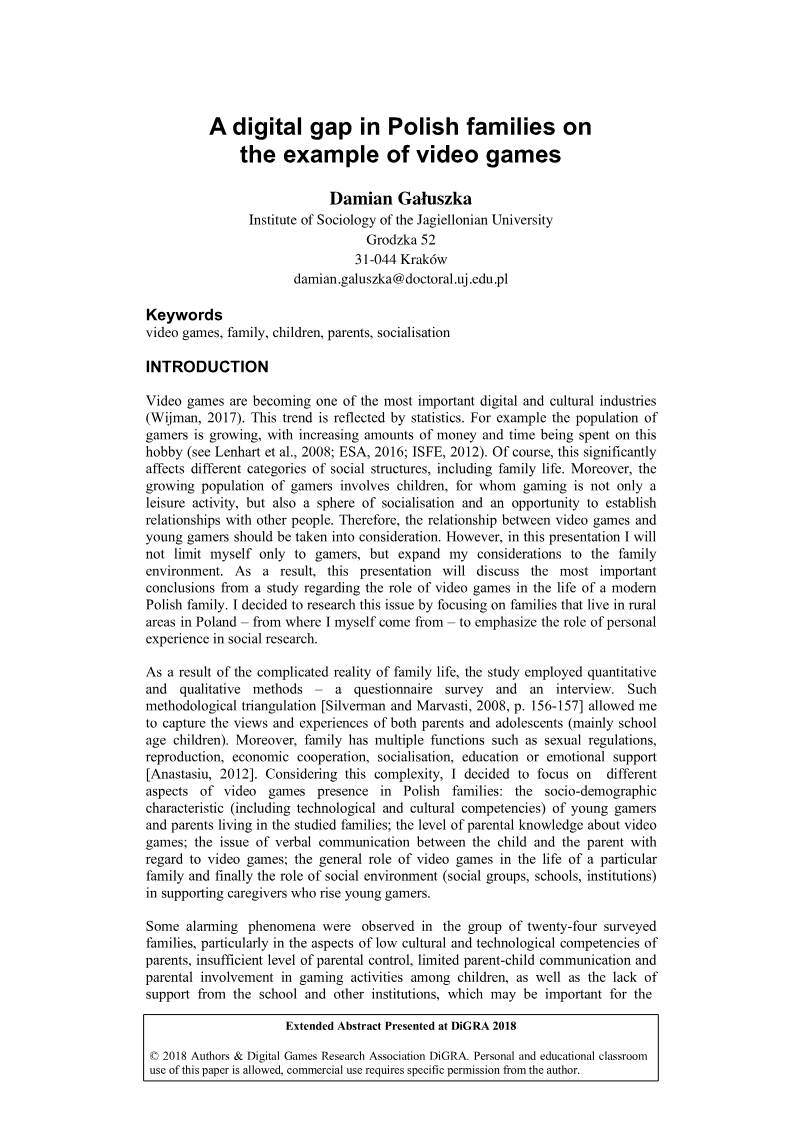
A Digital Gap in Polish Families on the Example of Video Games
This study investigates the role of video games in modern Polish families, specifically focusing on those in rural areas, to understand the potential "digital gap" between generations.
- Video games' growing popularity has outpaced the knowledge and engagement of Polish parents, schools, and institutions responsible for raising young players, creating a digital gap within families.
- The study used methodological triangulation, combining a questionnaire survey with interviews, drawing on a sample of just twenty-four surveyed families, with a regional focus on rural households.
- Parents often showed low cultural and technological competencies, limited control over their children's gaming, and restricted communication with children about games.
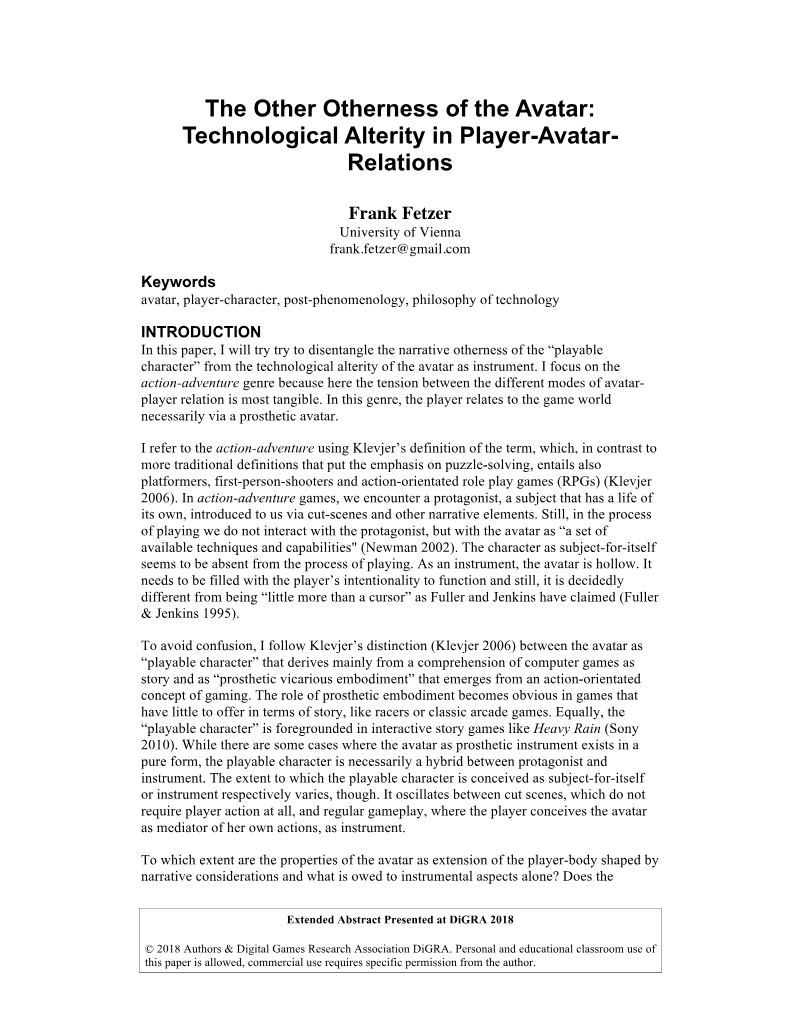
The Other Otherness of the Avatar: Technological Alterity in Player-Avatar Relations
Frank Fetzer's extended abstract, presented at DiGRA 2018, separates two intertwined aspects of the game avatar: the narrative otherness of the "playable character" and the technological alterity of the avatar as instrument.
- The paper argues the player avatar is a hybrid of protagonist and instrument, and its position on that spectrum shifts depending on whether the player is watching cut-scenes or actively controlling gameplay.
- The analysis uses a post-phenomenological framework based on Don Ihde's concept of technological alterity, comparing the avatar to a horse that can serve as an instrument while retaining its own physical properties and a degree of subjectivity.
- The argument rests on close analysis of individual games rather than empirical data, so its scope is theoretical and conceptual rather than quantitative.
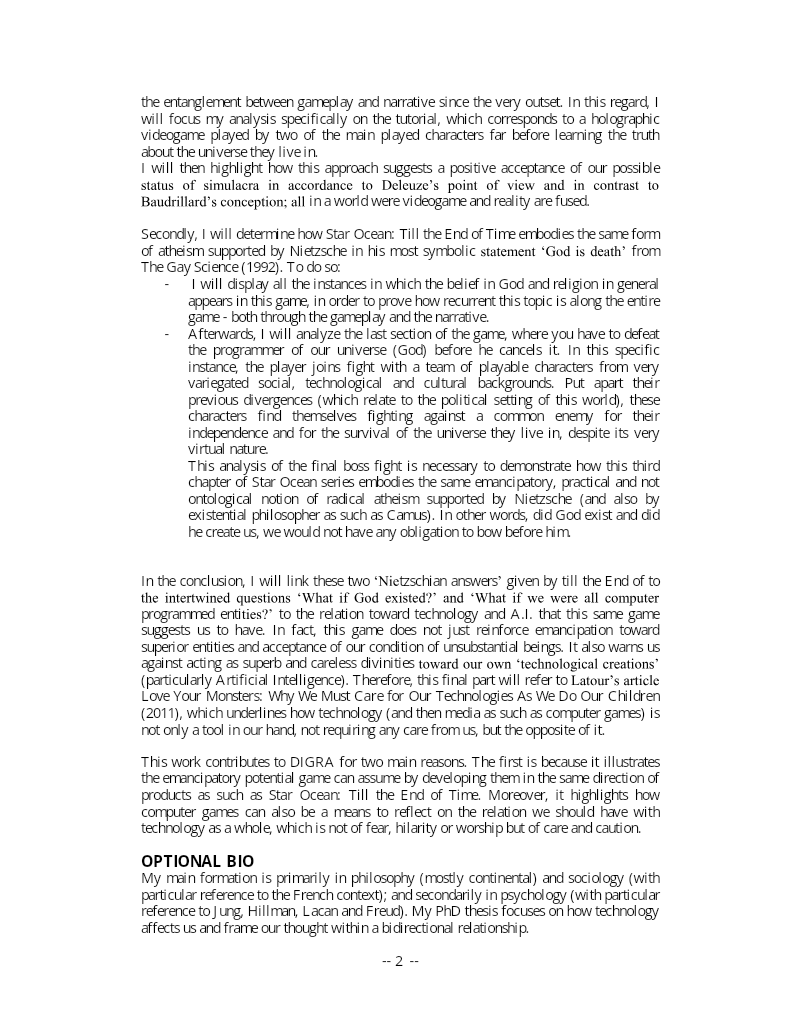

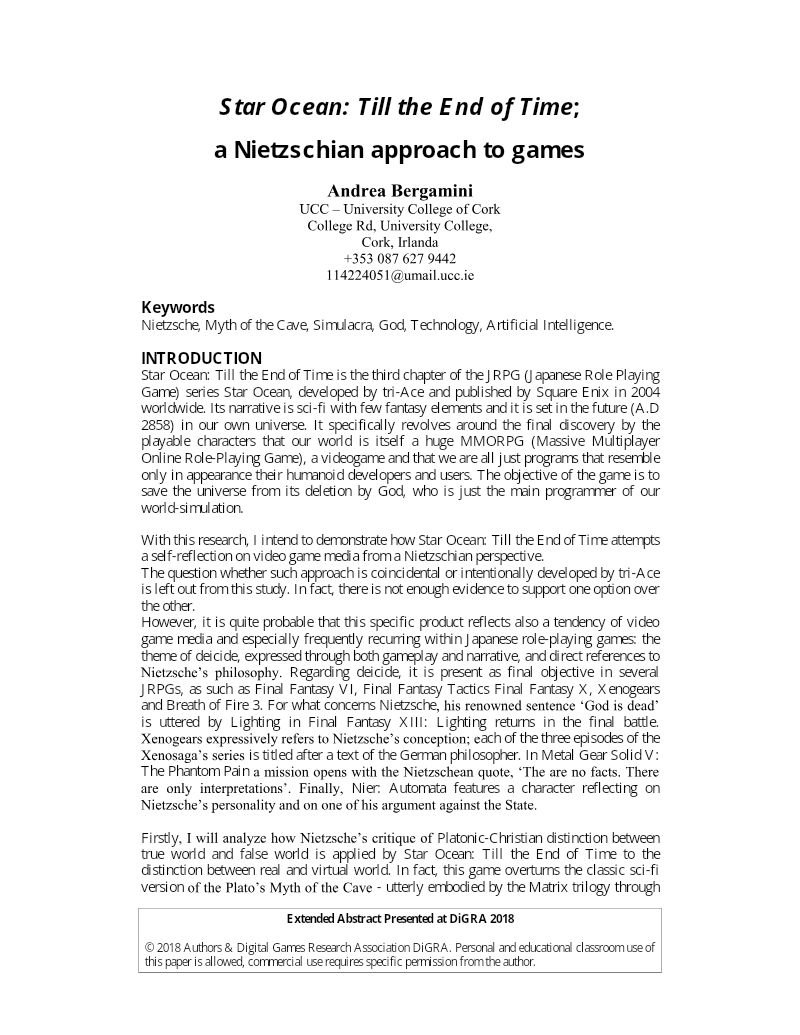
Star Ocean: Till the End of Time: A Nietzschian Approach to Games
Andrea Bergamini's extended abstract, presented at DiGRA 2018, argues that Star Ocean: Till the End of Time (tri-Ace, 2004) engages in a self-reflection on video game media through a Nietzschian lens.
- Andrea Bergamini's DiGRA 2018 abstract reads Star Ocean: Till the End of Time (tri-Ace, 2004) through a Nietzschian lens, centering on the game's revelation that its characters' world is a simulated MMORPG run by a programmer-God.
- The paper links the game to two themes: the overturning of Plato's Myth of the Cave in science fiction, and the atheistic, emancipatory stance tied to Nietzsche's declaration that God is dead.
- Bergamini situates the game within a wider tendency of Japanese RPGs to stage deicide and quote Nietzsche directly, citing Final Fantasy VI, Xenogears, Xenosaga, and Metal Gear Solid V.
How Local Policies Shape Game Production: A Nordic Perspective
This extended abstract examines how national and regional policies shape game production in the Nordic countries, with a focus on Finland, Norway, and Sweden.
- The paper argues that the spatial organization of Nordic game production is tied to local histories, networks, and policy environments, and that how governments classify games (as cultural heritage, technology projects, or business ventures) concretely affects their funding, regulation, and the games made.
- Norway channels game funding mainly through the Norwegian Film Institute, favoring projects that foster national cultural heritage, while Finland has historically routed most industry funding through Tekes, the national technology and innovation agency, emphasizing technological and economic aims.
- Sweden has lacked a coherent domestic policy for game development, though recent years have seen movement toward a Finnish-style model.
Interpretive Challenges in Games
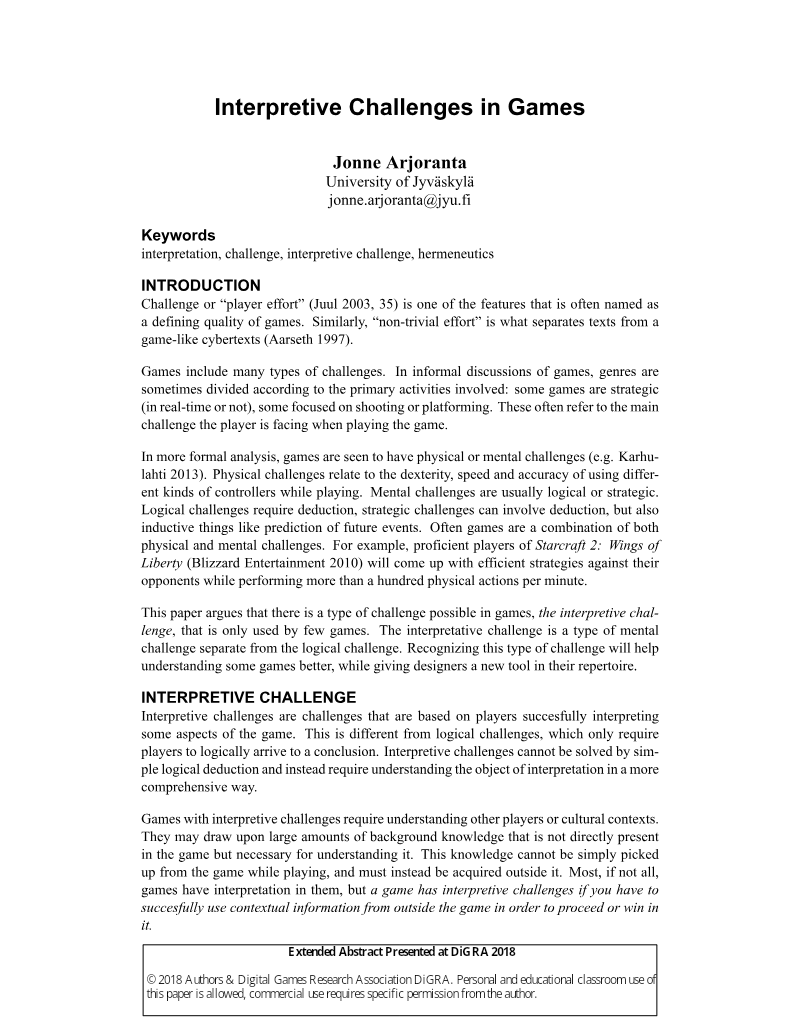
The document introduces and defines the concept of "interpretive challenges" in games, distinguishing them from traditional physical and mental challenges.
- Jonne Arjoranta's paper defines the 'interpretive challenge': a mental challenge in which a player must draw on knowledge outside the game (understanding people, cultural frameworks, background concepts) to progress or win, distinct from the logical or strategic challenges usually discussed in game studies.
- Most games involve some interpretation, but only a small number make successful interpretation a condition of play, which is why the category is useful for identifying a specific class of games.
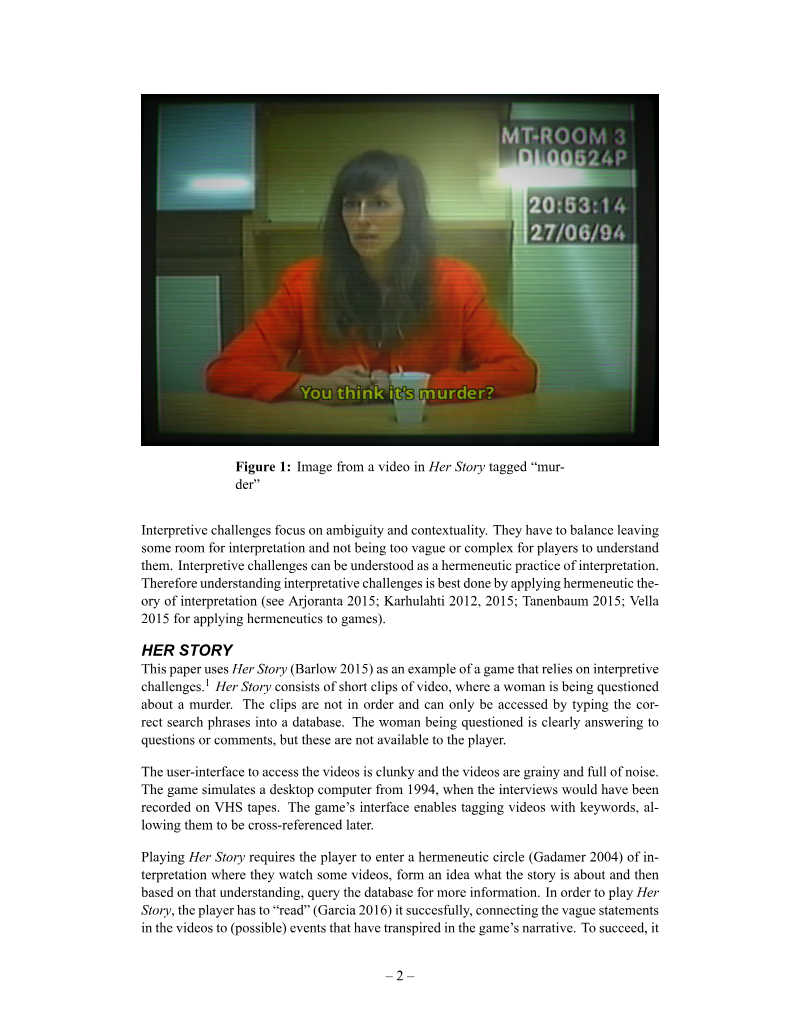
- The paper's central case study is Her Story (2015), in which players search fragmentary video interview clips about a murder and revise hypotheses to connect vague statements to narrative events.
Audiencing on Twitch
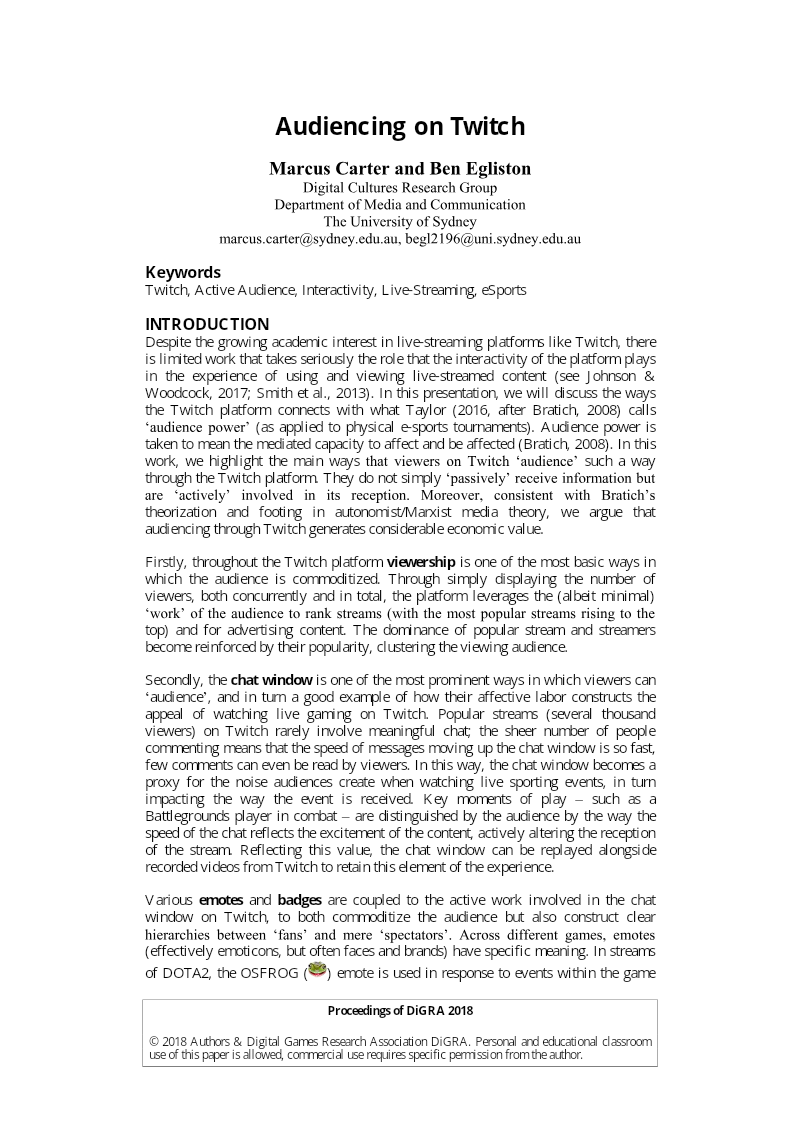
The document "Audiencing on Twitch" examines the active role of viewers on the Twitch live-streaming platform, arguing that their interactive engagement, termed "audience power," generates significant economic value.
- Viewers on Twitch are framed as active, economically valuable participants ('audiencing') rather than passive recipients, and their labor is commoditized by the platform.
- Concurrent and cumulative viewer counts are used to rank streams, reinforce the dominance of popular channels, and support advertising revenue.
- The chat window is the most prominent form of participation; in high-traffic streams messages move too fast to read, so chat speed acts as a proxy for crowd noise and signals excitement.
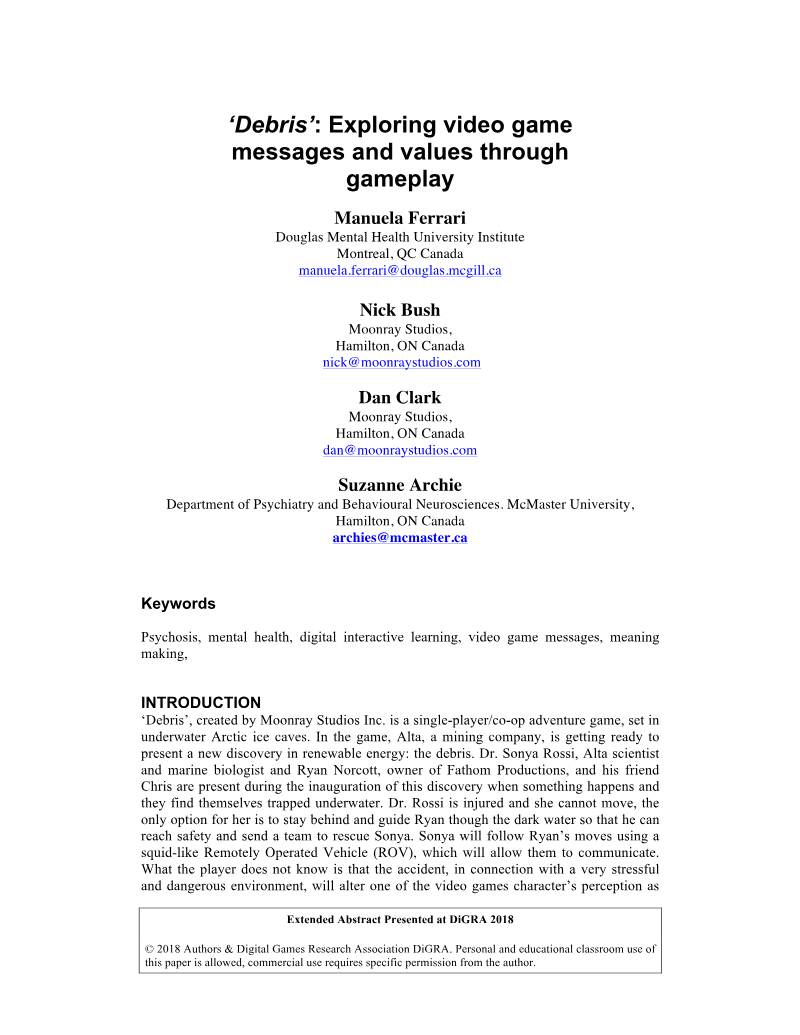
Debris: Exploring Video Game Messages and Values Through Gameplay
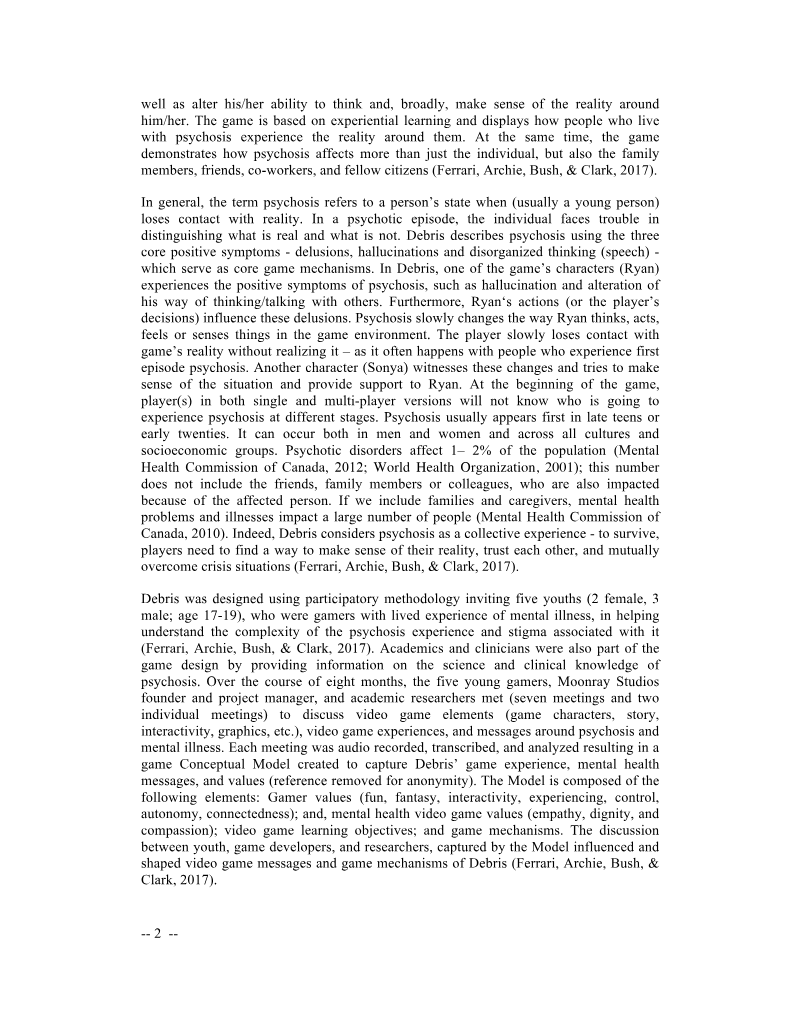
"Debris" is a single-player and co-op adventure game developed by Moonray Studios that uses experiential learning to portray psychosis, placing players inside the perceptual distortions of a character who gradually loses contact with reality.
- Debris, developed by Moonray Studios, is a single-player and co-op adventure game that uses experiential learning to place players inside the perceptual distortions of psychosis, including hallucinations, disorganized speech, and delusions that respond to player choices.
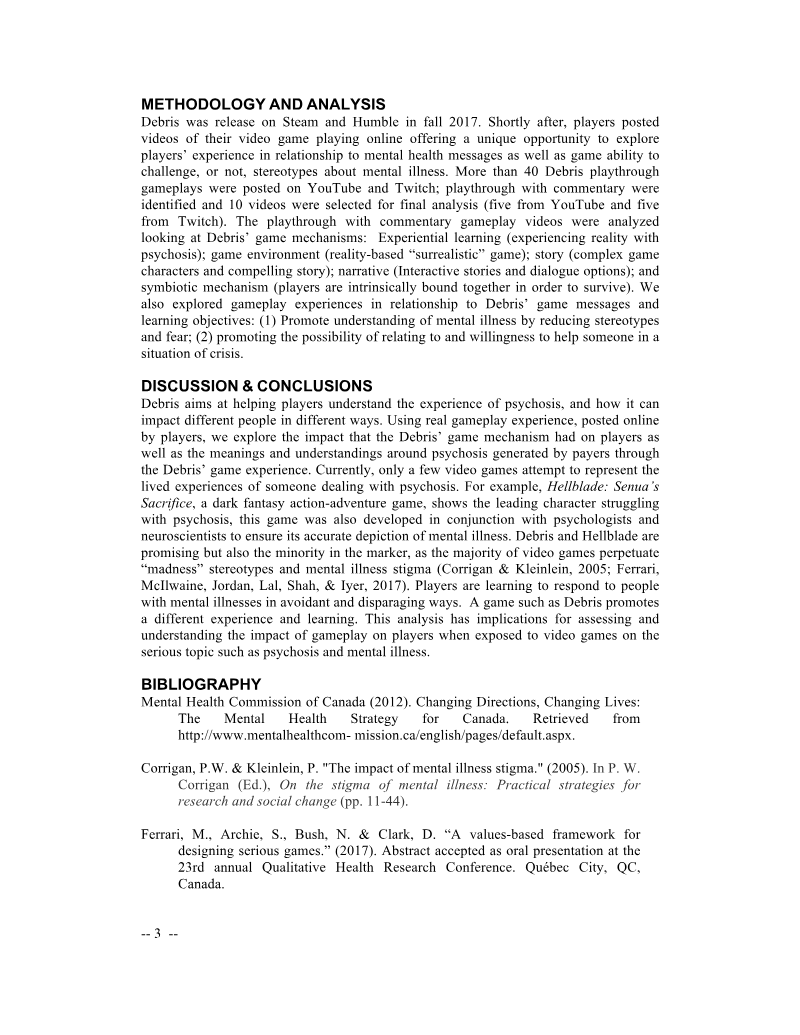
- The game was co-designed over eight months with five youths aged 17 to 19 with lived experience of mental illness, working alongside developers and clinicians, with their discussions recorded, transcribed, and analyzed to build a model linking gamer values (autonomy, connectedness) to mental health values (empathy, dignity, compassion).
- The authors argue the game can reduce stereotypes and fear of mental illness and encourage willingness to help someone in crisis, and they frame psychosis as a collective experience affecting family, friends, and colleagues, not just the individual.
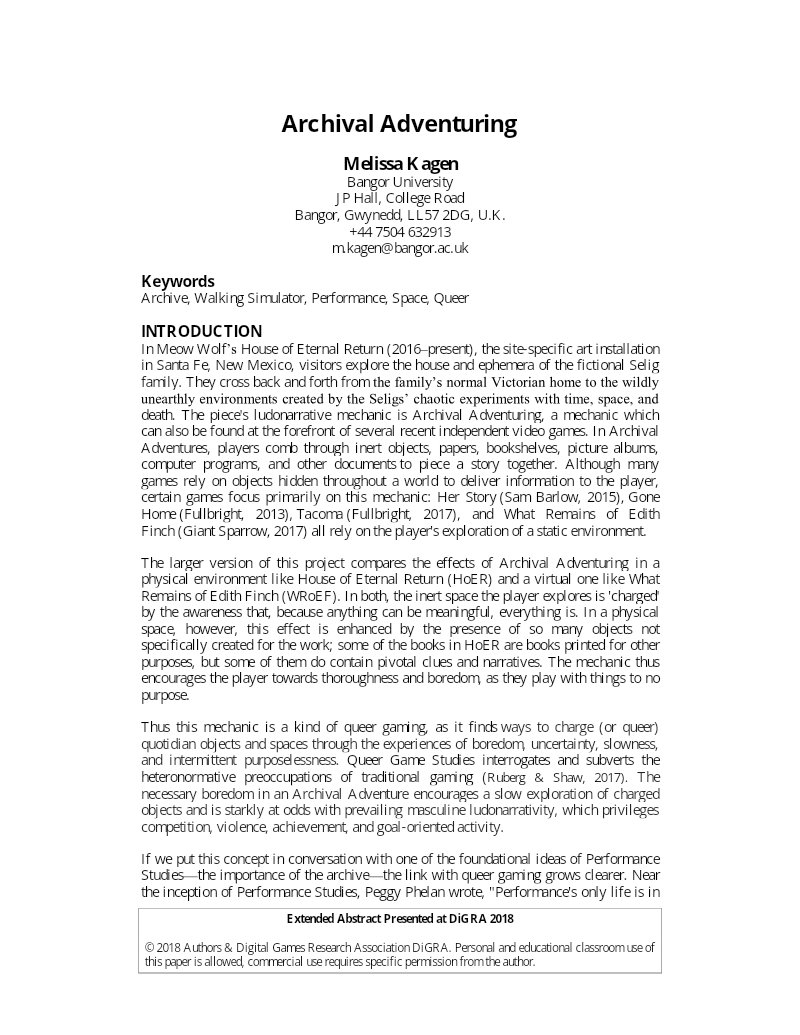
Archival Adventuring
Melissa Kagen's extended abstract, presented at DiGRA 2018, introduces "Archival Adventuring" as a ludonarrative mechanic in which players comb through inert objects, papers, photo albums, and computer programs to reconstruct a story.
- The paper argues that archival adventure games (e.g., Her Story, Gone Home, Tacoma, What Remains of Edith Finch) constitute a form of queer gaming because they reject competitive, achievement-driven, and masculine design conventions in favor of slowness, boredom, and purposeless wandering.
- The central theoretical move draws on Peggy Phelan's claim that performance exists only in the present and vanishes when archived, and on Rebecca Schneider's critique of the archive as a masculine structure that privileges solid documentation over ephemeral embodied practice.
- Kagen argues that archival adventures reverse the archive hierarchy by letting players restore 'flesh' to inert objects, papers, and environments through exploration.
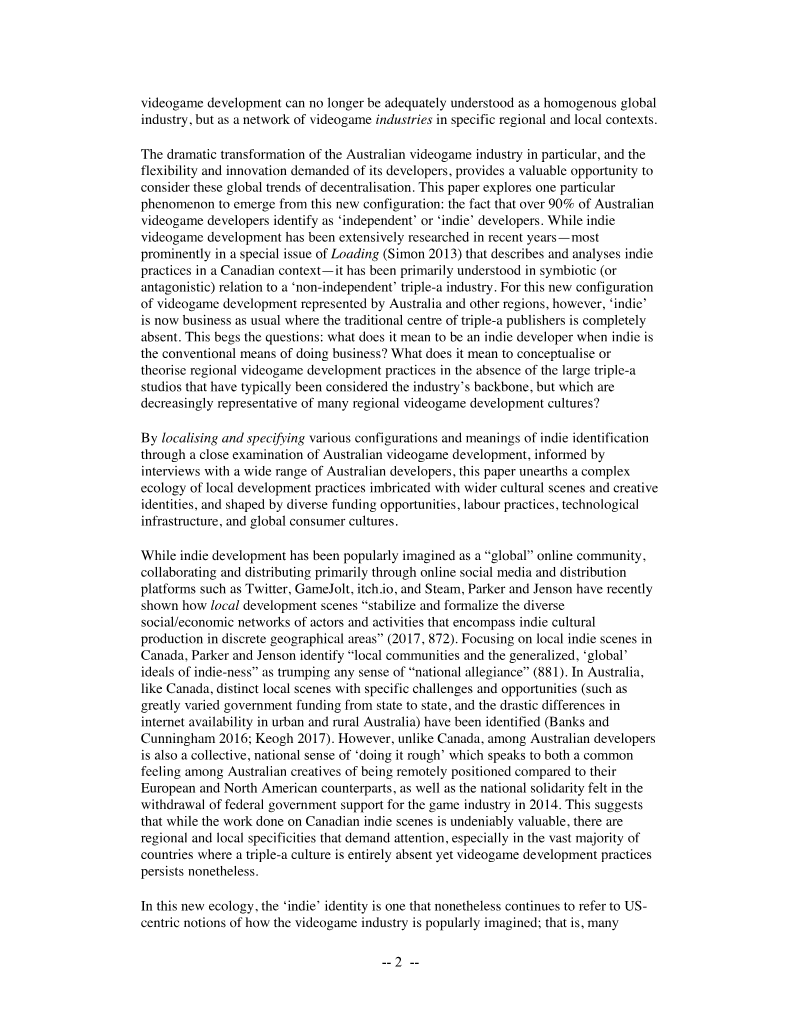
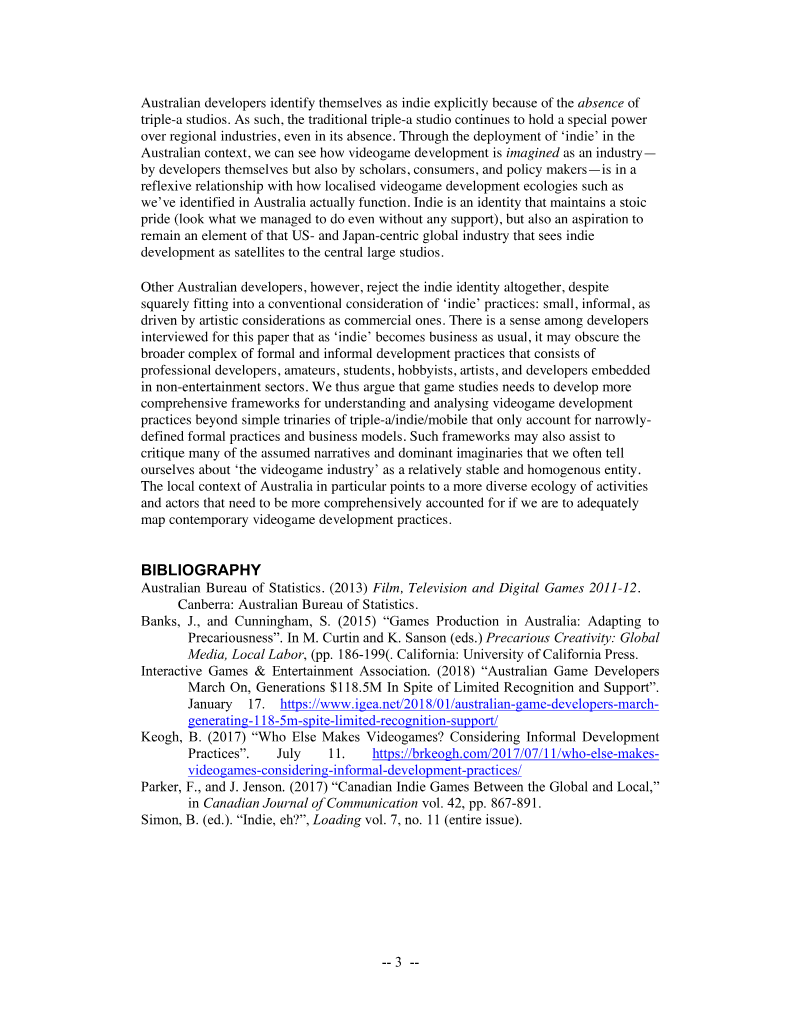
Indie as Usual: Localising Australian Videogame Development
The document examines the transformation of the Australian videogame industry, focusing on the prevalence of "indie" development in a context largely devoid of traditional "triple-A" studios.
- Australia's videogame industry shifted after the collapse of its traditional fee-for-service model, and indie development has become the conventional mode of business in a country without large triple-A studios.
- Employment in the Australian industry fell from 1,431 in 2007 to 581 in 2012, while studio numbers rose from 45 to 84, reflecting 'creative destruction' after the Global Financial Crisis and the US-Australian dollar parity.
- By 2018 employment had recovered to 928 while the studio count dropped to 63, which the authors read as smaller groups and individual developers stabilising and increasingly exporting original intellectual property for digital distribution platforms.
Do you work at DiGRA? Get a free report of how these documents are read and cited here.