
DiGRA
The Digital Games Research Association: the international association of academics and professionals who study digital games. Its Digital Library holds the proceedings of the DiGRA conferences since 2002.
Documents
Video Games Production Networks in the Periphery: The Chilean Case
The document examines the Chilean video game sector to determine if it risks replicating historical economic dependency patterns, moving beyond traditional resource-based dependencies to focus on techno-dependencies within global production networks.
- Chile's video games sector in 2016 comprised around 33 medium and small companies generating roughly 13 million dollars in revenue, within a national economy historically dependent on copper exports.
- The study frames Chile's games industry through dependency theory, cognitive capitalism, and Global Production Networks, asking whether it risks reproducing older patterns of economic dependency on the Global North.
- Dependence on development tools such as SDKs and engines, largely controlled by publishers and console manufacturers in the Global North, is a central concern, with console certification requirements imposing strict technical and stylistic standards on developers.
Multimodal Analysis of Using Video Game Minecraft to Study BA-Construction in Chinese
This study investigates the efficacy of using the video game Minecraft to teach "ba-construction" in Chinese as a second language, aiming to provide a more natural learning environment than traditional classroom settings.
- The study proposes using Minecraft to teach the Chinese Ba-construction, arguing that classroom methods that pair Ba-constructions with SVO counterparts lead learners to treat them as interchangeable or to overgeneralize the structure.
- Analysis of six participants in three collaborative pairs found that all target Ba-construction structures emerged during authentic communicative and problem-solving exchanges in Minecraft, whereas such authentic interaction was absent from classroom settings.
- Transcripts were analyzed in ELAN using a multimodal framework that included gestures, facial expressions, body language, and situational context, not just spoken language.
The Business Model Network of eSports: The Case of Overwatch
The document examines the unique business model network within the eSports industry, emphasizing its deviation from traditional business structures due to its young, global, and digitized audience.
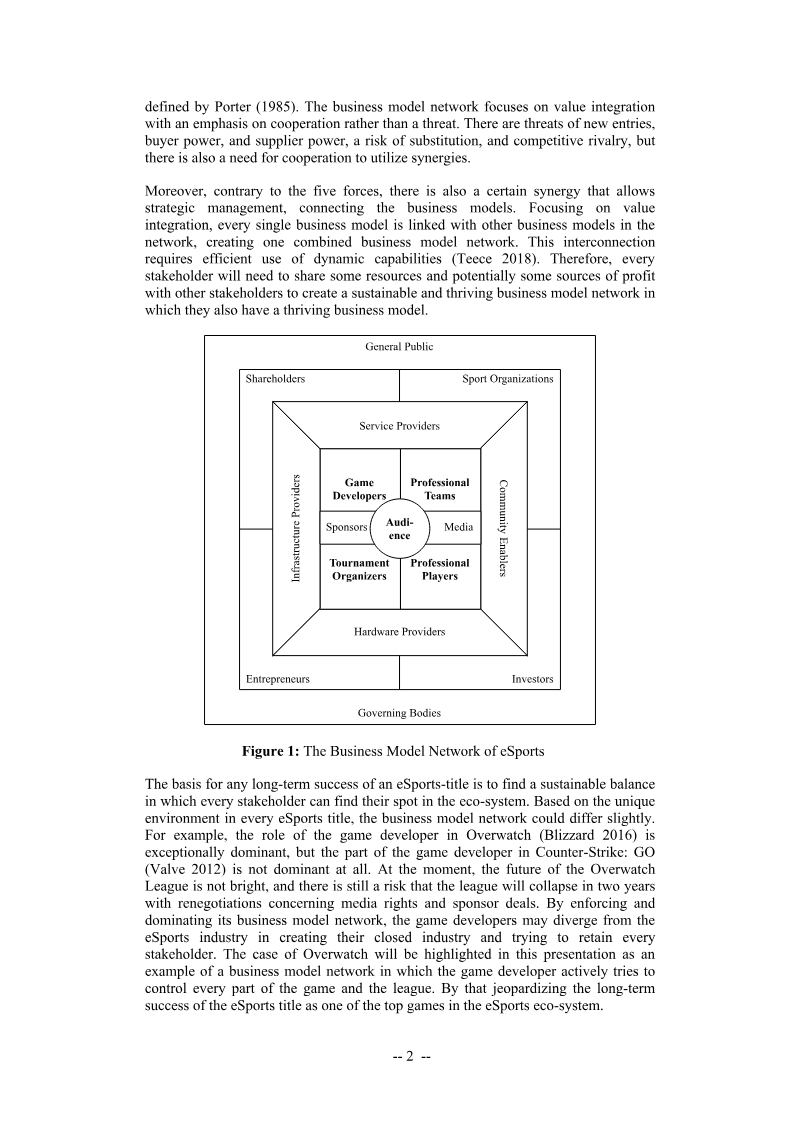
- The paper frames the eSports sector as a 'business model network' of interdependent stakeholders (entrepreneurs, media, sports organizations, investors, developers, sponsors, tournament organizers, and players), extending Porter's five forces model toward value integration and synergy over pure rivalry.
- The central claim is that long-term viability depends on each stakeholder finding a sustainable place in the ecosystem, and that this network structure varies by game title.
- Using Overwatch as the primary case, the authors argue that developer Blizzard plays an unusually dominant role by seeking to control both the game and its competitive league, whereas Counter-Strike: Global Offensive shows a far less dominant developer role.

Radical Game Fictionalism
This philosophical paper, presented at DiGRA 2019 and written by Grant Tavinor of Lincoln University, examines how games relate to fiction and proposes a position it calls "radical game fictionalism."
- Grant Tavinor (Lincoln University) presents 'radical game fictionalism' at DiGRA 2019, arguing that the connection between games and fiction is more fundamental than previously recognized.
- The paper distinguishes 'gameworld fictionalism' (worlds like Tamriel in The Elder Scrolls are fictional, and tabletop and card games can count as 'ludofictions') from the more ambitious 'radical game fictionalism'.
- Radical game fictionalism borrows from philosophical fictionalism used in mathematics and morality, proposing that talk about games should be understood as fiction rather than literally.
Promoting Yokosuka via Video Game Tourism: The Case of the Shenmue Sacred Spot Guide Map
This research examines video game-induced tourism, specifically focusing on the Japanese city of Yokosuka and its connection to the Sega Dreamcast game Shenmue.
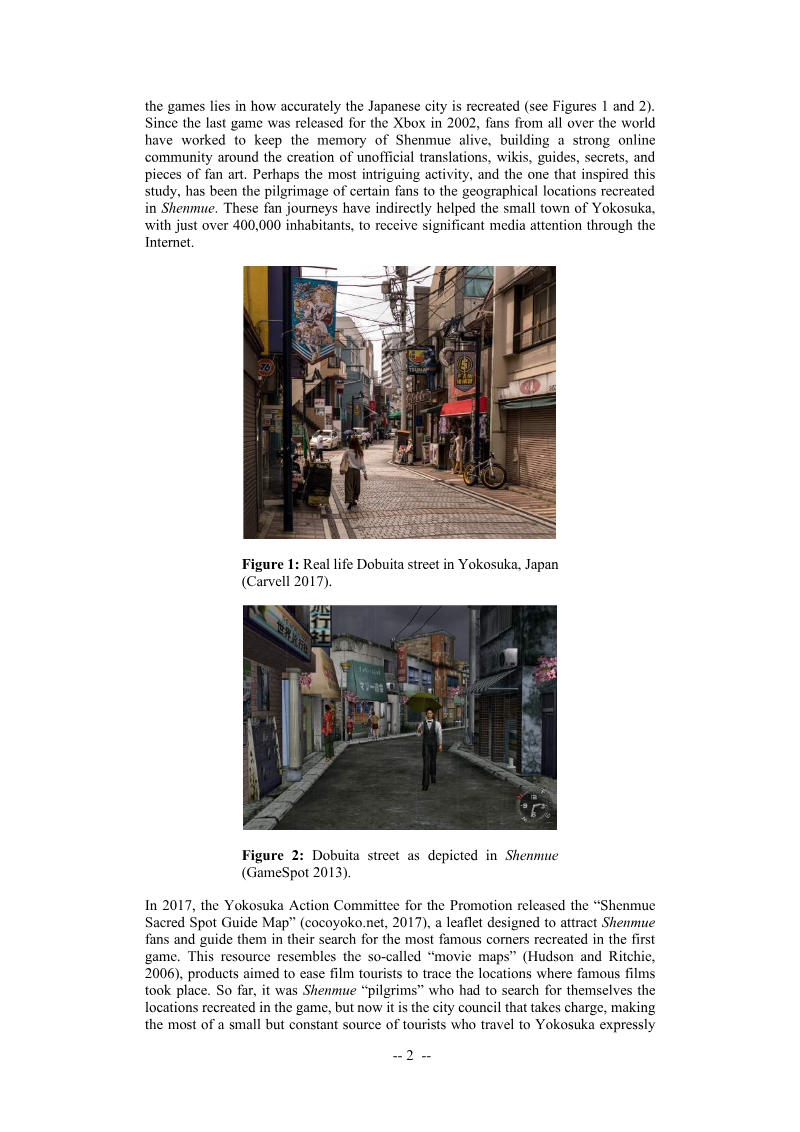
- Yokosuka, a city of roughly 400,000 people in Japan, has drawn tourism driven by fan pilgrimages to locations recreated in SEGA-AM2's 2000 game Shenmue, a phenomenon the author calls "video game-induced tourism" or "secular pilgrimage."
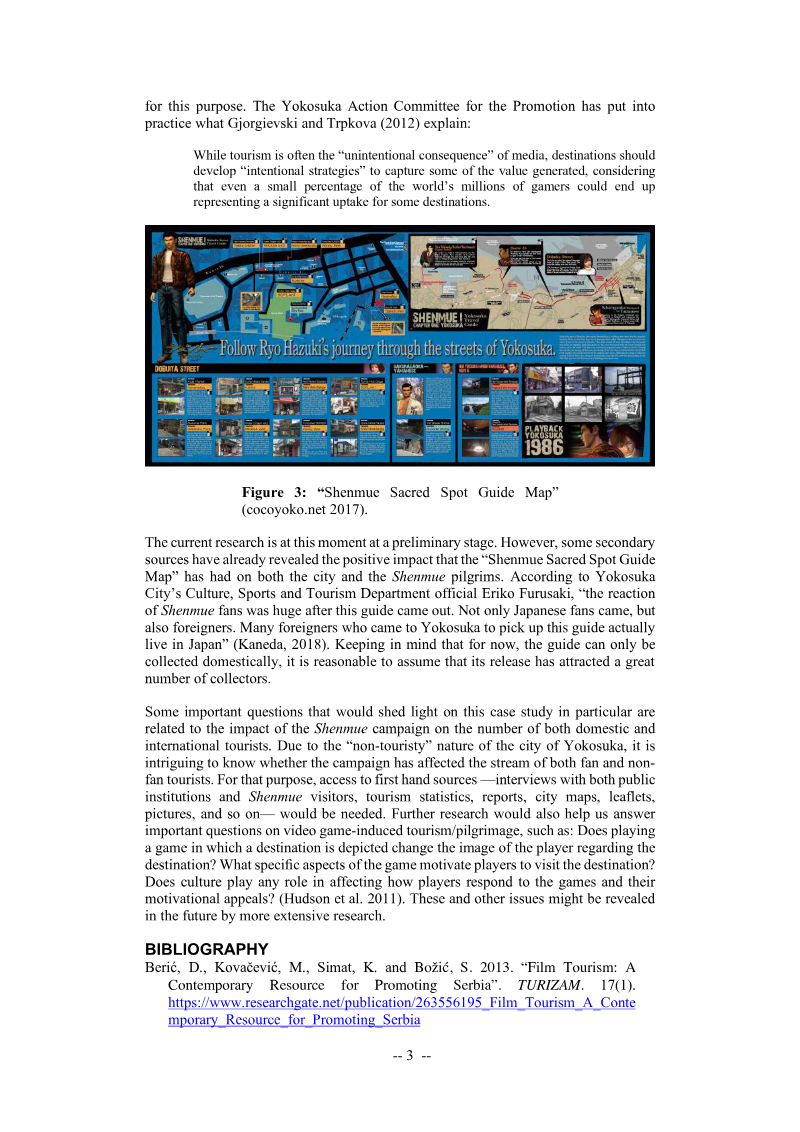
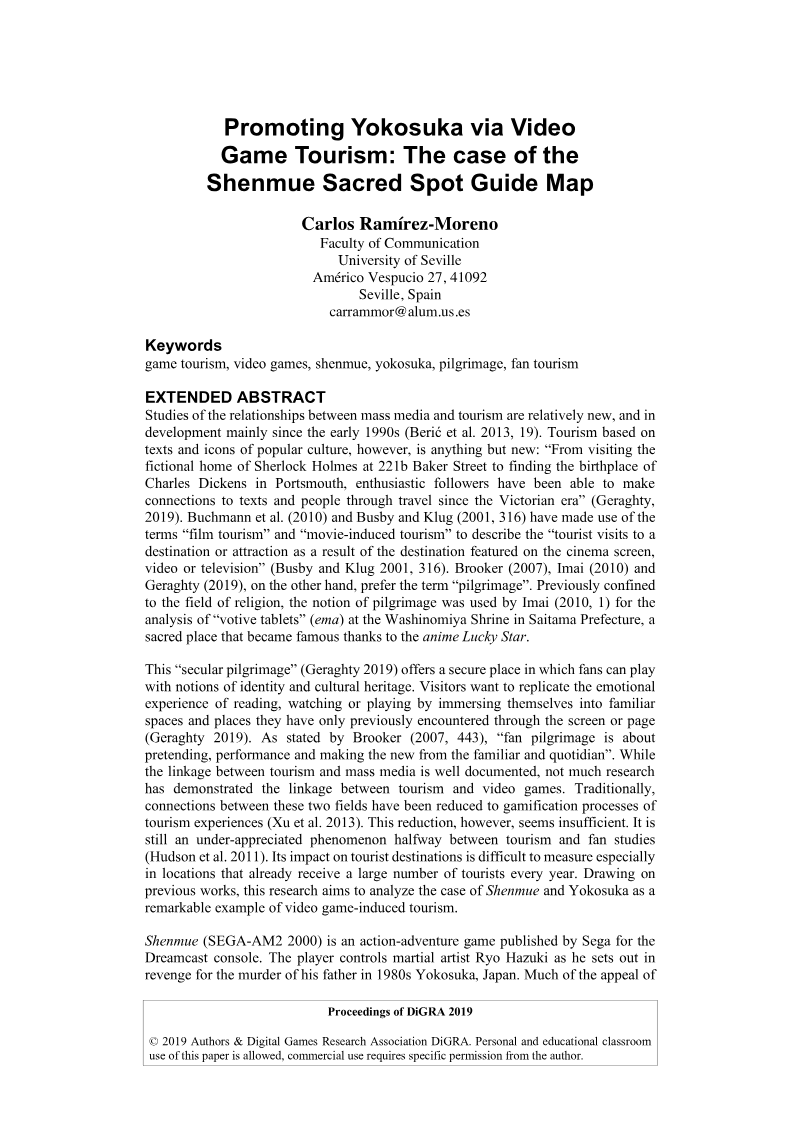
- In 2017 the Yokosuka Action Committee for the Promotion released the "Shenmue Sacred Spot Guide Map," shifting the municipality from passively benefiting from fan travel to deliberately capturing its economic value through a promotional leaflet modeled on film "movie maps."
- Per an interview with a Yokosuka City tourism official, demand for the guide is strong among both Japanese and foreign fans, many of whom were residents of Japan, and the guide is currently available only domestically.

New Media Ecosystems: Amazon and the Advancing Game Economy
This analysis examines Amazon's strategic integration into the game economy and its broader impact on media ecosystems.
- Amazon's 2015 acquisition of the CryEngine codebase (rebranded as Lumberyard) and its 2016 purchase of the Twitch streaming platform, combined with Amazon Web Services, form an integrated ecosystem linking game developers and players.
- The paper positions Amazon as a media company whose influence spans e-commerce, middleware, and consumer hardware, and argues that game engines are becoming foundational to commerce, artificial intelligence, and everyday interfaces.
- Amazon reportedly uses game spaces as testing grounds for new interaction models, linking its Alexa voice service and connected devices to engine-driven infrastructure and crowdsourcing research through its developer and streaming communities.
Fired in a Blog Post: The End of Heroes of the Storm Esports
Blizzard Entertainment's abrupt December 2018 announcement that it would end its Heroes of the Storm esports league, days before Christmas, effectively removed the livelihoods of hundreds of players, casters, coaches, and team managers.
- Blizzard Entertainment ended the professional competitive league for Heroes of the Storm (HotS) in December 2018, announcing the decision with little warning.
- The study is based on seven qualitative open-structure interviews (90 to 180 minutes each) with former and prospective professional players, team managers, casters, and board members of European and North American amateur HotS leagues, analysed via thematic analysis.
- Preliminary findings suggest Blizzard's professional league was both a rallying point and aspirational model for players, yet it also constrained the organic growth of HotS esports.
Designing Global Empowerment? Activist Self-Narratives in Culturally Mixed Settings
The study examines the self-narratives of facilitators from Game Girl Workshop (GGW), a Denmark-based feminist initiative, to critically analyze the complexities of cross-cultural empowerment within game development.
- The Denmark-based Game Girl Workshop frames empowerment around three assumptions: self-expression, teamwork built on flat hierarchies and agile participatory design, and tangible achievement as the route to lasting engagement.
- The central thesis is that these individualist-leaning assumptions can conflict with collectivist cultural contexts, producing consequences beyond a simple mismatch.
- Completing a game and the pride it produced was the most meaningful dimension of empowerment for participants, often more so than the quality of the finished product.

Adapting the Empty Orchestra: The Performance of Play in Karaoke
"Adapting the Empty Orchestra: The Performance of Play in Karaoke" examines karaoke as a highly adaptable social simulation game, characterized by "New Games" aesthetics that prioritize participation over competition.
- Karaoke is framed as an adaptable social game of performance play, grounded in more than 600 hours of participant observation across United States venues, and presented at DiGRA 2019.
- Karaoke's adaptability stems from five factors: its ubiquity, minimal explicit rules, flexible implicit social norms, varied personal player goals, and multiple modes of play.
- In most venues, explicit rules are limited to sign-up procedures and start and end times, while implicit social norms do most of the shaping, accepting loud public singing and showing off but discouraging booing.
In Situ: Researching Corporate Diversity Initiatives with Game Developers
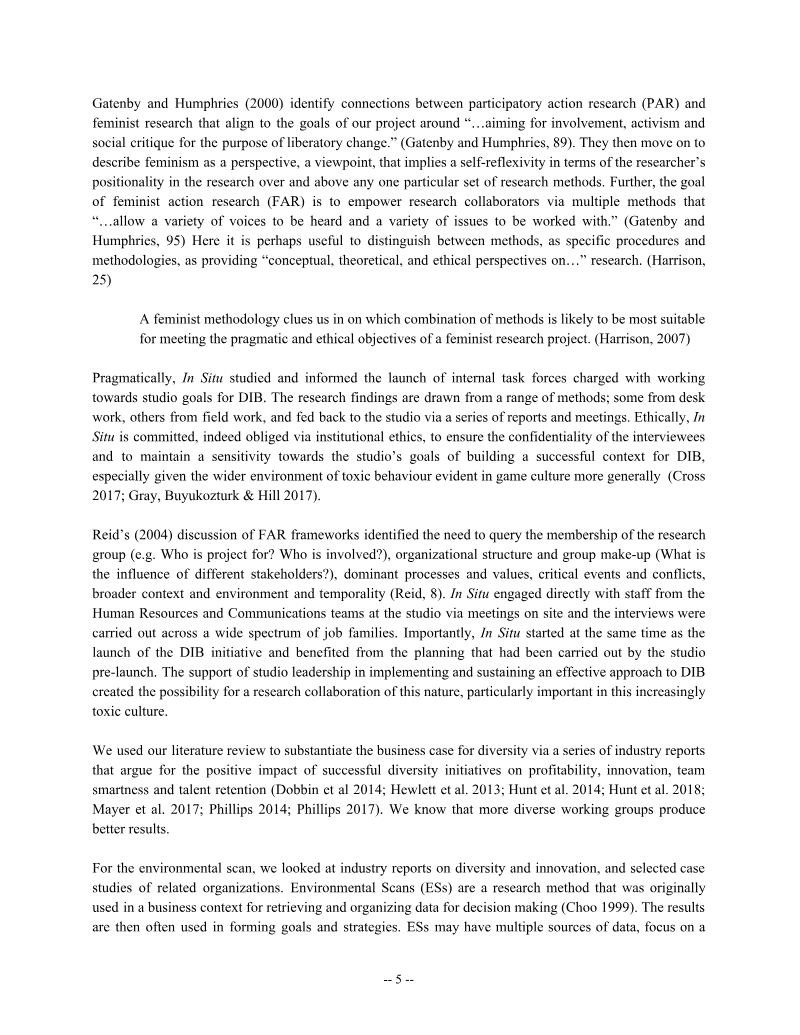
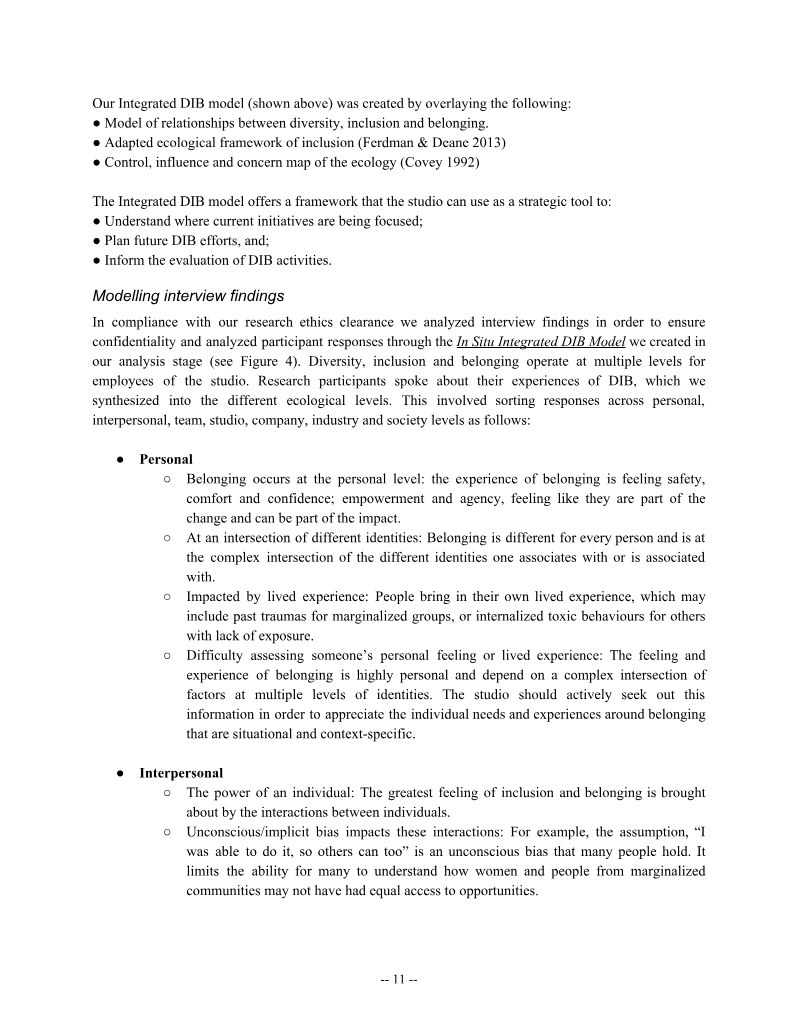
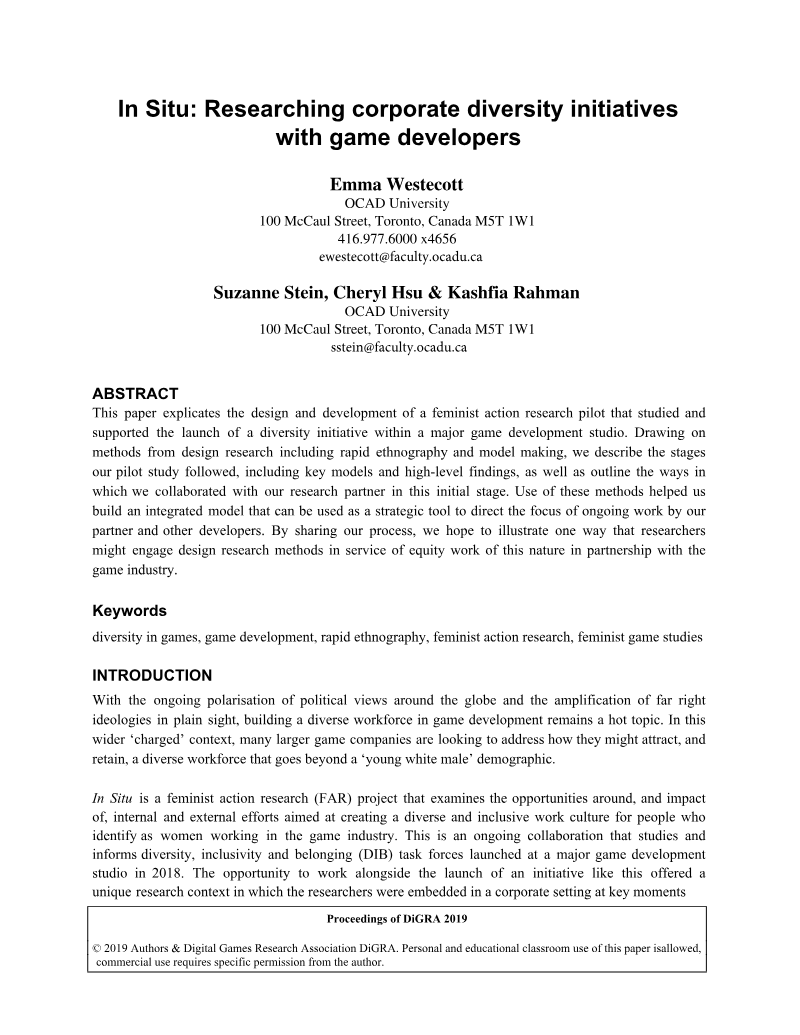
"In Situ: Researching Corporate Diversity Initiatives with Game Developers" presents a pilot study examining Diversity, Inclusion, and Belonging (DIB) initiatives within a major game development studio.
- The study was an eight-month feminist action research pilot conducted in 2018 within a major Canadian game studio, examining diversity, inclusion, and belonging (DIB) task forces aimed at women game developers.
- Its findings rest on rapid interviews with five senior leaders and twelve DIB-invested employees, plus environmental scans of companies including Riot Games, Microsoft Xbox, and Intel.
- The authors conclude that inclusive practices are the mechanism linking diversity to belonging, because diversity alone may produce assimilation or differentiation rather than genuine inclusion.
Describing the Game Studies Canon: A Game Citation Analysis
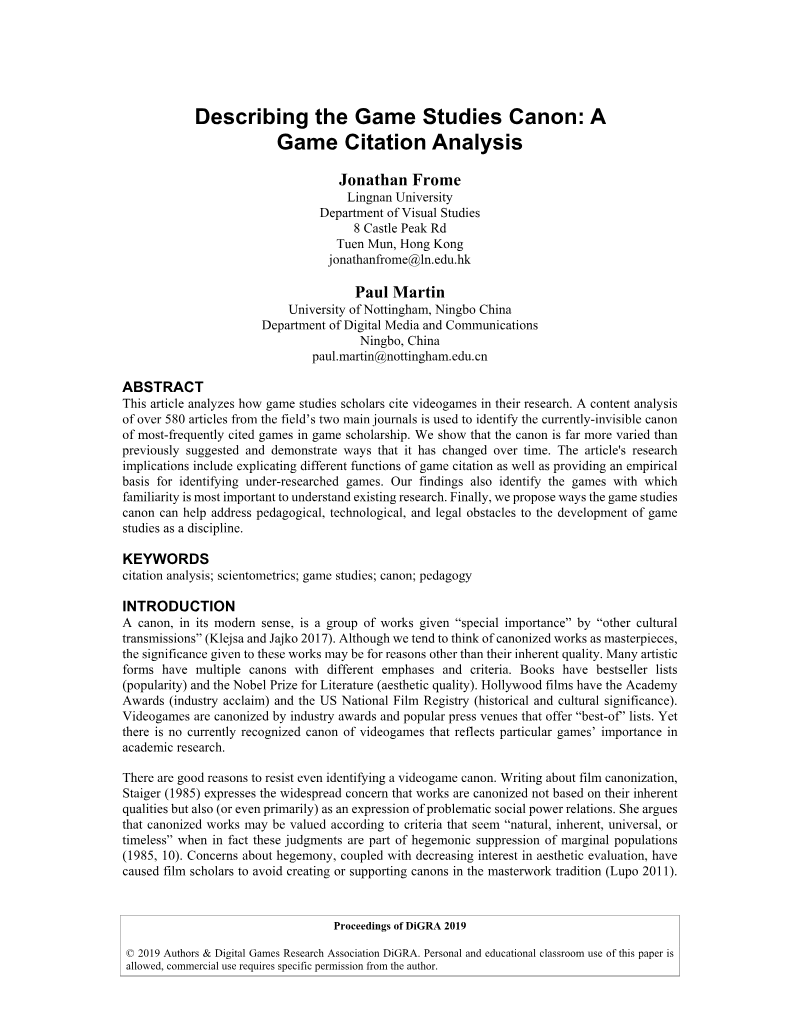
Frome and Martin construct a descriptive, rather than prescriptive, canon of the games most cited in game scholarship, arguing that such a canon aids teaching and helps researchers understand the existing literature despite legitimate concerns about hegemony in canon-building.
- Roughly 90 percent of the 582 articles published in Game Studies and Games and Culture between 2001 and 2018 cite at least one videogame, contradicting an earlier claim that nearly 40 percent do not.
- World of Warcraft leads all citations with 159, followed by Grand Theft Auto and Chess, while about 96 percent of cited games appear in fewer than ten articles, revealing a pronounced long tail.
- The authors argue the field lacks a recognized canon and propose a descriptive canon built from the titles scholars most often cite, rather than a prescriptive list of significant games.
Sites of Play: Locating Gameplace in Red Dead Redemption 2
"Sites of Play: Locating Gameplace in Red Dead Redemption 2" examines the concept of "gameplace," defined as the affective relationship between place, experience, and play within video games.
- The paper argues that places in games emerge from the interplay of space, human connection, and player activity, drawing on placeness theory and site-specific performance, based on more than thirty hours of close gameplay analysis of Red Dead Redemption 2.
- The authors identify four modes of environmental storytelling through which RDR2 constructs its world: evocative spaces, enacting stories, embedded narratives, and emergent narratives.
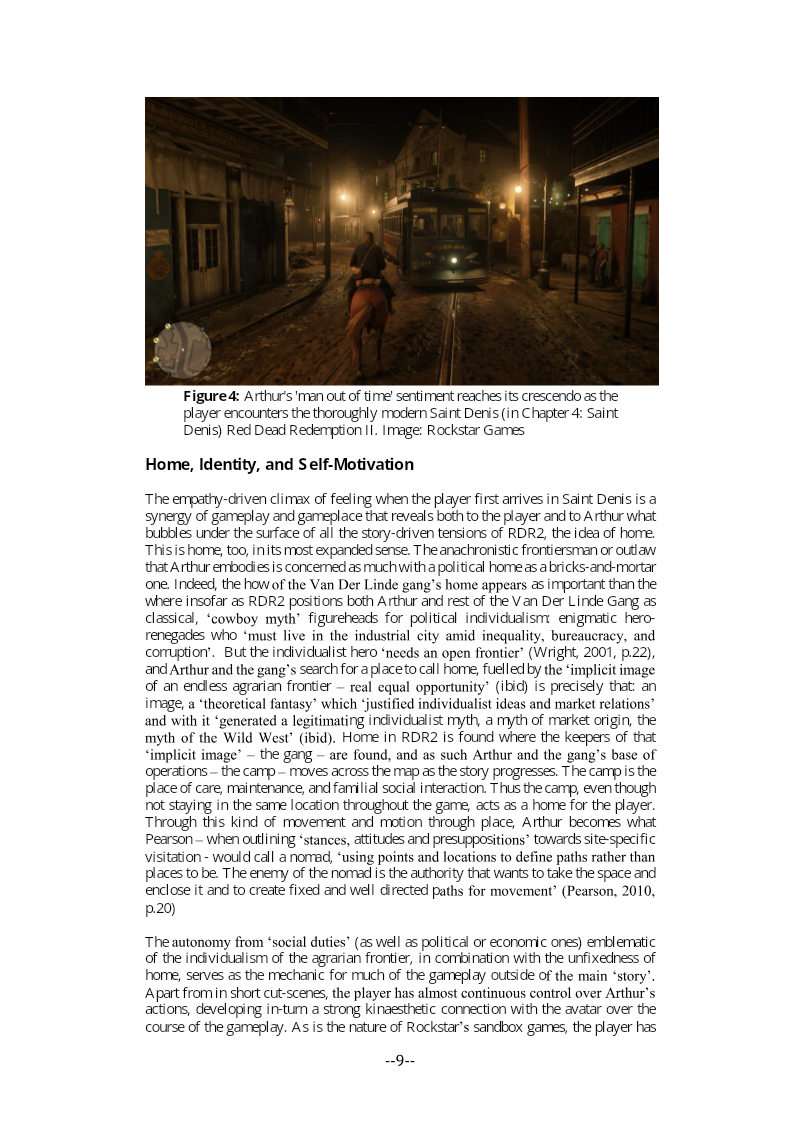
- Place functions as both storyteller and structural device, dramatizing Arthur Morgan's movement from frontier myth toward modernity via the progression from snowy mountains to Valentine to the industrial city of Saint Denis.
Do you work at DiGRA? Get a free report of how these documents are read and cited here.