
DiGRA
The Digital Games Research Association: the international association of academics and professionals who study digital games. Its Digital Library holds the proceedings of the DiGRA conferences since 2002.
Documents

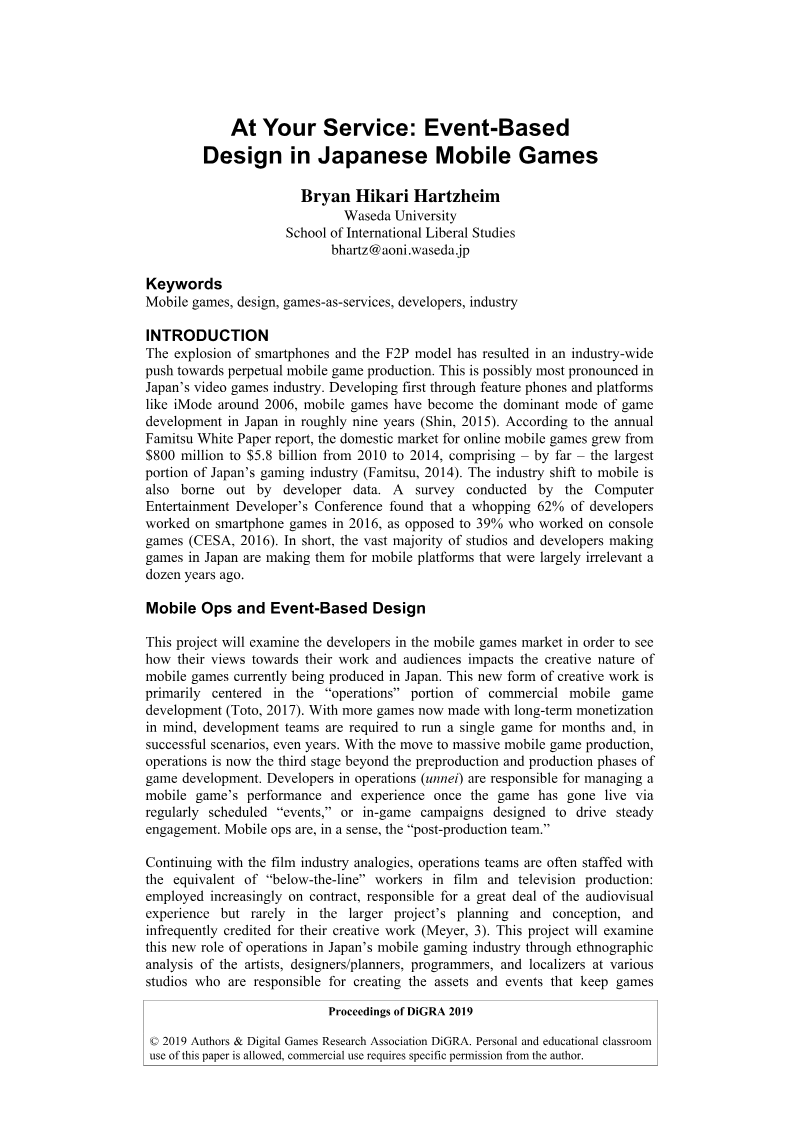
At Your Service: Event-Based Design in Japanese Mobile Games
The document examines the role of event-based design and "operations" (unnei) in the Japanese mobile games industry, focusing on how developers perceive their work and audiences.
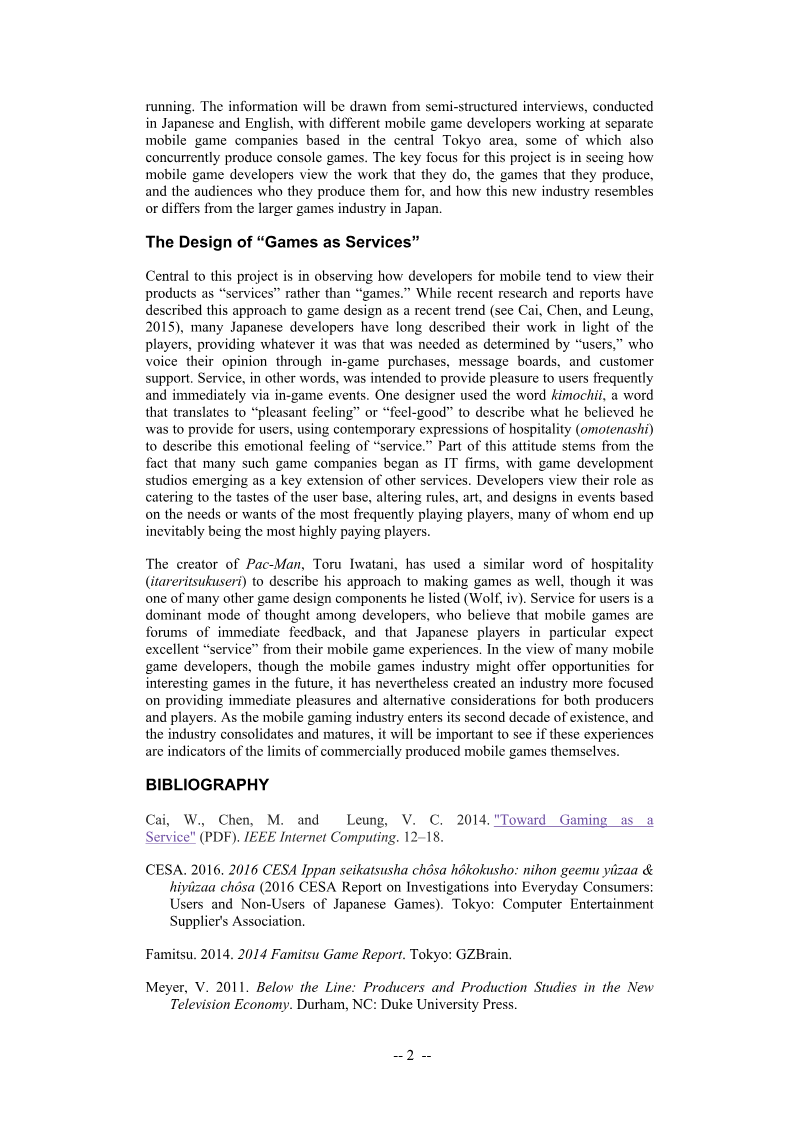
- Many Japanese mobile game developers treat their products as ongoing services rather than finished games, designing for immediate, frequent pleasure and treating the most engaged, highest-spending players as the primary reference point for changes to rules, art, and design.
- The domestic online mobile game market in Japan grew from roughly 800 million yen to 5.8 billion yen between 2010 and 2014, according to Famitsu figures cited in the paper.
- A CESA survey found that 62 percent of Japanese developers worked on smartphone games in 2016, compared with 39 percent who worked on console titles, showing mobile has become the dominant platform for studios.

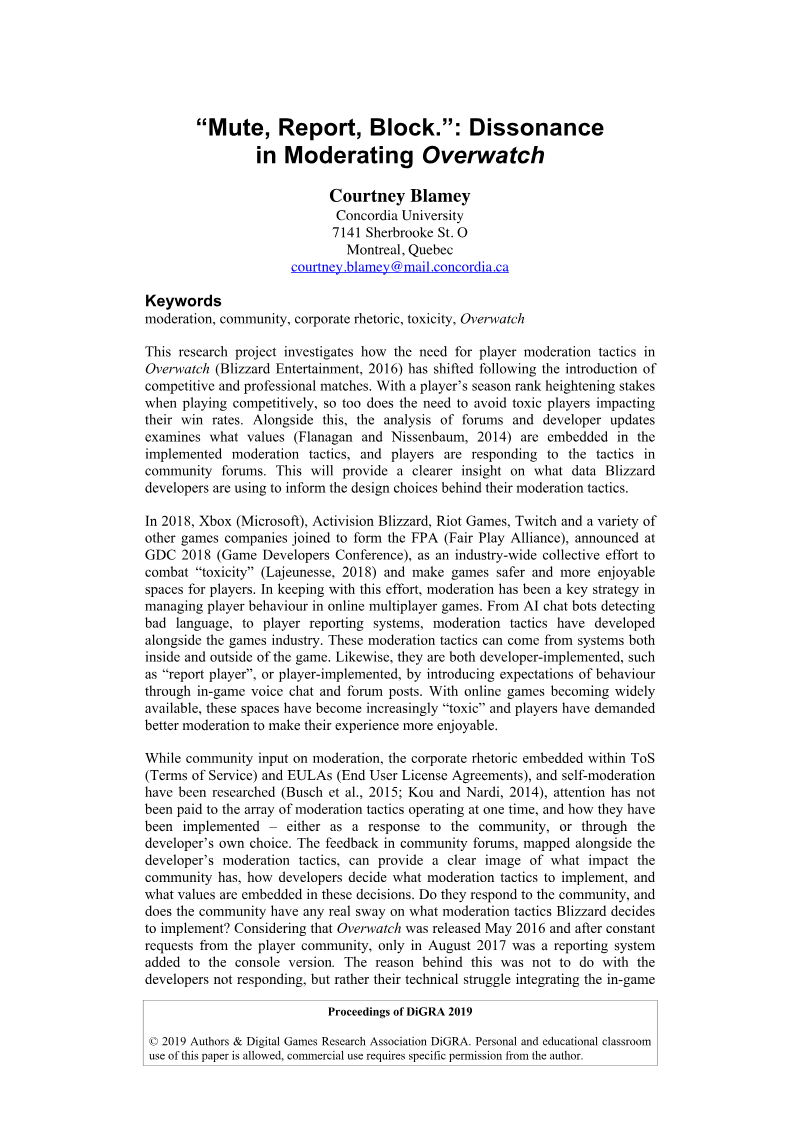
"Mute, Report, Block.": Dissonance in Moderating Overwatch
This research investigates the effectiveness and player reception of moderation tactics in Overwatch, particularly as the game evolved to include competitive and professional play.
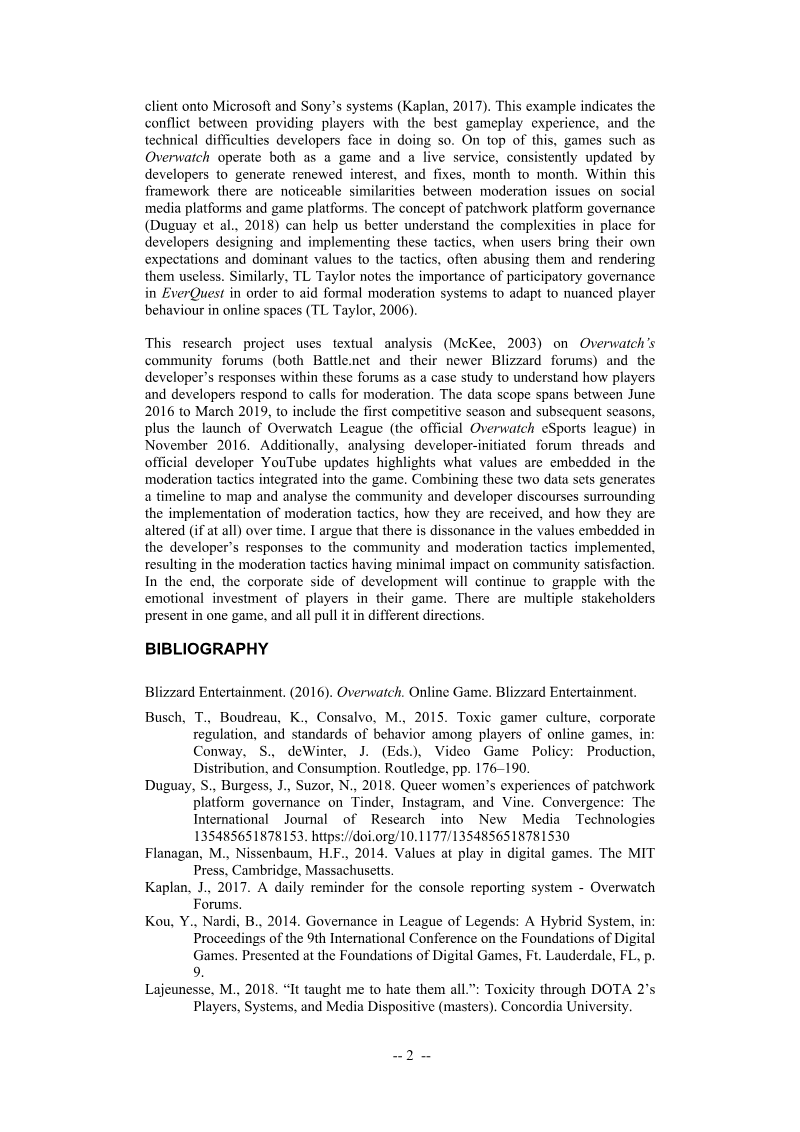
- The report argues that a mismatch ('dissonance') between values embedded in developer responses and those expressed by the Overwatch community causes moderation tactics to have minimal impact on player satisfaction.
- Competitive play and professional esports raised the stakes of toxic behaviour in Overwatch, since toxicity directly affects players' season ranks and win rates.
- Players requested an in-game reporting system after the game's May 2016 release, but a console reporting system did not arrive until August 2017, a delay the paper attributes to technical difficulties integrating with Microsoft and Sony's platforms rather than developer indifference.
An Attempt to Develop SIR ("Shit-Game Is Real") Index
This short DiGRA 2019 paper proposes the concept of a "SIR" (sit-game, or "shit-game, is real") index, drawn from a catchphrase in the Japanese manga The World God Only Knows, whose protagonist prefers galge dating-sim worlds to an uncontrollable reality.
- The paper proposes a conceptual "SIR" (shit-game is real) index to measure how far everyday reality falls short of game worlds, reversing the usual direction of gamification, which starts from reality and applies game mechanics to work and education to raise performance.
- The author's stated aim is to make ordinary life more pleasant and convenient rather than to produce higher performers, starting from games and asking how inferior the real world is to them.
- The motivation draws on the phrase "sitgame is real" from the manga and anime "The World God Only Knows," whose persistence as an internet meme is treated as evidence of a widely shared sentiment about everyday life.
Playable Cities Now
The document explores the evolving concept of "playable cities" as a human-centered alternative to traditional "smart cities."
- Urban play is positioned as a counterpoint to function-driven smart city design, arguing that playful engagement with urban infrastructure can restore human experience to city planning.
- The paper frames smart cities as moving through second and third generations, with the third emphasising citizen co-creation and presenting play as central to that shift.
- The evidence base is a one-year qualitative study with interviews of more than thirty artists, designers, producers, and architects working on urban play projects.
Constructing Haenyeo: Defamiliarization and Sensemaking in the Game Design Process
The document explores the application of serious games in preserving intangible cultural heritage, specifically focusing on the Korean Haenyeo, the traditional female free-divers of Jeju Island.
- The paper presents Mermaids of Ieodo, an analog card game about the Haenyeo, the diving women of Jeju Island, as a case study in how serious games can turn an intangible cultural heritage practice into a playable artifact.
- Its central argument is that defamiliarization, the 'making strange' of familiar design processes, exposes the interpretive choices involved in translating cultural practice into game design, and the authors document design decisions and their rationales to show how sensemaking unfolds.
- The Haenyeo population declined from 14,143 divers in 1970 to 5,659 in 2002, and the share of divers over sixty rose from 4.6% to 52.5%, illustrating the vulnerability of the practice to younger audiences turning away.
Ludocriticism: Steps Towards a Critical Framework for Games
Koenitz and Eladhari's paper argues that game criticism remains marginal compared with film, literature, and theatre, and that this marginality stems from two linked problems: the reliance on analytical vocabularies borrowed from other disciplines, and the scarcity of frameworks aimed at aesthetic, semantic, and societal…
- Game criticism remains marginal compared with film, literature, and theatre, and this marginality leaves games perceived as cheap entertainment even among their own audiences.
- The marginality stems from two linked problems: reliance on analytical vocabularies borrowed from other disciplines, and a scarcity of frameworks for aesthetic, semantic, and societal evaluation rather than functional description.
- Terms such as patterns, textual analysis, close playing, framing, and mise-en-scène have been adopted with limited scrutiny of whether they fit interactive, procedural artifacts.
Gaming DOTA Players: Iterative Platform Design and Capture
The document analyzes the iterative design and "gamblification" of Valve's DOTA 2 Battle Pass, a seasonal subscription platform, to understand how game-as-a-service models optimize player retention and achieve "infrastructural capture."
- The paper argues that DOTA 2's seasonal Battle Pass is continuously redesigned to optimize player retention, aiming at what the authors call absolute retention and infrastructural capture, where community participation feeds the platform's data collection and commodification.
- Based on long-term ethnographic observation of the 2017 and 2018 Battle Pass seasons, the authors combined autoethnographic notes with observation of The International, the Esports tournament that concludes each season.
- Gamblified systems introduced in 2017 to raise player investment were partly removed the following year, while new systems were added to boost retention and encourage more laborious forms of play, showing a pattern of additions and rollbacks between years.
Beyond the Recipe: A Critical Analysis of Craft in Games
This paper critically analyzes the representation of craft in digital games, arguing that current in-game crafting systems often trivialize the inherent materiality and nuanced value judgments associated with real-world craft.
- The paper argues that existing game crafting taxonomies, such as Grow et al. (2017) and King (2015), are mechanics-first and therefore miss the underlying values of real-world craft.
- The central thesis is that digital representation tends to reduce craft to recipe-like mechanics, stripping away material specificity, communal practice, and social dimensions that give craft its meaning.
- Feminist and cultural critiques are drawn on to note that craft is often valued below art and is associated with women's labor and marginalized makers.
Mythmaking and Codebreaking: The Hunt for GTAV's Bigfoot and/as Digital Cultural Memory
This extended abstract argues that play itself is an archival practice, and that player-generated activity shapes the future histories of videogames and digital culture.
- Play itself is framed as an archival practice: activities around play generate archival materials, and the paper argues non-canonical works and practices deserve greater recognition in how digital cultural memory is formed, drawing on De Kosnik's concept of 'rogue archives' and her archive-repertoire double-helix model.
- Grand Theft Auto V (2013) is presented as a preservation challenge because its continued success under games-as-a-service business models makes it both a playable object and an ongoing activity that resists static conservation.
- The central case study is the multi-year 'Bigfoot' mystery, which began with player speculation, was seeded by cryptic clues encoded in Rockstar Games' game code across several titles, and was ultimately solved by a player community known as the Codewalkers.
The Awakening of the Goddess in Competitive League of Legends
The document explores the challenges and initiatives surrounding women's participation in competitive League of Legends in Brazil, focusing on the Athena's E-sport all-female team project.
- Athena's E-sport was an all-female League of Legends team formed in Brazil in 2018–2019 as a response to sexism in competitive gaming, and this exploratory case study examines gender dynamics in Brazilian e-sports through its player selection and online reactions.
- The initiative attracted thousands of new Facebook followers and nearly 600 applicants within ten days of its announcements, showing rapid community attention.
- Online responses to the team were tied to Brazil's polarized political climate following 2013 and the 2018 election, with recurring gendered insults interpreted as expressions of broader ideological conflict.
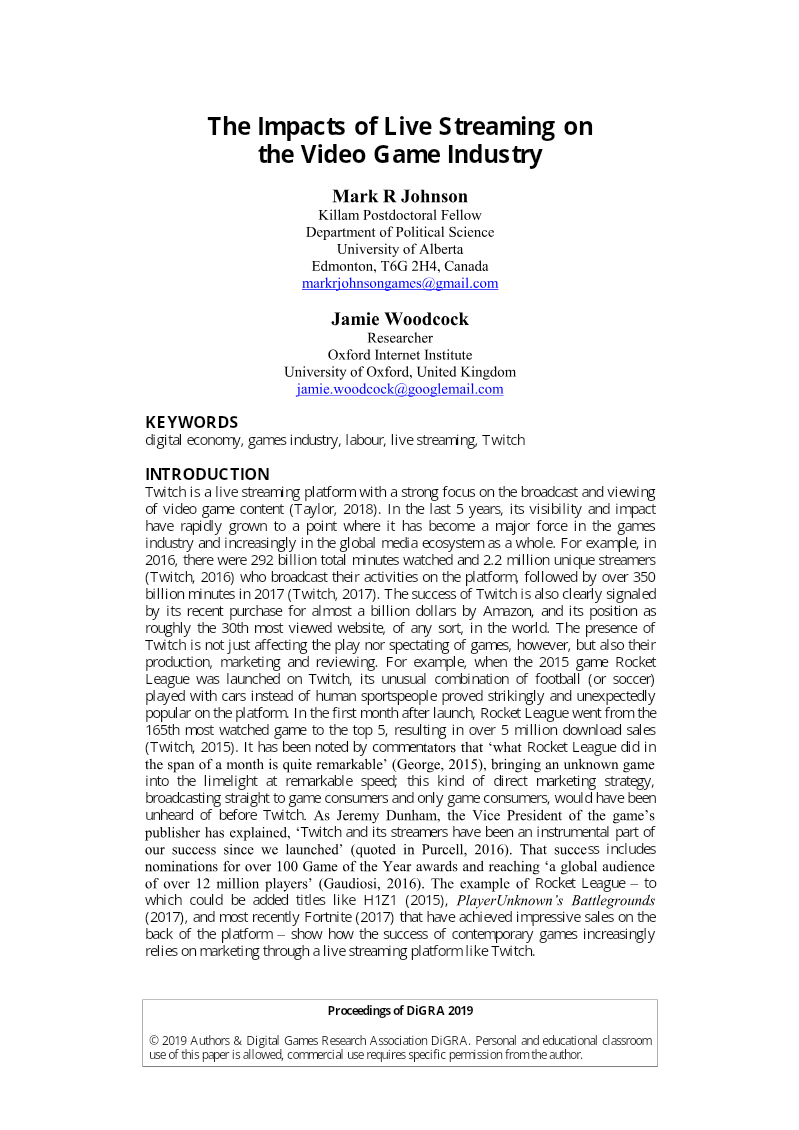
The Impacts of Live Streaming on the Video Game Industry
This analysis investigates the transformative impact of Twitch, a prominent live streaming platform, on the global video game industry.
- Twitch's total viewing grew from 292 billion minutes in 2016 to over 350 billion in 2017, and Amazon's acquisition of the platform for nearly a billion dollars underscores its commercial significance.
- Live streaming can drive rapid visibility and sales for games that would otherwise remain obscure, as shown by Rocket League, which climbed from the 165th most-watched game to the top five within a month of its 2015 launch.
- The influence of Twitch extends across game consumption, production, marketing, and reviewing, with streaming of new releases emerging as a viable alternative to established game-reviewing paradigms, though with both advantages and drawbacks.

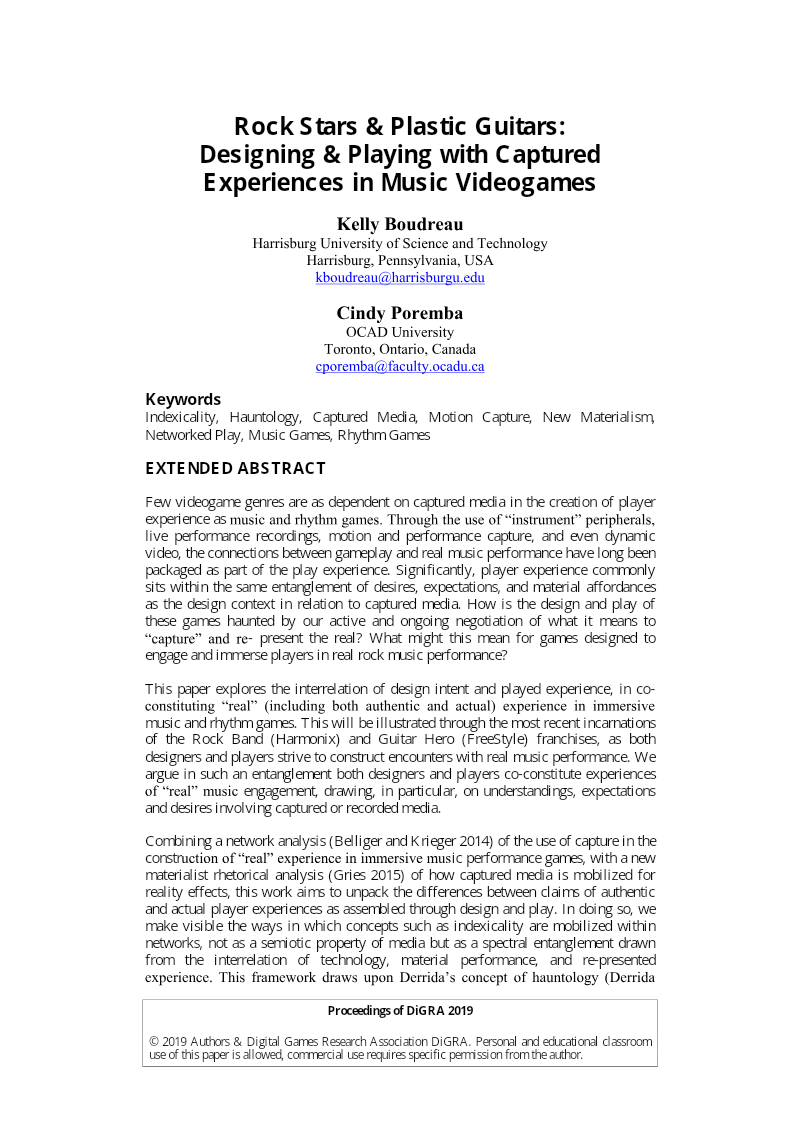
Rock Stars & Plastic Guitars: Designing & Playing with Captured Experiences in Music Videogames
The document explores the profound dependence of music and rhythm videogames on captured media to construct player experiences, particularly focusing on how design intent and player experience co-constitute "real" music engagement.
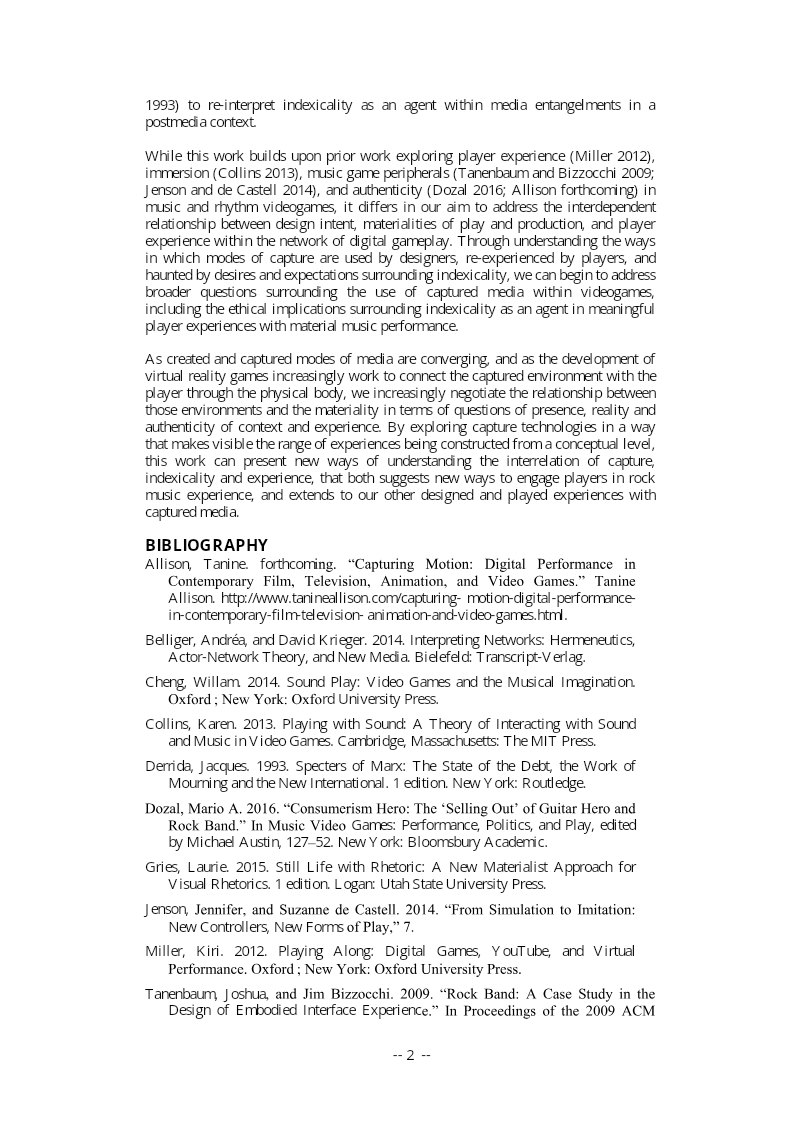
- The paper argues that authenticity and actuality in music games such as Rock Band and Guitar Hero are co-constituted by designers and players through shared expectations about captured media, rather than being a fixed property of the media itself.
- Using Derrida's hauntology, the authors reframe indexicality as an active agent within networks of technology, material performance, and re-presented experience, described as a 'spectral entanglement'.
- The methodology combines actor-network theory and hermeneutic network analysis with a new materialist rhetorical analysis of how captured media is deployed to produce reality effects.
Do you work at DiGRA? Get a free report of how these documents are read and cited here.