
DiGRA
The Digital Games Research Association: the international association of academics and professionals who study digital games. Its Digital Library holds the proceedings of the DiGRA conferences since 2002.
Documents
Defining Gaming Communities: A Super Smash Bros. Ultimate Case Study
The document outlines a research study aimed at defining the main characteristics and social dynamics of the Super Smash Bros. Ultimate (SSBU) competitive community.
- Gaming communities are proposed to form through a power-laden relationship between players and the publisher, in which the publisher's game design guides player behaviour while members reinterpret and extend the game's culture.
- Community leaders accumulate cultural, social, and symbolic capital through discourse and action, allowing them to shape norms, the competitive 'meta,' and expected conduct, especially toward newcomers.
- The authors argue that in-game activity and out-of-game spaces such as forums, streaming platforms, and video-sharing sites are central to community formation, and they model the two as continuously interacting.
Player Persona Research
This research paper explores the concept of "persona" within player research, aiming to synthesize the market research understanding of personas with the anthropological and psychological perspectives.
- The paper argues that two traditionally separate meanings of "persona" (anthropology/psychology and market research/HCI) can and should be synthesized into a single framework for player research.
- It defines "player persona" as a first-person vantage point, an "I-as-a-player" identity distinct from both an in-game character and an everyday personality, and argues players experience a discontinuity between their personal selves and their player positions.
- The author proposes that HCI player-type modeling (aggregate types for design) and phenomenological accounts of the player position address complementary aspects of the same phenomenon.
Analyzing Random Reward System Mechanics and Social Perception
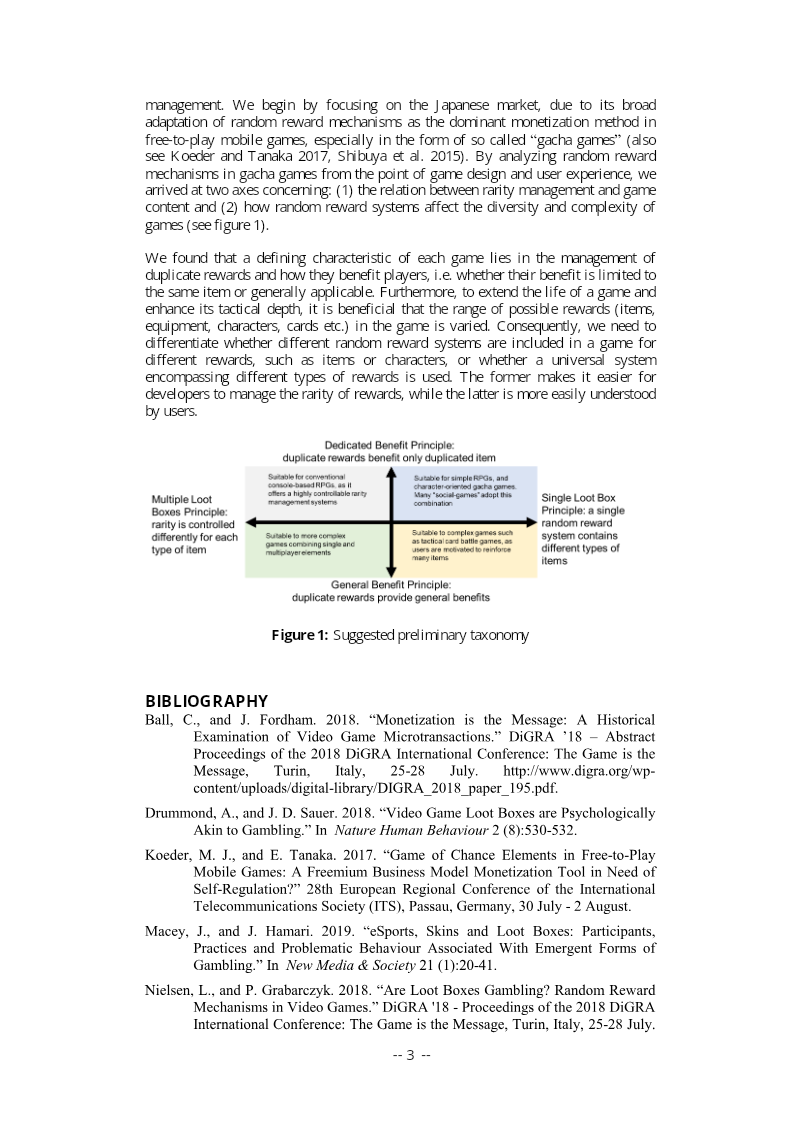
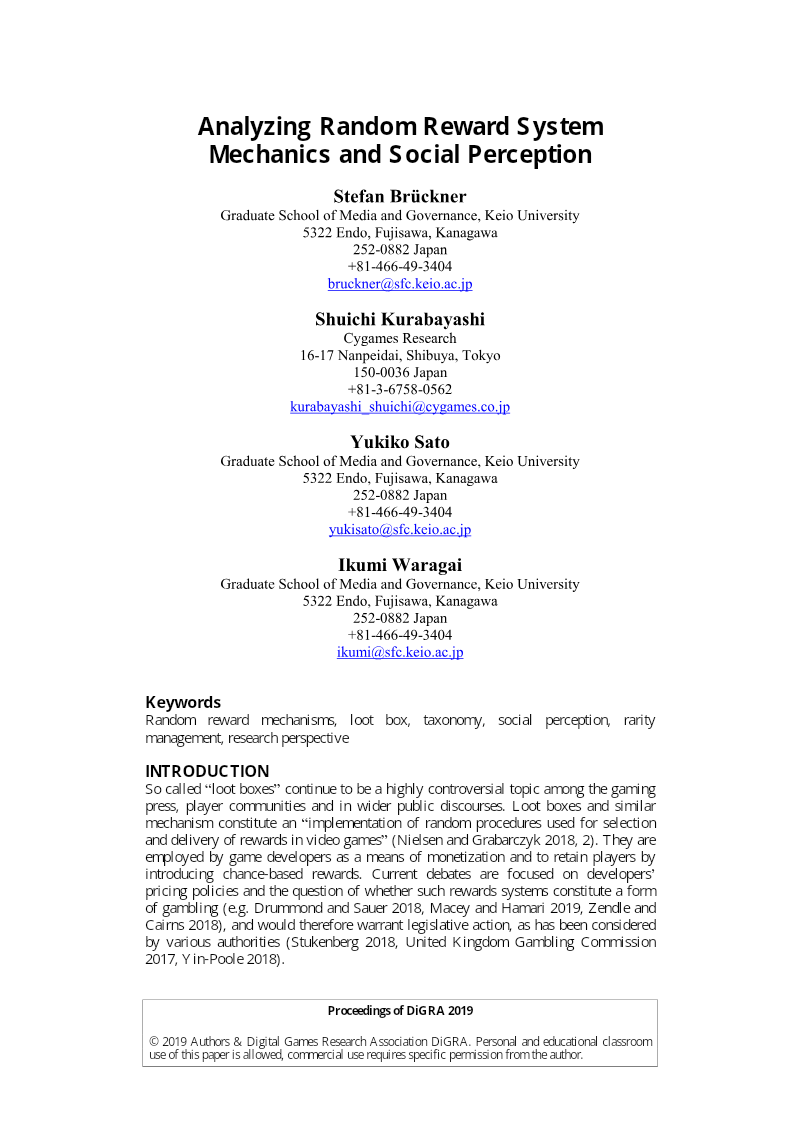
This paper proposes an empirically grounded taxonomy for monetized random reward mechanisms in video games, commonly known as loot boxes, to better understand their social perception and the factors contributing to negative player reception.
- The paper argues the most fundamental distinction among random reward mechanisms (loot boxes) is whether they are embedded in a monetization model, meaning they can be triggered with real money, or isolated from it.
- Rather than focusing on the link to gambling as prior typologies such as Nielsen and Grabarczyk's four-part classification did, the authors aim to identify the conditions under which players reject these systems.
- The proposed framework compares variables including implementation context (genre, platform, business model, franchise, publisher), eligibility to trigger rewards (real-currency purchase vs. in-game earning or free attempts), reward content (cosmetic vs. pay-to-win), and whether the mechanism is integral to play or optional.
The Unintended Consequences of Using Twitch as a University Professor
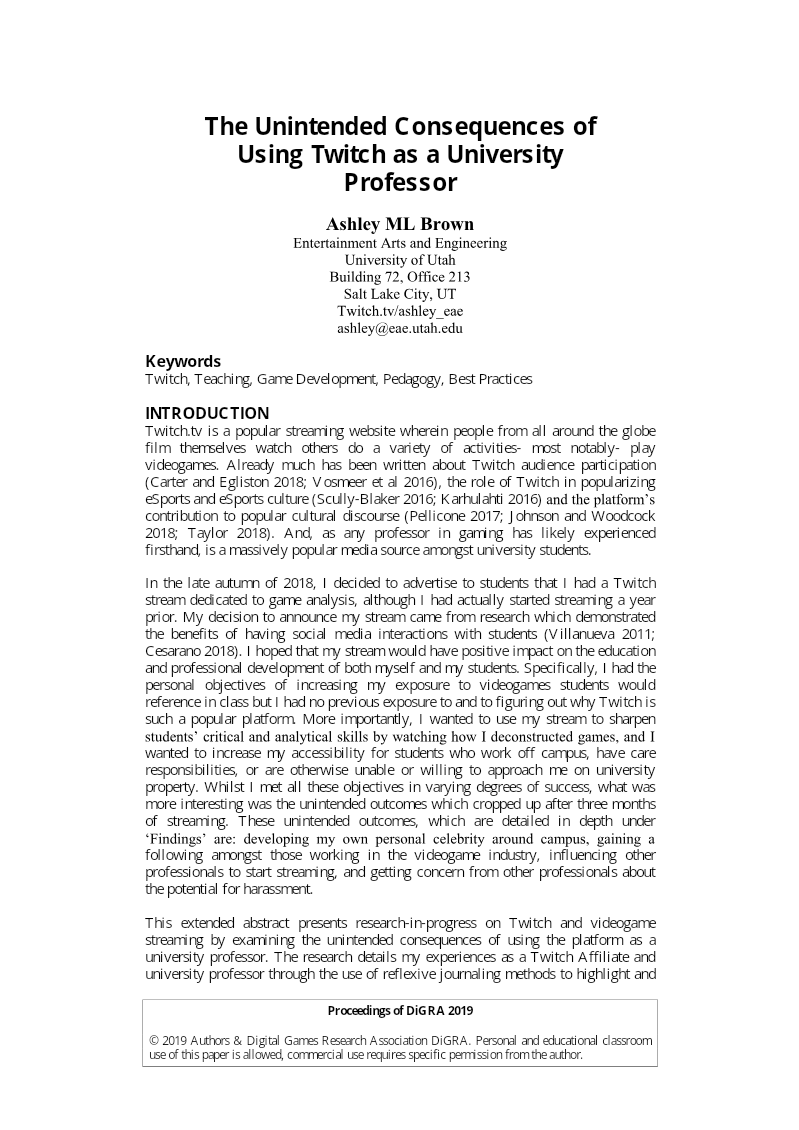
This extended abstract explores the unintended consequences of a university professor using Twitch for game analysis and pedagogical purposes.
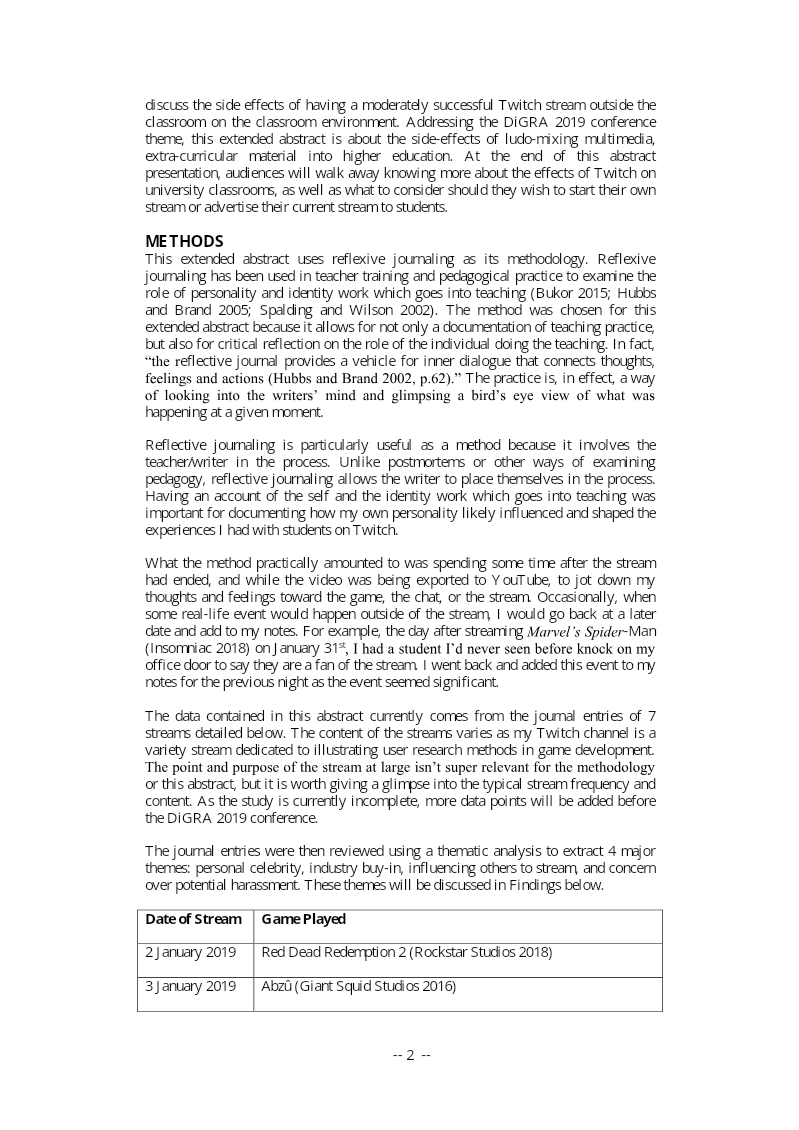
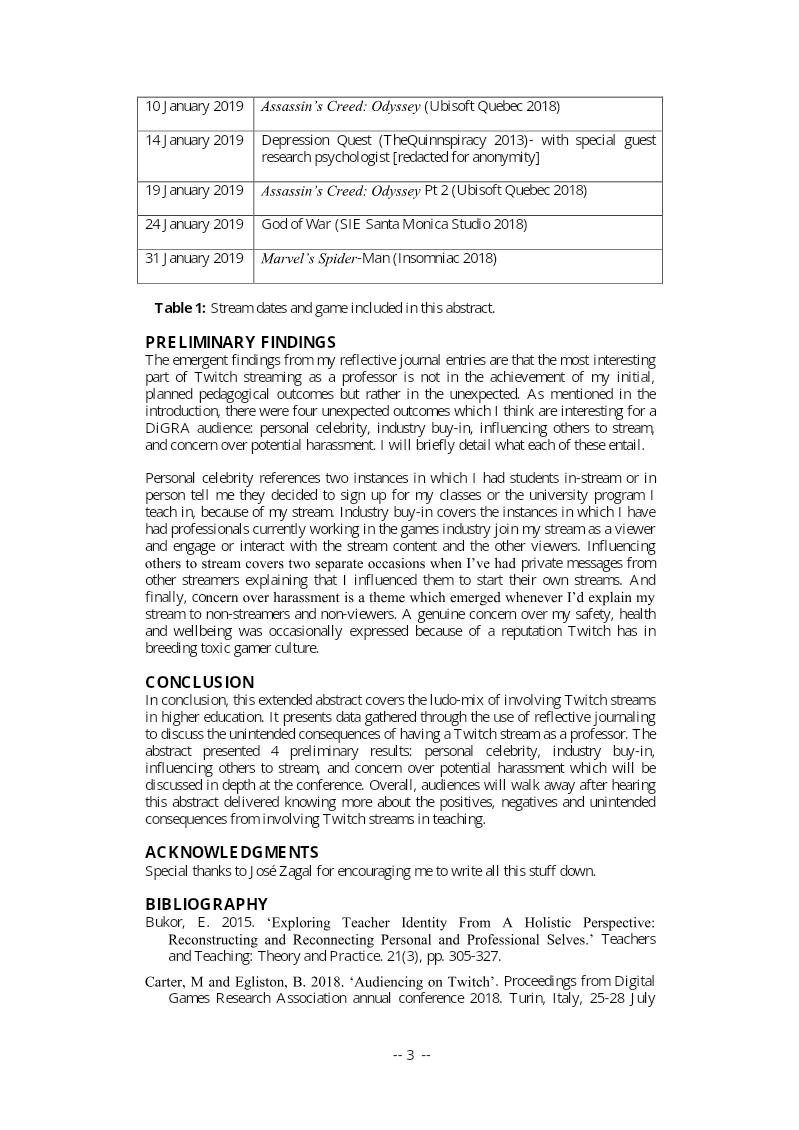
- The study's most significant effects of streaming were unplanned: rather than the intended pedagogical gains, four unexpected outcomes emerged: personal celebrity among students, buy-in from games-industry professionals who joined as viewers, other streamers being inspired to start channels, and concern from non-streamers about harassment and toxic culture on Twitch.
- The research is a single-instructor, self-reported reflexive journal study by Ashley Brown (University of Utah) covering roughly three months of Twitch Affiliate streaming after advertising the channel to students in late 2018, analyzed across seven January 2019 sessions via thematic analysis.
- The stream, a variety channel illustrating user research methods in game development, improved accessibility for students who cannot easily approach faculty on campus, such as those with off-campus work or care responsibilities.

No Rivalry Without Commentary: Misja Esport Case Study
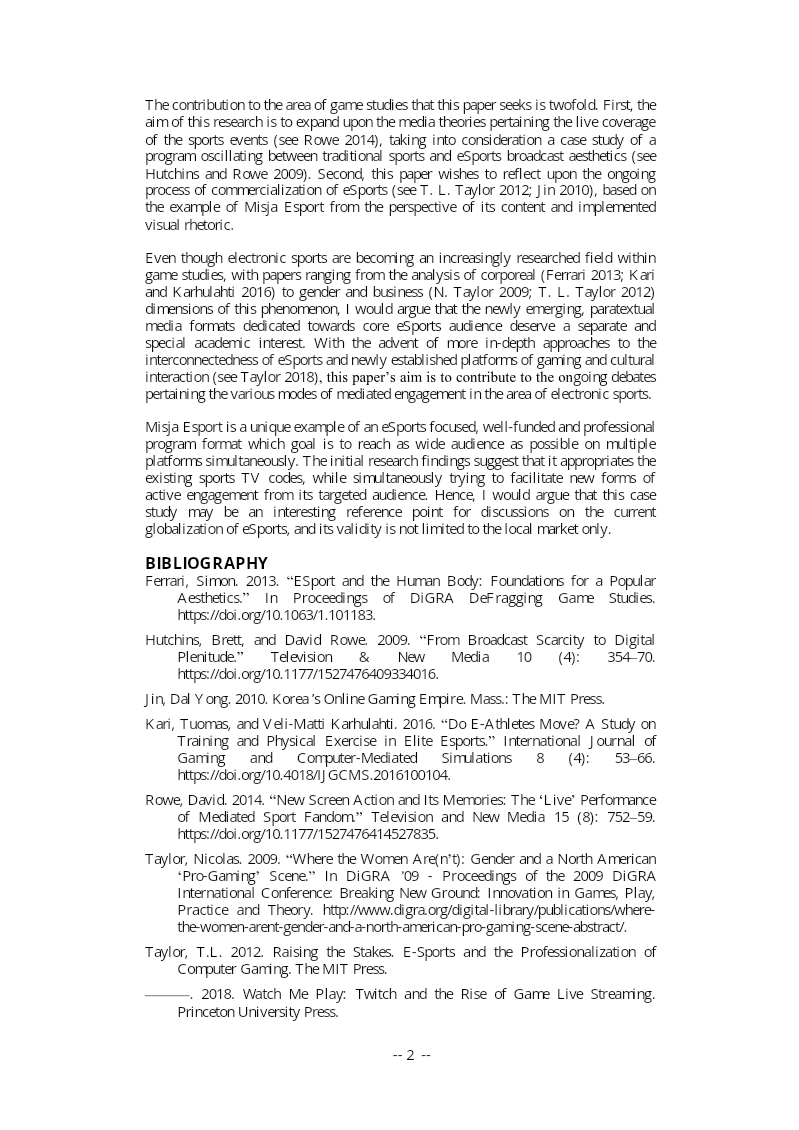
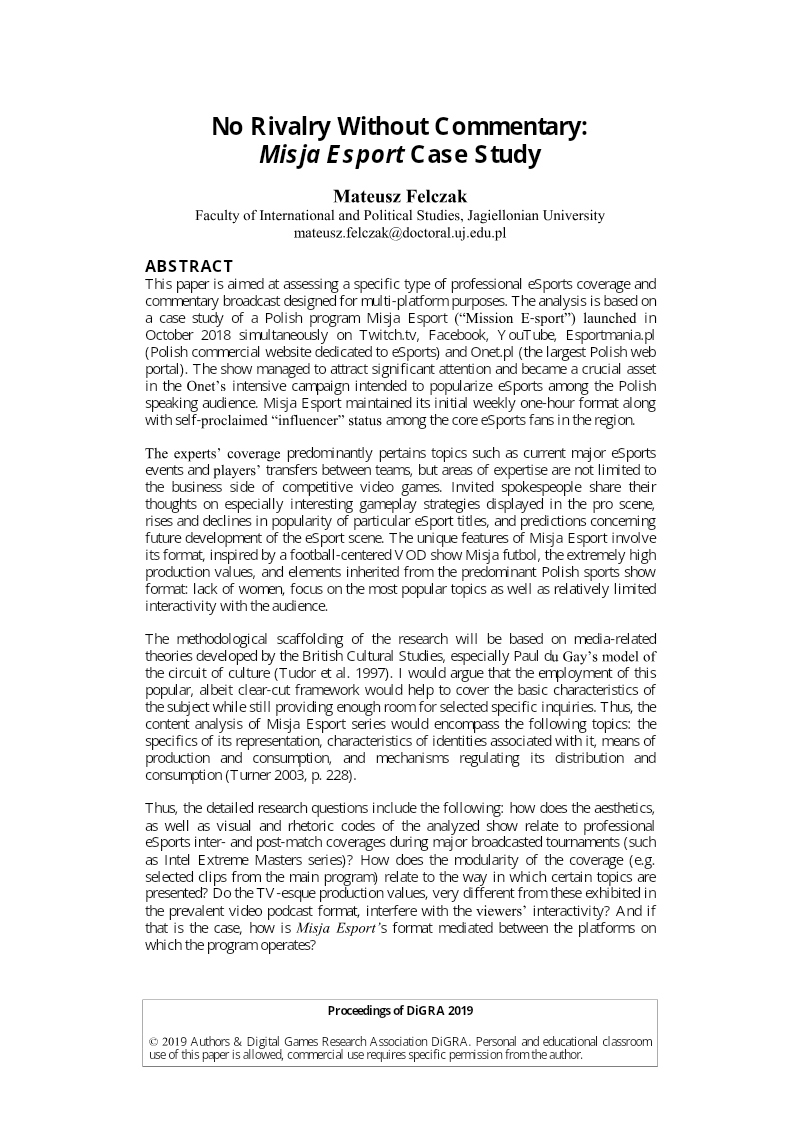
The document analyzes "Misja Esport" ("Mission E-sport"), a Polish multi-platform eSports commentary program launched in October 2018, as a case study for professional eSports coverage.
- Misja Esport is a Polish eSports program launched in October 2018, broadcast simultaneously on Twitch.tv, Facebook, YouTube, Esportmania.pl, and Onet.pl, Poland's largest web portal.
- The author argues the show is a distinctive hybrid that appropriates established sports television conventions while attempting to foster active audience engagement, sitting between traditional sports broadcasting and eSports-native video podcast aesthetics.
- The weekly one-hour program covers major tournaments such as the Intel Extreme Masters series, along with player transfers, gameplay strategy, shifts in title popularity, and predictions about the scene's future.

Gaming My Way to Recovery: Understanding How to Integrate Serious Video Games into Youth Mental Health Services
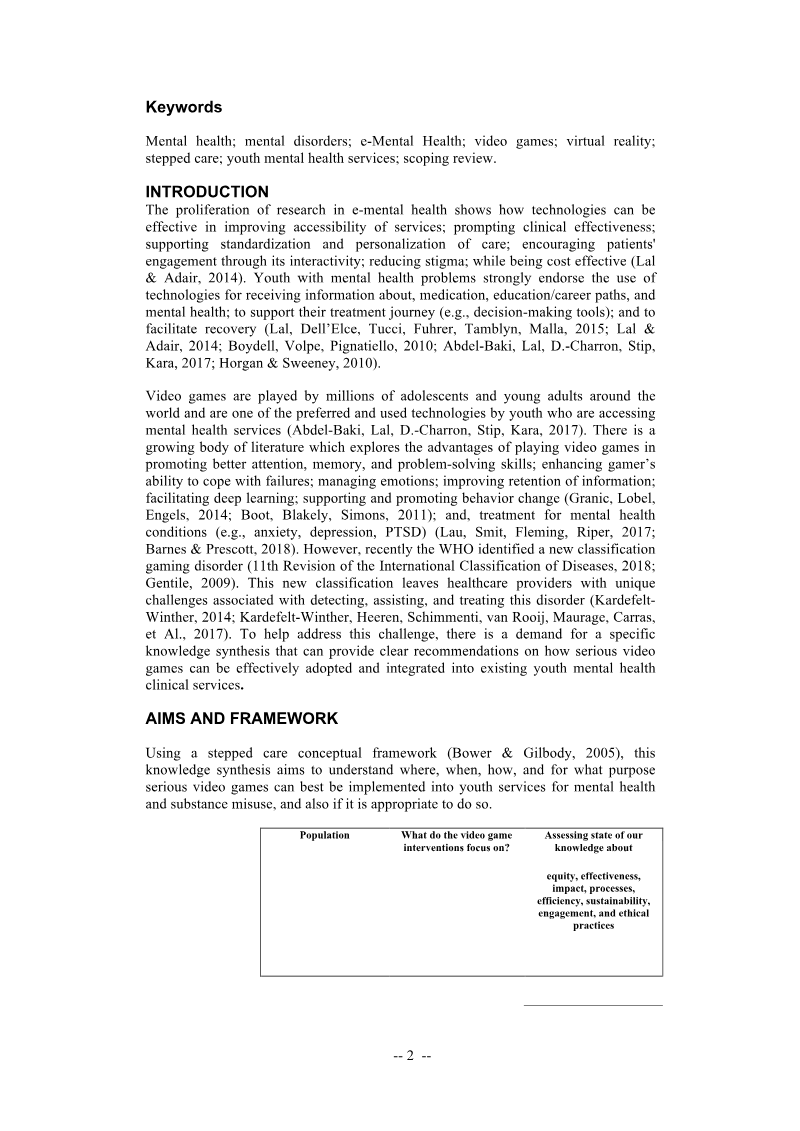
This document outlines a scoping review protocol aimed at understanding how serious video games can be effectively integrated into youth mental health services.
- The paper argues that video games, which adolescents and young adults widely play and prefer as a technology, could be used for monitoring, assessment, and treatment in youth mental health and substance misuse services if implemented appropriately.
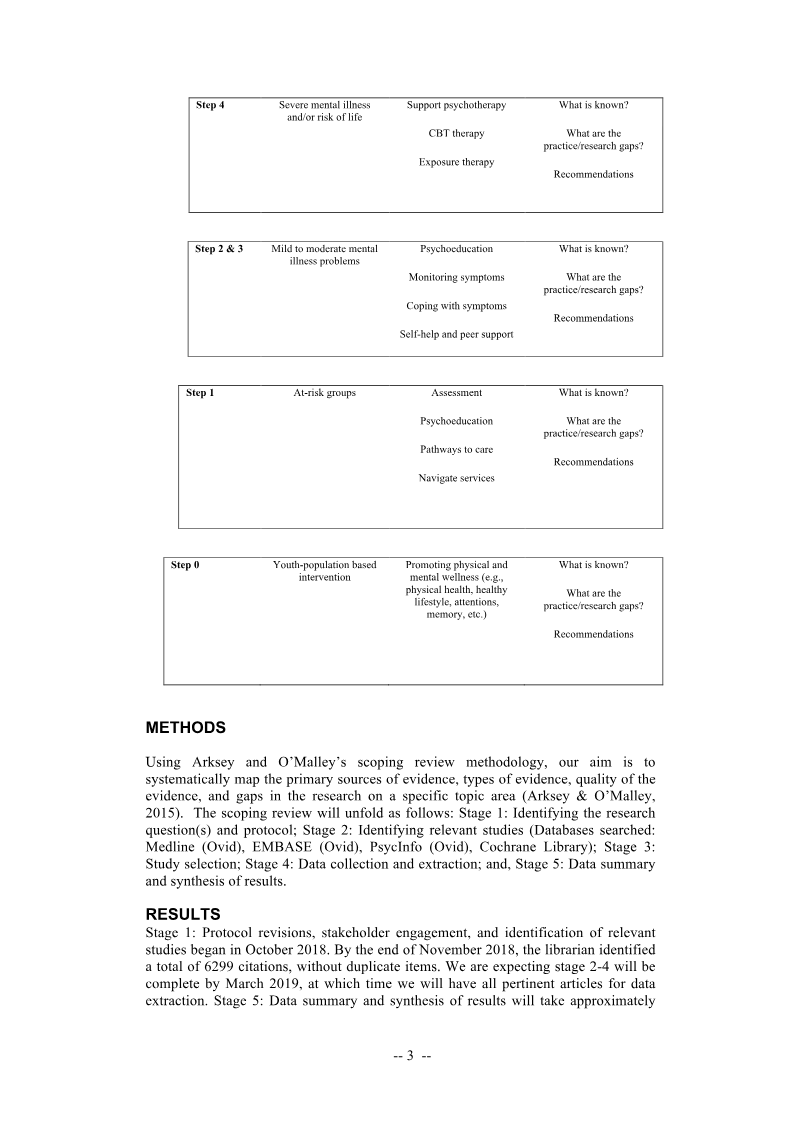
- It organizes potential applications within a stepped care framework, running from population-based wellness promotion (Step 0) through at-risk groups (Step 1), mild-to-moderate illness (Steps 2 and 3), and severe illness (Step 4).
- The work is a scoping review following Arksey and O'Malley's methodology, searching Medline, EMBASE, PsycInfo, and the Cochrane Library for studies of youth aged 11 to 29 with mental health or substance use concerns.
The Uses of Ludobiography: Life Writing and Game Studies
Rob Gallagher's paper argues that videogames and auto/biography, though seemingly incompatible, can be productively brought together through what he terms "ludobiography," a written life narrative centred on digital play.
- Rob Gallagher's paper introduces "ludobiography," a written life narrative centred on digital play, and argues it can enrich both game studies and life writing studies.
- The paper identifies three main virtues of ludobiographies: they serve as historical resources preserving first-hand contexts of early arcade machines and consoles, they challenge reductive "typical player" categories, and they inform posthumanist inquiry into the timescales of technocapitalism.
- As historical sources, first-hand accounts expose gaps in canonical gaming histories, such as the marginalisation of the 3DO platform.
Challenge Types in Videogame Play
The document outlines the development and validation of a Videogame Challenge Preference (CHA) inventory, aiming to categorize and measure player preferences for different types of challenges in videogames.
- The paper develops and validates a Videogame Challenge Preference (CHA) inventory measuring which types of challenge players prefer, as distinct from Denisova et al. (2017), who measured how challenges are experienced.
- The inventory started from 38 preliminary challenge types drawn from play and game research literature and triangulated against neuropsychological research on gaming and cognition.
- An exploratory factor analysis of 813 completed web-survey responses (out of 1,397 who opened the survey) yielded five factors after parallel analysis and removal of four low-loading items: Analytical, Physical, Insight, Socio-Emotional, and Foresight.
Transcultural Learning and Live-Action Role-Play in Japan
This extended abstract, presented at DiGRA 2019, explores whether live-action role-play (larp) can foster transcultural learning and empathy toward absent or stereotyped "others" in Japan.
- The paper argues that live-action role-play (larp) can serve as a mediated experiential alternative to direct contact with marginalized groups, which is often impractical, for fostering empathy and understanding of difference as non-threatening.
- The main case study is a larp on the perceptions and life-worlds of people diagnosed with Autism Spectrum Disorder, designed to test whether larp can produce sustainable learning effects in Japanese school and civic education, a context where the form is still nascent.
- Design principles for empathy-inducing play include transparency about goals in pre-workshop briefings, tasks encouraging empathic play, and portrayals of diverse ASD experiences informed by qualitative interviews and ongoing feedback.
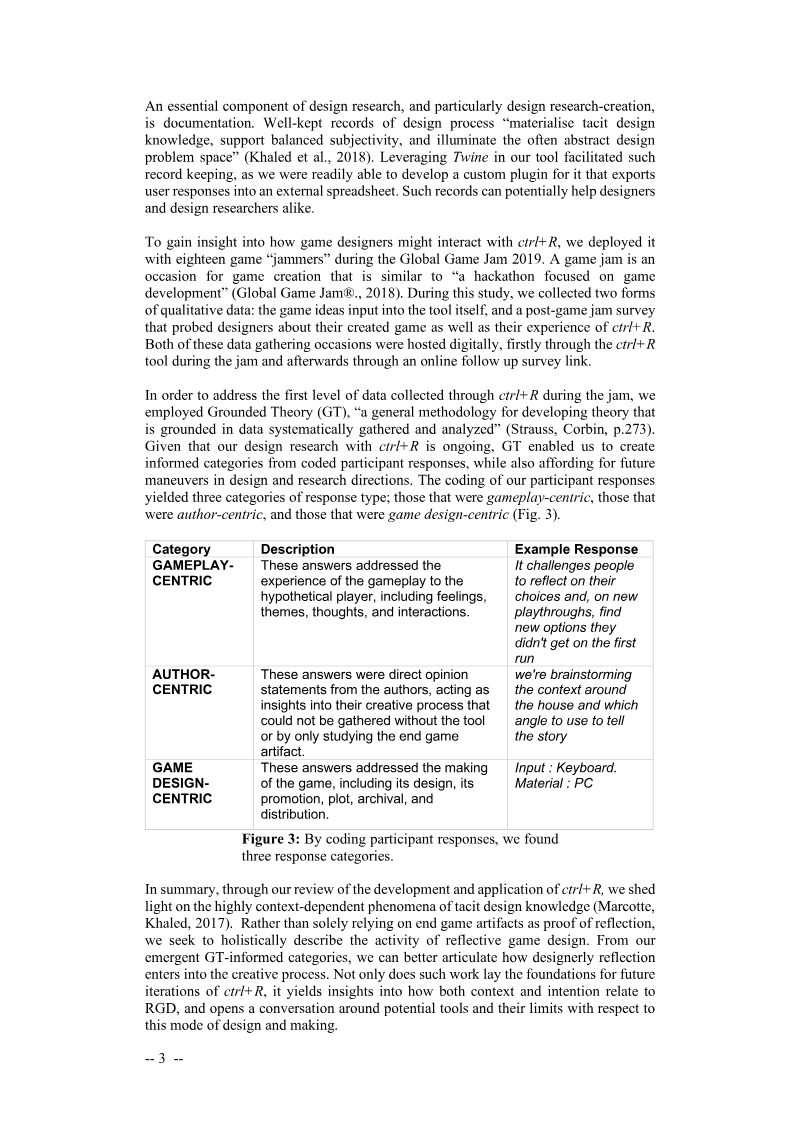
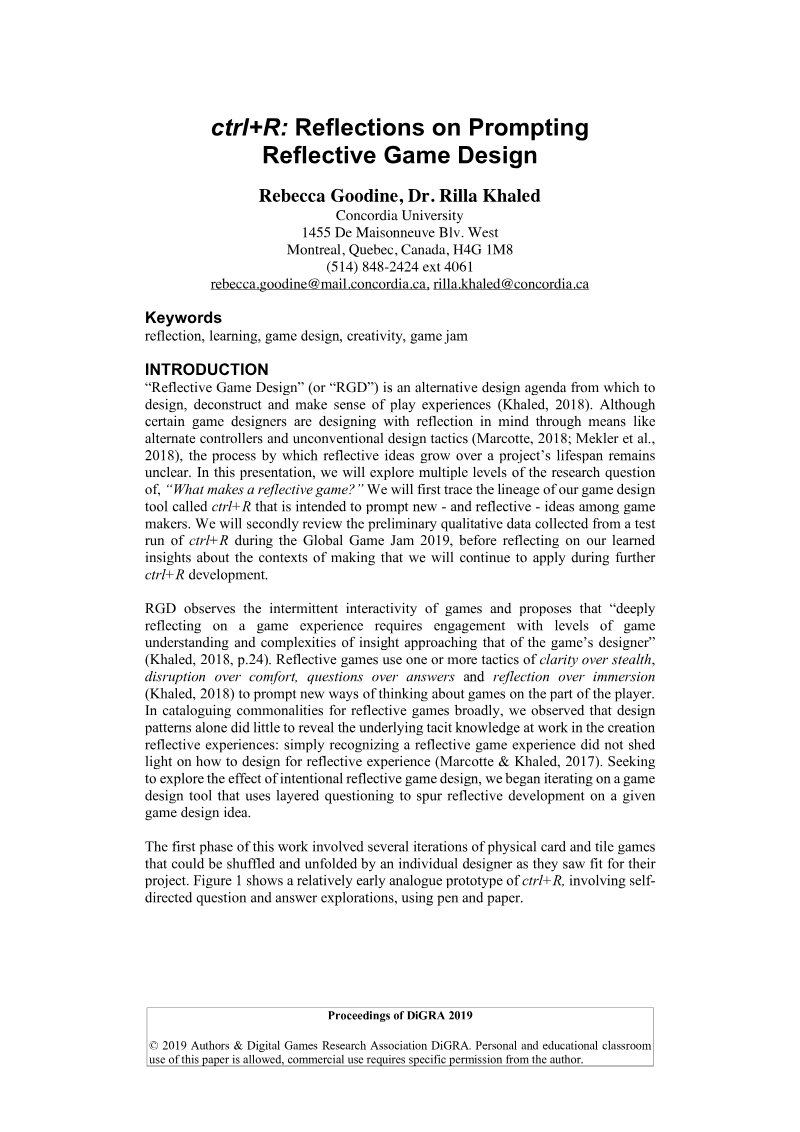
ctrl+R: Reflections on Prompting Reflective Game Design
The document explores "Reflective Game Design" (RGD) as an alternative design agenda focused on deconstructing and understanding play experiences, aiming to clarify how reflective ideas evolve during game development.
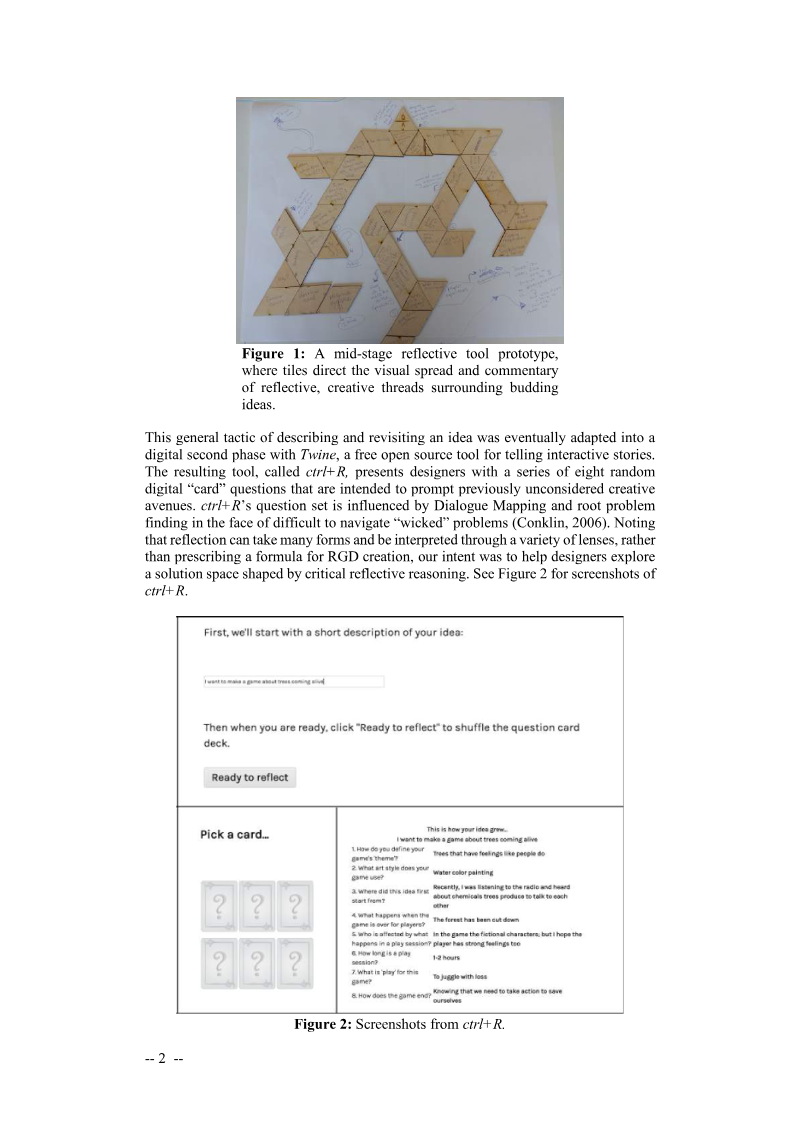
- ctrl+R is a game design tool that prompts reflective thinking by presenting designers with eight randomly drawn question cards, evolving from physical card and tile prototypes into a Twine-based digital version.
- The tool draws on Dialogue Mapping and root problem finding for 'wicked' problems, and a custom Twine plugin exports user responses to a spreadsheet to document the design process.
- A preliminary test with eighteen participants during the Global Game Jam 2019 generated game ideas and post-jam survey data about both the resulting games and the experience of using ctrl+R.
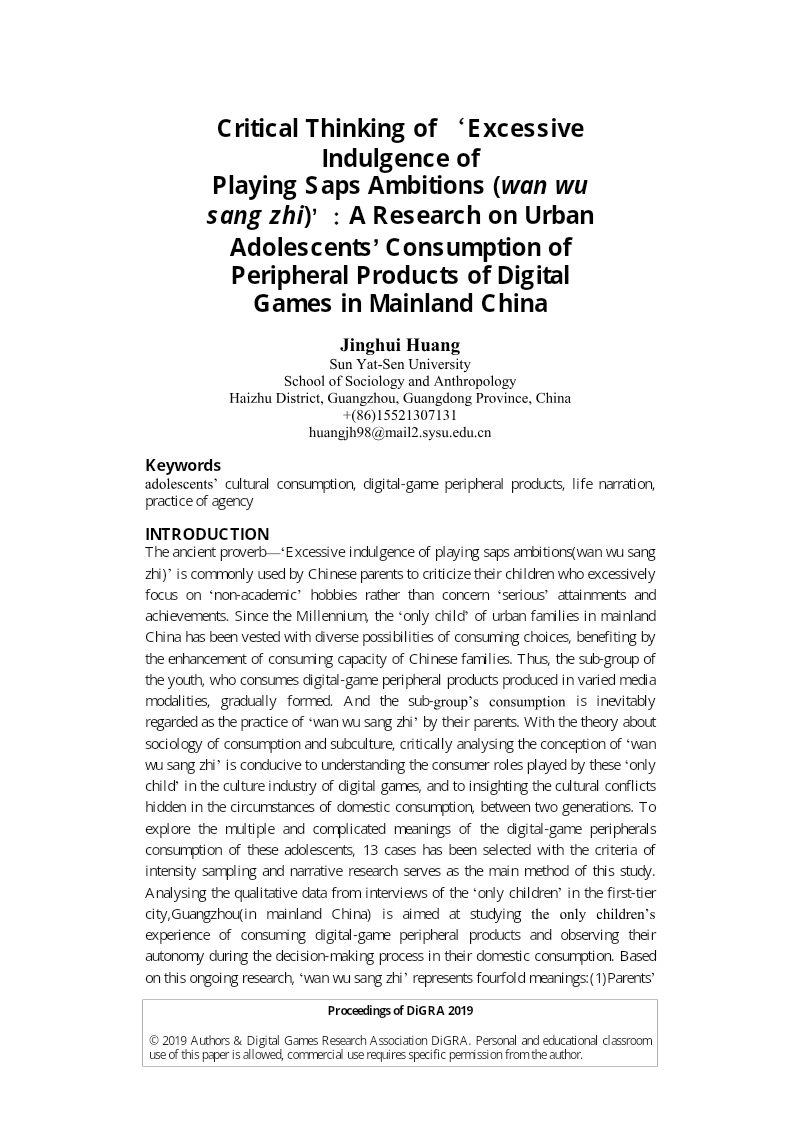
Critical Thinking of 'Excessive Indulgence of Playing Saps Ambitions (Wan Wu Sang Zhi)': A Research on Urban Adolescents' Consumption of Peripheral Products of Digital Games in Mainland China
This research critically analyzes the proverb "Excessive indulgence of playing saps ambitions (wan wu sang zhi)" in the context of urban adolescents' consumption of digital game peripheral products in Mainland China.
- The study, presented at DiGRA 2019 by Sun Yat-sen University researchers, argues that parents' use of the proverb "excessive indulgence of playing saps ambitions" to criticize adolescents' game peripheral consumption masks deeper generational conflicts over consumption, education, the meaning of play, and morality.
- The research is qualitative, drawing on 13 intensity-sampled narrative cases of only children in Guangzhou, a first-tier city, so its findings describe patterns in a small urban sample rather than national figures.
- Parents' criticism is linked to upward social mobility expectations that compete with sub-cultural consumption for adolescents' time, and to limited parental gaming experience that prevents recognition of digital games' cultural and social significance.
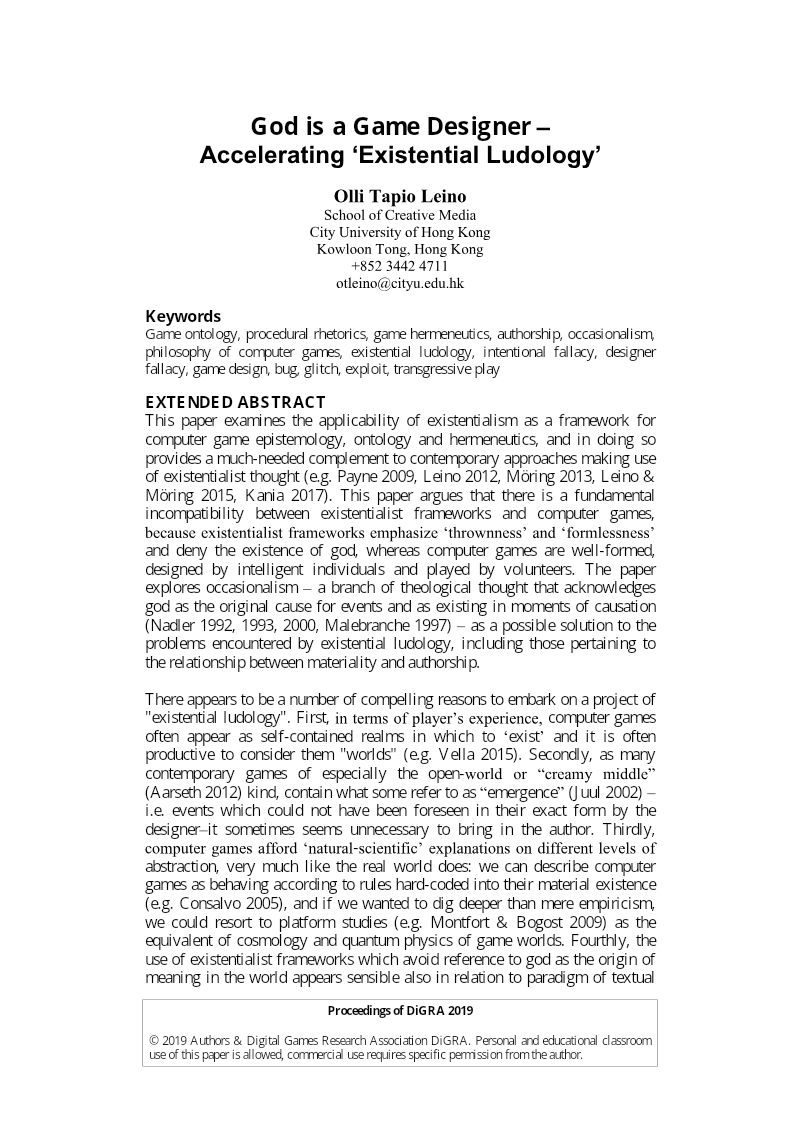
God Is a Game Designer: Accelerating 'Existential Ludology'
The document, "God Is a Game Designer: Accelerating 'Existential Ludology'," explores the compatibility of existentialist frameworks with computer game epistemology, ontology, and hermeneutics.
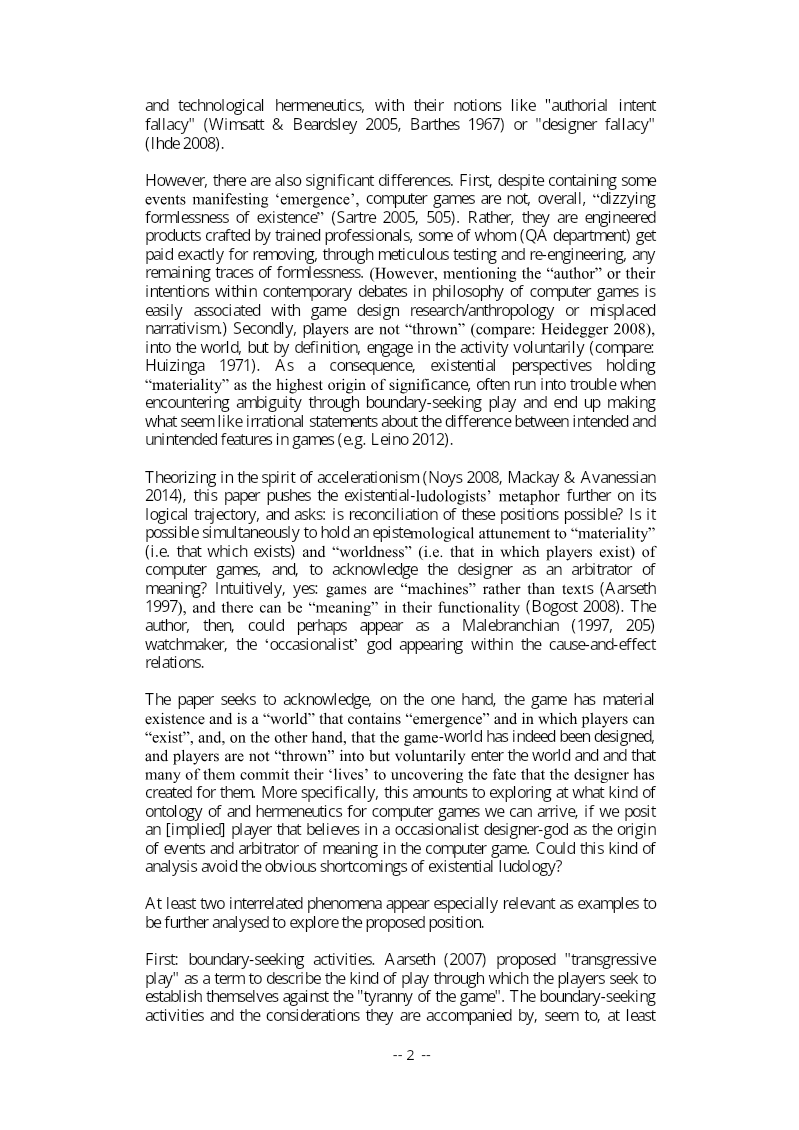
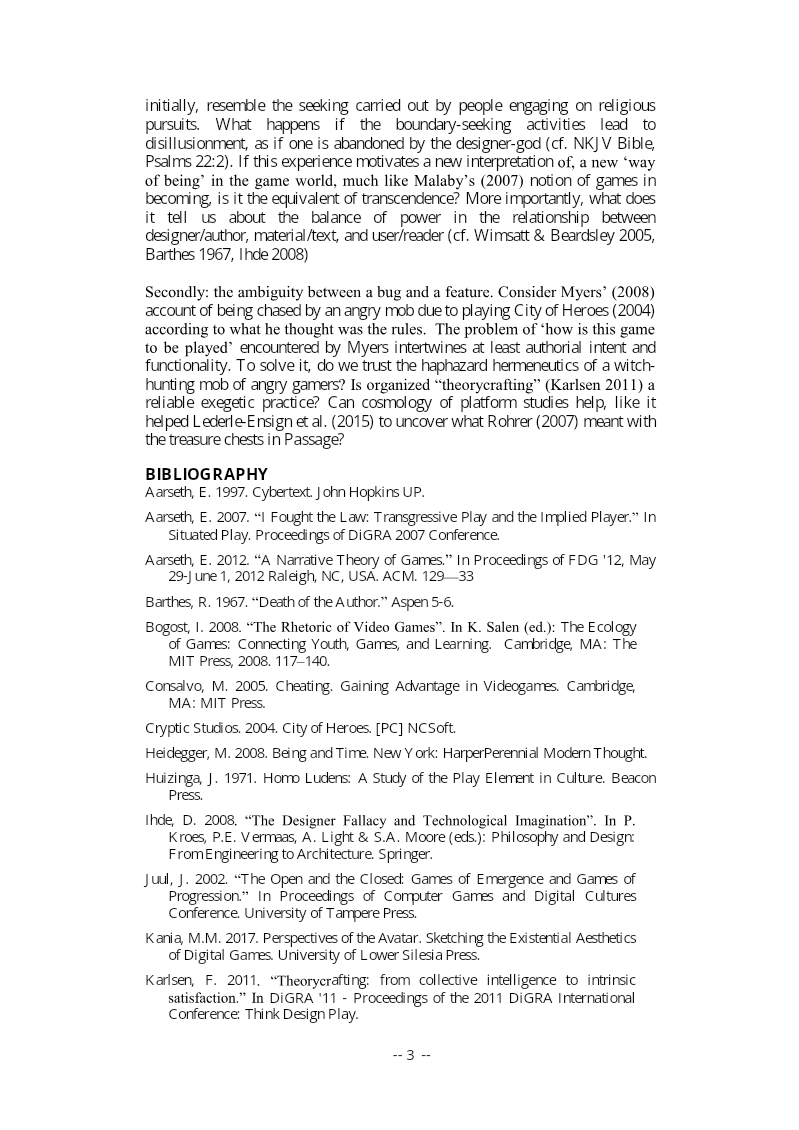
- The paper argues that existentialist frameworks stressing thrownness and formlessness clash with games, which are designed artifacts entered voluntarily, and proposes an accelerationist extension of 'existential ludology' to resolve this tension.
- It draws on occasionalism, the theological view that God is the original cause operating within moments of causation, and imagines the game designer as a Malebranchian watchmaker whose agency appears within cause-and-effect relations.
- The core question is whether one can attend to a game's material existence and emergent 'worldness' while still recognizing the designer as an arbiter of meaning.
Do you work at DiGRA? Get a free report of how these documents are read and cited here.