Loading the document
1 free read left. Create a free account for unlimited reading + AI research.
Create free accountArticle DiGRA
1 free read left. Create a free account for unlimited reading + AI research.
Create free accountArticleDiGRA
Current gamification applies game mechanics to work and education to raise performance.
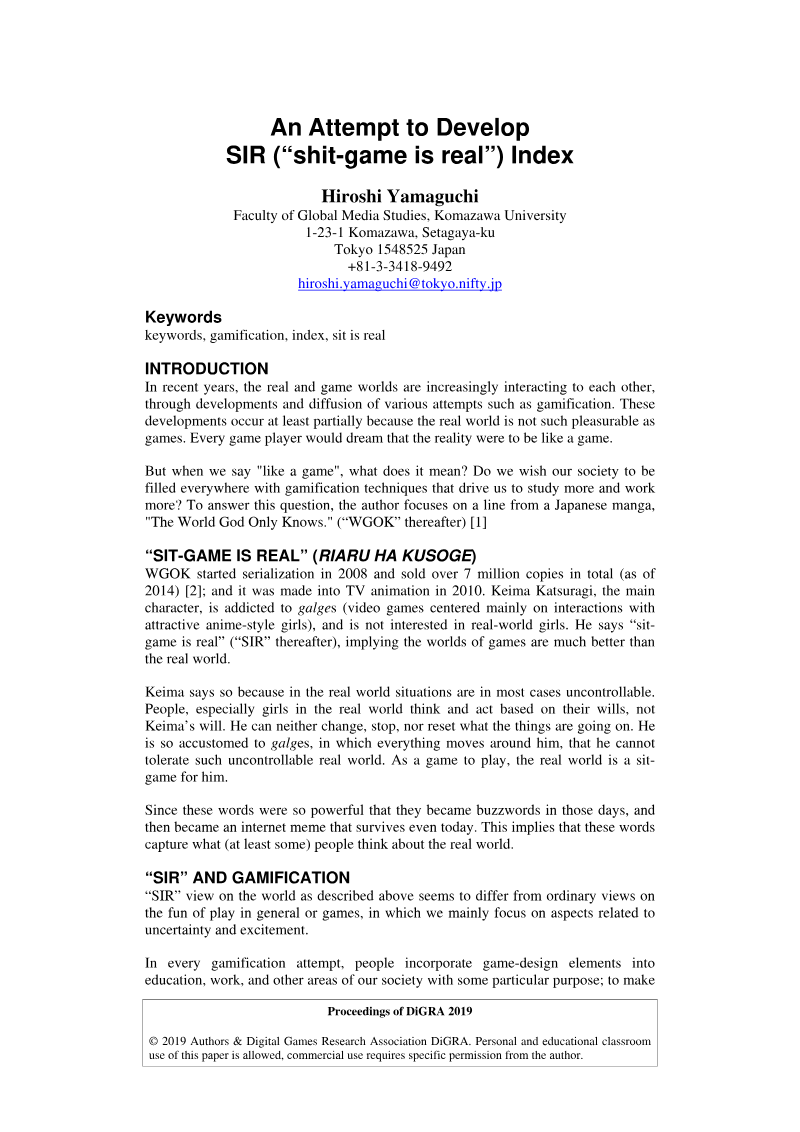
This short DiGRA 2019 paper proposes the concept of a "SIR" (sit-game, or "shit-game, is real") index, drawn from a catchphrase in the Japanese manga The World God Only Knows, whose protagonist prefers galge dating-sim worlds to an uncontrollable reality. The author argues that current gamification, which inserts game mechanics into education and work to raise performance, overlooks the view that people may want reality itself to be more game-like in its comfort and predictability rather than more productive.
The empirical basis is a collection of 1,719 Japanese-language tweets referencing the phrase, gathered between July and December 2018 from both male and female users, including fans of otome games. Using the KJ affinity diagram method, the author identified six traits explaining why people prefer games to reality: predictability, fantasy time-space, a feeling of being a hero, the presence of capture books (walkthroughs), a paradise for underdogs, and resettability. These group into two orientations: sweetness (the first three) and convenience (the latter three).
The findings cut against some established play theory. SIR adherents favor predictability despite Caillois's emphasis on alea, and they dislike failure despite McGonigal's claim that players enjoy it. The author proposes quantifying how far reality falls short of game worlds on these traits to produce an index, though no calculation method is yet developed.
Two justifications are offered. Starting from games and measuring reality's inferiority clarifies gamification's goals, and gamification should make life more pleasant for ordinary, non-competitive people rather than turning them into high performers, a concern linked to Inoue's warning about exploiting worker motivation without added pay. The author connects this to Endo's "fantasy physics" in game design and closes with Huizinga, suggesting that bringing reality closer to games could create a world better suited to human beings.

DiGRA · 2026

DiGRA · 2026



DiGRA · 2026



DiGRA · 2026



DiGRA · 2026



DiGRA · 2026



DiGRA · 2026



DiGRA · 2026



DiGRA · 2026

DiGRA · 2026



DiGRA · 2026



DiGRA · 2026
Karlsruhe Institute of Technology · 2026




Comments