
Atari
1 document by Atari in the Game Industry Library, the newest “Atari Rapport Financier Annuel: Exercice 2012/2013” (2013).
Documents


Atari Rapport Financier Annuel: Exercice 2012/2013
VERITABLE INNOVATEUR DU JEU VIDEO Société anonyme au capital de 14.767.375,50 euros Siège social : 78 rue Taitbout 75009 PARIS - France AXIF AUTORITE Le présent Document de référence a été déposé auprès de l'Autorité des Marchés Financiers le __ 2013, conformément à l'article 212- 13 de son Règlement général.
Reports about Atari
109 documents by other writers name Atari in the title or summary.

How to Build the Amazon of Game Companies
Game companies lack the durable defensive moats that define firms like Amazon, and this 2020 analysis by Michail Katkoff examines why and what studios could do about it.
- Most game companies lack the long-term defensibility seen in tech giants like Amazon or Facebook because they rely primarily on brand or scale rather than the network effects that drive 70% of value in the broader tech sector.
- Network effects—where each new user increases the value for others—are rare in gaming, with only platforms like Roblox, Epic Games, and Unity successfully leveraging this model to build durable, multi-generational businesses.
- While companies like Nintendo, Activision Blizzard, and EA are considered the most durable in the industry, they have struggled to maintain dominance during platform shifts, particularly the transition to mobile gaming.

Games, AI, and Systems
Straeubig's 2019 essay in Eludamos argues that current progress in game AI differs fundamentally from the "AI revolution" Paul Tozour called for in 2002.
- Recent AI progress rests largely on decades-old algorithms made practical by dramatic declines in computing cost, with the price of a teraflop falling from an inflation-adjusted US$156.8 trillion in 1961 to roughly US$30 in 2017, alongside the availability of large datasets.
- Straeubig argues that game AI and academic AI have developed largely in parallel, and that game-based perspectives offer a more grounded way to think about AI than prevailing speculative debates about an 'AI revolution.'
- The paper proposes a framework of seven roles AI can play in games: Mechanic, Alter/Ego, Observer, Protector, Player, Creator, and a speculative seventh role, the 'God,' an AI integrating all the others.

Games and AI: Paths, Challenges, Critique
This introduction to a special issue of Eludamos examines the two-way relationship between artificial intelligence and games, framing it as both the implementation of AI to make games more believable and immersive, and the use of games as benchmarks and training environments for AI.
- Games and AI influence each other in both directions: games serve as a testbed for AI research, while AI increasingly shapes game design, testing, and marketing.
- The authors frame the issue as a critical inquiry into the sociocultural, ideological, and economic dimensions of AI, rather than a purely technical account of its capabilities.
- A 2012 University of Toronto team won the ImageNet competition using convolutional neural networks trained on GPU hardware developed for gaming, showing how the games industry indirectly advanced AI.
Sweeney's Utopia: The Puritan Perspective of Epic Games CEO
This February 2020 newsletter from a games-industry analyst, written as he marks ten years since founding SuperData, offers a weekly roundup of commentary on business strategy, platform competition, and monetization across the global games market.
- Apple’s 2019 services revenue reached $46 billion with a 64% margin, which is double the margin of its hardware business.
- Tim Sweeney’s push for open ecosystems and reduced monetization is financially viable primarily due to the massive success of Fortnite, while most other industry players remain dependent on closed platforms and predatory revenue models.
- YouTube’s $160 million media rights deal for Activision Blizzard’s Overwatch and Call of Duty leagues indicates a stagnation in esports growth compared to previous Twitch agreements.
The Technical, Social, and Cultural Affordances of Intellivision
Mattel's Intellivision, produced from 1979 to 1984 as the chief rival to the Atari VCS, is examined here as a case for expanding platform studies beyond its traditional focus on material constraint.
- The authors argue that temporal pressures, inherited code, licensing agreements, and marketing strategies shaped Intellivision game design as much as or more than the hardware, and sometimes productively expanded creative possibilities rather than only limiting them.
- The study rests on thousands of archival documents (marketing research, game code, memos, test reports, legal records) and more than 125 interviews with engineers, programmers, executives, lawyers, marketers, and testers.
- Over 80 percent of sales in the second-generation cartridge period occurred during the Christmas season, making holiday timing a defining pressure on development.
Popular History: Historical Awareness of Digital Gaming in Finland
Popular accounts of Finnish digital gaming history took shape in the 1980s, well before any academic historiography of games in Finland existed.
- The analysis draws on roughly 800 items from Finnish computer and hobbyist magazines such as Potti, MikroBitti, and Printti to trace how popular narratives of Finnish digital gaming history first took shape in the 1980s, before any academic historiography existed.
- Popular histories tend to canonize an official narrative built around an origin and turning point tied to commercial or technical success, which can overshadow personal and unorthodox recollections of gaming.
- Discourse across the periods studied is classified into four waves, moving from early-1980s popular articles through mid-1980s chronicles and nostalgic player accounts to a 2000s national narrative shaped by institutions such as Neogames and the Finnish Museum of Games, which opened in 2017.

From Symbolism to Realism: Physical and Imaginary Video Game Spaces in Historical Aspects
Filip Tołkaczewski argues that video game space has evolved from symbolic, minimally defined environments into highly realistic, elaborately constructed worlds, and that this shift is turning games toward a new medium resembling interactive film.
- The study argues that video game spaces evolved from abstract, symbolic settings in early titles like Spacewar!, Space Invaders, and Asteroids toward increasingly realistic, continuous, and detailed worlds, a shift tied to technological advancement.
- The analysis frames early game spaces as simplified 'allegories of space' in the sense described by Espen Aarseth, relying heavily on player imagination to fill in what the graphics did not show.
- Key milestones in the trajectory include the flip-screen technique in Adventure and Gravitar, the side-scrolling and off-screen virtual space introduced by Defender (1980/1981), the 2D era of Super Mario Bros. (1985) and Contra (1988), the pseudo-3D of Wolfenstein and Doom, and the true 3D turn of Super Mario 64 on the Nintendo 64.
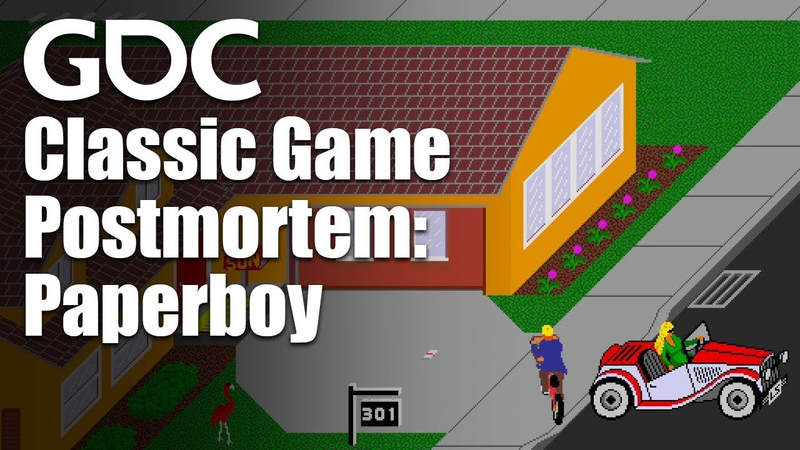
Classic Game Postmortem: Paperboy
The development of the 1985 arcade title Paperboy represents a pivotal shift in Atari’s design philosophy, moving away from traditional vector-based graphics toward a sophisticated, isometric raster-based experience.
- The NES home console port of Paperboy achieved significant commercial success with 2 million copies sold, far outpacing the 3,500 units sold for the original 1985 arcade version.
- Development of the arcade title utilized Atari’s System 2 hardware, featuring a 16-bit processor programmed in BLISS and a custom medium-resolution monitor to surpass the fidelity of 8-bit competitors.
- Gameplay was engineered around tight 30-to-90-second loops to maximize arcade player turnover, a strategy refined after initial focus group failures led to a shift toward a parallel horizontal layout.
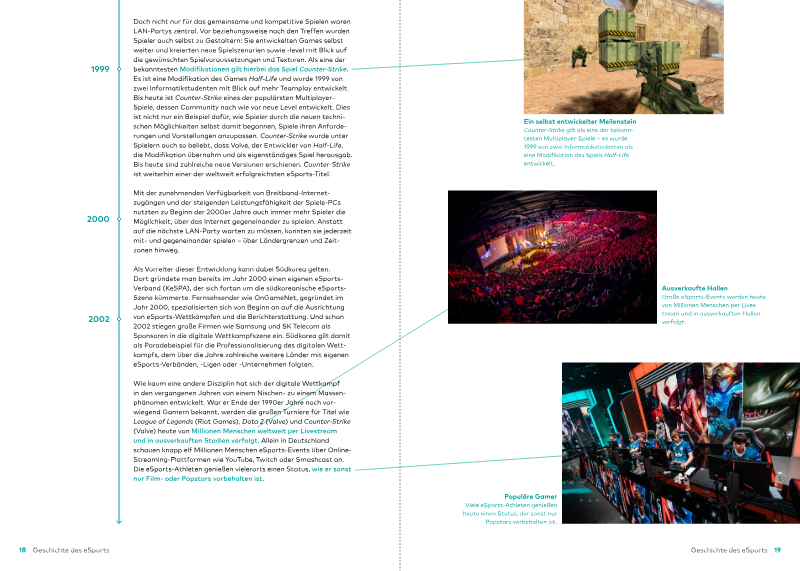
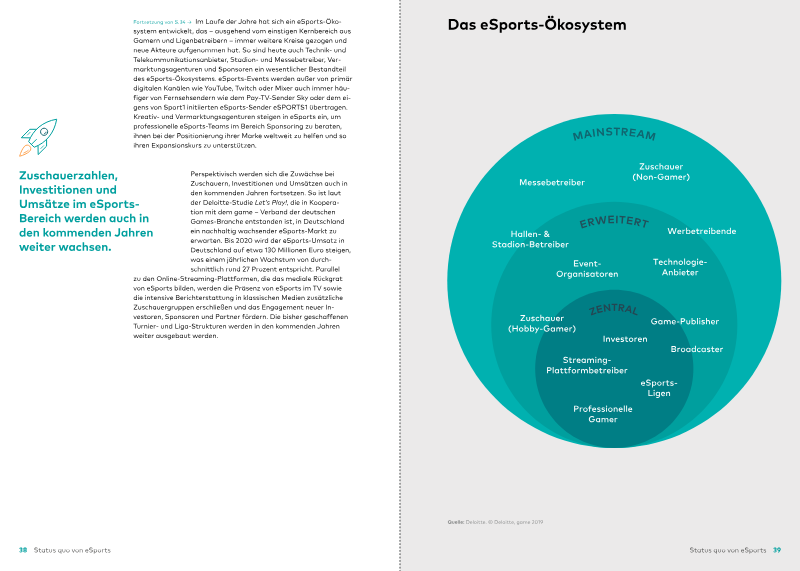

Game Fokus: Esports 2019
Esports in Germany has grown into a mass phenomenon, yet its institutional status lags behind its economic and cultural weight.
- The German eSports market is projected to reach approximately 130 million Euros by 2020, representing an average annual growth of around 27 percent.
- Despite its growing relevance, eSports in Germany faces significant hurdles due to a lack of official recognition as a sport, unlike 50 other countries (including EU states like Austria, Netherlands, and Sweden) that already acknowledge and promote it.
- The German government, through the 2018 coalition agreement, has pledged to support eSports as its own sport with club and association rights, and the Foreign Office eased entry requirements for non-EU eSports athletes in August 2018, yet full equality with traditional sports is still missing.

Primal Rage II from Heartbreak to Resurrection: The Journey After Cancellation
Primal Rage II represents a significant, albeit ill-fated, attempt by Atari Games to evolve the fighting game genre during the mid-1990s.
- Primal Rage II was a $2.3 million arcade project initiated on March 1, 1995, featuring a team of 20 developers and specialized stop-motion animation that ultimately led to its cancellation on December 5, 1996.
- The game's development was hindered by the high cost and time-intensive nature of stop-motion animation, which made character pre-visualization impossible and prevented the creation of a polished vertical slice.
- The project was effectively lost for nearly two decades due to the use of custom hardware and unorthodox graphics delivery methods that made standard emulation impossible until the game was discovered and leaked by fans.

Pocket Beans: Hamburger Kultsender Machs Mobilformat
Hamburg-based internet broadcaster Rocket Beans TV launched Pocket Beans on February 6, 2018, a biweekly format devoted entirely to mobile gaming.
- Rocket Beans TV launched 'Pocket Beans' on February 6, 2018, to position mobile gaming as a sophisticated medium comparable to console and PC gaming.
- The program categorizes mobile titles by player behavior—specifically puzzlers, high-scorers, and grinders—rather than traditional genre classifications.
- Rocket Beans TV operates with approximately 90 staff members in Hamburg-Eimsbüttel and produces roughly eight hours of new content daily.

Instantaneously Punctuated Picture-Music: Pilgrim in the Microworld and an Alternative Evaluation of Videogame Expression
The document, an extended abstract presented at DiGRA 2018, proposes an alternative framework for evaluating videogame expression, drawing primarily from David Sudnow's 1983 book, Pilgrim in the Microworld.
- The paper argues David Sudnow's 1983 book Pilgrim in the Microworld, about playing a simplified Atari 2600 port of Missile Command, offers a better framework for evaluating videogame expression than the dominant game studies models that emerged about fifteen years later.
- Sudnow located the core pleasure of videogames not in winning, narrative immersion, or sophisticated rules, but in becoming incorporated into an audiovisual spectacle where the player's bodily movements are reflected back as rhythmic lights and sounds.
- The author identifies a persistent tension in early game studies between mechanical, technical, and narrative essentialisms, and notes that videogames have repeatedly resisted the predictive models scholars built around them.
Do you work at Atari? Get a free report of how these documents are read and cited here.