1 free read left. Create a free account for unlimited reading + AI research.
Create free accountArticle DiGRA
1 free read left. Create a free account for unlimited reading + AI research.
Create free accountArticleDiGRA
The authors argue that temporal pressures, inherited code, licensing agreements, and marketing strategies were often as consequential as material constraints. They treat these forces as sources of creative possibility as well as limitation.
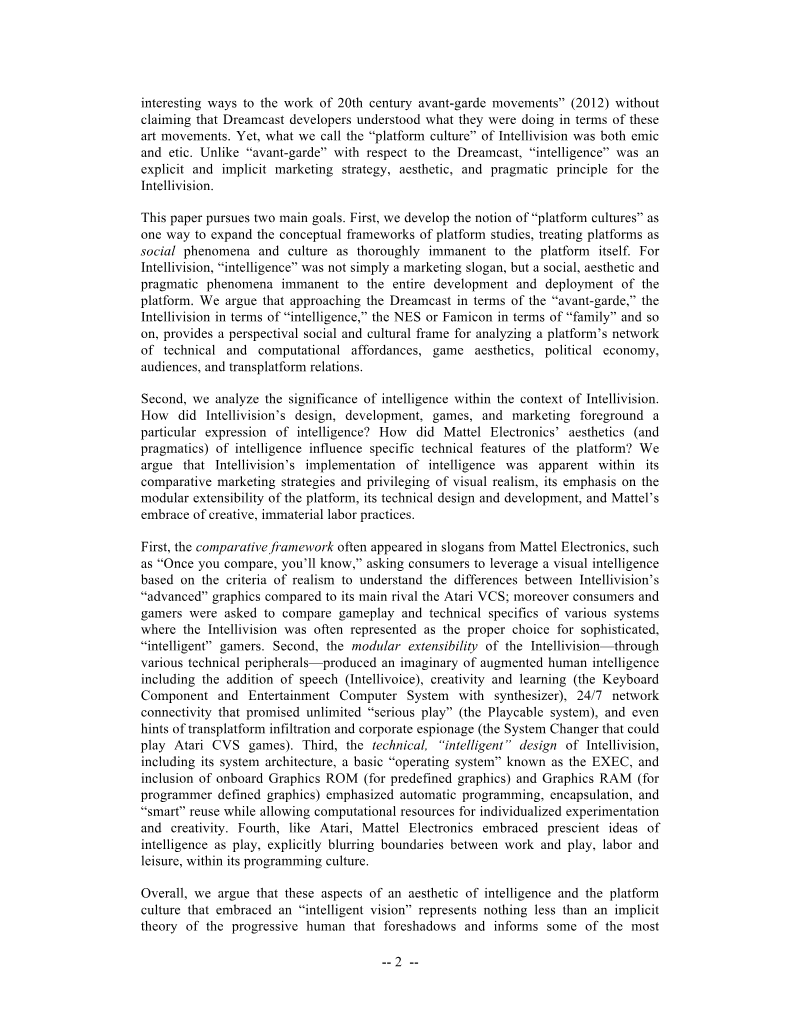
Mattel's Intellivision, produced from 1979 to 1984 as the chief rival to the Atari VCS, is examined here as a case for expanding platform studies beyond its traditional focus on material constraint. The platform's distinctive technical features, including the EXEC operating system, the Standard Television Interface Chip, and the Intellivoice synthesizer extension, shaped game aesthetics and play. The central thesis, however, is that social, cultural, and institutional forces were equally powerful, and were often experienced as more consequential and more productive than hardware limits. Drawing on Gibson's theory of affordances, the authors propose a perspectival approach that avoids treating the platform as the most fundamental explanatory layer, and they frame many of these constraints as sources of inspiration rather than simple limitation.
Four categories of nontechnical constraint organize the analysis: time, legacy, licensing, and marketing. Temporal pressure is illustrated by the fact that over 80% of second-generation console sales occurred during the Christmas season, which dictated development cycles. Titles such as B-17 Bomber and Maze-A-Tron were affected, and managers at Mattel chose to document Maze-A-Tron's bugs in manuals as features to avoid delaying production. Legacy appears in Space Hawk, which was built from Astrosmash code and an inherited scrolling module that left a visible mark on its look. Licensing required realism in the professional sports titles (Major League Baseball, NBA Basketball, NHL Hockey) and imposed strict content rules on Kool-Aid Man, whose protagonist could not die and had to appear full of liquid, as well as on Masters of the Universe: The Power of He-Man.
Marketing research identified younger males as the target demographic and favored certain themes and mechanics. Its influence on design varied: strong where licenses were involved, while managers sometimes shielded programmers to give them more creative freedom.
The study rests on thousands of documents from corporate, institutional, and personal archives, including marketing research, game code, memos, test reports, and legal and court records. It also draws on interviews with more than 125 people who worked on Intellivision, from engineers and programmers to executives, lawyers, marketers, and QA testers. The authors situate their work alongside recent platform studies of the BBC Micro, Wii, SNES, Famicom, Minitel, and TurboGrafx-16, but emphasize how contexts shaped the games themselves, not only the hardware. They argue that dynamics established in this era continue to inform contemporary videogames and debates about technology and society.
Each row is a game or company this document names, each column a document, oldest first. A mark means that document names it. Select a row to see those documents.

DiGRA · 2026

DiGRA · 2026



DiGRA · 2026
Thomas Brush · 2024