1 free read left. Create a free account for unlimited reading + AI research.
Create free account
What Happens When AI Becomes Your Gaming Teammate

Key insights
7 takeaways- 01Foundation models are shifting game AI from scripted behavior trees to autonomous, goal-oriented agents capable of improvising based on player intent.
- 02The primary objective of integrating these agents is to create unique, unpredictable gameplay experiences rather than replacing developers or automating cost-cutting measures.
- 03Successful agent implementation requires 'agent empathy,' where virtual entities are designed with environmental awareness to ensure they function naturally within the game world.
- 04While major publishers are building internal AI teams, a growing market for third-party, end-to-end solutions is emerging to help medium-to-large studios deploy agentic features without massive overhead.
- 05Owlchemy Labs has demonstrated the practical application of this technology by creating VR co-op companions that manage memory and intent to facilitate unscripted social interactions.
- 06Hierarchical training models allow studios to reduce AI inference costs to single-digit cents per player hour, making the technology economically viable compared to using expensive frontier models.
- 07Developers should prioritize balancing AI capabilities with intentional, human-like imperfections to ensure that virtual teammates remain engaging rather than frustratingly superhuman.
Ask AI about this video
Transcript
[music]
Welcome to the Naavik Gaming Podcast, where it is our mission to explore the business and future of video games. We bring together the industry's brightest builders, investors, and thinkers to keep a pulse on current events, dissect emerging trends in games, share lessons learned, and have a great time. This podcast is also part of Naavik's growing ecosystem, which ranges from free and premium research to consulting and advisory services. For more information, visit www.naavik.co. This episode is brought to you by metal.tv. Built by gamers, for gamers, and used by over 15 million gamers per month. Metal is the fastest way to clip, save, and share gameplay on PC. Millions of clips get shared every week, turning your games moments into word-of-mouth at internet scale. With discovery being one of the biggest challenges in the games
industry today, Metal is building a platform where publishers, studios, marketers, or anyone looking to reach gamers can find the right players across multiple genres and geographies. For more information, head to metal.tv or check out the link in the show notes. Now, let's jump into the episode.
All right. Hello everyone. Welcome back to the Naavik Gaming Podcast. I'm your host Alexander and it has been a bit. Generative AI in games has spent 3 years being sold as I think two things. One, cheaper way to make assets and smart NPCs that you can chat with. The first one has mostly made a lot of developers angry. GDC's 2026 state of the industry survey found that 52% of game professionals now think generative AI is hurting the industry, up about 20% from 2 years earlier. And the second one, the chatty NPC, has mostly just made demos. Only about 5% of respondents said their teams use it for player-facing features. And I kind of think that the more interesting bet is neither of these.
It's behavior. Agents that can read a game state, understand what the player is asking for, take an action the designer allowed, not just dialogue trees um with a language model glued on. You know, teammates who might actually help you, opponents who could possibly adapt to you. Um maybe the words that I might use are a game director nobody sees. Um and the problem has been that this has the been the promise of game AI since like A* pathfinding. And the industry has watched a lot of companies in this space raise a lot of money, demo well, and then pivot. And so today I want to separate what's genuinely new from what's rebranded and get specific about the part that I think we're not talking about that much, which is like actually what it is a cost to run an agent every second a player is in the game. Um my guest today has 25 years in reinforcement learning, held a leadership role at DeepMind, and is about to ship what his company calls the first commercial game mode built around one human working alongside multiple human uh multiple AI agents in real time. Uh Brian Tanner is the co-founder and CEO of Artificial Agency, building a behavior engine for games. He and his
co-founders, which a couple of them are from DeepMind, uh started the company back in I believe March of 2023. Uh you've raised around 16 million from investors including Radical Ventures, Toyota Ventures, and BDC. And in September, uh they launched their and shipped their first integration, a new single-player mode for Alchemy's Dimensional Double Shift um game uh due out in I think in the first half of 2027. Brian, uh welcome to the show.
Well, thank you. And thank you yeah.
Thank you so much for having me. It's a pleasure to be here.
Amazing. Um so I'd love to just dive right in, but before we go, I would love to learn a little bit more about you and and then help the audience get to know you. Um you said that you wanted to make games intelligent I think since you were a very young child. I was reading in some sort of other other reports and and research. And then you spent decades actually doing, you know, RL research. Um you know, and that was when like you were data constrained, data capped, etc. So what's the biggest thing that you think has changed in the past like 20 years? For you specifically.
I mean, the the biggest thing that's
changed is that we've actually been able to scale these AI ideas. So, like when I started my PhD in the early 2000s, we were running off of laptop computers and you could you could you could train a very small agent to do something in reinforcement learning. When you really wanted to scale up to something with a lot of inputs and outputs, we just didn't have the computing power to do it. And through the 2010s, with the work um, you know, bringing this AI and and machine learning to graphics cards and GPUs, we finally were able to unlock that scale and that was a lot of DeepMind's success uh in Atari and in the game of Go and StarCraft, it was really about leveraging that huge amount of compute to take just so much data and then train these policies we could actually run in the games. What's happened since then and and what I'm so excited about and the reason we started the company was foundation models now, they have this like common sense knowledge actually built into them. So, they know what to do and they can reason and make common sense decisions in in new situations that have never been planned for and that's something that we never had with reinforcement learning.
I see. Okay. So, the first change is just like you're you feel like you're here a little too early. You don't actually have the battery supply to be able to actually do the thing that you want to do. And now that you've had the battery supply and we've been juicing the whole um kind of like uh agent and LLM space for a while, you feel there is actually some sort of generalized intelligence that they actually contain.
That's exactly right, yeah. We we saw that first when ChatGPT came out. It was like, "Oh, wow, we finally have something that actually has batteries included. We don't have to train it from scratch."
Right. Um okay, and then you also mentioned this is sort of like why you started the company. Um and I'm curious, why did you start a company instead of doing this inside a lab or maybe a video game publisher?
Uh I think we saw the writing on the wall that the big companies were going to start turning towards consumer applications and training larger and larger models and starting a company of our own was an opportunity to actually take this idea that we'd always had, which was to bring something that faces players quickly. And you know, we finally had the technology to do it. So, it was I I think a great opportunity for us. We you know, we have lots of friends
in the games industry and we've always I think been just a little bit disappointed that we didn't have the ability to like really interface with games in a way that you know could reach the public and this felt like a just a very direct and straightforward way to do that to bring the excitement we were seeing with these models to everybody.
Okay. All right. So, want to dive into our first topic which is sort of like what's actually new like the AI of like then and the AI of now. Um right. So, like it's funny because we've been talking about AI and there's AI has been in games for a very long time path finding behavior trees procedural generation. I think in one of our kickoff calls I mentioned the Nemesis system. So, where do you feel that this toolkit hit its ceiling and now I mean you you're maybe alluding to it a little bit but like what are the specific foundational models add that this could not? The old stuff could not.
Yeah, it's a it's it's a great question and it's so broad right because like AI has been around since the 1960s. A lot of people think of this is a very new technology but it's been around for a while and it's been you know continually
improving through that period. We had AI in games in the 90s and the 2000s and so forth um and pretty much anytime you interact with a system that's in any way complicated inside a game it is some sort of an AI driven system and yeah you you you hit all the highlights A star and path planning um state machines and planning algorithms have been around since the very beginning. And anytime that you've played against a bot or or anything like that in a game you are you are playing with these systems.
Yeah.
What's been traditionally difficult about these systems is they require tons and tons of human effort tuning and scripting to get them just right. And so, people do just hundreds and hundreds of hours of play testing experimenting tweaking knobs to get everything feeling right and then if the player does something or the game puts itself into a state that wasn't really anticipated by the developer it's it's really a dice roll as to what's going to happen and whether it's going to be something that's interesting for the users. So, all of that work is foundational and
we're actually not trying to sort of like replace or supplant any of that. What we found foundation models are good for is we don't necessarily use them to get to the goal. We still use path planning if we want to move a character from one point on the screen or one point in the world to another. Um we still use finite state machines and behavior trees. All that stuff is great for having the agent execute or the the character in the game execute something that the designers created. What we're using the foundation models for is actually setting the goals. So, understanding what the player wants to do, understanding what the capabilities of the character system are, and then making a decision at runtime about how to react that maybe couldn't have been planned in advance. And so, these things really do work work well together.
Okay. So, for me, like I'm hearing the challenge in the past was edge cases essentially. Like if a player did something that you didn't feel so it's edge cases and like spending a lot of time figuring out how to match commands, right? Like okay, I have to think through all of the 6,000 bajillion options and then the edge case is the 6,000th and one option that we didn't
think of. Um and you're saying that obviously like the advantage is that I don't have to spend so much time building out and two, I can use it more at the planning level than at the actual like, you know, I'm still going to use pathfinding to get my player from one place to another.
Yeah, that's exactly right.
Um and that's I think also why you call it a behavior engine, not a conversation engine. Like not not smart NPCs. Um can you explain why that distinction should matter to a designer?
Yeah, no, absolutely. I think when and this is yeah, we we we lean away from smart NPCs because when you say smart NPCs, I think people have the idea that it's going to be just a chatbot that's embedded inside the game. And now I can have a a never-ending conversation with a shopkeeper at, you know, my favorite RPG game.
My favorite thing to do.
Yeah, maybe maybe that's great. Maybe maybe people like that, right? Um but like the the joke I used to always make is you can walk up to any random person on the street and have a conversation with that them, too. But we we tend not to do that. We tend to be playing games for a reason. There's some things we want to do. And so, our behavior engine has been built from the ground up to allow a designer to
expose a set of behaviors, whatever they are. Whether they're interacting with the player, combat, crafting, exploration, spawning new encounters, anything you can think of, you can expose that to one of our agents, and then the the gameplay is really about the system picking the right thing at runtime that's within the designer's intent. And so conversation is totally a feature of our system, and of course most of the things we end up building have some sort of interaction mode with the player, but that's not it it's not a conversation system with some actions bolted on, it's a behavior system with conversation slotted in.
Okay.
Um and and from the very earliest experiments we did, that's where the magic was. Like we were giggling and laughing and calling our friends to tell them what the things we saw in the early days, because as soon as you took a Minecraft agent and allowed it to understand the world around it and do whatever it wanted to do, you sort of started having these really magical experiences.
Hm. Very cool. Okay, so, you know, we're talking about conversations, and we just talked about
the shopkeeper, but walk me through some you know, some archetypes I guess of companions, virtual players, opponents, um like which one of these things do you think actually matters like most commercially in like the next 2 years?
In the next 2 years we are leaning very hard into virtual players. We found that many different game game use cases, um whether it's not enough players and player liquidity, whether it's your friends not being around, whether it's people having social anxiety around playing multiplayer games with strangers, there's lots and lots of different reasons why it's exciting, interesting, or useful, um or cost-effective to have an agent-driven sort of player in the game. And that that can be somebody that's on your team, that can be a friend to play board games with or to fill out a squad if you're missing a certain role, or it can be opponents that actually make mistakes that are more like humans, uh and not, you know, turning up the difficulty isn't just turning up the reaction speed on the aimbot, but it's actually making the the opponent more intelligent.
Okay.
I thought I'd have like a maybe like a existential question, but do you think that AI teammates kind of fill the lobbies, right? Like just take your multiplayer example. Do you think that multiplayer games in general like might lose some of the human social glue that makes them like really sticky in the first place. Um, like how are you guys thinking about that?
So, I'm certainly not concerned about that. I think when people want to play with people, they will have the opportunity to do it as long as those people are around. The real challenge is if you want to play a game that requires people and your people
and you have to round
or yeah, and you don't want to just squad fill and be like matched up with three random people who have completely different strategies. Maybe you don't even want to turn your mic on because you've had a bad experience in the past. Like we hear these kind of examples all the time from people and for us it or or you know, you never had you don't have the the healer on your team or you don't have the tank on your team. None of your friends want to play those roles. You always want to be the sniper, whatever it is. Um, the ability to then have these bots fill in either for you personally or for your team. Um, yeah, we we think that's really compelling.
Interesting. Okay. Um,
you talked a little bit about in our kickoff call this idea of like I think you said agent empathy. Um, like someone who's never actually like worked or built an agent. What does that mean um, and how does that kind of play into the context of how we're building the next generation of AI tools versus the old generation of AI tools?
Yeah, I mean this is this is our our long learning we had in reinforcement learning is reinforcement learning systems much like a lot of the agentic systems people are building today on foundation models have this blessing and a curse, which is if you set them up wrong, they kind of work and they kind of do something, but to get them to do exactly what you want requires a great deal of care. And so what we learned in reinforcement learning was because if you set the reward function wrong or the set of observations wrong, the the system will learn to maximize that signal. It's probably just not what you wanted it to do. And so um, you know, Alex and and I my our co-our my co-founder Alex and I, we both studied reinforcement learning under Rich Sutton who is like the grandfather of RL. And one of the things that he always
taught us was you had to be the agent. You had to put yourself in the agent's perspective. You had to look at the signals the agent was receiving, look at the actions the agent has available and and think to yourself, if this was me, could I make a good decision? And if you can't, then the agent probably can't either. And so we've carried that over into the way that we design our agents here, and we found it's a very unnatural way of thinking for many people, and it is the unlock to actually make these systems work. Because when we make, whether it's our Frontiers team, which is like our forward-deployed engineering team, game designers, game engineers, when someone joins our company, they typically start making agents and they start playing with them, and they don't work exactly as they'd like. And then we force them to go and read sort of the transcripts from the agent's perspective and say like, "Would would you know what to do?" And that sort of that that empathetic pass of actually putting themselves in the shoes of this AI and realizing that they're asking it something impossible or they're not giving it the information it needs to know to make a good decision, um has been a game-changer for our team.
Yeah, it is actually really interesting. I mean, I think about the times honestly, like sometimes I message
Claude and I'm like, "Man, I don't even know how you knew that that's what I wanted, but like, oh my god, why are you so smart?" Like, um so, I mean, that's just a blessing, but I think of it as kind of like being a manager, right? Like, I mean, at the beginning, right, you had to, I think, in the I think some of these systems like ChatGPT, Astra, and Claude, they have gotten so good that you basically I can misspell everything. Like, I am like, I don't even know how it knows what I want, but it does. Um but in the in the past, right, you really had to kind of frame it for them, like and say, "Hey, like, imagine that this is like a a young person out of undergrad, and you want to give them context for the for the for the job that's meant to be done, the rules by which they should do it, what they should do in the case that this were to happen or not happen." Um and I think that's maybe like a the similar way that you're saying is like, you know, see it from their See it from the agent's perspective. Like, how would they know what to do if you didn't give them instructions to this?
Oh, and yeah, you're exactly right. And I and I think the point about Astra and and Claude is actually really good examples, because if you put Astra or Claude 5.5 into a video game using our technology, it probably doesn't need as
much agent empathy, because those models are so smart and they're so adaptable, and you can put them in any kind of situation. But, try and ship that model to players. Like, running an agent on one of those models is going to end up costing like $200 an hour, right? And so, yeah, we have to use much much weaker models uh to deploy in the games.
Yeah, makes sense. Um Okay, before we go on to talking about like your company as a games company, which I think we think of yourself as definitely being. Um, what is like a test that a studio should do to know that they actually need one of these models like in the loop? Cuz I feel like oh honestly like oh it's kind of like web 3 where like, you know, like it's kind of fancy and a little sexy but like you can get a little by with a good old database for like a lot of stuff. When should a studio basically say like, you know, this is just good old normal old AI pathfinding, right? Versus this kind of AI.
Yeah, and and I'm I'm glad you brought this up because I think I think that's exactly right. I think people are bringing AI to so many situations these days even where like yeah like a database where a SQL query would do the job and instead they've got a a whole agent in the loop. For us, when we talk to people, we're
looking for opportunities for where an agent added into the players workflow can recognize intent and take an action that would be otherwise hard to understand how you would program. And so game AI engineers are quite good at this. They've been doing it for a long time. And that's one of the things we actually have to sort of open their eyes to is they might say like, oh I've been doing game AI forever. I know how to do everything that I want to do. And it takes some time to sort of peel back those layers and help them realize that the framing they have for what they want to do is anchored in what they've been able to do. So, when we bring a very junior person into the studio or onto the team and talk to them, they have all of these crazy ideas that we can do. But when we bring a senior or a seasoned person in, oftentimes it's just like they kind of want to they want to find a a newer way to do or a faster way to do or a more reliable way to do what they've already been doing. And that's not actually where the technology is useful. Technology is useful where you need to recognize intent, you need to respond with creativity, you need to improvise in a situation that wasn't planned. And
when we talk to our studio partners, that comes up I mean I'm coming back to virtual players because this comes up a lot. Like if you want to have like a bot that plays a alongside someone in a in a multiplayer game, it is very easy to get the bot to like act like a good, you know, um NPC where they They near you, they shoot, they'll heal you if you're hurt. But as soon as you want them to do something specific, or as soon as you want them to react to the fact that you're like, you know, taking a you're hiding and you want them to go out and get, you know, get the attention of the enemy or anything like this. Suddenly, there's there's almost no way to build those systems in a traditional way. There's no way to have that that same social impact that you have when you talk to an LLM. When you're like, "Oh, hey, kind of understands what I wanted without me having to exactly lay it out for them." That's what these models can actually do inside a game setting.
Mhm. Okay. So, kind of approach it from like a what do you want the game to exper- what experience to be like, and then sort of think about it that way. If I can accomplish it the old way, right, then maybe the old way. And then if it's something that I it's a new experience, then maybe I could benefit from using
this.
Yeah.
Um yeah. I think that also, like you mentioned, you know, when we talk to old um more senior engineers or AI engineers in games, they're like very much benchmarking to what they have been able to build in the past. And I actually think that folds into the next the next topic, which is, you know, around how your guys are building a games company. And um you mentioned some, you know, when you bring young people in, they think a little bit differently. Um and I also want to talk a little bit about like the the tech tourist problem, right? Where AI teams arrive in games without really knowing how games get made. Uh what do you guys do in the process of hiring, and how do you try to avoid that? is on the one end, you want people who've like not been just been building games for 60 years, so they think it's about it this one way. The same time, you definitely want people to have some experience, because then they can build tools that actually apply to games. So, walk me through that thought process.
Yeah, so our games team is very uh highly biased on the experience side. So, we have many senior people that have worked at um you know, companies like BioWare and Phoenix Labs, these sorts of places, making AAA games for you know, in in some cases 25 years. So, it's not
that this, you know, I want to be careful. It's not it's not that experienced and senior people can't uh you know, learn this new way of thinking or can't do it. But we do have to we do have to basically find people that are excited about trying something new, and that aren't just looking for uh you know, the the games industry is unfortunately in a really tough spot right now. There's a lot of people looking for new opportunities. And we do need to find people that want to join our team that are excited to see what AI can do and that aren't just you know looking for a a more traditional games role because we don't have that to offer here. Um but the way we built the team really was to recognize that we were tourists and I think the thing we've we knew it and then now it's been reinforced over and over again after last 3 years is making games is hard. I think making games is probably the hardest thing in the world that you can make. Uh and the people that are really able to thrive in the games industry are people that have such resilience and such enthusiasm and they care so much for this craft and they can recognize that in others, right? So if if we show up at a meeting and start talking to games industry people without that games
pedigree on our team there's just no way for them to believe that we understand the hard thing that they're doing and that we're taking it as seriously as we need to that that you know they're not just another vertical that our product might be useful for which is exactly how we don't want to be perceived. So from day one we hired seasoned and experienced game engineers, game technical designers, and producers who have shipped real double and triple A titles and understand what it's like to crunch and understand what it's like to actually get something over the line, understand what it's like to have your project even work on for 5 years canceled and you have to pick up and move on to the next thing because those are the ones the people that are going to help us build systems that will be embraced by the games industry.
Mhm. Yeah, I think that perspective is really important and I've I think it's a it's funny because I have a lot of people that are always trying to talk about games and it's it's such a hard way road to cross a chasm to cross if you've never worked at a studio yourself or never worked on an IP um and coming in from the outside. Um so you had someone a very senior leader I think join your first executive who has
background Xbox, PopCap, and Xbox I mean and sorry Activision Blizzard. Um Greg joined as your COO I think also in April you acquired a company called Reflection Tree which was a planning system for Unreal Engine 5. So what are those two kind of moves um why did you make them and and what do they tell us about your your chapters your next chapter?
Yeah, Reflection Tree so that was Alando Ballantyne. He's a an amazing young engineer who had built this and he unfortunately suffered from the thing we were just talking about whereas he didn't have any games industry background but he had some really exciting ideas that he wanted to build and so he built this whole planning system at Reflection Tree and a lot of really cool and useful tech was built into his stack but he wasn't able to really get the traction that he wanted with the games industry because it wasn't really built in a way that they could easily pick up and use. Um so we were we were very excited to have Alando join our team and he works on our machine learning team and just been a the code that he wrote and the things that sort of he worked on there were very helpful for our team to pick up from. Um but by and large it was it was
Alando's enthusiasm and excitement that that that caused us to acquire his company. Uh Greg is a different story. Greg Canessa is yeah he's our new COO and he brings sort of an energy and an experience to the room that has been very welcome here. I mean we are a bunch of people that like to make games and a bunch of people that know a lot about AI and Greg has sort of brought in that like senior games industry leadership experience has been very helpful for us to navigate exactly like the ways that we need to sort of like position and promote this so that game studios can really understand the value. And so yeah.
Okay, very cool. Um how are you guys sort of positioning yourself in the field? Right? So you know Inworld for example you know raised at a $500 million valuation AI NPCs they since have way broadened to general real-time voice AI platform. I think that's sort of a bit of a warning signal they couldn't figure out how to make enough money doing AI NPCs which is probably not tracking. Um and there's also other in-house efforts. Ubisoft team mate they have 80 people
working on Ubisoft team mates. Krafton is about to publish or may have already published PUBG Ally. Um so like if the biggest publishers and some other companies are doing this in-house and then there's other competitors like Inworld if you consider them a competitor who's your like ideal buyer?
Yeah it's interesting I'm trying to think of where to start because so so the ideal is start right at the end I guess. The ideal buyer for us is a studio that wants to do something with AI or sees value in it and doesn't want to make themselves into an entire tech company. Because the truth is what we have is an end-to-end solution which includes the plugins into the game engine, all of the sort of like middle context management agent agent management components, and then the actual machine learning models, the ability to train custom models per game, and deploy them at scale. And so if you want to if you want to do this yourself inside a studio, um well, I I mean you called out Ubisoft has a team of 80 people working on this and they haven't, you know, shipped this to any of their games yet. Um and I think the work that they're doing over there, I'm familiar with the folks I met met them. Tremendous people working
really hard doing some really great stuff. But most game studios can't afford uh to add an 80-person team into their company to bring the AI features into their game. Um so yeah, for us it's a it's a studio that's medium or large um that basically wants to do something and commit some of their team to building an amazing experience uh and uh and that's and that's what we're focused on. I'm not sure yeah, I mean I I We can talk about competition in the rest of the market if you want, but that that's that's our ideal customer right now.
I see. Yeah, I'm just I guess I'm just curious because like I think like, you know, one of the challenges I think is of course um you know, Krafton and Ubisoft and all of these other bigger teams having the information and the data and the landscape of the games that actually like you know, they're they're you know, they're they're they're building an agent that's very specific I guess for that maybe for those specific games or some of their titles. Um and how you get that level of generalized outcome from a studio is and and and and have enough and and then think of that as a big enough commercial opportunity. I think it's sort of like where I'm
trying to hone in on.
Yeah, no, that makes sense. So yeah, so absolutely. So like Tencent, Krafton, and Ubisoft are I think the big three that have shown things publicly and are and are working and have made significant investments into this. And the way that we think about this is all three of those are large publishers who are going to be focused internally on helping their own teams. And so if you don't work at Krafton or you're not a Tencent studio or you're not at Ubisoft, how are you going to sort of compete and bring this sort of AI first uh agentic, you know, customer-facing um agents into your game? And so that's that's what we're we're offering. And we've had conversations We were at GTC earlier this year, the Nvidia conference, and um a bunch of us that are doing this, like including the folks from from some of those companies, got together and we're chatting. And what I was excited about was they were excited that somebody sort of like outside of a major publisher was actually tackling this problem. Because that's that's the way that it's going to be accessible to the rest of the games industry, right?
Okay. I mean, and okay, but in talking actually about the rest of the games industry, I want to maybe this is an opportunity to move into the case study around Owlchemy Labs. Um am I saying
that? Owlchemy?
Yeah, Owlchemy.
Owl- Owlchemy.
Owlchemy. Um Owlchemy Labs, it's spelled like owl, like the bird, and then alchemy. Um so Owlchemy Labs, um they have a game called uh Dimensional Double Shift, and then so for the audience, in case you're not familiar, uh Owlchemy's four-play uh Dimensional Double Shift is a four-player cooperative VR game. Um I think that launched on the Quest in 2024, and on another XR set, maybe, you know, sometime after that. Um and it's passed like over a million players. Um there, and then what you guys did for them, I think, was that there's a new single-player mode that replaces your human crew with three AI co-workers, which are called the the temps. Um so this is actually kind of appealing to the the way that we opened, which was, "Hey, some of these people, they want to play with not with real people, your humans, but I they want to play with a temporary agent who's their companion." So walk me through kind of the beginning of how the partnership started, um and
yeah, how did the partnership start?
Yeah, so as as a as a very very fortunate accident, actually, is that um one one of the folks that's on our partnerships team, shout out to Russell Singh, uh he was at uh Gamescom last year, and he bumped into Andrew, who's the the chief executive owl over at Owlchemy Labs, uh and uh Russell was just talking with some some of his friends about the work that we were doing here at Artificial Agency, and Andrew overheard, and they got into a conversation pretty quick. And Andrew was saying basically like, "We want to do exactly this. We want to bring a single-player mode to our inherently multiplayer game, and we've been thinking about how to do it and maybe using LLMs and maybe, you know, starting to do something with ChatGPT, but if if Artificial Agency is already working very diligently, deliberately on bringing this to market, then maybe there's an opportunity for us to work together. So, um I became fast friends with Andrew over a couple of calls uh last year, and very quickly we were able to get started working together at the beginning of this year to bring this single player mode to their game.
Okay. I have like a bunch of questions, so here I go. Yeah. Um so, what does the temp the the the agent
do that maybe like a classic co-op bot like can't do?
Yeah, so this is a great question, and one of the design philosophies that they have over uh at Alchemy Labs is they don't want single player mode to change the game in any fundamental way. They just want it to be the same game as you play with your friends, except you can play with these agents. And so, what we've brought into the game and what's different about the mode that we've created is Well, so first of all, it is a the game generally is a a very um speech-oriented game. You play with your friends, it's very frenetic, you're throwing things at each other, you're shouting at each other, you're asking each other for things. And so, the first thing is how do you bring that experience to AI where you actually need it to understand what you mean and what you're asking for, and you can do this historically with sort of like voice control and voice matching, but then you have to write these very, very specific set of procedures, and you have to write these very, very specific dictionaries of words, and then try and match these phrases and make it all work. And it
turns out it's just really hard to get a compelling collaborative experience like this. And so, maybe the best example I can give is I'll tell you just a a a brief story. So, I was playing in an early build of our stuff in the game, and so, there's three temps, Debbie, uh Stan, and Alex. And Debbie is such a grouch. She is this like sarcastic personality. She doesn't want to be there. Um and then Stan is this sort of like frenetic maniac who's always talking about, you know, eating your blood or or crunching your bones. They're they're they're weird characters in this game. And so, I asked Stan to spray Debbie with the hose. So, first of all, this is kind of interesting. I was like, "Hey, you see that hose over there? Grab it and and spray Debbie. She's being a brat. I don't you know, I want to I want to punish her for being so difficult in this session." And so, Stan goes over and grabs the hose, and he sprays it sort of across to Debbie. And then, Debbie picks up a fire extinguisher, and she sprays me with this fire extinguisher. And that's the that's the sort of thing you could never get in a traditional game. Was it It's not just that she retaliated against the
person that sprayed her, but she recognized that Stan sprayed her because I told him to, and so, she should aim her revenge at me. And this is just gives you a little hint as to like the social interactions and collaborations
Yeah.
that can start to happen when agents can actually understand intention and who's saying what to who and why and then how they should participate in the scene.
Yeah. And of course, like you could like write that as a rule, but it would have been very hard for the designer to anticipate that you, Brian, would have said to Stan, "Shoot Debbie with a hose."
Yeah, exactly right.
yeah. Okay.
And interesting. Like Alex, my co-founder, she she is I think one of the most creative people at at playing with these agents that's on our team. And so, one day she's like, "Let's have a food fight." And sure enough, they all started throwing vegetables at each other. You know, she said, "You know, do you guys know how to play hot potato?" And she grabbed a potato and threw it to one of the characters, and then they started kind of passing it around. You would just you would never be able to anticipate even a small fraction of the kind of ways that people want to interact with these agents. And the whole point of the game is
you know, and the whole point of many games is discovering what you can actually do and pushing the boundaries of the game design and seeing what happens. A lot of people like to like to play that way. And now, it's like you almost have this like limitless canvas. So, you can have them remember things, you can have them act out sequences, you can have them take on personas. Um and they're really willing to like play back at you however you want.
Hm. Are you using a foundational model for the natural speech and and like their memory logs? So, yeah, like how is how does that even work?
So, there's there's a few tiers to our system. Basically, the um the agent state management system that we've built, it manages short-term and long-term memory, core knowledge, uh lore, and all these sorts of things. And basically, it it maintains um an accurate worldview of what's happening in the game right now from the character's perspective so that they can consistently, you know, behave well when when And then that that system asks the machine learning model, like the foundation model, basically what to do next. And so, when we're training these models and when we're, you know, setting up the game in the first place, we're often using very, very powerful models
to do this that you could never ship to the actual um end users. But, through our training program, through our evaluation refinement process, we get really, really great play data that covers a lot of the common cases. And then we train a smaller model to actually be very, very effective in those common cases. But, it still has enough common sense knowledge that it can behave well in the edge cases or in the situations that weren't planned.
Okay. Interesting. Um you guys said that I think that I was reading that you guys wrote the personalities, um like the like you um Artificial Agency did. And obviously, Alchemy has like a whole pipeline going. So, like what's the line between like their design of like what they want those characters to be? Like did they design Deborah to be bratty? Um and your engine? And like those things are taking over. You know, does that make sense?
Yeah, makes sense. So, all all of the control is actually with Alchemy. So, they wrote the characters, they wrote their backstories, and and and their personas. We helped them tweak it a little bit when, you know, they wouldn't understand uh a priori, like maybe how
much you know, you can say Debbie's a brat and she just sometimes doesn't participate. And then when the agent just actually stops playing the game sometimes, that's a problem. So, we worked with them a little bit to make sure that those personalities who actually were consistent with making the agents do the right thing. But, the the line we typically think about uh between us and the studio, and specifically between us and Alchemy, is they're the body, we're the mind. So, they have created these bots, these temps. They've created all the actions that the temps have, all the different things they can do in the world. And then we use our system to like to basically loop that in together with our brains. Our brain controls their body.
Got it. Okay, so that's all how you solve the navigation, right? They don't actually They don't navigation is totally solved by Alchemy and like whatever
Oh, yeah. They have very sophisticated 3D path planning. So like that robot's hand, you know, doesn't go through things. It picks up the ingredients it wants. We just We just tell it what to pick up.
I Okay, makes sense. Um yeah, cuz the other part is yeah, a whole other conversation to talk about um navigation. Um okay, but um where is the model um hosted for this? So they the players obviously have an experience.
They're playing with the Thrist with Stan and and and and Deborah. Um where is the Does it Is it in the cloud or is it on device?
For So for for Dimensional Battleships specifically, it's in the cloud. And that's because the the the variety of VR headsets that Alchemy uh ships to are various, and a lot of them are very very low power.
Um
Oh I see.
So we've been able to train this model small enough that it runs very cost-effectively in the cloud. Um and actually we get we get really great latency because of that as well. I think This is a little bit of a tangent, but like we talked to a lot of people, and I think everybody thinks on-device models is the panacea that's going to like solve all the cost problems, and it's the future is all going to be on device. And I think eventually that's probably true, but in the meantime, it's actually very hard to run even a small model fast on a device. Like in the Alchemy game, we want the response to players between 500 milliseconds to a second after they're done talking or or acting. And so it's a very very fast turnaround, and we've been able to manage those latencies very well with a sort of hierarchical models that we've trained.
But if you ran even our smallest models on the headset itself, you would be waiting 2 or 3 seconds for a response. And so it's actually very very useful to have it in the cloud.
Okay. Yeah, I think I was reading some article about a a Gamescom demo that you guys might have done as well. Um and like obviously like the Wi-Fi was a little rocky. Um obviously VR pushes latency. Um so I was just curious like how you guys are thinking about like where you could move those models. Um and obviously cuz that's a little bit of like a constraint. It might be true for the first half of 2027, but like, you know, like for you, what's the fall back if like the if the connection is bad? It's just the player can't have that experience. Um is there a way that you guys are thinking about making it smaller to move it on device even though you said that that's not the panacea?
Yeah, so we're doing all of it, right? So, one of the things we have is we do have um fallback reflex-based systems that we can use so if the cloud's unavailable for for short periods of time, and that's shipping in Alchemy's game. And I think importantly, I think it's it's good that you brought up the Gamescom demo because I think there is no worse internet than
conference floor internet.
Oh no, there is literally none. It is impossible.
There's 200,000 people at Gamescom, and we could we couldn't even get our phones to load websites while at the time, you know.
like the developer curse. Like you come to me with all the um investors and like show off your game, and like your biggest problem is like that you just literally can't get the internet to work. Uh
Exactly.
So, yeah, having it be local is like I mean, that's obviously the way that you solve safeguard it, but
And we did. We we actually had uh we we built a $30,000 infrared server and brought it with us on the airplane to to Germany. That That was a whole fiasco of itself. So, we did have the local model we could switch over to. Uh but we had we ended up not using it. Um but yeah, so in our in our play tests and in all the times that we've used it, using any kind of like home Wi-Fi or or you know, office in our everything's been great. It really was Gamescom where this was such a problem. Uh but at the same time, we are building on-device models and we have a whole on-device program. It's just It's important for me to
I mean and maybe I shouldn't be like sort of like making a big deal out of this, but so many people seem to think it's going to be only like if you play it like a competitive online multiplayer game, you can't run the agents on these users' device because you can't trust anything that comes from the users' computer. You need to be server authoritative. Um and I think there's just so many settings like that where it's going to have to remain in the cloud for one reason or another. Uh but no, absolutely, we have on-device models, and in fact, I have a I have a mini version of of DDS that I coded um where the model that we've trained actually runs on my phone. Um
Oh, cool.
Yeah. Okay. So,
Yeah. Yeah, I mean, I totally understood like all the competitive integrity points, and um yeah, I was just curious sort of like where you guys are and where you're going. Um I do want to ask some questions more about it from the from the Alchemy side, right?
Um are people playing the game now more with the agents than they are with their friends? Sort of like what did they How did they benefit? Was there an increase in retention, player hours? Um, what's the division between matches with the group of people versus the temps?
Uh, what did it look like for them?
So, so it's interesting. So, what we showed off at Gamescom was just a preview of the single-player mode, and single-player mode has not shipped to Alchemy's end users yet. So, they're shipping that sometime
Oh.
in in early 2027. So, we are over here, we are working very diligently to productionize, uh, you know, the whole system and make sure that we can ship ship it to all their players, uh, early next year, but that's that's we're not quite there yet.
Okay. And so, what are they hoping for?
So, I think they're hoping for a way for people to play So, it has been an ongoing request from people to be able to play the game in single player since the game shipped. Um, so there's and I think what's been exciting about that is even so far with the QA testers and the play testers and sort of the limited friends and family tests we've done, people play the game and they're finding it, I think, energizing and exciting in a way that's surprising them. Like, there's something about knowing that you're playing against AI characters, but it's not a chat bubble and you're
not sort of in this detached experience. You're in VR, you know, you know what it's like to be in VR. You feel very much like the world around you is real and you are uh, directly interfacing with it. And so, so far all the experiences have been that this is like actually like a magical and surprising way to interact with AI. And so, certainly they're hoping that that's that's the experience that their players have and that that makes their players want to pick up the game more, um, want to get good at it and then still want to play with their friends.
Okay, cool. Um, one final question before we move on to some of the economics, I think, for agentic gameplay. Um, how do you think, uh, how do you QA a system where isn't fully scripted? So, how do you think about like ratings and platform certification if like I can't guarantee that this thing is going to do X or Y or not to X or not Y.
Yeah, this is this is a great question and I think it's I think it's one of the biggest ones. Is So, first of all, we have a very sophisticated eval system
that our team builds out basically layers and layers and layers of different ways that the game can play basically through scripted scenarios with the agents. So, every night we we have we put them through their paces through all sorts of different scripted scenarios. And when we run into things that surprise us, we add more just like you should do with testing. You add more more of those scenarios to make sure that the agents are doing what they're supposed to do. Um that mostly work Once that's all set up, they mostly keep working. Usually what happens is uh something breaks in the game actually. And then our eval start failing cuz something in the game's broken. And that's no no disrespect to Alchemy. It's just like game design and game development moves very quickly. And so, we end up being a bit of a canary in the coal mine sometimes that there's a a game system that's had a change that had an unexpected side effect. Um but the one of the nice things and I think one of the very smart things that Alchemy did when they designed what the single player mode would look like is there is no generated text. There's no generative There's no generative anything really in their game. This is a very much a handcrafted game. So, all of the things that Stan, Debbie, and Alex
can say everything has been written by a human. It's been recorded by human voice actors. And then it's offered up as a menu of options for agents to choose from. And so, in Dimensional Double Shift, we have no concern about any of these agents sort of like going off the rails and doing something. The worst thing they can do is start throwing food at you when you don't want them to throw food at you. But they certainly can't sort of invoke any outside IP or, you know, use curse words or anything like that. That's completely locked down by the studio's design.
I see. Okay, so there's pretty I wouldn't think of these agents as my They're sort of mimicking the best that they can possibly do, but they're not like, you know, they're not real people. Like they have a set of scripted options that they can do. They're very sandboxed in to like what they can actually do and say to some extent.
That's so it's true, but I think you'll you would be surprised at how much the compositionality of having a bunch of primitives that are pretty pretty pretty flexible, how an AI system can sort of like string those together into
a sequence make experience, yeah.
that that that actually seems like they are not that way. I I totally understand where that is. Okay, makes sense. Um okay, so I do want to spend uh start moving on to like one of our final topics which is around the economics of the uh the genetic gameplay. And obviously like we mentioned, right? You you you you use a huge model to train at the beginning, you train at and then you you you refine it and then you make it smaller. Um and obviously persistent agents means that there's some sort of inference that's going on you know every single second that the player is in the game. Um you kind of already mentioned this before, but like just to clearly state it again, like why does that break the budget for frontier APIs?
Yeah, if you were if you were to try and run any game like this off of like uh if you were to do an Astra or like uh like a Claude 5.5 model, it would be like hundreds and hundreds of dollars per player hour to run even a single agent, forget three of them. Um what we've been able to do is if you even run it off of um what I would say are the most cost-effective commercial models, you're still looking at like two three bucks an
hour, which again is just something that's completely beyond like there's no way to monetize that in a way uh in the current market that anybody can would play or pay for it. So by training our own custom models and having this tiered hierarchical approach that I was mentioning earlier, we've managed to get it down into like single digit cents per hour per player.
Mhm.
And that that is the point where the studio can actually roll this out and find ways to monetize it. But it is only through like a 10-step optimization process and a lot of the things we've learned about how to train these very specific small models that we've been able to get there. Um and I think the the thing that's I think the the thing the thing that's really exciting to me is we predicted this in 2023 when we started the company. Like we sort of we knew we'd get here. Uh but it was still an unproven hypothesis until the Alchemy project that we could actually get the cost down to this point. Uh and so yeah, we've just been tremendously excited about the progress we've made over the summer and the ability that we're going to be able to ship this to to players next year.
Yeah, yeah. I mean, I was even reading
an I think it was an article actually that the Navic uh my my writing team wrote about this Discord sort of chatbot escape room game and like blew through its compute budget because it was like it was obviously it was hilarious, but people were just like firing so much stuff at it that they were like, "We have to like stop people from playing cuz it's actually costing us so much more to run." Which I think is interesting. Um, and you said you obviously make these very very small models. I think there's been some quoted around like 1% smaller than like of sorry, 1% of a Gemini flash or GPT mini. Is that generally accurate and how you think about it cuz you said you got it into the double digit cents, but in terms of its smallness?
Yeah, it's it's a little bit tricky because nobody actually publishes how big those frontier models are. Like, nobody really knows how much Gemini 3 A flashes or GPT mini. So, usually when we're talking about percents, we're talking about cost is is we're down to about 1% of the cost of running it on a on a
Okay.
a commercial endpoint.
1% of the cost. Okay. Yeah, which is the hence the sense thing. Okay.
Walk me through sort of like the business model for what you guys are doing maybe with maybe with Alchemy or how you think about things in general. Is it a like you've also mentioned the forward deployed engineers. So, what does that look like for you guys right now in your setup?
Yeah, so there's sort of two stages. There's the there's the development phase and there's the production stage. For the development phase, we typically charge a studio like a a subscription fee to have access to our platform and our team and support all that sort of stuff. And that and that gets them the ability to build with our tools. What we found so far is most game studios are pretty busy with the act of actually building their game and they don't have a bunch of spare people hanging around just looking for stuff to do. And so, they've all of the customers we've talked to have been very interested in having some of the experts from our team sort of embed in their project and help them basically get things working quickly. So, yeah, we have this forward deployed engineering team. We call it our frontiers team. And so, they are a combination of technical game designers, game engineers, and AI engineers that in Alchemy's case are working hand in hand with their team, you know, in the same
Jira boards, going to the same stand-ups. Sort of like they're building the body, we're building the mind, but we're doing it hand in hand. Um, and I think for the next couple of projects, that's how it'll be. Uh, in the longer term, we plan to be completely self-serve the ability for people to pick up the tool and using it. But it's like any new technology, it takes a little bit of time to build that familiarity and and get the the mass of people that can can wield the tool effectively. When we go to production, it all depends on the studio. So many of the larger studios have their own resources, their own cloud, their own accounts, and so we basically allow them to deploy it to their own, you know, basically take a copy of the code, take a copy of the model we trained for them, and then they can go and deploy it to their own uh, resources, or we can host it on our SaaS system uh, and charge them um, sort of in a usage-based way. It's sort of we're very flexible about doing this however they want. Typically, we are working on, you know, medium and large-size projects with medium and large-size studios. So, there's um, every deal's a little bit bespoke, and that makes sense because everybody has different needs.
Okay, interesting. Um, yeah, I uh, was thinking I think that
the structure you guys kind of have now um, is a little bit more like a services business than a software margins. Um, so it sounds like you're trying to move towards that direction, but for now you're definitely having people call in and embed and and and help with the technology. Um, do you think that um, you know, like that studios should basically be building directly in OpenAI or Anthropic models um, themselves or like do you like would you encourage them to basically go the artificial agency way from the get-go? Um, sort of like what's the model dependency risk that you think about for both of those options?
Yeah, so naturally I'm a little bit biased here, and I think they should work with us directly, but there's a real reason for this, right? It's not only are the frontier model providers just too expensive to ship, they aren't in the business of making something that's reliable that you can sort of count on for the long term. And so, everybody has run in Everybody that's tried to build a game on any of these services has run into the problem where they've tuned the game to a specific model, and they've got it all working, and then the model is no longer
supported or the latency is degraded because the company has shifted their resources to the newer the newer models or anything else. So, one of the I think the value that we bring to the studios is we help them I shouldn't say we help them, we train a model for them for their game, and then that model belongs to them in the sense that they can deploy it and over the next 5 years the long tail their game as hardware gets faster and as the the GPUs get better, it gets cheaper and cheaper for them to run that model. And they don't have to worry about it changing out from under them and them having to somehow like rejig their game because their upstream provider has, you know, switched the model out from under them.
Okay. Yeah, I'm I'm I'm I'm blanking so hard right now on the San Francisco company that's run by like 23 Oh, Mercor. You're basically the Mercor of games. Um where you come in Mercor has a whole enterprise team and they build you something fancy and then they leave. Um and that's sort of what you guys are doing as well.
Well, yeah, we I prefer to think we're building it together, but uh for the
Well, no, they're the same thing. They they they Yeah, they they do the forward deploy engineer, they integrate with the teams, they like figure out what they
need. They're their premise is a similar in saying, "Hey, every single in the same way that you're saying every single game engine, every single art style, all of that is very different and unique, right?" Mercor is saying the same thing about every single legal company, everyone has different processes, finance flows, everything. Like you can't just get Harvey legal for AI, you need special legal process for what you guys do at this company and the way that your company has been working for the past two decades. So, it's that's where that analogy was coming from. Um so, they they go in and they uh they have a code built together.
So, um and then I think finally, I would love to hear your perspective on what games are sort of the best fit for working with you. Um you've obviously said like this is all the reasons why we should work with you. If you're multiplayer, mixed roles, you're um like big living worlds, single player, indie, large studios, like what's the sweet spot?
Oh, it's it's it's hard cuz cuz I want to work with everybody and I think there's so many exciting places that we can bring this tech um to players. Um we're focusing right now on virtual
players and and broadly that means any place where you want humans and agents to coexist in a way that feels collaborative, cooperative, or oppositional. And so for us that's going to mean bringing single-player modes to a lot of inherently multiplayer games, to party games, first-person shooters, you know, MMORPGs, all these sorts of things. So any any any real place where you want humans and agents collaborating, we think that's a great fit right now. Um but I think there is a huge amount of exciting social games, obviously traditional RPGs, dynamic commentators, dynamic audiences, like there's so much focus on embodied characters right now that you sort of interact with and you see them and you talk to them and they run around the world. But one of the things we're most excited about is where can we make these agents actually invisible or embed embed them either as a game director or as a game mechanic that really gives each player like a really unique experience in a living world.
Um and I think that's that's the next phase. But yeah, for right now just we are so focused on finding people that that want to bring these virtual players in their games that that that seems to be a a great opportunity.
Okay. I want to talk about players, like some developer stuff, and also the road ahead for you guys as we as we kind of wrap up. Um so first more about you guys before we talk about, you know, some general industry sentiment, things like that. Um you're about 30 people. Uh you're currently not fundraising. You obviously raised the the 16 million round um within the past, you know, 2 years or so. And I think your first commercial title, the one that we've been spending a lot of time talking about, ships in 2027. So what's the sort of the bridge right now between like real revenue scale and sort of like what's the plan ahead, right? Like are you have more clients kind of lined up in the future that you'll be shipping alongside? And also how do you think about like the dependencies of, you know, the business model they're paying paying you, which is basically just like compute per agent use, which is kind of puts you a little bit maybe in the the back-end gaming engine problem where you're kind of relying on the success of those games and like the people actually
playing them, which is always a really hard place to be because if there's no CCU, you make no money if you're back an engine even though you did all the hard work and then built amazing thing.
Yeah, so yes, it's great great set of questions. And so I guess the the first thing to say is we have some I was actually hoping to be able to announce it today on your podcast, but unfortunately, we're not quite there yet, but we have we have some very exciting people that we're working with on the next big commercial project that I'm just super excited to announce that I can't do it quite yet, but no, there I think there's no shortage of people that are needing the sort of things that we can do with our virtual players. And so we're currently like firming up those those next set of announcements, but yeah, we'll be shipping in many more things in 2027. Um We have we are you know, we're we're well-capitalized startup and so the reason we're not fundraising is because we got plenty of runway to actually like continue building and and telling this commercial story. Um and so so I think you'll see a lot more out of us in the next few months for sure. When it comes to your question about back end, I think maybe to be
clear, I didn't I didn't mean to say exclusively that it's a SAS model that that we have like there is there is a licensing fee that goes along with it.
Okay.
And so so yeah, so I think we're a little bit protected from from the the concern that you mentioned there. But otherwise, like we do actually just feel that the model we have set up has us, you know, well compensated for the time in the product during the development phase of the project. And so obviously, we would love for every title we work with to be a huge commercial success, but that's not like a critical part of our business model. But naturally, if it is a huge success, that's great. And and we think that bringing these features into games gives them a whole new angle to excite players. So yeah.
Okay, interesting. Yeah, I mean I'm just curious on those perspectives. So I think like obviously, I think for a lot of people you want to align the outcomes with you know, want to you there's a there's a there's a pro and a con to being basically getting in the same wagon with the game studio. Start with the with the start with the game itself. You either are like on it for an amazing ride and and and and some or you're
you're you're you're not. So I was curious what your perspectives were there. I do you to talk a little bit about like maybe like more towards the what's the gaming sentiment towards AI kind of questions to close us out? Um, you know, I mentioned and I opened the conversation with the fact that people feel and perceive that generative AI is hurting industry. What I think that what you're doing is that I would not consider to be quote generative. Um, but um, that sentiment is low nonetheless. And maybe perhaps AI sentiment is low nonetheless. So, where does a behavior engine and where have you found yourselves in this debate? Like like you're the boots on the ground. Like you're having these conversations all the time. Like how's it looking for you?
Yeah, it's uh it's it's a it's a tricky thing to manage right now because certainly it is true so we love games. We love the games industry and we love the people that make games. And so when we set out to to build this company, we had a lot of different, you know, strategies we could follow, but we decided from the early days that we wanted to be advocates of the game industry, advocates of of the game development community. We wanted to give them tools that allowed them to do things that they couldn't do any other
way, not that we wanted to like replace their existing work. And so from sort of like from the way that we think about the work that we're doing and the way that we position it when we talk to people, we feel very much like we're not contributing to the like that negative way that generative AI might be affecting the games industry. Now, I can't promise that everybody that hears about us or, you know, whether it's players or developers are going to see that same level of nuance and that's that's something that that we are sort of like thinking very carefully about. Um, but I can tell you I talked to so many studios and people are they're struggling to get funded, they're struggling to move forward. And so I I I have a lot of I think empathy in my heart for people that are using generative AI to speed up the development process or do more with less because I I mean if it's if it's the choice between closing a studio or, you know, using some generative AI to like help
move some things along, I'm what I'm really trying to say here is I feel I feel a lot of empathy for these studios who are facing backlash when they're just doing the only thing that they can do uh to stay alive and and I think that's that's a that's a really tough part of this negative player sentiment.
Yeah, I mean it I think it completely makes sense. I also think that honestly sometimes underneath constrained resources and bad times people can become the most creative and the most scrappy they've ever been. Um and not that the games industry has ever experienced anything like bloat or over budgets or anything like that, you know, where this could potentially have been useful. Uh and so I think there's there's two ways of sort of sort of looking at it, so I understand. Um I've got some I think this is another one around players, which is different than sentiment around developers, but do you think what do players need to see before they trust an AI teammate the way they trust a friend?
I don't know I don't know about trust, but I think to have have a great experience, I think they need to be surprised. They they need the agent to do something that they didn't think it could do. It needs to pick up on a cue
or recognize an intention or to again to your to your story about when you talked to Claude and Astra, to sort of like take something that was too vague to really think it should know what to do and then have a response they're like, oh, yeah, that's great. Um and so that that's what I think it is. I think it's I think people are ripe to be surprised for what it's like to in interact with an intelligent agent in some sort of a 3D or or or otherwise um engaging space.
Hm. Do you think that some of the So I was thinking about this the other day. Um Kingdom Hearts 4 got announced. I'm a huge Kingdom Hearts fan person uh for like every game, even collect the up scale ones. And um I was I have I had to get all the social feed content and so I was watching a clip of Donald doing the classic thing where you just healed yourself and Donald used his all of his MP to also just heal you even though you totally don't need health. And it's like a very funny meme-able kind of like, you know, like you get it if you're from the Kingdom Hearts community of like Donald being like the dumbest NPC ever. Um
do you think that maybe there's going to be some change and maybe like that level of like glory and fun of like having if the agent is too intelligent because it was it's actually too it's not scripted and like, you know, it's it's not following a set of rules that like the small joys of like the Donald Duck that like heals you even though you don't need healing, goes away. Does that make sense?
I don't I don't think it goes away. I think it just changes. I think like I think there is an opportunity to Well, yeah, well, I'm trying to think of the the right way to think about it. So, the the first thing is definitely I I I don't think we want to make agents that are too good or too smart. I mean, um I work with people that worked on, you know, the the world's best, for example, poker players or the world's best chess or Go players that were, you know, agentic or or driven by reinforcement learning. And it's a great accomplishment to beat the world champion in Go or to beat poker pros, but those agents aren't fun to play against if you want to play poker or if you want to play Go.
Yes, yeah, yeah.
And so so certainly we don't want to bring sort of like the superhuman play into these games because that actually just just ruins the fun. So, we can make agents that make mistakes, that make human-like mistakes, that that goof up. Um but I think what we will lose is the predictability of those mistakes. Um and I think partially so you'll lose the Donald experience that you described, but I think you'll gain something where you want to pay attention all the time because you want to see just how these agents are surprising you.
Yeah, I'm torn, man. Donald is so bad. Like
[laughter]
where I'm like, oh man, I really should get rid of Donald, but then I'm like, it's endearing in some way. Um okay, and a closing question for today's show as we're running up on time, which is uh one piece of advice for a studio leader who is deciding whether or not to put AI in front of their players.
I think it's to think broadly about what you could do if you could put a human-like intelligence in any part of your game. I think and it's hard and it's creative and it's a whole new way of thinking, but I think if they're just
looking for a way to do something cheaper, faster, it's not necessarily clear that sort of agentic AI that we create, at least, is going to be the tool that they want to reach for. But if they want to provide a differentiated experience that like nobody has been able to do before or they've always wished there was a way to do this, and their their tech teams just told them, "No, that's not possible with with current technology." I think that's the place to look. What is What is something that if we could do this, it would blow people's socks off, or it would make a differentiated experience with our game? And then think about how a gentle player-facing AI can help, because the gap between you know, there's this there's this old sort of like XKCD comic about, you know, if I ask you an AI programmer to do two things, the first one's like, "Oh, I can do that in an hour." And the other one's, "I'm going to need a research team in 5 years." It's this experience comes up a lot when we talk to studios is their idea of what's going to be hard, and their idea of what's going to be easy is not well calibrated to what the tech can actually do. So, it's worth having the conversation, because they can be
pleasantly surprised about what we can bring to the to to to bear, um that they might have thought was like beyond state of the art.
Mhm. Very cool. Okay, Brian, thank you so much. Um where can people find you and Artificial Agency? Uh like, where should a studio go if they're want to talk about your behavior engine?
Well, we're going to be at GamesBeat next um next month, and then at the AI and Games conference in London. So, if you want to meet up with us uh in person, come on down. But, um otherwise, just yeah, grab a come to the website, send us an email, hit us up on LinkedIn, and and and let's talk about it.
Okay, very cool. Um all right, for everyone listening, uh obviously look out for the dimensional double shift co-op but single player co-op experience that they'll be shipping together, um I think maybe sometime next year. Um and thank you for listening. If you have any feedback, of course, um I'm always open. My email's [email protected], and I'll see everybody next time. Thank you so much, Brian.
Thank you for having me.
If you enjoyed today's episode, whether on YouTube or your favorite podcast app,
make sure to like, subscribe, comment, or give a five-star review. And if you want to reach out or provide feedback, shoot us a note at [email protected], or find us on Twitter and LinkedIn. Plus, if you want to learn more about what Novic has to offer, make sure to check out our website, www.navic.co. There, you can sign up for the number one games industry newsletter, Navic Digest, or contact us to learn about our wide-ranging consulting and advisory services. Again, that is www.navic.co. Thanks for listening, and we'll catch you in the next episode.
Summary
The integration of foundation models into game development is shifting the industry toward autonomous behavior engines capable of managing complex, goal-oriented decision-making at runtime. By moving beyond simple conversational chatbots, these systems function as collaborative virtual teammates that can fill multiplayer lobbies or provide dynamic, human-like opposition. This evolution prioritizes functional gameplay utility, allowing agents to adapt to player intent through improvisation that traditional scripted systems and behavior trees cannot replicate.
Successful implementation requires developers to adopt agent empathy, ensuring that virtual entities possess the necessary environmental awareness to function effectively within the game world. While major publishers are investing in large internal AI teams, a growing market exists for third-party, end-to-end solutions that enable medium-to-large studios to deploy agentic features without the prohibitive costs of massive internal departments. Practical applications, such as the co-op companions developed for Owlchemy Labs’ virtual reality titles, demonstrate that these agents can manage memory and intent to facilitate unscripted social interactions while remaining within safe, sandboxed parameters.
Economic viability is achieved through hierarchical training models that reduce inference costs to single-digit cents per player hour, avoiding the expense of frontier models. By utilizing custom, proprietary models for each studio, developers can ensure long-term stability and performance. Ultimately, the goal of this technology is not to replace human developers or automate cost-cutting, but to create unique, previously impossible gaming experiences. By balancing artificial intelligence with intentional, human-like imperfections, studios can foster engaging, unpredictable interactions that enhance the player experience rather than rendering it frustratingly superhuman.
















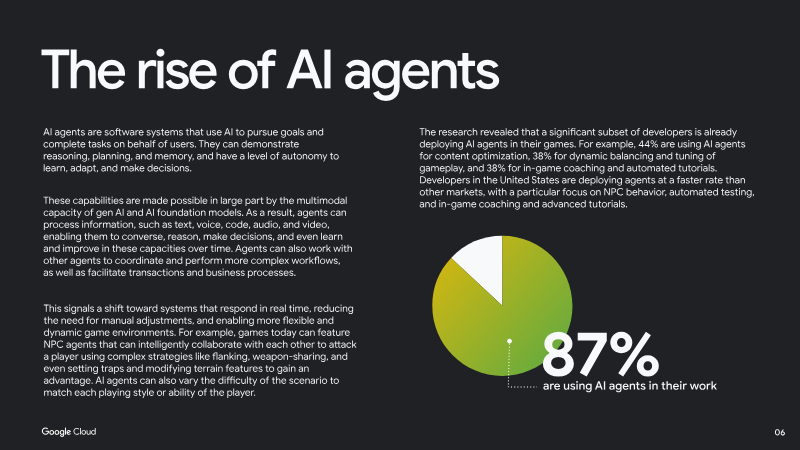
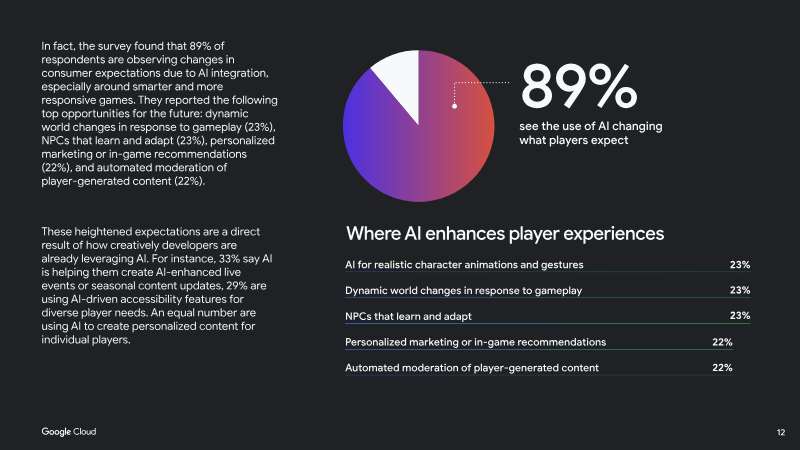

Comments