User Acquisition reports and market data
Documents
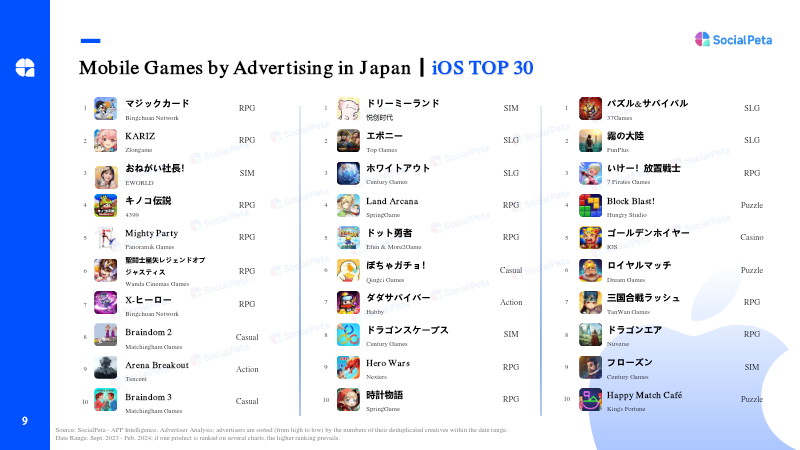


Insight into 2024 Marketing Trends for Japanese Mobile Games
The Japanese mobile gaming market is characterized by a conservative but highly specialized marketing landscape, where local companies maintain a dominant revenue position.
- Japanese firms dominate the domestic market, holding nine of the top ten revenue spots on the App Store, while Chinese developers account for 30% of the top 100 grossing titles.
- RPG titles are the most lucrative genre in Japan, representing 32% of the top 100 revenue-generating games on Google Play.
- Marketing in Japan is characterized by low creative turnover, with only 62.23% of advertisers using new creatives and a total new creative volume of 29.77%, both significantly below global averages.

Mobile Ad Creative Index 2024
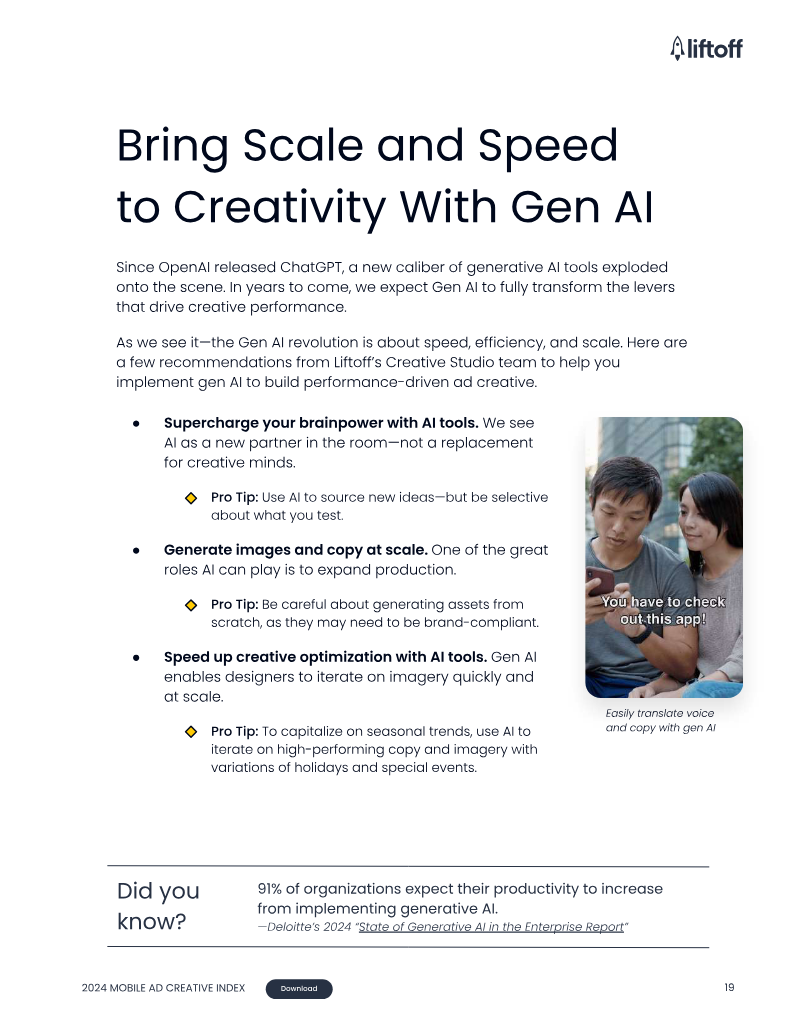
The Mobile Ad Creative Index provides a comprehensive analysis of performance benchmarks and emerging trends within the mobile advertising ecosystem.
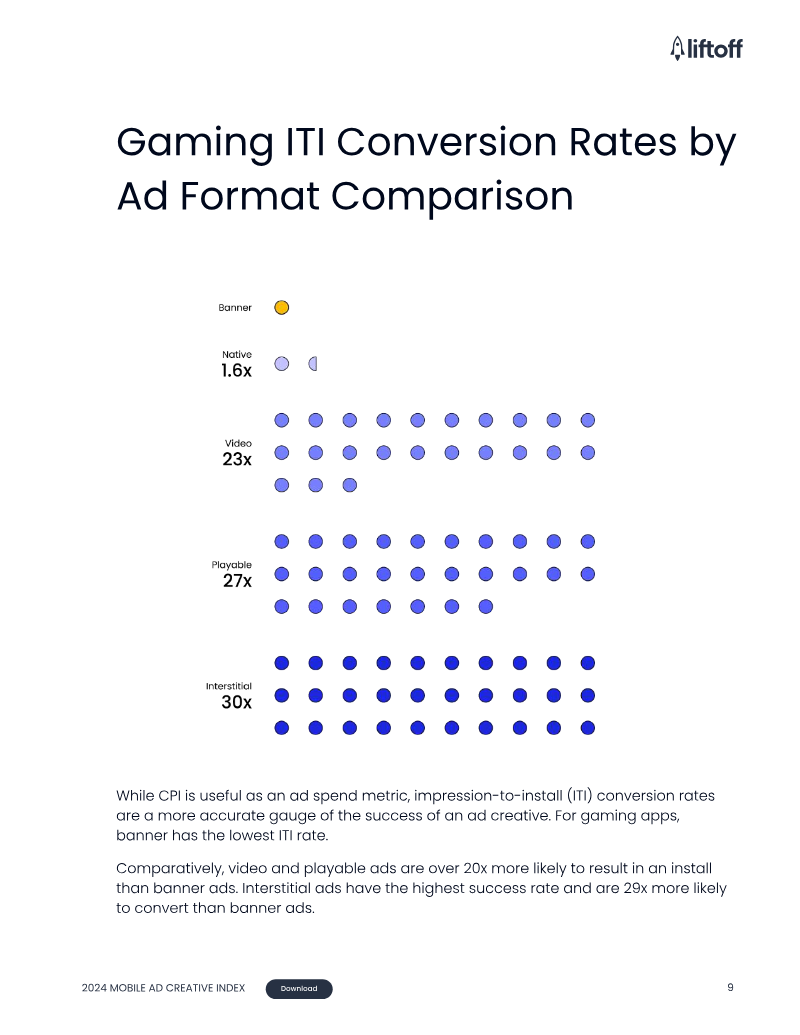
- High-engagement formats like video and playables outperform banners by 20 times in gaming installs, while finance sector interstitials are 18 times more effective at conversion.
- Long-form video ad spend grew by 245% year-over-year, and 'triple-page' ads combining video, playables, and end cards saw a 355% increase in investment.
- Optimized user-generated content (UGC) ads achieve a 20% lower cost-per-install (CPI) compared to standard video creative.

Supercell's Clash Mini Softlaunch: Game design, UA & Creative review (#90)
Clash Mini represents a strategic attempt by Supercell to capture the mobile auto-battler market, a genre that has historically demonstrated significant revenue potential in Asian territories compared to Western regions.
- Supercell’s Clash Mini faces a high probability of cancellation or fundamental restructuring due to its inability to meet the company's rigorous internal benchmarks for a global release.
- Since its November 2021 soft launch, the game has generated $2 million in revenue from 4.7 million downloads, failing to demonstrate the revenue depth required for long-term viability.
- The game’s monetization strategy, which locks high-impact units behind binary gacha systems, has created a pay-to-win dynamic that alienated players and hindered revenue performance.

UA strategies in the post-IDFA world LIVE - Gamedrive x 2.5gamers!
The mobile gaming industry has undergone a fundamental transformation in the post-IDFA era, necessitating a shift from granular, deterministic tracking toward a holistic strategy that balances performance marketing with brand-building.
- AppLovin has emerged as a top-two UA channel for most mobile games, joining TikTok, Facebook, and Unity as essential platforms for iOS user acquisition.
- The current industry trend for creative strategy involves integrating 'fake' ad mechanics directly into the game as mini-games or calendar events to ensure a smooth transition from creative to gameplay.
- Switching ad mediation platforms can significantly impact revenue; for example, changing banner refresh rates from 30 seconds (AdMob) to 10 seconds (LevelPlay or MAX) can potentially triple banner revenue.
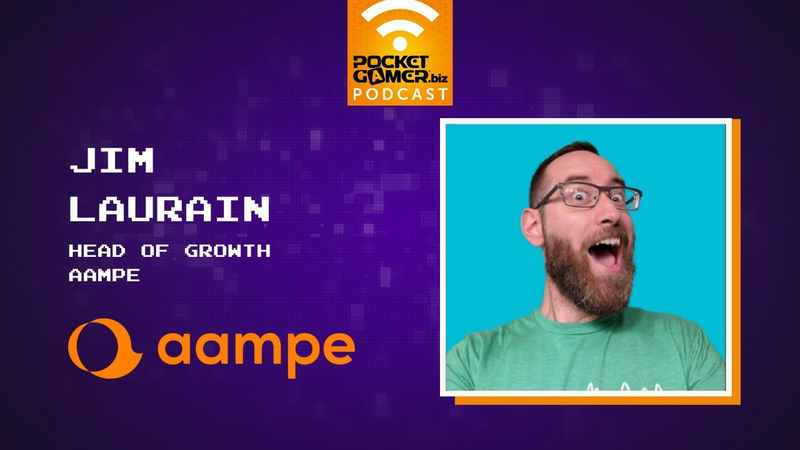
Aampe’s Jim Laurain On Smart Steps To Inspire Players With Messaging That Matters
Mobile game studios frequently overlook the critical importance of early-stage player communication, with three-quarters of top-tier titles failing to implement any welcome messaging for new users.
- Approximately 83% of mobile games fail within three years of launch, often due to a failure to deliver relevant, engaging content to users.
- Roughly 75% of top gaming apps fail to effectively welcome new players, missing a critical opportunity to drive retention during the onboarding phase.
- Developers should move beyond generic, repetitive messaging by testing different player motivations—such as escapism, competition, or social cooperation—to segment their audience.

Unraveling Content Creator Programs
Content creator programs have emerged as a critical strategic instrument for game publishers, shifting the focus from traditional awareness-based influencer marketing to performance-driven ecosystems.
- Players participating in creator-led ecosystems retain at twice the rate of non-participants, while creator-driven reactivation efforts are up to five times more effective than conventional marketing.
- Content creator programs are shifting from awareness-based marketing to performance-driven models that incentivize long-term engagement, retention, and monetization through revenue-sharing.
- Successful program management requires a hybrid skill set that balances community engagement with rigorous data analysis to measure incremental growth and return on investment.
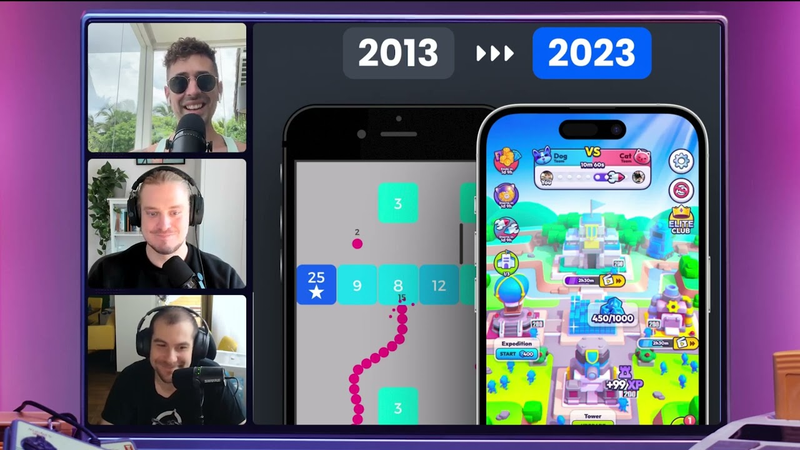
Voodoo Block Jam 3D Hybrid casual story: Is Voodoo a Rising Phoenix? (#89)
Voodoo is successfully executing a strategic pivot from its hyper-casual origins toward a hybrid-casual model, a transition that now accounts for 75 percent of the company’s total revenue.
- Voodoo’s 'Block Jam 3D' demonstrates a shift toward hybrid-casual, where in-app purchase (IAP) revenue shows a hockey-stick growth curve while download volume remains flat or declining.
- Interstitial ads drive the majority of the game's revenue, accounting for approximately 50% to 66% of total ad income, with an average of 8–9 impressions per session.
- The game utilizes a 'VIP experience' branding for its no-ads option rather than a standard 'no-ads' label, a strategy that reportedly increased purchase conversion rates by 1,000%.
Kwalee’s John Wright On Attracting Valuable Users With A Loyalty-Driven Approach
The mobile gaming industry has reached a critical inflection point where the traditional hypercasual model is no longer viable due to escalating user acquisition costs and the depreciation of tracking identifiers.
- The shift from hypercasual to hybrid-casual mechanics—integrating meta-layers and live operations—has increased average revenue per user (ARPU) from the traditional $0.30–$0.50 range to $1.50–$2.00.
- Studios must transition from high-volume, short-term user acquisition to a loyalty-driven model that prioritizes long-term retention to counter rising acquisition costs and the loss of tracking identifiers.
- Treating games as part of a broader portfolio ecosystem allows studios to mitigate revenue decay by cross-promoting players across multiple titles rather than relying on isolated products.

Zenless Zone Zero: First look! Everything we know from Closed Beta (#88)
HoYoverse continues to solidify its dominance in the global gaming market by applying a highly refined, high-production-value gacha model to its latest title, Zenless Zone Zero.
- HoYoverse employs a standardized, highly profitable template for its gacha-based titles, allowing the company to develop new games in roughly half the time required by Western studios.
- Zenless Zone Zero utilizes a gacha monetization model identical to Honkai: Star Rail, featuring a 1% base pull rate for top-tier characters and a pity system that guarantees an S-rank character after 50 pulls.
- The game features a complex progression system with six equipment slots and randomized stats, requiring players to repeatedly farm artifacts to achieve optimal character builds.

Mintegral ROAS Bidding 101
Mintegral’s ROAS (Return on Ad Spend) bidding strategy is designed to automate user acquisition by leveraging machine learning to predict user lifetime value in real time.
- Mintegral’s ROAS bidding strategy automates user acquisition by using machine learning to predict real-time user lifetime value, shifting optimization from volume-based metrics like CPI or CPM to profitability.
- Successful implementation requires a two-week calibration period for postback data collection and a minimum daily budget of $500 per country.
- Advertisers should initiate ROAS bids at 1.1 to 1.5 times their standard CPI to provide the algorithm with sufficient data to identify high-value users.

Product Marketing 101 with Jesse Lempiäinen, Founder/CEO of Geeklab
Product Marketing Managers (PMMs) serve as a critical bridge between game development teams and the broader marketing ecosystem.
- Product Marketing Managers (PMMs) act as the primary bridge between development and marketing to identify product-market fit early, preventing expensive post-launch pivots.
- In the post-privacy landscape, PMMs must proactively generate market intelligence through independent methods like surveys, pre-launch testing, and competitor analysis to compensate for the loss of granular ad network data.
- Embedding PMMs directly within game teams ensures marketing strategies and user acquisition efforts remain synchronized with the actual gameplay experience and development lifecycle.
MY.GAMES’ Elena Grigorian On Smart Strategies To Stay Afloat During This Industry Downturn
The gaming industry currently faces significant volatility, necessitating a shift toward operational agility and diversified business models to ensure long-term stability.
- Companies can mitigate the risks of a hit-driven market by adopting a grid-based organizational structure that balances centralized marketing expertise with decentralized studio-level execution.
- Operational resilience is supported by a hybrid, remote-first workforce model capable of managing a diverse portfolio of over 80 titles across mobile, PC, and console platforms.
- Diversifying business models through a combination of internal development, third-party licensing, and strategic investments allows firms to maintain marketing and operational scale during economic downturns.