VideoDeconstructor of Fun
Product Marketing 101 with Jesse Lempiäinen, Founder/CEO of Geeklab
27 Nov 202329 min video
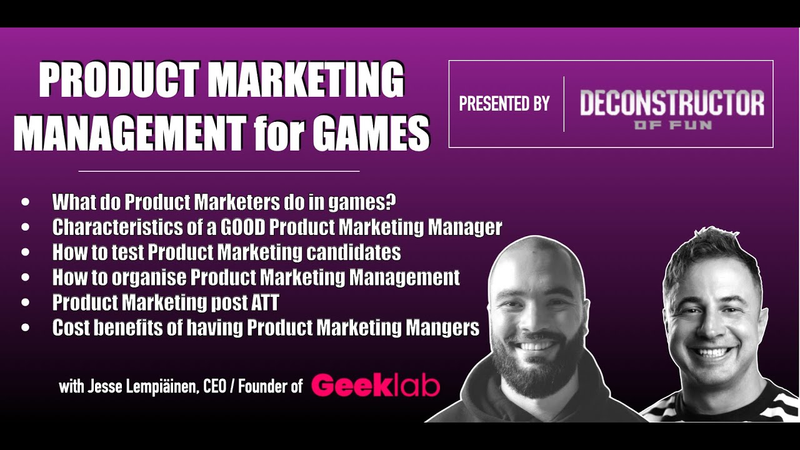
welcome welcome welcome everybody to the deconstructor of fun podcast I have a special guest today yes sanan CEO of geek clab founder and CEO of geek clab welcome to the podcast thanks a lot MSA it's it's great to be here uh it's been a while since we actually last had a chat so uh extremely excited to be here we were supposed to record this on site and then I have to I have the school thing with my kids and there was a storm and I'm lazy let's put it that that way but I really really wanted to record this onite I wanted to do this today because I think it's important to talk about product marketing and I was thinking who do I who's the uh who's the best person to talk about product marketing with and it's of course you yes you've been a product marketer at roio you were a product marketing manager at at uh at a studio that I was leading and since then I'm just doing a quick intro so that people know who you are and since then um thanks you you
built a platform while being at roio the ski clab platform you were just working nights during the day you were product marketing manager for the studio and during nights you were this uh bootstrapper startup person uh building this amazing Tool uh with you know it looked really nice and then roio started using it and some other companies started using it and then at one point you had like I think you had like 130 leads uh by leads I mean different companies that wanted to sign up and start using it and at that point you pulled the trigger and became an entrepreneur uh but but your platform geek clab can you just tell a little bit to the audience what is it about yeah uh point on thanks this is always easy when someone else do the bracking part uh but uh awesome thanks thanks for that uh but yeah so essentially actually speaking of product marketing like this tool was something that I truly like felt that I needed back when I was doing product marketing at Rio and and it didn't exist
at a level that I I wished it would have so that's precisely why we why we build it and all the features like sort of around it um so it's it's been fun ever since leaving roio I felt like for at least the first like 30 months sorry half a year uh so uh I felt like I worked more with the my former product marketing team than than was at braio because I was literally building the tool for the product marketeers uh with the with the team here at geek laab but yeah so essentially we we have a we have a tool that that's focused on like three key areas so we have our analyze uh section where we can truly like seese the market uh a big part of what what product marketers actually do where the market opportunities lay uh what's the what's the average rpu download you know uh revenue of of of your competitors what are the key selling points they do all of that stuff We Gather that data and and and showcase that in a in a way that I I wish that that that would have
been accessible back when I was a product marketing manager at Rio uh it was a lot of manual labor so we tried to get rid of that uh then we have our testing platform which allows you to run uh like pre-launch tests which is extremely crucial for for product marketing as well so essentially uh you can create these local like app store Pages for for IOS app store Google Play and and steam as well uh so that you can get like a hunch of of what your U marketing metrics would look like if you if you have a theme that's that's around sci-fi against the theme that's uh Pirates which is something that everyone loves um and then lastly we have our our sort of the thing that we call ask so uh our survey tool that's very sort of uh mobile first made uh done in a way that you're you're able to get like as high completion rates as possible and then we have pre-made templates that allow you to quickly assess the the like sort of motivational framework of your of of your potential audience or or
demographics and and so on and all of these combined uh kind of wraps up together as they uh ultimate product marketing tool I guess so so just to okay so I I'll lead on to the like a first question uh and use what you said before and that is so what is product marketing and what you said is you build a tool that allows to gather Market intelligence so that I know product marketers give a lot of good Market intelligence of especially like a product managers we tend to look at more at the revenues and the kind of competition inside the genre and when it came the intelligence for product marketing team it was a lot about positioning of of the game um of course some of the key like there's overlap between product management but it was a lot about positioning and in terms of positioning of how do we want to advertise what are the unique selling points versus the product manager we're focusing so much on the individual features uh instead of how to communicate those features so Market intelligence number one um testing
product Market fit that's getting the early hunch of how marketable your setting your art style your themes are uh so that you're not steering away too much into you know I've done those mistakes I've built the game with sci-fi and it was very very expensive to Market and you end up in a soft launch looking at crazy cpis so kind of getting that first product Market fit and then the the third part was surveying so basically understanding uh the potential audience and being able to really design against that audience uh and and position your product in the development already to a target audience but what other elements do product marketers do except these three I think it would be easiest to sum it up in a way uh back when I was doing product marketing and and still today as we as we work with a lot of developers and we see a lot of product marketing managers and different you know like company compositions and stuff so the successful ones that we see is where like uh the two best bodies
really are like the game lead and then the product marketing manager uh and whereas the game lead is is a very inter internal voice in the sense it's it's it's hyper focused on the on the game and and the game team and and and U communicates and and make sure that the vision gets executed within the game itself so then the product marketing manager on the other hand is a very sort of external voice it it often in bigger companies communicates with all the central units uh that that uh you kind of need to have to to be able to acquire the audience uh and and then is is whereas the game lead is is responsible for uh communicated that Vision internally so that product marketing manager is then more uh about how to communicate that external actually make make it happen um so on top of on top of things that you just just mentioned it it also depends a bit on on what the life cycle of the product is so in in pre-launch the the teams that you
collaborate are are quite different than than when you do liveops as an example and and also like uh a lot of the stuff that I did for liveops was was preat uh so so that was that was also I guess a bit of a different story but what I would add on on to that is product marketing manager is typically the owner of the entire marketing funnel uh holistically uh so whereas U with big companies you might have your UA team that's that's strictly about like the actual user acquisition uh you might have your own like dedicated influencer team and then on top of that you have your have your app store optimization team that is focused on the on the second layer of it and then at the end of the day there's still like the monetization in the game and you have to make sure that all of this works and and and you're acquiring users that actually get what they're expecting in the game itself and this is the main responsibility of the of the uh marketing manager in in my view and uh
the companies and and in my previous experience the cases where this this things went extremely well uh is where it's quite quite a solid uh collaboration with nearly all the like Central units uh that a big company might have uh and then then the product marketing sort of gets them together uh to then work with the with the game game team very close got it so so as a product marketing manager on a team the key role is to really reing all these specialist functions whether it comes to user acquisition brand marketing App Store optimization uh influencer marketing um CRM or direct marketing campaign people uh and and basically uh being that that touch point for all these um auxilary resources and partnering together with the game lead or game director or product owner uh to make sure that the marketing is on par
and um working with the product that they are marketing yeah and and to add on to that sometimes the things that you know what you do in marketing specifically uh if if you're doing like a a bit more midcore titles so so often then things that happen in the marketing might not reflect 100% what's in the game itself so it's very important to still have an alignment into into what the marketing is and then what's actually happening in the game itself and on top of that to to communicate that and involve the game team also into into into understanding on on on who the audience is as as those are are are the players the the the consumers in the business as well so so that's also a big big responsibility for the product marketing manager to be able to then then to get to get help the game lead to to communicate and have all the data points to be able to communicate also uh who the audience is and and and you know
how they Perce like perceive the the the the idea of the game and the theme and so on yeah that's that's actually very true I I often you know interact even now with with larger teams that that individual product managers might say that hey our Instagram page is not up to par compared to this other product that is our rival so they have like opinions about things that is not in their ownership and there you start seeing that really even though people own certain let's say social Pages advertising campaign brand marketing campaigns they're not coordinated sometimes uh to communicate uh the qualities of the product and sometimes there's just no communication between the marketing team and the product team itself and so product marketing manager is kind of like project manager for all the marketing efforts yeah very very clear um let's say I'm hiring a product marketing manager and I have a let's put a game in soft launch like we're gearing
up for launch and I'm working at a midsize studio with with all these auxiliary resources like what kind of a what is a good product marketing manager like what kind of a person am I looking for what are what are my expectations for this person so I've always found it extremely useful to be sort of a a uh good generalist so you're not like extremely good at anything but you're quite okay with a with a ton of stuff the reason for that being that that way you're able to communicate very clearly with with a specific vocabulary with with the certain crafts within the team and this is a case where where you mentioned that you have a midside studio that actually has these resources in soft launch you definitely need like a a user research like personnel as well on top of what we mentioned earlier so so that would definitely be one thing that uh i' I'd be looking for like this is where I feel that also like the experience comes comes handy to understanding the full full marketing funnel it's it's
something that we we often talk about a lot and there's a lot of presentations about it but but also to truly actually have been held or or have the will to truly H hold all the different different sections somewhat in in your in your product product management uh so that you'll be able to craft like a story from the first ad that the user sees to to then actually making the final purchase or the first purchase uh in the in the in the game itself that's that's it's like a it's a journey that you have to have to truly be able to understand and that's something that I would I would verify that the product marketing manager is truly on top of got it so understanding the full marketing funnel that means um I mean that means a lot of thing like you have to understand user acquisition you'll be able to run campaigns at at a at a small scale you have to understand creative creative production uh creative Trends um you have to understand App Store optimization to to to uh to increase your install per thousand
Impressions surveys you have to understand those to kind of understand the type of players and then you have to start understanding the game as well that you're marketing or the product that you're marketing because you need to know what Drive sales um at what points do do uh do players monetize and and what kind of a Hooks and so forth so you have to be quite quite good on on many things but not an expert on on on everything got it all right clear yeah maybe I quickly add also kind of hence the name manager so I actually m it felt quite natural to to then move to a role of a CEO and I I contined kind of doing the same thing not being an extreme expert on anything but let like other people that are actually better at at those specific crafts do the thing and then just just kind of take the ownership of the vision and and and making sure that that's communicated and executed actually uh as as plann how would you test uh a product marketing manager that's actually a very good question trying to reflect uh because I
I was helping to hire replacement for myself too uh so what were the actual questions we asked but that was also kind of exactly post at so everything was as chaotic as as it was uh yeah last week when when Unity news came up I would really deep dive into into first um kind of questioning like how the the product marketing manager is is approaching about like actually seizing up the market like uh do they have the knowledge and understanding of of being able to look at the market opportunities and and and go towards a specific uh blue ocean or to understand the risks about going there as well and then then secondly uh just ask in general about like the the full marketing funnel and how how they would actually break it down into what that
full marketing funnel consists of to understanding of of whether or not they truly understand it uh in the in the way you'd want them to got it and would you expect them to have direct experience and running you know Facebook campaigns and you know maybe creative creative Productions and stuff like that right uh I would say that depends a lot on the on the size of the company too uh but like specifically a midsized company where you might have your like UA team separately uh then then not even necessarily at all like it's that's that's a completely uh different CFT as well uh and and I feel like the product marketing manager is fully capable of doing their job as well without themselves actually running the the technical side of things but they would still have to be able to
understand how like for example the self attributing networks uh work like got it so they have to be Avid Reader of mobile Dev memo pretty much yeah yeah all right or or or a or a member of deconstructor of fun well I would say mobile Dev memo in this case and also subscriber to the pay tier of mobile Dev memo shout out to to mob Dev mobile Dev Memo's uh a month subscription with with a incredible Insight so uh so all the product marketing managers get get on that um and what is the uh what is the good organizational setup for product marketing is this person part of the uh the marketing function Central marketing or you know however you want to see it or marketing division or is this person directly on the product team this is a a a a good good question because
uh I I feel like it's always been a burning topic um the best cases however when like that I've seen is when the product marketing manager is as close to the game lead as as game team as possible literally sitting with the game team if if that's the only product they work on even better then they then they can truly like bring their full focus on it because that's truly also a a a job that that deserves the full focus on it so uh that would be ideal but quite often it does seem that like the product markeet managers do have to split a few multiple uh titles uh but I would still recommend to actually you know then split your week uh among sitting together with the game game teams because at the end of the day that's the actual product that you're marketing uh so that's exactly where you should be in might op got it so even even if you're placed in an organization into a central function or you might be working on two or more titles you should be still
spending most of your time directly with the team and and that's actually a great point I mean Jen uh on on this podcast as well has earned a lot of respect from the game teams by just being so deep in the game and often times like playing the competitors games and being like even even more advanced in in the game than the game team itself and that garnish a lot of respect in terms of what what she has to then to say or any product Market Mar manager has to say so you kind of have to not kind of you really have to have to use the product that you're marketing uh and not only to understand it better but also to to be able to communicate with the same language with the uh with the product team yeah um 100% all right last one how has product marketing evolved from preat when you were a young um Mark product marketing manager with a full set of hair working at at Robo I knew that was
coming up I know to now being a a Founder four years and there's not a lick of hair left because role of a Founder is so fun yep yep um well like preat I I I thought about this the other day and uh it was it was it was great time as well like we we but but we actually put a lot of trust in the networks too I felt like back then it was more about like just keeping up with the trends coming up with the creative strategy and and then then sort of uh letting the networks kind of find your audience if if if you know what I mean whereas now with post like ATT it's it's so much more difficult when you lack so much data from from what you kind of were able to to feed back to the to the uh behemoth so now like it's a lot for the it's a big responsibility
for the product marketing manager to actually be the one that then finds the data meaning that you have to conduct these surveys constantly you have to to to find ways to to to test and and research and and and learn about your audience uh what things work and what don't to then feed back to your creative strategy as you you kind of lack that uh automatic machine that that used to work uh pread I would say that that's probably the the biggest difference uh so would you say would you say that the role of a product marketing manager has um increased in terms of uh in terms of I wouldn't say value everybody's valuable in in the in the grain but uh but increased in terms of like their share of voice has increased over time yeah like previously it could have been that you had a team that that had like a very strong creative lead within the team as well uh and then they used a research team I feel like pre previously
it was more capable of running without a product marketing manager whereas now because we we lack those data like opportunities the UA managers are still if not more busy than than than preat so they don't have any time to to find any any new data sources either on or or surveying the the audience constantly so so yeah I I I guess uh I could you you could say that I'm saying that uh the important has has risen and and has anybody else's importance in the uh uh the marketing funnel decreased post at that's a good question too um not necessarily decreased but I feel like a lot of like the roles have shifted I I wouldn't say that anyone's has necessarily decreased just just maybe maybe shifted a bit like uh into into into um the areas right like kind of side to your own craft got it and F okay
actually I always say final questions and I ask five more uh final final question let's say I'm I'm hiring this I I have all the functions but I don't have product marketing I have everybody like I can access my my UA team my brand teams my CRM teams my user research teams if I bring in product marketing manager will that increase my cost or decrease my cost because I'm getting somebody to manage my cost centers better yeah they will also want to test things uh and typically that costs too so I would say like in the in the in the uh the upcoming four months it will it will cost you uh a lot more hopefully that means that they're doing their job well by actually testing and and and understanding the audience but then on the other side um that will save you save you if not Millions uh a lot more uh by then making sure that you if
you're in a soft launch or or even better if if you're already bringing in a product marketing manager when when you're um in a pre-production phase and and you want to bring them in to assess the market and and and run these tests at a at a stage where it's it's most crucial so that product marketing manager might end up costing you you quite a bit but then it might also help you to fail extremely early saving you you know 12 to 24 months of run run rate uh as as then you don't go and end up on on like a early St days of soft launch to find out the exact same things that you could could have found out like way earlier leaving your room to to try again with uh with the learnings that you got from the first failure awesome let's put it this way fail faster with a product marketing manager the early test and over the long time you're able to adjust your marketing efforts accordingly to the phases of the product and this is is actually really important when working with especially external marketing teams
it takes so much of your effort and time to figure out what's going on in the marketing side are they doing everything possible why am I getting these type of users what's happening with my retention where the product leads or game leads attention goes between the internal development which has to be as fast as possible to to adjust to all the kpi that you're seeing to again second guessing what's happening on the marketing is everything okay doesn't seem like it can we figure this out so if you can up upload basically that external part to a product marketing manager and just ask one person instead of chasing UA managers down and asking what's going on with these campaigns why am I getting this type of stuff that makes uh your life a lot easier and you're able to focus on the product that you're building yeah 100% And it's it's an internal balance between like the tltv and and and then the CPI and and quite often as We Know when when you do things that can drastically lower lower
your CPI that will then then end up hurting your um LTV if there's a mismatch and this is this is kind of what what the product marketing managers are extremely good at is is balancing these things out I think it was back at Rio but we we kind of Co this this Northstar metric of of uh cpid D1 we didn't follow uh like the cpis uh per se at all but we actually all only followed CPI uh like then multiplied by the day one retention uh back when when the game was at a stage where it didn't still necessarily even have content for three days but like that was a way for us to see as we do things in in the marketing side and evolve our creative strategy how that how does that then sort of be get interpreted and and and felt like when you then actually come to the game itself uh are you are you getting in into what what you expect and specifically with mid and titles that like like mentioned earlier that can have like a bigger this balance between the uh what the ads are showing and then
the actual core gameplay um so so this this is extremely important so CPI day one meaning like if let's say my C my day one is 40% and my CPI is uh $10 so that would give me four right yeah exactly okay and then if my day one is 20% and my CPI is $10 still then that would give me two and so the higher the number the better the the the other way around so we we had to obviously revert the D1 so that it like um the lower the number uh the better it was so if if if you have a 10 $10 CPI being being bad uh at a soft punch I guess but if you have a had a $10 CPI and then 30 30% retention rate so then that would have been inverted so that then you multipli that with
0.7 leading up to a DPI of less than what it would be if it would be 20% because then you would multiply it by 0.8 so uh with 20% you would add up end up in in in uh sort of eight as the balanc GPI and and with uh 30% you would end up in in seven as the balanced CPI C CPI times 1 minus retention percentage right exactly sorry you mentioned about the storm you mentioned about the storm and that's that's that actually woke me up like 3:00 a.m. this morning so I haven't slept since either so so like the equations are a bit you're you're you're a Founder you're a Founder you shouldn't be sleeping either way true true all right yes this was fantastic a quick podcast basically I wanted to just have a call and and refresh my my memory but also my understanding of product man management what it was then what it is now how you
should optimize your teams to uh to take full benefit of product management um and for all the listeners hope you enjoyed this a quick information um tibit I don't know hopefully it's it's useful uh most importantly from my perspective I want to give a shout out to geek laab I've used it at two different companies really helped me out as I as we didn't have product marketing manager in the beginning so it helped even people like myself for quite dummies to uh understand how to position how to find that product Market fit um and and you know get some Market intelligence so you've built a really cool company against the needs that you had as a product marketing manager so thanks for the thank for the product and thanks for the uh for the for the BL blog for the podcast so thanks yes sir thanks a lot M it was a pleasure as always all right every everybody talk to you guys later
Auto-generated captions from YouTube — names and numbers may be misheard.
Product Marketing Managers (PMMs) serve as a critical bridge between game development teams and the broader marketing ecosystem. Their primary function is to facilitate early identification of product-market fit, which helps studios avoid costly post-launch pivots. By acting as a central liaison, PMMs allow Game Directors and Product Managers to focus on core development and key performance indicators (KPIs) while ensuring that marketing efforts, such as user acquisition, influencer campaigns, and app store optimization, remain aligned with the actual gameplay experience.
The role of the PMM has evolved significantly in the post-privacy landscape. With the reduction of granular data previously provided by advertising networks, PMMs now bear increased responsibility for gathering market intelligence through independent means, such as conducting surveys, performing pre-launch testing, and analyzing competitor data. This shift has elevated the importance of the PMM, as they must now proactively generate the insights necessary to inform creative strategies and ensure that marketing messaging accurately reflects the product’s value proposition to the target audience.
Effective PMMs function as generalists who possess a holistic understanding of the entire marketing funnel. While they do not necessarily need to execute technical tasks like running Facebook campaigns, they must be capable of communicating with various specialists—including user acquisition, creative, and research teams—using a shared vocabulary. Ideally, PMMs should be embedded directly within the game team to foster deep product knowledge and ensure that marketing activities are synchronized with the game’s development lifecycle. Although hiring a PMM may increase short-term operational costs due to the emphasis on testing and research, this investment often yields significant long-term savings by enabling teams to fail faster during the pre-production or soft-launch phases, thereby preserving resources for more viable projects.

Deconstructor of Fun · 2026

Deconstructor of Fun · 2026

Deconstructor of Fun · 2026

Deconstructor of Fun · 2026

Deconstructor of Fun · 2026

Deconstructor of Fun · 2026

Deconstructor of Fun · 2026

Deconstructor of Fun · 2026

Deconstructor of Fun · 2026

Deconstructor of Fun · 2026

Deconstructor of Fun · 2026

Deconstructor of Fun · 2026

Adjust

Naavik · 2026

Deconstructor of Fun · 2026

Almedia · 2026
Deconstructor of Fun · 2026
Deconstructor of Fun · 2026
InvestGame · 2026

Deconstructor of Fun · 2026

Deconstructor of Fun · 2026

Deconstructor of Fun · 2026

Deconstructor of Fun · 2026
Deconstructor of Fun · 2025
Comments