User Acquisition reports and market data
Documents

Review radar #8: From Stable Dinosaur to Revenue Rocket. Podcast curse broken!
The current mobile gaming landscape is defined by a shift away from volatile growth patterns toward long-term stability, where success is increasingly driven by aggressive user acquisition, disciplined creative strategies, and consistent live-ops.
- Long-term stability in mobile gaming is now driven by aggressive user acquisition, disciplined creative strategies, and consistent live-ops rather than radical feature innovation.
- Pokémon Sleep is currently on track to reach $1 billion in annual revenue within its first year, highlighting the significant market power of established intellectual property.
- Celebrity-led marketing campaigns have proven highly effective, as demonstrated by Royal Kingdom, which successfully doubled its revenue and download metrics.

MAU'25 Live Special: The Bold New Era of Rewarded Gaming & UA in 2025
The rewarded gaming landscape is undergoing a significant transformation as platforms transition from traditional Android-centric models to more complex, multi-platform ecosystems.
- Rewarded gaming strategy for 2025 is shifting from Android-centric models to iOS expansion, requiring a move away from last-touch attribution toward rigorous incrementality testing.
- Measurement frameworks now rely on a triangulation strategy that combines last-touch data with causal incrementality testing and self-reported user insights to validate growth.
- Successful geographic expansion, particularly in competitive markets like South Korea, now mandates deep culturalization through local staffing and region-specific reward structures.
Q2 2025 Gaming Ad Snapshot
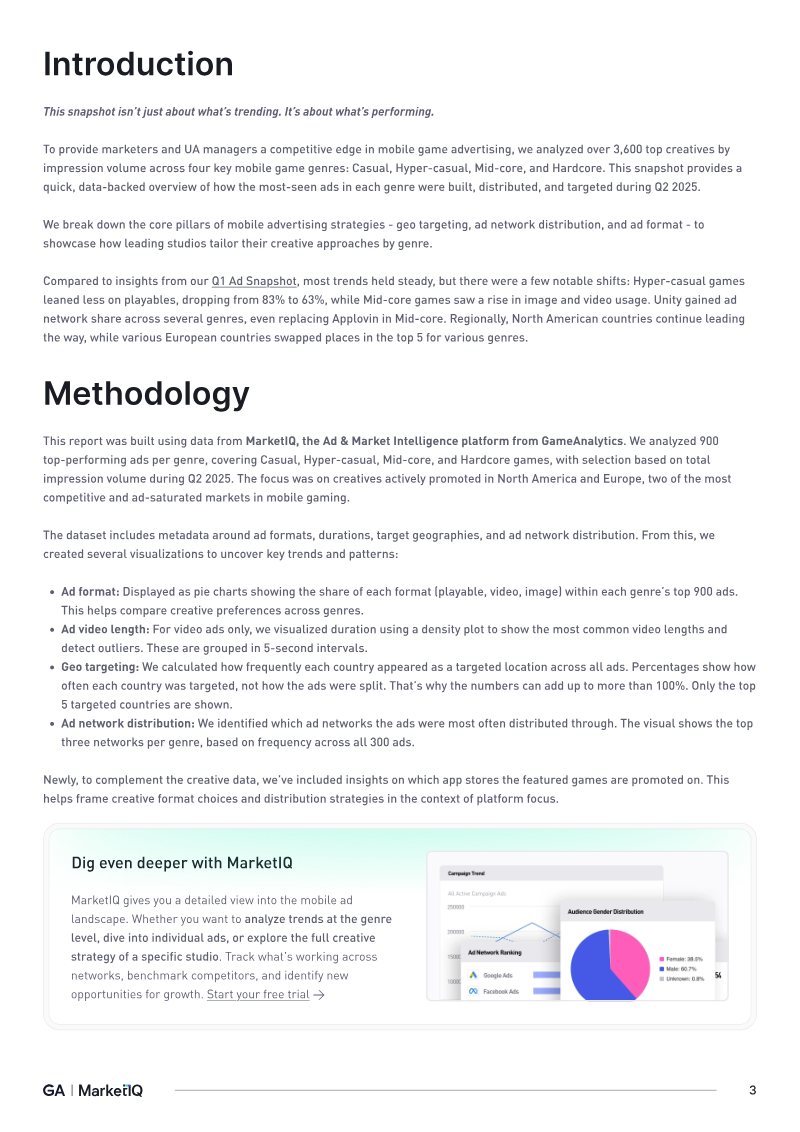
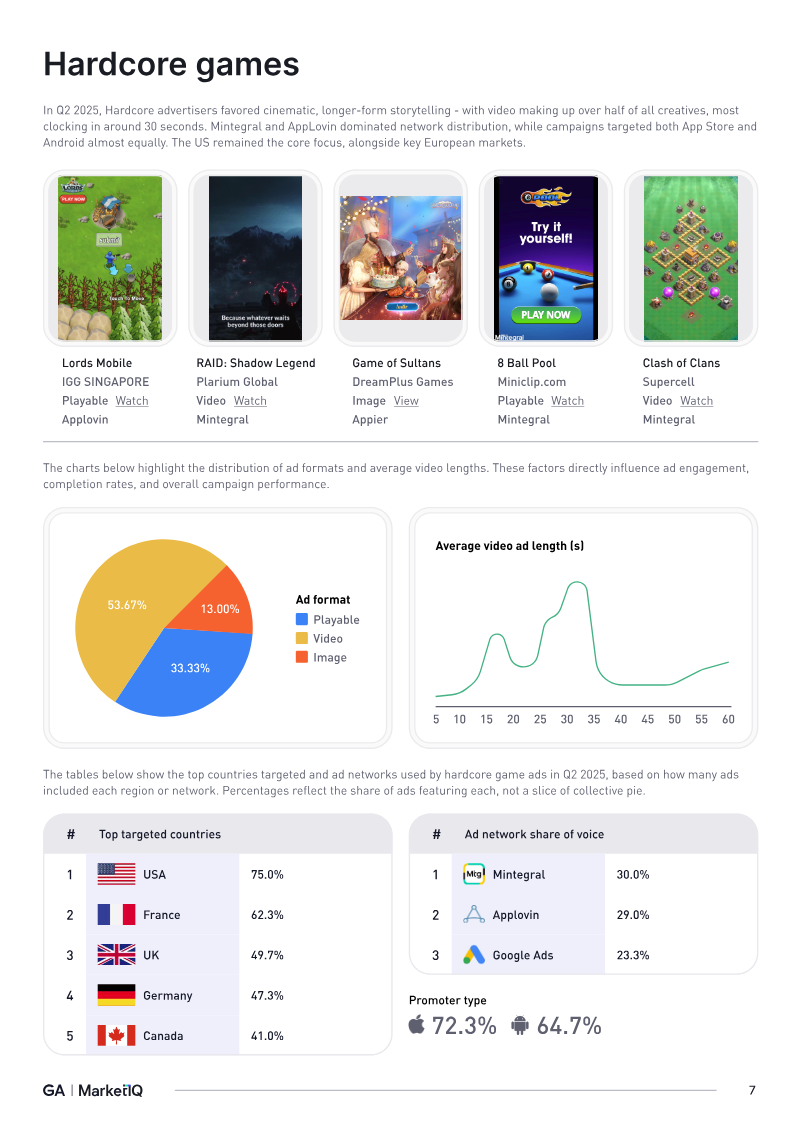
The Q2 2025 Gaming Ad Snapshot provides a data-driven analysis of mobile advertising trends across four primary game genres: Casual, Hyper-casual, Mid-core, and Hardcore.
- Google Ads and Facebook Ads remain the dominant platforms for mobile gaming promotion in Q2 2025.
- The active mobile gaming audience is composed of 61% males, 38.5% females, and 0.8% unclassified users.
- High-performing mobile gaming ad assets demonstrate rapid scaling, with impressions growing from an average of 13 million to 47 million over their lifecycle.

GOAT: Paul Bowen on Ad Network Wars & Future of UA
The mobile advertising landscape has transitioned from a fragmented, high-growth environment into a mature, consolidated market dominated by major entities such as Meta, Google, and AppLovin.
- The mobile advertising landscape has undergone significant consolidation, leaving AppLovin as a dominant force in the ad network space alongside the walled gardens of Google, Facebook, and TikTok.
- The incentivized offer market, popularized by Mistplay, has a low barrier to entry that has led to a surge of new, non-defensible business models relying on gift card rewards.
- Allegations of fraud regarding AppLovin's auto-downloading of apps are largely misunderstood, as iOS technical constraints make such actions impossible and the ecosystem remains a matter of buyer awareness and contract transparency.

🔥 The Art of Scaling Applovin UA & Admon: A Deep dive
AppLovin’s Axon 2 algorithm represents a fundamental shift in user acquisition, moving away from manual optimization toward a sophisticated, data-driven black box model.
- AppLovin’s Axon 2 algorithm functions as a black box that requires stable data inputs; changing ROAS goals every 2–3 days prevents the system from calibrating, as it forces the algorithm to constantly re-target different user segments.
- For IAP-based games, D28 ROAS campaigns are recommended over shorter windows because they yield higher-quality, higher-retention users, even if initial D0 metrics appear significantly lower.
- Campaigns require a minimum of 10–14 days to calibrate on a specific ROAS goal before any adjustments should be made to the target.

Session: Playhop: Current State & Opportunities For Developers - Nikita Bokarev, Playhop.
Web-based gaming has emerged as a critical strategic pivot for mobile developers facing rising user acquisition costs and stagnant lifetime values.
- Web gaming serves as a high-margin alternative to mobile, where revenue contributes directly to profit rather than being absorbed by rising user acquisition costs.
- Playhop currently hosts over 20,000 games and reaches 10 million monthly active users who spend an average of more than 50 minutes per session.
- Successful midcore titles on the platform now derive up to 85% of their total revenue from in-game purchases rather than traditional ad-based monetization.

Session: State Of Gaming - Josh Skinner, Sensor Tower
The mobile gaming industry experienced a notable shift in 2024, characterized by a return to revenue growth despite a contraction in global download volume.
- Mobile gaming revenue grew by 3.8% in 2024 despite a global decline in download volume, driven largely by a 17% drop in casual game installs.
- Live service models are the primary revenue engine for the industry, currently accounting for 84% of all mobile in-app purchase spending.
- Hybrid casual games are a major growth segment, recording a 37% revenue increase as publishers increasingly pivot toward this monetization model.

Scaling 100+ Mobile Games: PSV Game Studio Shows How They Use Tenjin
PSV Game Studio, a Cyprus-based mobile gaming firm established in 2014, manages a portfolio of over 250 titles and provides publishing, marketing, and monetization services for 20 external gaming studios.
- PSV Game Studio manages a portfolio of over 250 titles and provides publishing services for 20 external studios, utilizing Tenjin as its centralized data infrastructure to scale operations.
- The studio tracks day-zero return on ad spend (ROAS) as its primary benchmark to evaluate the success of user acquisition campaigns across more than 100 active applications.
- Analytical strategies include granular performance breakdowns by channel, campaign, and geographic region to identify high-performing segments for scaling and underperforming assets for adjustment.

Full Steam Ahead: How Steam trends influence Mobile games?
The mobile gaming industry is increasingly leveraging Steam as a primary incubator for market validation, utilizing successful PC titles to identify engaging mechanics and creative loops for mobile adaptation.
- Mobile developers are increasingly adapting Steam hits into mobile titles, with some 'copy-paste' clones generating significant short-term revenue, such as one title that earned $1.3 million in ad revenue within 90 days.
- Successful mobile adaptations often involve 'remixing' Steam mechanics into established mobile genres, such as integrating survival or idle mechanics into 4X strategy frameworks, rather than performing direct ports.
- Genre-specific mechanics like digging simulators, Plinko-style roguelites, and idle RPGs show high potential for mobile conversion due to their simple, repeatable loops that align with mobile play patterns.

What Gaming Taught Them—And Why App Companies Are Hiring Them Fast with Mission One's Gerard Miles
The gaming industry is currently serving as a primary talent pipeline for the broader consumer application sector, including fitness, education, and AI-driven platforms.
- Consumer application sectors like fitness, education, and AI are aggressively recruiting gaming veterans to replace failing traditional performance marketing with high-retention engagement strategies.
- Gaming professionals are enabling non-gaming firms to pivot from rigid subscription models toward flexible, high-retention frameworks rooted in live operations and monetization expertise.
- Successful application development is shifting toward immersive, narrative-driven experiences built on technical frameworks like Unity, prioritizing long-term user value over short-term revenue extraction.

GOAT: Jani Torppa aka Fashion FRIDAY
The mobile gaming industry is currently navigating a critical transition, moving away from a period of stagnation toward a more dynamic and experimental future.
- The mobile gaming industry is shifting toward a decentralized model, with a positive growth outlook projected for 2025 driven by the integration of data-informed creativity.
- The Turkish market is emerging as a high-potential ecosystem for mobile gaming due to favorable government incentives, lower operational costs, and a high volume of agile startups.
- Finland’s gaming sector is currently undergoing a structural renewal, moving away from rigid legacy operational models to regain its competitive edge in innovation.

⚠️ The Industry’s Dirty Little Secrets: Confessions from the UA Underground
The mobile gaming industry is currently characterized by a systemic reliance on unsustainable user acquisition strategies that prioritize short-term valuation over long-term profitability.
- Chinese game studios are outperforming Western competitors by utilizing massive creative teams, with some companies employing over 300 people specifically to iterate on ad assets and lower acquisition costs.
- Mobile user acquisition (UA) has become increasingly simplified since 2020, shifting the primary focus for many managers toward creative testing and bidding rather than deep algorithmic understanding.
- Internal UA reporting is frequently subject to 'window dressing,' where managers manipulate data or highlight specific metrics to secure bonuses and satisfy management, often misleading founders who lack a deep understanding of UA mechanics.