Key insights
7 slides
Core idea
Instructional value depends on fidelity across three dimensions.
The TIE-SSG framework argues that a serious game's value depends on its fidelity in Tasks, Interactions, and Environment. Those ratings should be matched to scaffolding and specific learning goals.
1 / 7
- 01The TIE-SSG framework argues that an SSG's instructional value depends on its fidelity across three dimensions (Tasks, Interactions, and Environment), and that these ratings should be matched to scaffolding and specific learning goals.
- 02The framework runs in three phases (prerequisites, assessment, and integration) and is supported by fillable fidelity tables, a fidelity-level guide, and a TIE diagram that visualises each tool's profile.
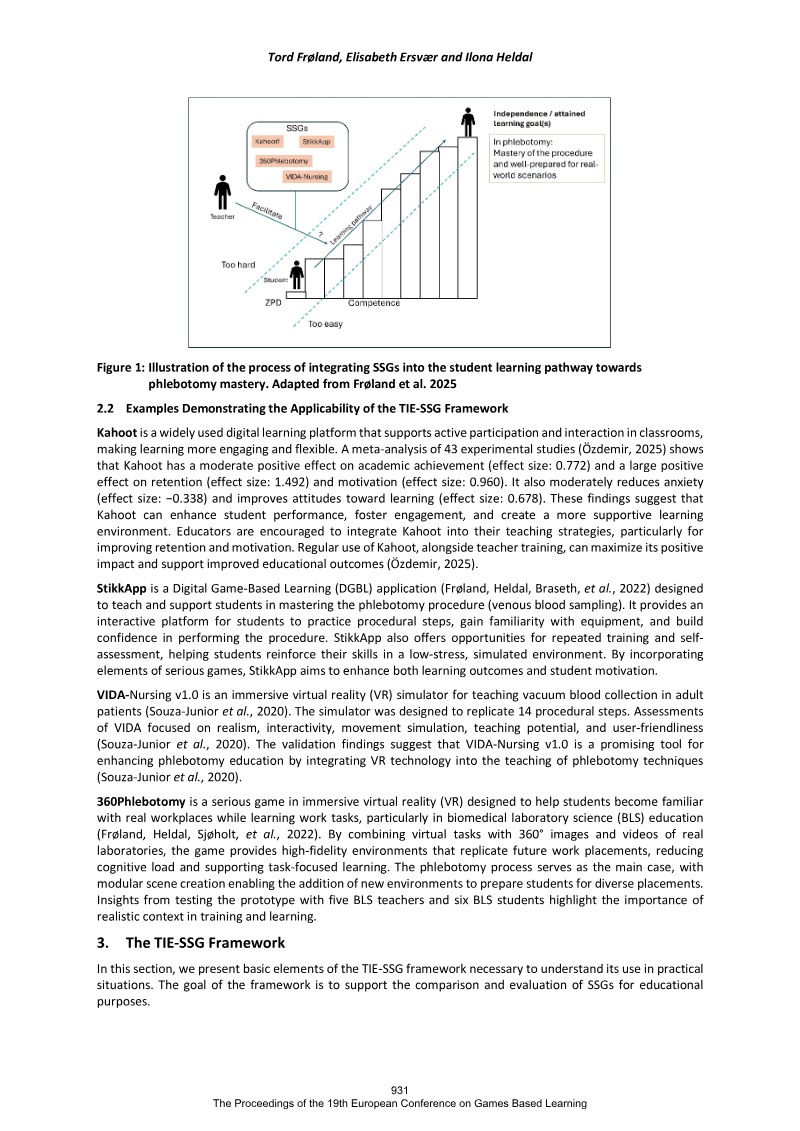
- 03In a phlebotomy case study of four serious games, low-fidelity Kahoot was judged suitable for foundational theoretical knowledge, moderate-fidelity StikkApp and VIDA were associated with procedural skill development, and high-fidelity 360Phlebotomy was positioned for contextual learning.
- 04Physical clinical placement is treated as the highest-fidelity stage, and the authors propose sequencing tools along a pathway from theory toward independent clinical practice.
- 05The framework maps dimension combinations to outcomes; for example, high Interactions paired with low Tasks and Environment is associated with motor skill building.
- 06The framework currently focuses on clinical and simulated skills and simplifies assessment, and it does not yet fully address adaptivity, feedback, game mechanics, ethics, or learner motivation.
- 07The paper reports no empirical effectiveness data, so its authors call for rigorous testing across diverse educational settings before the framework's effectiveness can be established.
Ask AI about this report
Summary
The TIE-SSG framework paper presents a structured, evidence-oriented tool for evaluating and sequencing Simulations and Serious Games (SSGs) in healthcare education. Its central thesis is that the instructional value of an SSG depends on its fidelity across three dimensions, namely Tasks, Interactions, and Environment, and that these fidelity ratings should be aligned with instructional scaffolding and specific learning goals. The framework operates through three phases (prerequisites, assessment, and integration), supported by fillable fidelity tables, a fidelity-level guide, and a TIE diagram for visualizing each tool's profile.
The framework is illustrated through a phlebotomy (venous blood sampling) case study, in which four serious games were assessed. Kahoot, with low fidelity, was judged suitable for foundational theoretical knowledge, while StikkApp and VIDA, at moderate fidelity, were associated with procedural skill development. 360Phlebotomy, at high fidelity, was positioned for contextual learning, and physical clinical placement represents the highest-fidelity stage. The authors argue that mapping these tools along the three dimensions allows educators to sequence them along an instructional pathway progressing from theory toward independent clinical practice. The framework also maps dimension combinations to specific outcomes; for example, high Interactions paired with low Tasks and Environment is associated with motor skill building.
The authors are candid about the framework's limitations. It currently concentrates on clinical skills and simulated aspects, simplifies assessment, and does not yet fully address adaptivity, feedback, game mechanics, ethics, or learner motivation. The paper reports no empirical effectiveness data, and its authors recommend rigorous testing across diverse educational settings before the framework's effectiveness can be established.