Serious Games reports and market data
Documents



Impact of a Cognitive Training on Reading of 6-Year-Old Children
The integration of gamified executive function training into early childhood education aims to determine whether cognitive stimulation can produce far transfer effects on foundational literacy skills.
- Gamified cognitive training using the CogniFit platform showed limited impact on early literacy, failing to produce meaningful gains in word decoding or pseudoword fluency for 40 novice readers.
- The eight-week intervention resulted in a statistically significant improvement only in the speed of letter recognition among the five-to-six-year-old participants.
- The study suggests that while the training successfully enhanced inhibitory control, it did not adequately engage the working memory and complex lexical processing required for advanced reading.


Dynamic Adaptive Surveillance Training in a Virtual Environment Using Real-Time Cognitive Load and Performance
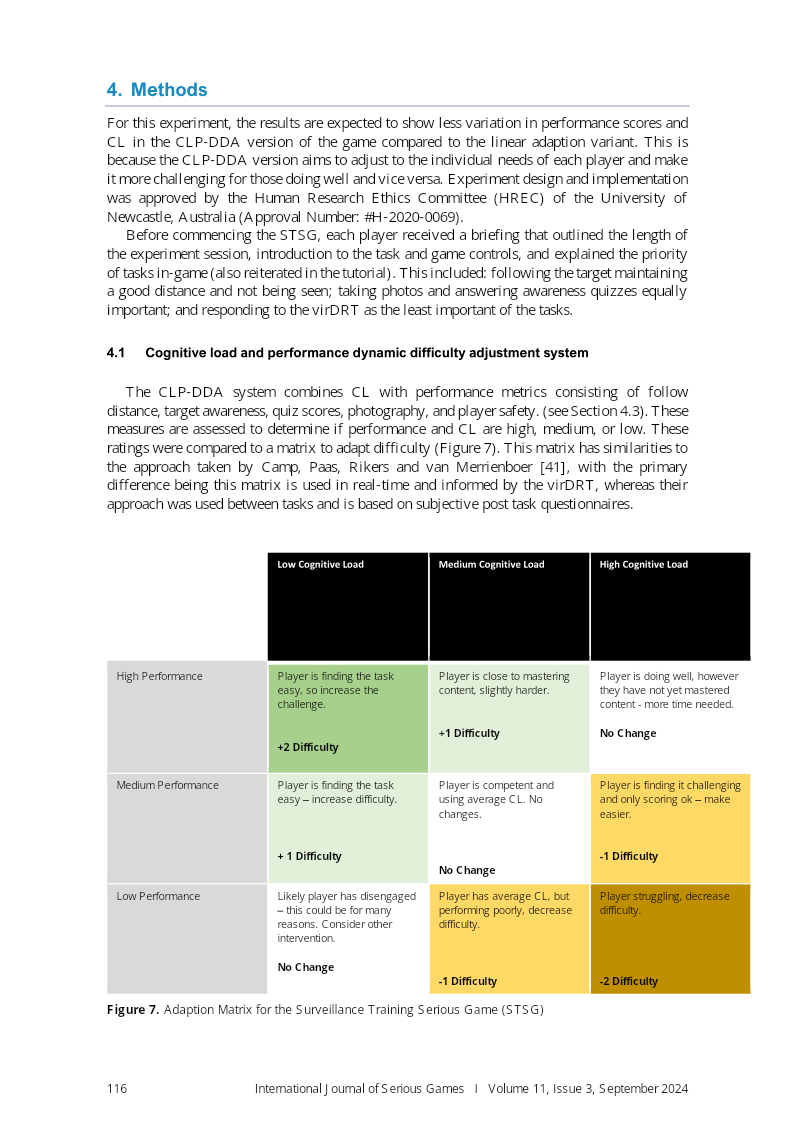
The implementation of a Cognitive Load and Performance-based Dynamic Difficulty Adjustment (CLP-DDA) system represents a significant advancement in the design of serious games for surveillance training.
- A Cognitive Load and Performance-based Dynamic Difficulty Adjustment (CLP-DDA) system significantly outperforms traditional linear difficulty models in surveillance training simulations.
- Empirical testing with 52 participants confirmed that adaptive systems reduce performance variance and cognitive load disparities compared to non-adaptive training environments.
- The CLP-DDA system optimizes training by dynamically modulating variables such as target speed and pedestrian density based on real-time physiological and performance metrics.


Effects of Meaningful Choices in Serious Games for Meaningful Learning
Meaningful choice design serves as a critical pedagogical framework for enhancing learning outcomes within serious games, particularly in high-stakes fields like mining hazard detection.
- Meaningful choice design acts as a core pedagogical framework that bridges the gap between theoretical engineering knowledge and real-world application in high-stakes fields like mining.
- Effective serious games must balance player autonomy with structured feedback loops to ensure the learning process remains both challenging and supportive.
- Integrating tangible consequences for player decisions fosters accountability, though these outcomes must be calibrated to avoid inducing counterproductive stress in learners.



The Emergence of Collaboration in Serious Games: An Exploratory Study
Serious games serve as a distinct environment for fostering collaboration, functioning as dynamic, non-linear spaces that require participants to navigate complex social interactions to achieve shared objectives.
- Successful collaboration in serious games is not an automatic result of gameplay, but a cognitive process requiring participants to manage and integrate individual differences.
- High-performing teams achieve success by reframing diverse mindsets as collective strengths and proactively adapting individual roles to meet group needs.
- Collaboration follows a three-stage progression: recognizing individual differences, taking adaptive individual action, and developing a shared collaborative strategy.


Development and Usability Testing of a Virtual Reality Game for Learning Computational Thinking
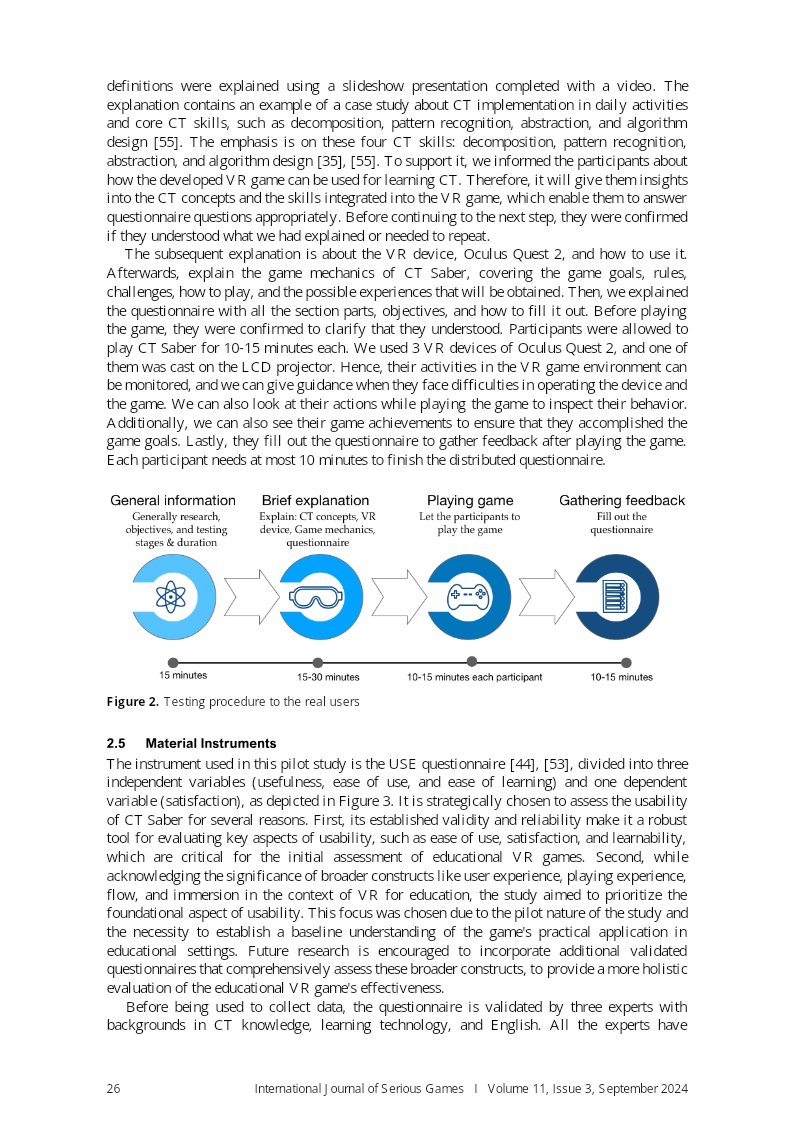
The development of CT Saber, a virtual reality application built for the Meta Quest 2 platform, serves as a proof-of-concept for integrating computational thinking education with immersive gaming mechanics.
- The CT Saber VR application achieved a high usability score of 80.70 out of 100 in a pilot study involving 36 computer science students.
- Perceived usefulness is the primary driver of user satisfaction, indicating that educational efficacy is more critical to engagement than entertainment value in VR learning tools.
- The project successfully validated the use of rhythm-based mechanics, similar to Beat Saber, to teach abstract computational logic and pathfinding concepts.


The Subject of Games: Cartesian Anxiety in Game Cultures, Game Studies, and Gameplay
Gerald Voorhees's argument in "The Subject of Games" is that game studies is divided by a "Cartesian anxiety" over whether the player is a self-coherent, rational agent in control of play or a relational, malleable subject shaped by the games and social structures around them.
- Voorhees argues game studies is split by a "Cartesian anxiety" between viewing the player as a self-coherent, rational agent in control of play versus a relational, malleable subject shaped by games and social structures.
- The author traces the rational Cartesian cogito to Western colonial and imperialist traditions and proposes Lacan's split subject as a more productive alternative.
- The core thesis is that the field should develop a theory of the subject that is self-coherent yet lacks a stable foundation, rather than resolving the tension toward sovereign player agency or dissolving the player into posthuman or structural accounts.



AI-deation: When the Teacher is a Transformer in Role-Playing to Create Privacy Decision Serious Games
Generative artificial intelligence, specifically GPT-4, serves as a viable and effective substitute for human stakeholders in the collaborative design of serious games focused on privacy decision-making.
- GPT-4 functions as a viable substitute for human stakeholders in the collaborative design of serious games, performing at a level comparable to human collaborators in ideation and conceptual balancing.
- The model effectively acts as a structured teacher by evaluating game concepts, identifying conflicting design affordances, and providing actionable feedback for privacy-focused decision games.
- AI-assisted design is highly effective at maintaining logical consistency and identifying design tensions within complex development workflows.



Can ChatGPT Match Experts? Comparing Input for Serious Game Development
Generative artificial intelligence, specifically ChatGPT versions 3.5 and 4.0, serves as a viable supplementary tool for serious game development, capable of producing design inputs that are qualitatively and statistically comparable to those provided by human experts.
- ChatGPT-3.5 and 4.0 are viable tools for serious game development, capable of producing design inputs comparable to human experts across learning content, mechanics, gamification, and accessibility.
- The research analyzed a dataset of 148 expert suggestions compared against 1,455 AI-generated ideas to validate the effectiveness of generative models in reducing development workloads.
- Human experts remain essential for addressing complex narrative structures and critical pedagogical concerns, such as identifying potential cheating vulnerabilities, which AI models currently fail to detect.

Bayesian Knowledge Tracing Implemented in a Telecommunications Serious Game
The integration of Bayesian Knowledge Tracing (BKT) into the 3D serious game Volatile Systems represents a significant advancement in educational technology, specifically designed to replace flawed streak-based assessment methods with a more nuanced approach to student mastery.
- Bayesian Knowledge Tracing (BKT) was successfully implemented in the 3D serious game 'Volatile Systems' to replace flawed streak-based assessment methods with continuous, real-time mastery estimation.
- The BKT model achieved a predictive accuracy of 73.6% and a root mean square error of 0.4325 when tested against a synthetic dataset of 75 students modeled via the Rasch method.
- The system utilizes fine-grained knowledge components and procedurally generated practice problems to dynamically adapt game difficulty and progression based on individual learner proficiency.


A System Design Approach of Gamification for Disseminating Intangible Oral Expressions of Indigenous Textile Heritage
The preservation of intangible cultural heritage, specifically the oral narratives embedded in the traditional textile practices of the Ao tribe in Nagaland, India, requires a transition from static documentation to interactive digital engagement.
- Gamification serves as a viable solution to bridge the generational divide in cultural knowledge transmission, specifically addressing the decline of oral narratives among the Ao tribe in Nagaland.
- Empirical testing with 157 participants confirms that Gen Z learners maintain a strong interest in cultural identity but require modern, interactive digital formats to engage with traditional heritage.
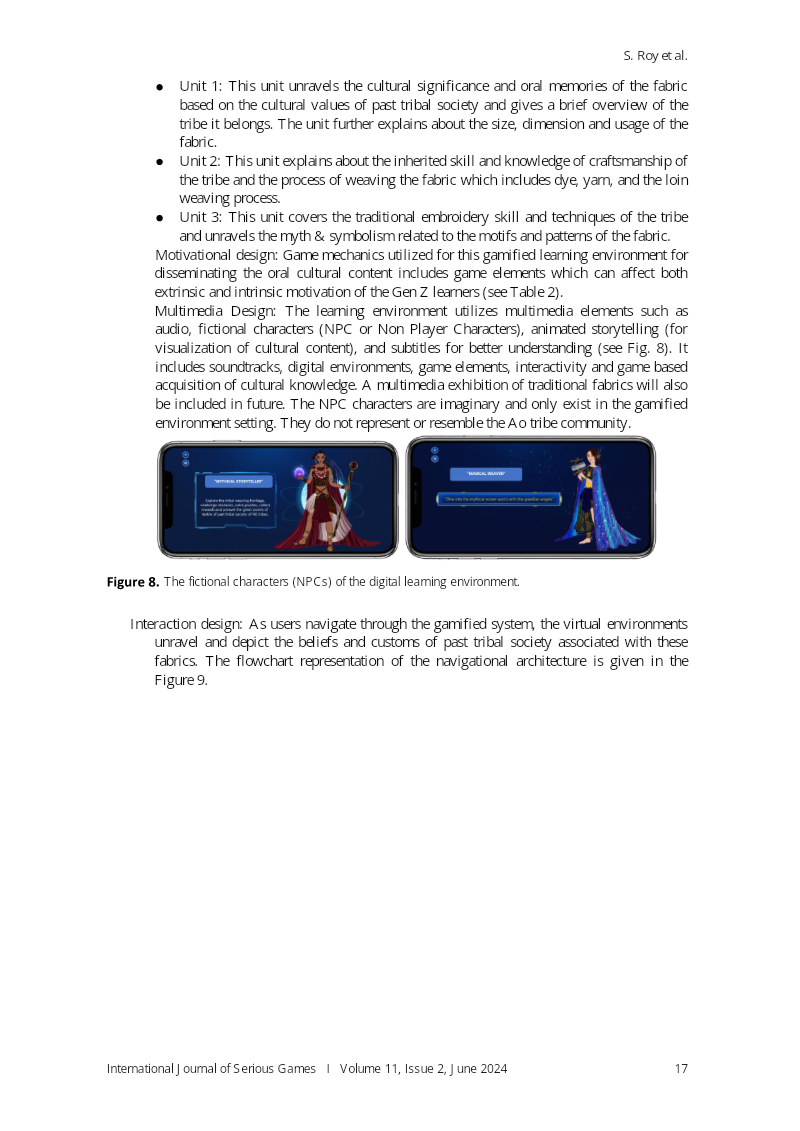
- The 'Woven Memoir' prototype, built using the Unity engine, demonstrates that integrating game mechanics like progression systems and narrative-driven quests results in high usability and user engagement.


Zermelo Game: All or None?
The Zermelo Game serves as an innovative educational instrument designed to bridge the gap between natural language and formal mathematical logic for students ranging from primary to high school levels.
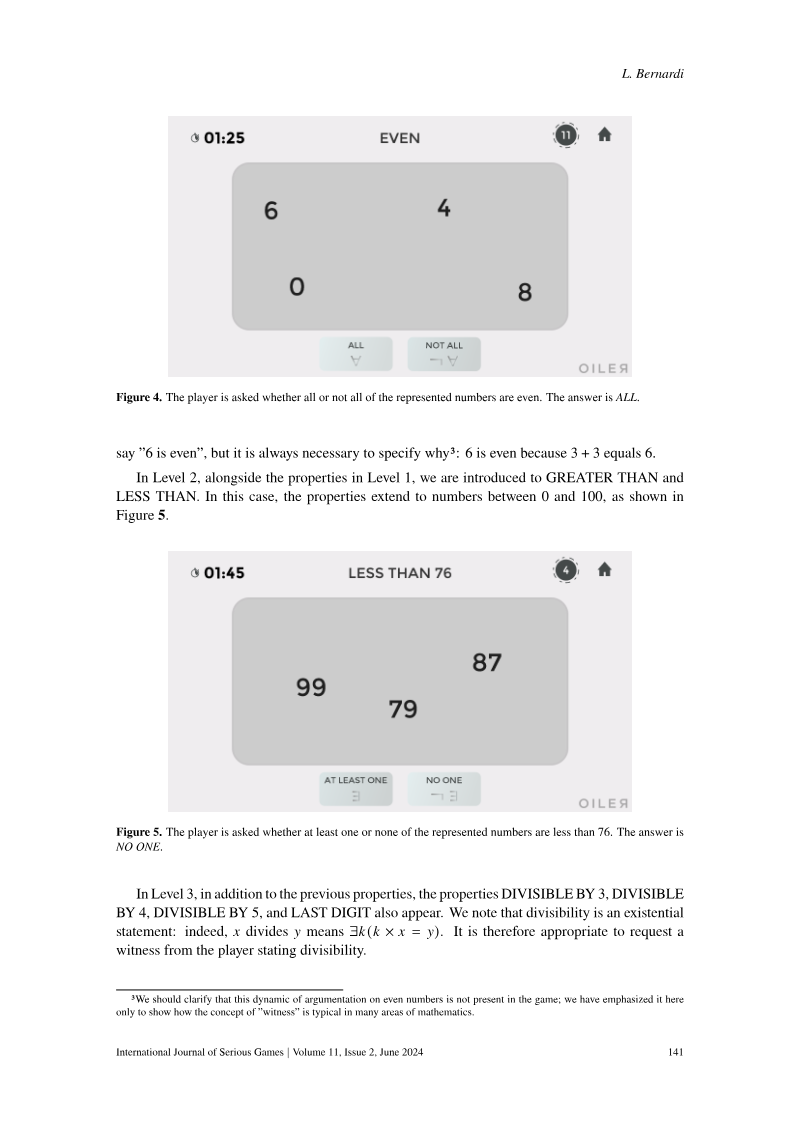
- The Zermelo Game uses Game Semantics to teach formal mathematical logic, including quantifiers and negation, to students from primary through high school levels.
- The software functions by requiring players to identify specific witnesses to verify or refute logical claims, transforming abstract symbolic logic into interactive dialogical challenges.
- The platform employs diverse environments such as colors, polygons, numbers, and bags to provide a structured framework for logical argumentation.


BehaviourCoach: Exploring the Use of a Web-Based Serious Game in Health Promotion
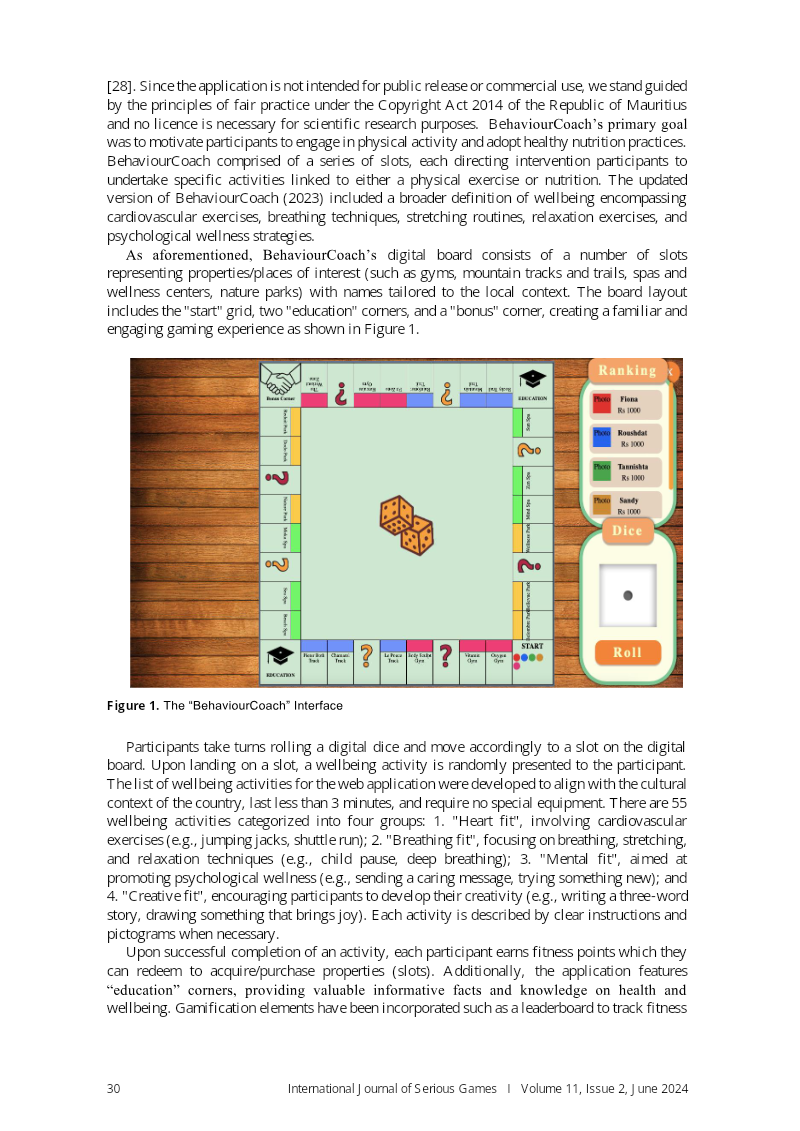
BehaviourCoach functions as a web-based serious game designed to enhance physical activity and holistic wellbeing through culturally tailored, gamified health tasks.
- User experience factors—specifically enjoyment, social interaction, and interface usability—are the primary determinants for the adoption of digital health interventions.
- A pilot study of 55 participants in Mauritius confirmed that positive perceptions of interface and social features significantly increase the intention to use gamified health tools.
- Baseline health status and subjective wellbeing are predictive indicators of a user's willingness to engage with digital health technology.