Player Behavior reports and market data
Documents

Game Design: 14 Ways to Make Players Feel Smart! - [Animated]
Game design strategies that prioritize player intelligence significantly enhance user experience and engagement.
- Design mechanics that allow players to discover solutions independently through invisible tutorials and environmental cues rather than explicit instruction.
- Leverage real-world logic and intuitive object interactions to reduce the learning curve and allow players to apply existing knowledge to the game environment.
- Guide player movement and progress using environmental design elements like lighting, landmarks, and shapes to maintain player agency while subtly directing behavior.

How does Marvel Strike Force monetise?
Marvel Strike Force utilizes a complex, multi-layered in-app economy typical of squad-based mobile RPGs, centered on the acquisition and development of iconic Marvel characters.
- Marvel Strike Force utilizes a dual-currency model consisting of gold as a soft currency and power cores as a hard currency to drive its squad-based RPG economy.
- The monetization strategy centers on loot boxes known as 'orbs,' which provide players with character shards and gear components necessary for progression.
- The game minimizes early-game friction by distributing resources generously, ensuring players rarely face progression bottlenecks during the leveling process.

How to Create Tension in Games.
Effective game design relies on the strategic management of tension to maintain player engagement and enhance the watchability of a title.
- Effective game design requires a dynamic cycle of alternating between high-tension moments and periods of relief to prevent player exhaustion or boredom.
- Tension is primarily generated through three mechanisms: expectation via mechanics like charge-up times, uncertainty through randomized elements, and surmountable difficulty.
- High-tension gameplay is a critical driver of commercial success and visibility, as it directly correlates with increased watchability for streamers and their audiences.

Mobile gaming: Been there, done that
The mobile gaming industry has experienced exponential growth since 2009, with app stores now hosting millions of titles.
- The top five apps on a user's device capture approximately 90 percent of their total screen time, creating a highly saturated environment where most installed applications struggle to gain meaningful engagement.
- Market dominance is increasingly held by established titles, as data shows the most successful games are often several years old rather than new releases.
- Retention is a more critical driver of success than initial acquisition, particularly because the cost of acquiring a new user significantly exceeds the cost of retaining an existing one.
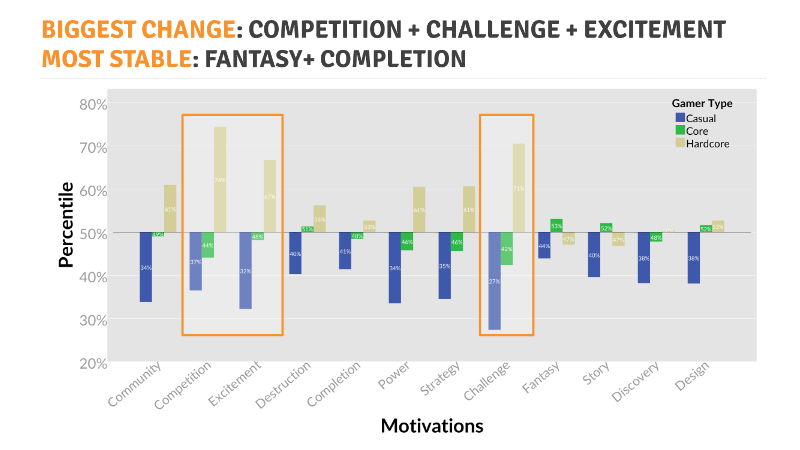
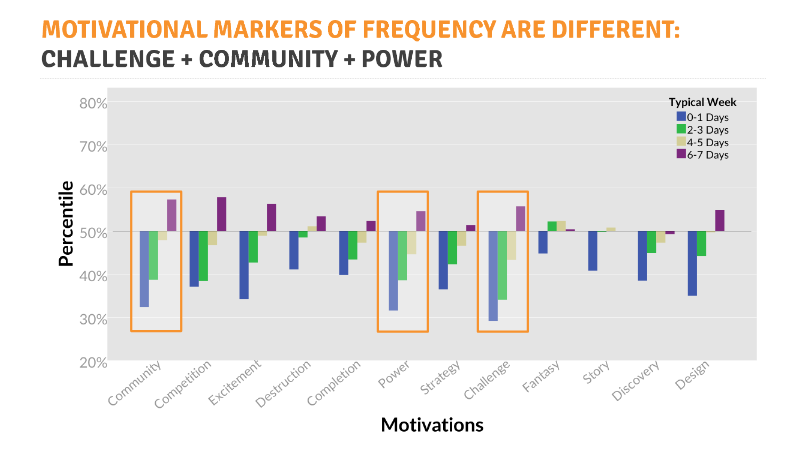

Profiling Casual, Core, and Hardcore: What We Learned from 350,000 Gamers
Gaming motivations are driven by a complex interplay of psychological factors rather than traditional industry labels.
- Traditional industry labels of casual, core, and hardcore are ineffective at predicting player behavior, as they function more as demographic markers than accurate reflections of play style.
- Gaming motivations are universal, with an 86 percent overlap in preferences between genders, debunking the idea that play styles are defined by demographic stereotypes.
- While men and women show distinct preferences—men favoring competition and destruction, and women favoring design and completion—women match men in their interest in challenge and competition.


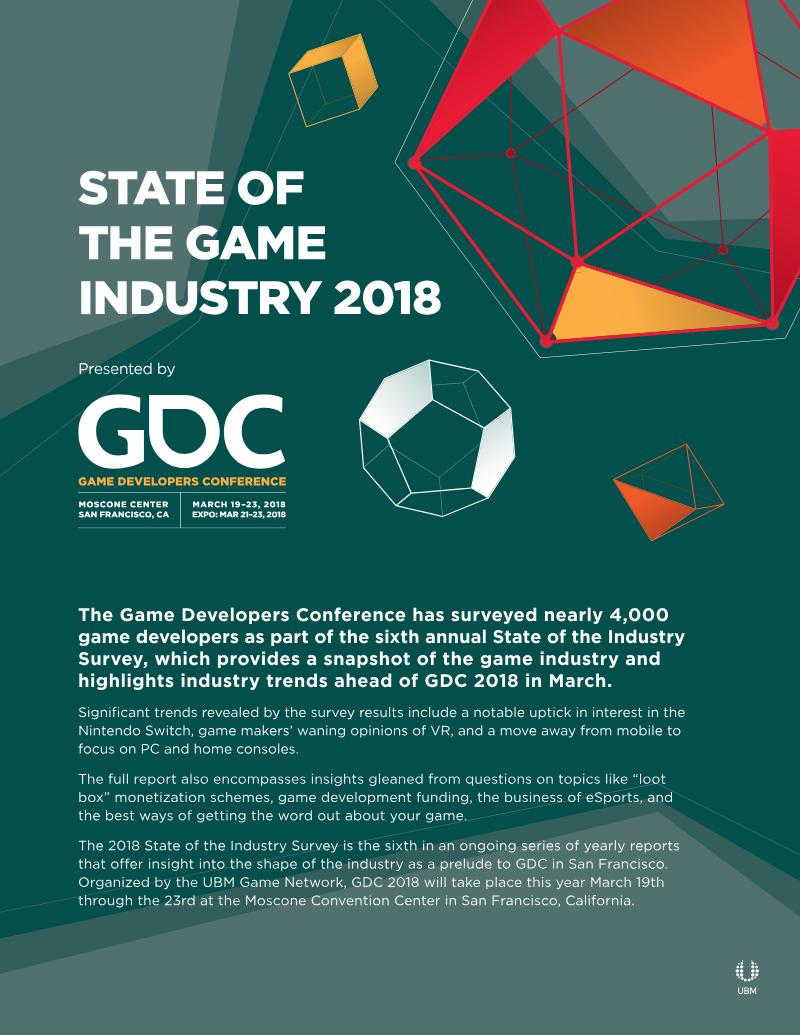
State of the Game Industry 2018
The 2018 State of the Game Industry report provides a comprehensive snapshot of the global game development landscape leading into GDC 2018.
- PC remains the dominant development platform at 60%, while interest in mobile development has declined to 36%.
- The Nintendo Switch has become a major industry force, with 36% of developers expressing interest in the platform, surpassing interest in the Xbox One.
- Confidence in the long-term sustainability of VR/AR has declined for the first time in three years, with 29% of developers expressing skepticism and 42% predicting mobile-based immersive reality will be the dominant technology within five years.

A/B Testing for Game Design Iteration: A Bayesian Approach
Bayesian A/B testing provides a superior framework for mobile game development, offering a dynamic and actionable alternative to traditional frequentist methods.
- Bayesian A/B testing allows for real-time optimization by providing a direct probability (0 to 1) that one variant is better than another, unlike frequentist methods which only provide a binary rejection of a null hypothesis.
- Frequentist testing is prone to the 'family-wise error' problem, where the risk of false positives increases significantly as more variants are added to a test (e.g., the false positive rate for two treatments is approximately 9.75%).
- Bayesian analysis incorporates 'priors'—existing business knowledge or historical data—to inform the test, allowing developers to start with a baseline (such as a known 30% retention rate) rather than assuming zero knowledge.

Developing accessible virtual reality games for new players
Developing accessible virtual reality experiences requires prioritizing intuitive design to accommodate users who may have no prior gaming experience.
- Prioritize intuitive design by replacing complex button inputs with natural physical movements to bridge the gap between real-world actions and virtual interactions.
- Implement a non-demanding acclimation period at the start of the experience to allow new users to adjust to the sensory novelty of virtual reality without becoming overwhelmed.
- Utilize real-world metaphors, such as using a deck of cards to represent data selection, to simplify complex user interfaces for players without gaming experience.

5 "Facts" I Believe In. (Do You?)
This analysis outlines five core philosophical beliefs regarding human behavior, the nature of play, and the structure of social systems.
- Systemic design flaws are the primary cause of exploitative behavior, meaning rule-makers—whether in game design, parenting, or social structures—are responsible for the outcomes their systems incentivize.
- Play is defined as an activity occurring within a 'safe zone' where outcomes lack real-world consequences while providing clear feedback and defined goals.
- Human selfishness is the fundamental driver of all behavior, as even altruistic actions are motivated by the pursuit of personal satisfaction or the avoidance of negative emotional states.

Be Authentic - The Only Way! (My Opinion)
The concept of authenticity is often misunderstood as a singular, static state of being, when in reality, human interaction is defined by the performance of various roles.
- Authenticity is defined by the absence of deception rather than the maintenance of a singular, static personality.
- Adapting behavior, energy, and communication styles across different social environments is a functional mechanism for navigating diverse contexts, not a sign of dishonesty.
- Deception occurs only when an individual intentionally misrepresents their core beliefs or values to manipulate the perceptions of others.

Precision of Emotion: A New Kind of "Fun" Approach in Educational Games
The Sophia model redefines the concept of fun in educational gaming by framing it as a sophisticated psychological transformation where fear is converted into happiness through the acquisition of insight and mastery.
- The Sophia model defines educational 'fun' as the psychological transformation of fear into happiness through the achievement of mastery and insight.
- Effective game design should prioritize the player's emotional arc over simple performance-based tasks to foster deeper engagement and more durable learning outcomes.
- Designers should utilize the 'pain of absence' framework, which treats gaps in a player’s mastery or social efficacy as opportunities to build interconnected emotional loops.

Which of these Two Negative Feelings Is Better?
Human behavior often reflects a preference for comfort and predictability, yet this inclination toward safety frequently results in stagnation.
- Embracing fear and high-stakes situations is a necessary catalyst for personal growth and long-term development.
- Choosing the safety of a boring or predictable environment leads to stagnation and a lack of meaningful progress.
- Boring experiences lack impact and fail to contribute to long-term memory or personal evolution.