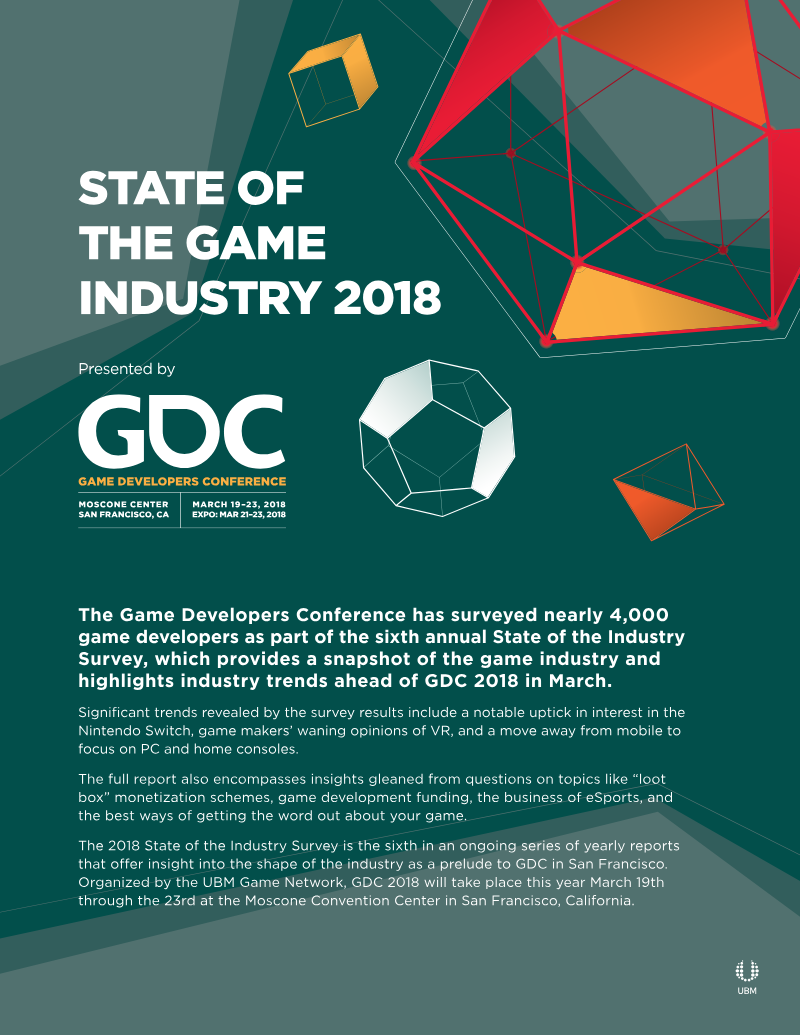
State of the Game Industry 2018
1 Mar 201819 pages~30 min full read
The 2018 State of the Game Industry report provides a comprehensive snapshot of the global game development landscape leading into GDC 2018. Based on a survey of nearly 4,000 game developers, the findings highlight a significant shift in platform preference, the maturation of the virtual reality market, and evolving monetization strategies. The survey sample primarily represents North America (63%) and Europe (22%), with a workforce largely composed of developers with three to ten years of experience.
A primary thesis of the findings is the resurgence of PC and console development at the expense of mobile platforms. While PC remains the dominant platform—with 60% of developers currently creating titles for it—interest in smartphones and tablets has slipped to 36%. The Nintendo Switch emerged as a major industry force; developer interest in the console (36%) surpassed both Xbox One and mobile. Furthermore, 28% of developers who launched on the Switch reported sales that exceeded their average on other platforms, and 73% expressed confidence that the Switch would outsell the Wii U.
The report indicates a cooling of enthusiasm for Virtual Reality (VR). For the first time in three years, faith in the long-term sustainability of the VR/AR business declined, with 29% of respondents expressing skepticism. While the HTC Vive remains the most popular headset for development, many creators believe VR will not reach the household penetration levels of traditional consoles until after 2030, if ever. Instead, 42% of developers anticipate that mobile-based immersive reality will be the dominant technology within five years.
Regarding business operations, the industry remains heavily reliant on self-funding, with 83% of developers using company or personal funds. Despite the public controversy surrounding "loot boxes," approximately 11% of developers plan to include paid item crates in their next projects. Marketing remains a largely internal effort, as less than a quarter of developers work with external publishers. Social media was identified as the most effective tool for game discovery, while eSports reached a record high in perceived long-term sustainability at 91%.
Game Developers Conference · 2026
Game Developers Conference · 2026
Game Developers Conference · 2026
Game Developers Conference · 2026
Game Developers Conference · 2026
Game Developers Conference · 2026

Game Developers Conference · 2026

Game Developers Conference · 2026

Game Developers Conference · 2025

Game Developers Conference · 2025

Game Developers Conference · 2025

Game Developers Conference · 2025
Niko Partners · 2026
Bryter · 2026
GameAnalytics · 2026
Poki · 2026

Sensor Tower · 2026
GamesBeat · 2026
Anzu · 2026
Newzoo · 2026

Decision Lab · 2026
Deloitte · 2026
Telekom Malaysia · 2026

InvestGame · 2026