Monetization reports and market data
Documents

Roblox Launches Rewarded Ads – Here's What it Means
Roblox has introduced rewarded video ads to its platform, marking a significant strategic shift toward hypercasual-style monetization.
- Roblox has launched a programmatic rewarded video ad system via Google Ad Manager, allowing players to watch 30-second ads in exchange for in-game rewards.
- The initiative aims to improve monetization for the platform, which has historically stagnated at approximately $20 in average bookings per monthly unique payer.
- Early testing shows high player engagement, with rewarded ad completion rates reaching between 80% and 90%.

TWIG #325 Ubisoft Bails Out, AppLovin Fights Back, Roblox Becomes an Ad Network
The global gaming industry is currently navigating a period of intense structural realignment, characterized by aggressive monetization shifts, strategic corporate restructuring, and evolving regulatory landscapes.
- Ubisoft has secured a $1.25 billion investment from Tencent, a defensive move designed to maintain founder control and bypass regulatory scrutiny through a subsidiary structure.
- Roblox is scaling its advertising business via programmatic partnerships with Google to monetize its Gen Alpha user base, though it continues to struggle with regional CPM disparities.
- Mobile developers are increasingly bypassing platform fees by pivoting to direct-to-consumer web stores and rewarded advertising to offset the impact of post-IDFA data limitations.
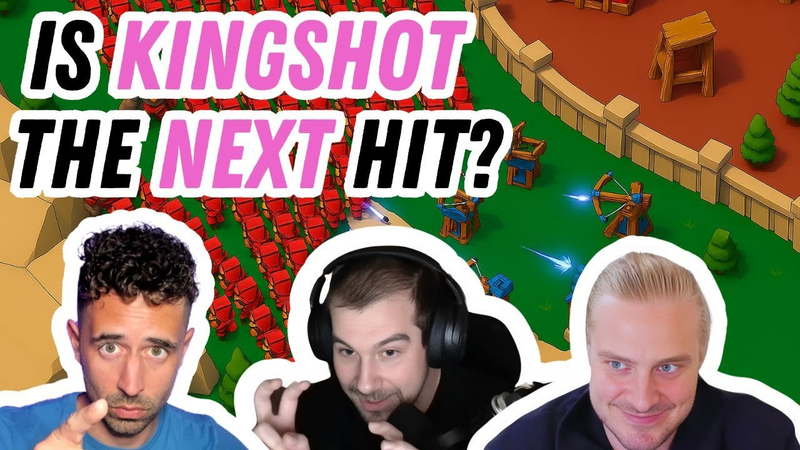
🎮 Kingshot's Insane Genre Mix Explained! How Century Games’ New 4X Hooks Players & Payers
Kingshot represents a strategic evolution in the mobile 4X landscape, functioning as a hybrid title that integrates idle survival mechanics, tower defense elements, and Archero-style combat into a traditional alliance-based meta-game.
- Century Games has adopted a standardized 'template' strategy for Kingshot, essentially re-skinning the successful survival-city-builder mechanics of Whiteout Survival and Frozen City by layering them onto a 4X strategy framework.
- The core gameplay loop of Kingshot combines idle survival mechanics, such as resource management and base building, with traditional 4X alliance warfare and hero-based gacha progression.
- Kingshot utilizes aggressive user acquisition tactics, including fake gameplay mini-games and AI-generated character assets, to mirror successful creative trends observed in other top-performing mobile titles.
Session: Skills & Cash – How Real Money Mobile Games Are Shaping A Billion-Dollar Industry.
The real money mobile gaming industry, specifically the skill-based gaming sector, represents a significant and rapidly expanding segment of the broader gaming market.
- The U.S. skill-based mobile gaming market is valued at $9 billion, representing 14% of the total gaming market with an annual growth rate of 12%.
- There are currently 20 million active skill-based gamers in the U.S., but market research indicates that 46% of all mobile gamers are interested in playing for money, signaling significant untapped potential.
- The industry is targeting a broader ecosystem of 200 million real-money gamers, which currently includes participants in daily fantasy sports, social casinos, and sweepstakes.
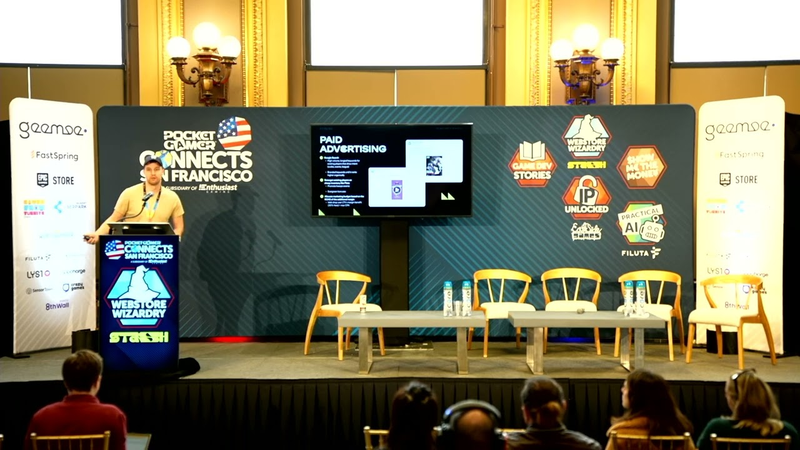
Session: How To Steer Players To Your Webshop (Without Breaking the Rules!) - Archie Stonehill.
The primary objective for mobile game developers is to successfully transition players from in-app environments to proprietary web shops, thereby bypassing traditional platform fees and increasing net revenue.
- Developers can leverage the 2021 Epic Games versus Apple and Google litigation outcomes to communicate alternative payment options and bypass traditional platform fees.
- Driving web shop adoption requires a multi-channel strategy that integrates non-commercial features like loyalty programs and daily rewards into the core game loop to incentivize migration.
- To maintain app store compliance, developers must avoid direct links to payment pages within the app and instead use pre-authenticated links to facilitate a seamless user experience.
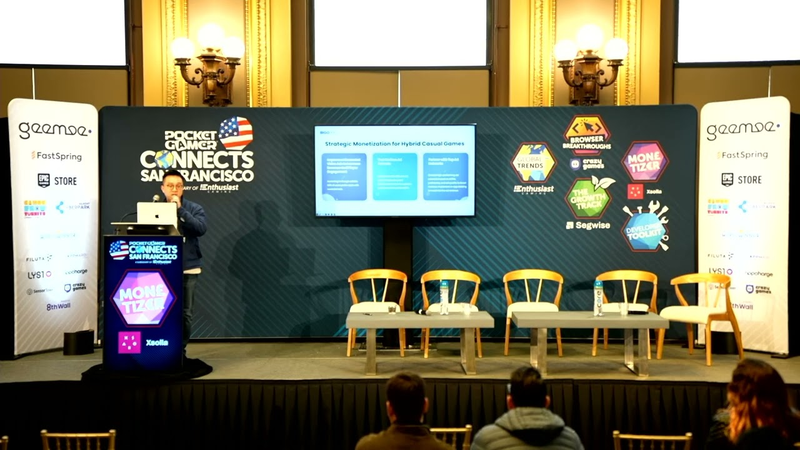
Session: Key Trends & Monetization Strategies In Mobile Gaming - Eden Liu, BIGO Ads.
The mobile gaming industry is currently undergoing a significant shift from hyper-casual titles toward casual games, driven by market saturation, rising user acquisition costs, and the impact of Apple’s privacy policies on traditional monetization models.
- The hyper-casual gaming sector is in decline, with global downloads dropping 12% quarter-over-quarter in 2024 and year-on-year declines of 18% in Western markets and 16% in Eastern tier-one markets.
- Developers are pivoting to casual subcategories like puzzles and match-three games, which achieve higher retention rates of 50% on day one and 15% on day seven.
- Casual games are shifting toward a hybrid monetization model that combines in-app purchases (IAP) with in-app advertising (IAA), specifically rewarded video ads preferred by 50% of users.
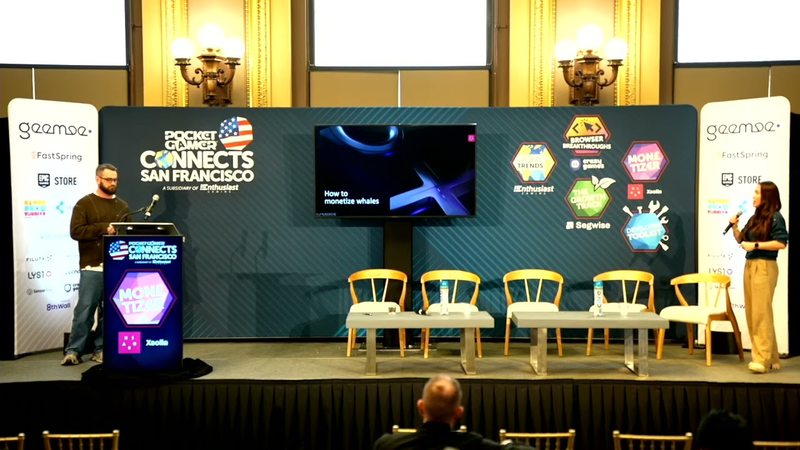
Session: Winning With Whales: How To Get, Retain & Monetize Them.
The primary objective of this analysis is to outline effective strategies for attracting, retaining, and monetizing high-value players, commonly referred to as whales, within the mobile gaming industry through the use of dedicated web shops.
- Whales represent a significant revenue driver for web shops, with an average spend of $847 per user and an average of 17 repeat purchases per month.
- Web shops should prioritize high-value, exclusive content that is difficult to obtain in-game, as whales consistently prefer added value over simple discounts.
- Direct communication channels—such as dedicated community managers and closed Discord channels—are essential for fostering the exclusivity and premium treatment that whales expect.
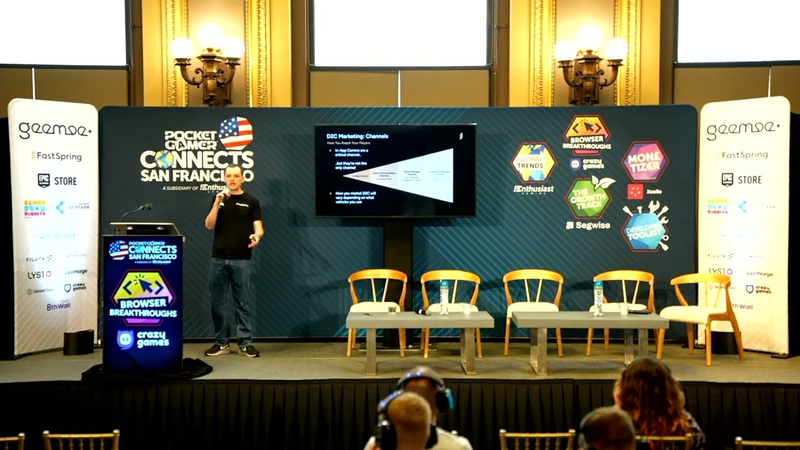
Session: Marketing Web Shops - Chip Thurston, Fast Spring.
Direct-to-consumer (DTC) web shops represent a significant, underutilized revenue opportunity for mobile game developers.
- Direct-to-consumer (DTC) web shops are a major growth channel, with Playtika reporting that 28% of its total revenue originated from these shops in its most recent quarterly report, an 8% year-over-year increase.
- Developers must avoid prohibited direct-to-shop links within mobile apps to remain compliant with platform anti-steering policies.
- To drive traffic legally, developers should route users to non-monetized web portals featuring community content, news, or leaderboards before guiding them to a shop.
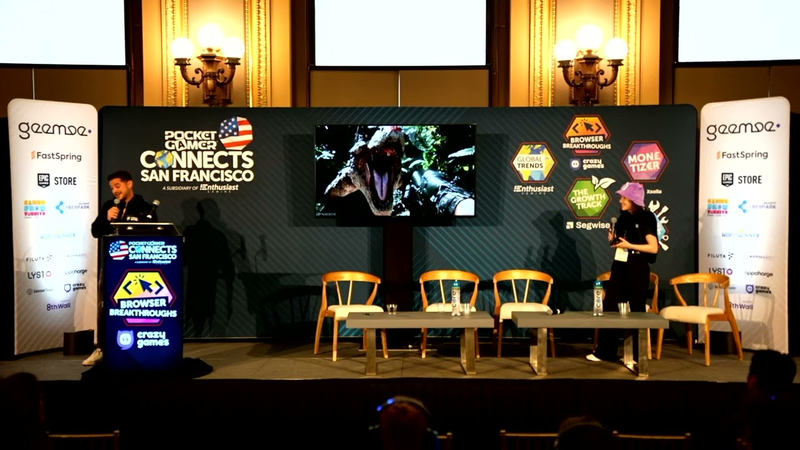
Session: The Web Gaming Renaissance - Rafael Morgan & Rabia Dincer, CrazyGames
The web gaming sector is currently experiencing a significant renaissance, driven by technological advancements, shifting developer needs, and a desire to bypass the rising costs and restrictive environments of traditional mobile app stores.
- Web gaming is experiencing a resurgence driven by high organic search visibility, zero user acquisition costs, and the ability for players to access games instantly via links without installation.
- CrazyGames has doubled its user base over the past two years and currently supports a developer community of over 3,000 creators.
- The integration of in-app purchases via Xsolla, alongside traditional ad models, has become one of the fastest-growing revenue streams for web game developers.
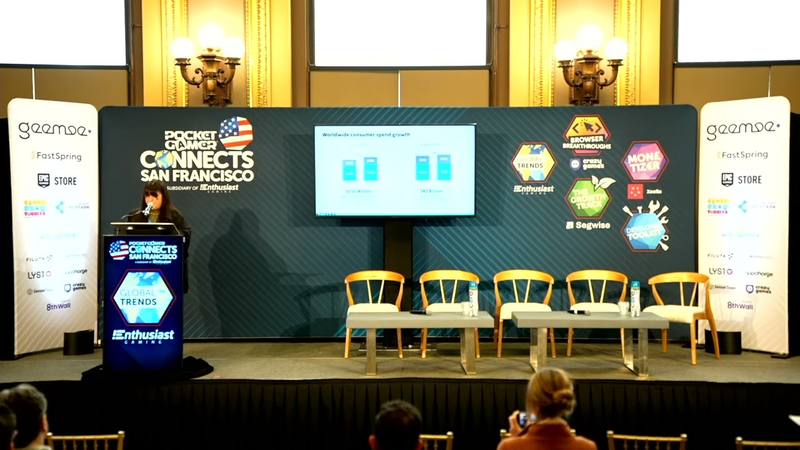
Session: State Of Gaming - Alyssa Paramo, Sensor Tower
The global mobile gaming market experienced a return to growth in 2024 following a period of contraction in 2022 and 2023.
- The mobile gaming market is increasingly top-heavy, with revenue growth driven by evergreen titles over five years old—such as Candy Crush, which saw its largest year ever—making it significantly harder for new entrants to gain market share.
- While total gaming downloads declined by approximately 6.6% year-over-year on iOS and Google Play, overall in-app purchase revenue grew, indicating that publishers are successfully focusing on better monetizing existing user bases through live ops.
- Hybrid-casual games emerged as a high-growth segment, recording a 37% increase in revenue, even though they still represent a small portion of the total market at 3% to 4% share.
AppLovin Max Mediation: Top Tips and Best Practices
AppLovin Max functions as a critical mediation platform designed to maximize effective cost per mille (eCPM) through extensive network reach and integrated user acquisition tools.
- For emerging studios, maximize performance by configuring three to four primary networks—specifically Google, Meta, and Unity—with only one ad unit per format to ensure clear tracking.
- Publishers must integrate network APIs directly into the AppLovin Max dashboard to enable real-time discrepancy tracking between reported revenue and actual payouts.
- Maintain an accurate app-ads.txt file, increasing update frequency from quarterly to bi-weekly as revenue scales to ensure full demand partner participation.

Screwdom 3D Is PRINTING MONEY! 💸 Vietnam’s Game Devs Just Raised the Bar
Screwdom 3D represents a significant evolution in the hybrid-casual gaming landscape, demonstrating how Vietnamese developers are successfully scaling sophisticated puzzle titles.
- Screwdom 3D is a hybrid-casual title generating approximately $3.6 million in monthly revenue, split roughly 40% from in-app purchases (IAP) and 60% from ad revenue.
- The game utilizes a physics-based core mechanic where players must manipulate and 'wiggle' 3D objects to clear levels, drawing design inspiration from titles like Screw Jam and Pinout Master.
- Despite being in a scaling phase with limited penetration in the US market, the game is achieving significant traction in Tier 2, 3, and 4 countries, with daily IAP revenue reaching approximately $200,000.