Monetization reports and market data
Documents
AppLovin at $250B: What Operators Know That Investors Don't | Pixels & Profits
AppLovin has emerged as a dominant force in the mobile advertising landscape, characterized by a transition into a high-growth, software-as-a-service model that has driven a 127% year-to-date stock increase and EBITDA margins of 82%.
- AppLovin has achieved significant market dominance, with EBITDA margins reaching 82% and the stock rising 127% year-to-date to reach a $250 billion market cap.
- AppLovin has successfully expanded into e-commerce, recently surpassing Google Ads on Android in e-commerce ad performance during Black Friday.
- The company’s Axon 2 engine provides a significant competitive moat, as no other competitor currently possesses the infrastructure to scale at a comparable level.

🚀 Our 2026 Mobile Gaming Predictions. No fluff!
The mobile gaming industry is entering a period defined by aggressive efficiency and the strategic replication of successful market trends.
- By 2026, top ad-supported mobile titles are projected to generate $3 million in daily revenue through aggressive monetization strategies.
- Developers are increasingly utilizing web-to-app flows and browser-based playables to qualify users and optimize cost-per-install metrics before driving traffic to app stores.
- Market growth is being driven by the systematic use of genre-skinning and the repurposing of competitor assets to minimize production costs while maximizing user acquisition.

🚨📢 BREAKING NEWS: OpenAI Becomes a Platform, AI Eats Consoles, Netflix Goes All-In
The gaming industry is currently undergoing a significant structural shift driven by the rapid expansion of artificial intelligence, which is simultaneously creating new platform opportunities and disrupting hardware supply chains.
- Global RAM prices have surged by 200% due to AI-driven demand, forcing manufacturers to prioritize AI inventory over consumer hardware.
- Valve discontinued its entry-level Steam Deck model as a direct response to rising memory component costs and tightening hardware margins.
- OpenAI is positioning ChatGPT as a new distribution platform by launching an app directory that allows developers to integrate games directly into AI conversations.

Games industry trends 2025 review | Week in Mobile Games podcast
The global games market is projected to reach $197 billion in 2025, with mobile gaming serving as the primary engine of growth at $108 billion, representing a 7.7% year-over-year increase.
- The mobile games market is increasingly dominated by Chinese publishers, who accounted for four of the top 10 grossing publishers in 2025, including Tencent, Century Games, and FunPlus.
- Top-performing mobile games in 2025 included Roblox, White Out Survival, and Royal Match, with all top 10 most downloaded titles exceeding 100 million downloads.
- The industry is shifting toward a more distributed revenue model, as evidenced by the fact that two of the top 10 grossing games were from outside Asia, compared to none in the previous year.

🚨📢 BREAKING NEWS: Unity Fee Drama, Netflix vs WB, Casino Games Everywhere 🤯
The mobile gaming and entertainment landscape is currently defined by significant shifts in corporate monetization strategies and evolving genre dominance.
- Unity has implemented an Enterprise Minimum Commitment Program that mandates annual fees between $250,000 and $2 million for large-scale developers based on gross revenue, sparking significant industry backlash regarding developer trust.
- Warner Bros. Discovery has shifted its corporate strategy by rejecting a $108 billion takeover bid from Paramount in favor of a $72 billion deal with Netflix, highlighting the growing market dominance of streaming platforms over traditional media.
- In the U.S. mobile market, Monopoly Go and Royal Match currently lead in absolute in-app purchase (IAP) revenue, while 4X strategy titles like Last War and Whiteout Survival dominate global performance.

Interview with Nex CEO David Lee: “We want a Nex Playground in every living room”
Nex, a technology company founded by former Apple developer David Lee, has successfully entered the home console market with the Nex Playground, a camera-based, motion-controlled gaming system.
- Nex has scaled the Nex Playground from an initial 5,000 units in 2023 to over 600,000 units sold by late 2025.
- The platform utilizes computer vision for controller-free, motion-controlled gaming, positioning itself as a modern successor to the Nintendo Wii.
- Nex employs a subscription-based revenue model to ensure recurring income and continuous content updates, moving away from the traditional cycle of individual game sales.
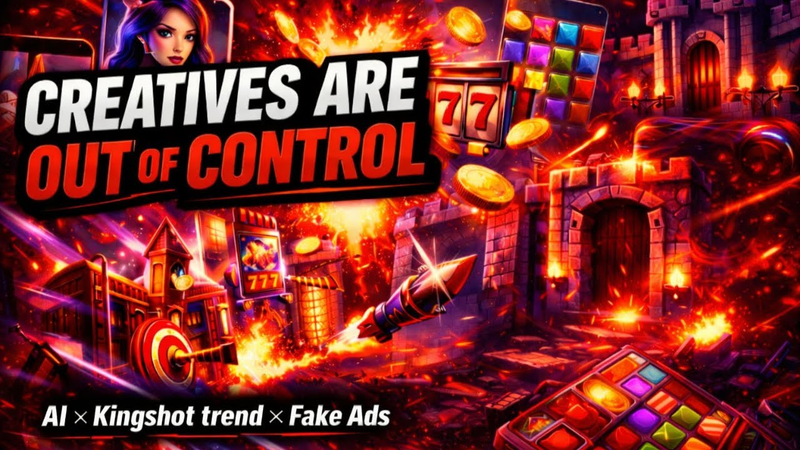
Creative trends November 2025: Players don’t care. Platforms don’t care. Only performance matters.
The mobile gaming industry has transitioned into a performance-first ecosystem where traditional priorities such as gameplay authenticity, creative originality, and ethical branding have been largely abandoned.
- The mobile gaming industry has shifted to a performance-first model where high-frequency ad output and data-driven trend exploitation take precedence over gameplay authenticity or thematic consistency.
- Developers are increasingly utilizing misleading or 'fake' creatives, such as puzzle-based playables that do not represent the actual in-game experience, to drive user acquisition.
- Titles such as King Shot and Whiteout Survival demonstrate the success of cultural mimicry and viral hooks, prioritizing market share capture over alignment between promotional content and the product.
Why is mobile mediation broken? Jim Payne: Here is whats next!
Mobile ad mediation currently functions as an outdated, inefficient legacy system that prioritizes the interests of ad networks over those of publishers.
- Traditional mobile ad mediation functions as a legacy system that prioritizes ad network interests over publisher revenue through opaque, network-owned ecosystems.
- Current mediation platforms often operate as 'black boxes' that utilize biased auction logic and hidden arbitrage, preventing publishers from maximizing lifetime value.
- The industry is shifting toward a supply-side infrastructure that replaces manual, biased processes with transparent, code-based automation.

Hard Truths About Co-Founders, Capital, and Competition with Appcharge's Founders Roei and Maor
Founding a successful startup requires a synthesis of deep personal partnership, strategic transparency, and a relentless focus on core competencies.
- Founders should prioritize achieving specific performance milestones to prove market viability before seeking external capital, as premature fundraising often hinders strategic focus.
- A pre-existing friendship between co-founders is a critical foundation for managing the high-pressure environment of scaling and converting inevitable conflict into productive growth.
- Startups gain a competitive edge by positioning specialized external tools as more efficient alternatives to internal infrastructure, allowing game developers to focus on core product development rather than maintenance.

Mini Game Gold Rush: How WeChat Turned Snackable Games into a $7B Market
The WeChat mini game ecosystem has evolved into a formidable $7 billion market, fundamentally reshaping mobile gaming through a frictionless, no-download architecture.
- The WeChat mini game market has reached a $7 billion valuation with 500 million monthly active players and 400,000 active developers, with top-performing titles generating over $1 million in daily revenue.
- Mini games function as an 'app store within a super app,' eliminating download friction and enabling instant play, which significantly lowers user acquisition costs compared to traditional app store models.
- Successful mini games prioritize deep meta-game systems and monetization design from the start, layering these over simple, accessible gameplay to ensure long-term lifetime value (LTV) and player retention.

JigSolitaire Review: The Jigsaw “Solitaire” ad-monetization monster
JigSolitaire, a mobile puzzle game developed by the Tokyo-based studio Gaming Cat, serves as a prominent example of a successful bait-and-switch user acquisition strategy in the 2025 mobile gaming market.
- JigSolitaire generates $100,000 to $150,000 in daily revenue exclusively through high-frequency banner and interstitial ads, despite having no in-app purchase monetization.
- The game has achieved 11 million downloads and 2.3 million daily active users by utilizing a bait-and-switch strategy that markets a jigsaw puzzle game under the high-traffic 'solitaire' genre.
- Approximately 95% of the game's traffic is sourced through AppLovin, demonstrating a heavy reliance on a single paid user acquisition channel.
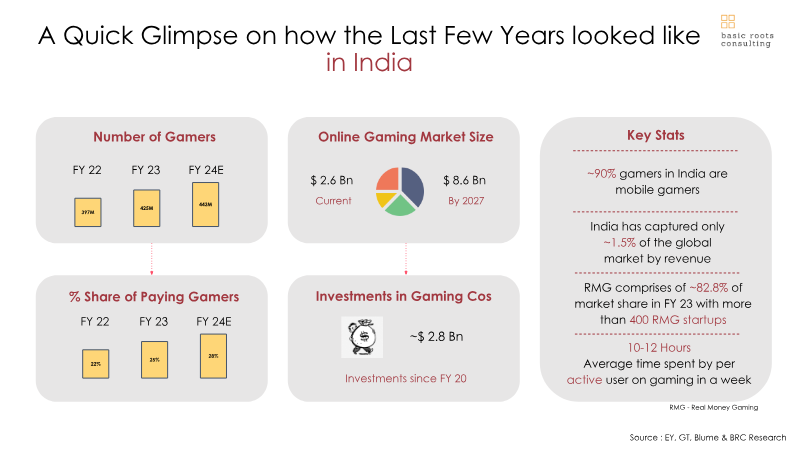
The Power of Play: Exploring the Growing Gaming Market
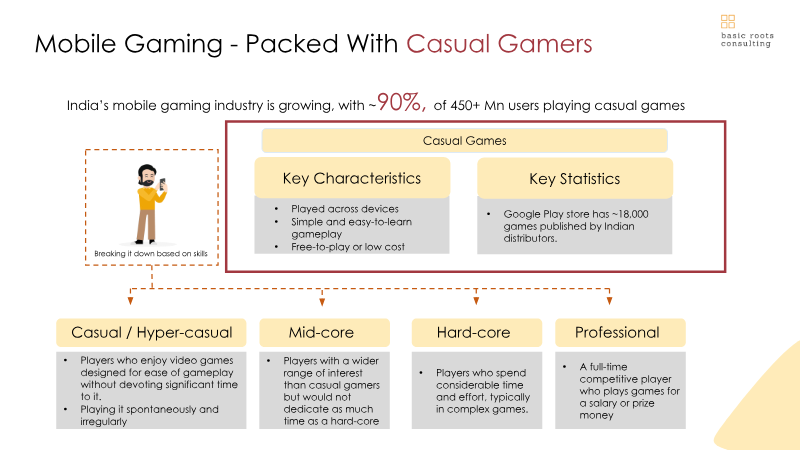
The Indian gaming market is projected to reach ₹8.6 billion by 2027, expanding at a 28% CAGR from FY20-23, while the global market is expected to hit $340 billion.
- The Indian gaming market is projected to reach ₹8.6 billion by 2027, growing at a 28% CAGR, while the global market is expected to hit $340 billion.
- A shift to a 28% GST on total deposits has pressured real-money gaming (RMG) firms, leading to layoffs, revenue slowdowns, and a strategic push toward geographic and genre diversification.
- RMG currently dominates the Indian market, accounting for approximately 82% of total gaming revenue, though monetization remains low relative to total download volumes.