Updated Jun 1, 2026 by Basic Roots Consulting
Report · December 14, 2025
Published by Basic Roots Consulting
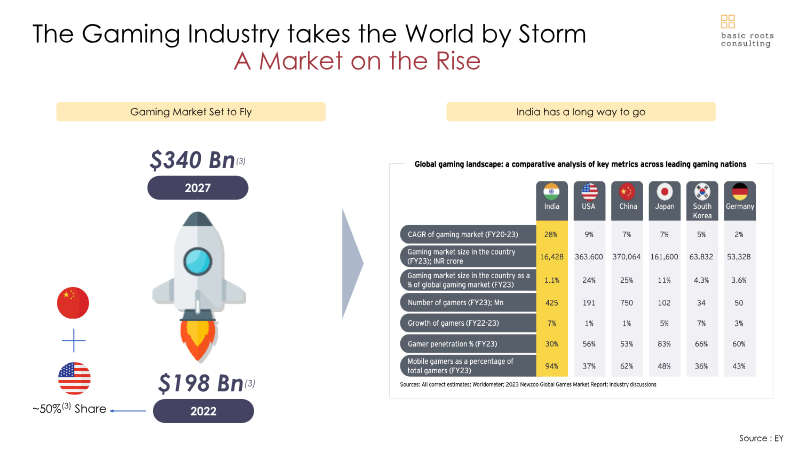
The Power of Play: Exploring the Growing Gaming Market Executive Summary basic roots The Indian and Global Gaming Market: A Rapidly Evolving Landscape The Indian gaming market is set to grow substantially, projected to reach $8.6 billion by 2027, while the global market is From FY 2020 to FY 2023, the Indian gaming industry has experienced a remarkable 28% CAGR.
basic roots consulting BRC BYTES The Power of Play: Exploring the Growing Gaming Market Aug 2024
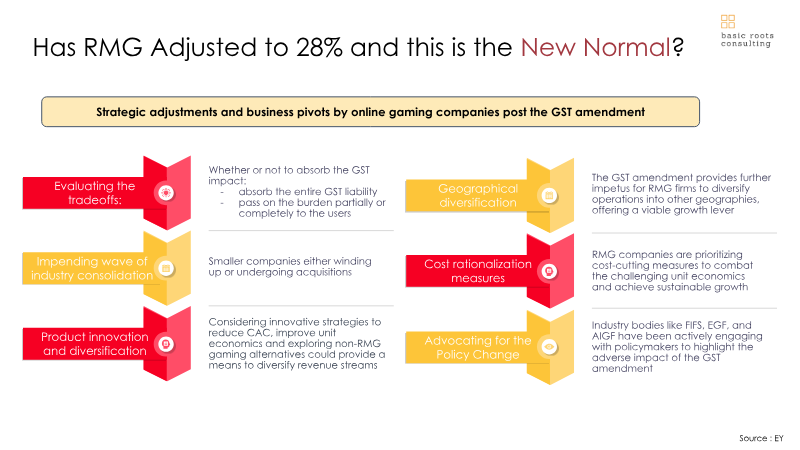
Executive Summary basic roots consulting The Indian and Global Gaming Market: A Rapidly Evolving Landscape The Indian gaming market is set to grow substantially, projected to reach 8.6 billion by 2027, while the global market is expected to hit 340 billion. From FY 2020 to FY 2023, the Indian gaming industry has experienced a remarkable 28% CAGR. Regulatory Challenges and Industry Responses However, the introduction of a 28% GST on total deposits for real-money gaming (RMG) companies, up from the MW previous 18% GST on gross gaming revenue, has created significant challenges, including: ● Geographical diversification by RMG companies seeking more favorable tax regimes ● Shutdowns and stalled revenue growth for some firms ● A funding winter and layoffs across the industry Evolving Business Models and Regulatory Advocacy In response, RMG companies are making structural changes to their business models to ensure viability. They are also actively advocating for regulatory authorities to devise taxation standards similar to those in other countries, which typically tax based on gross gaming revenue rather than total deposits.
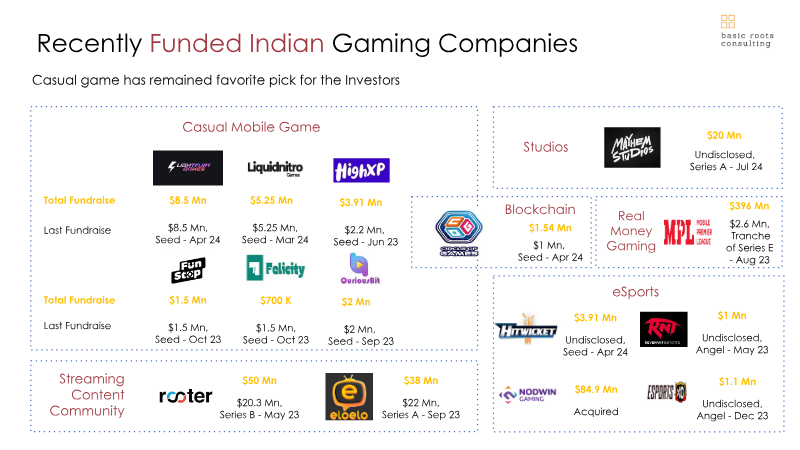
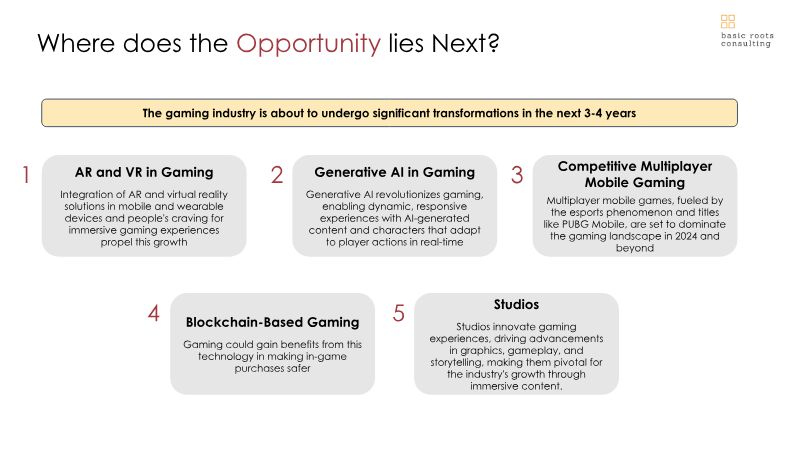
Executive Summary basic roots consulting Bright Spots in the Gaming Ecosystem Bright Spots in the Gaming Ecosystem Despite the challenges, certain segments of the gaming industry have shown promising growth in engagement, user 7 Despite the challenges, certain segments of the gaming industry have shown promising growth in engagement, user base, and investor interest: ● Esports ● Indie game studios ("estudios") ● Mobile-based casual games Emerging Opportunities in Gaming The segments that have the potential for significant growth in the coming years: ● Blockchain in gaming ● AR/VR gaming ● Generative AI in gaming Understanding the Gaming Landscape Understandina the Gamina Landscape To provide a broader context, the deck covers the gaming sector's parlance, value chain, and three key metrics relevant to every gaming company: ● Engagement ● Genre
basic roots Which Segment of the Entertainment Industry is the consulting Largest? Music Industry ~$25 Bn(1) Hollywood ~$40 Bn(2) Gaming Industry (GI) ~$200 Bn(3) Gaming industry is 8x of Music Industry, OG* of Entertainment Industry 5x of Hollywood
basic roots A Journey through Decades consulting 1 Rise of Arcade: Pong 1 1972 becomes first commercially successful Release of first arcade Home console: Atari 1975 2 releases first home version of Pong 1 Sales through the roof: 3 1977 Atari sell million units of home console(4) Raining Money: Arcade making more money than 1982 4 pop music and box office 1 The video game crash: 5 1983-85 Eager to capitalise on a Beginning of new tech growing market, companies race: Nintendo flood market with poor entertainment system 1985 6 quality devices and games releases Mario, revives console M 7 Gameboy: 7 1989 Release of first handheld
basic roots consulting PC emergence: PC games started Early ‘90s 8 gaining popularity The battle for market 10 90s dominance: Market split 9 between PC, Console, The new beginning: Nokia Handheld and Arcade release cell phone with 1997 10 "Snake” The Mobile gaming SMSSEEEESSE revolution: Mobile and - 11 2001-2020 internet is set to change the way games are played forever At Present Mobile games PCs dominates the Industry: capturing >50% of Console Mobile Market arket
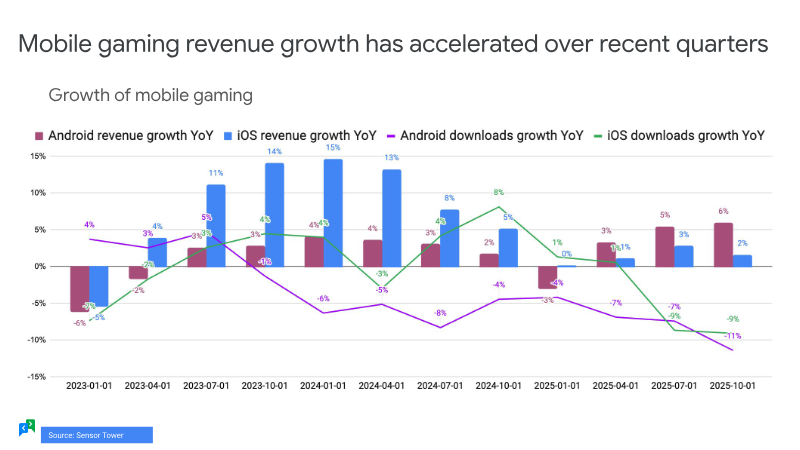
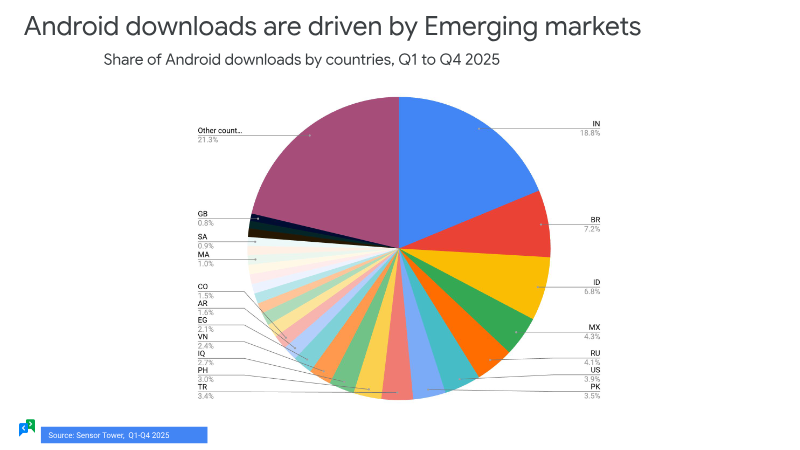
2023 - 2025 (Key Insights and Data) QUONADIS ● Users in Gaming on different platforms CANDISS ● The Attention Economy: Gaming vs. Other Leisure Spending oy ss GANG Ae IED ● Mobile Gaming Marketability ● Downloads and Revenue Concentration in Mobile Gaming ● Mobile Gaming vs Non-Gaming ● Mobile Gaming Growth (Android vs.
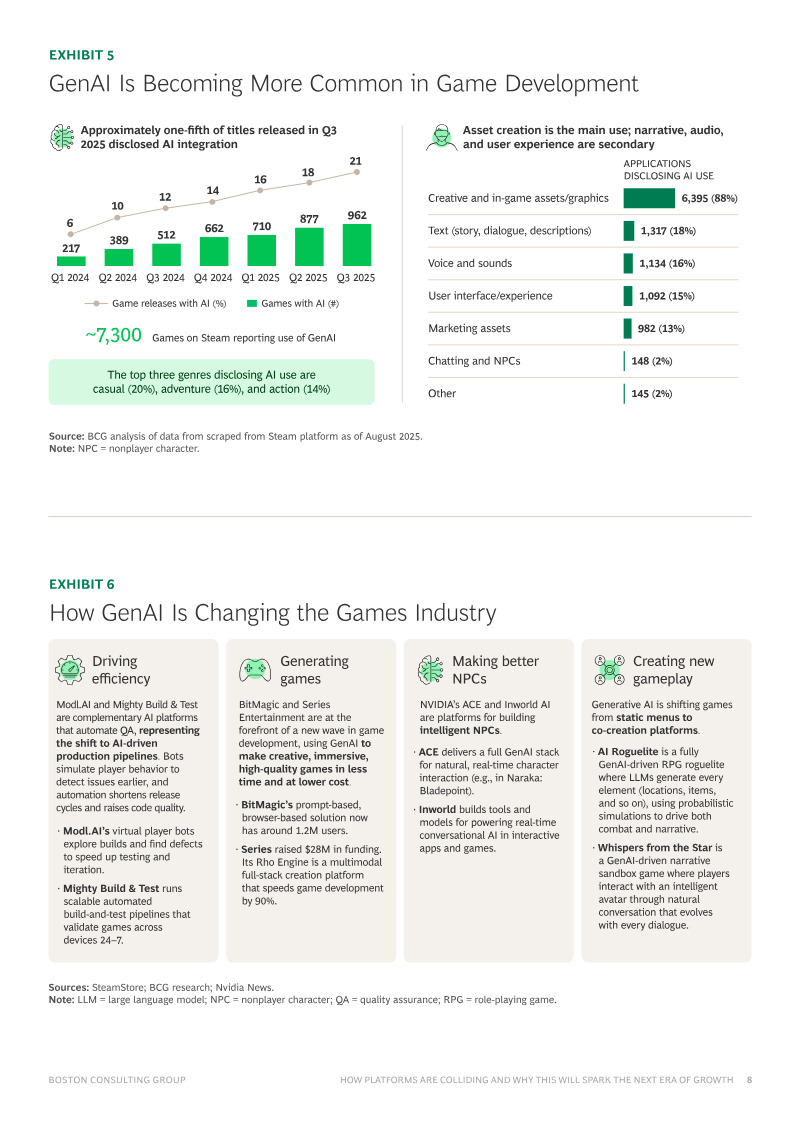
The global video game industry is currently transitioning from a post-pandemic period of stagnation toward a new era of growth defined by the convergence of hardware-agnostic ecosystems and decentralized distribution. The primary thesis posits that the industry is evolving into a collection of independent, platform-agnostic environments where traditional barriers—such as closed app store models—are being dismantled in favor of direct-to-consumer web stores and alternative distribution channels. This shift is designed to improve developer margins and provide greater control over monetization strategies, including tiered pricing and subscription models, to better serve a price-sensitive global player base. Technological and creative innovation serves as the catalyst for this transformation, with Generative AI accelerating development cycles and the expansion of user-generated content (UGC) fostering deeper intergenerational engagement. Cloud gaming is projected to become a cornerstone of this evolution, with revenues expected to reach $18.3 billion by 2030. These advancements, while promising, necessitate a strategic pivot toward robust content curation and the resolution of complex intellectual property challenges. As games increasingly function as community-driven platforms, stakeholders must prioritize engagement over legacy hardware dependencies to remain competitive. A significant opportunity for expansion lies in the correction of a persistent monetization imbalance. Although gaming commands 12.5% of total media consumption time, it currently captures only 3% of global advertising spend. By integrating sophisticated advertising models alongside AI-driven development and UGC, the industry is positioned to capture this latent value. Ultimately, the future of the sector depends on the successful navigation of market saturation through strategic windowing and the adoption of flexible, multiplatform ecosystems that prioritize community-led discovery and long-term player retention.
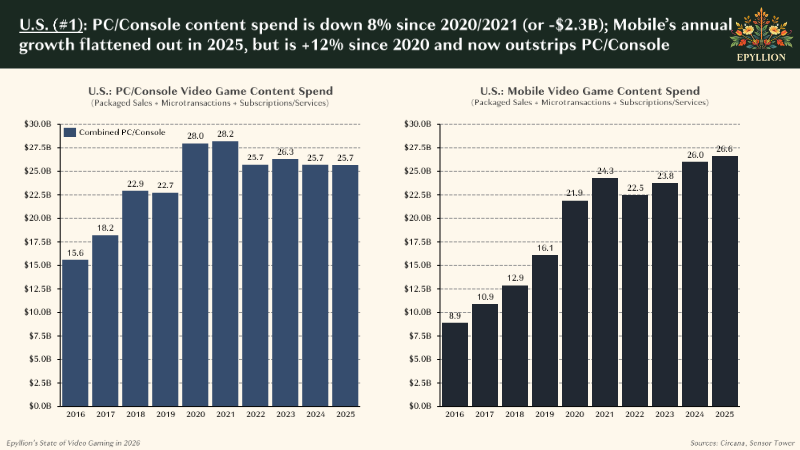
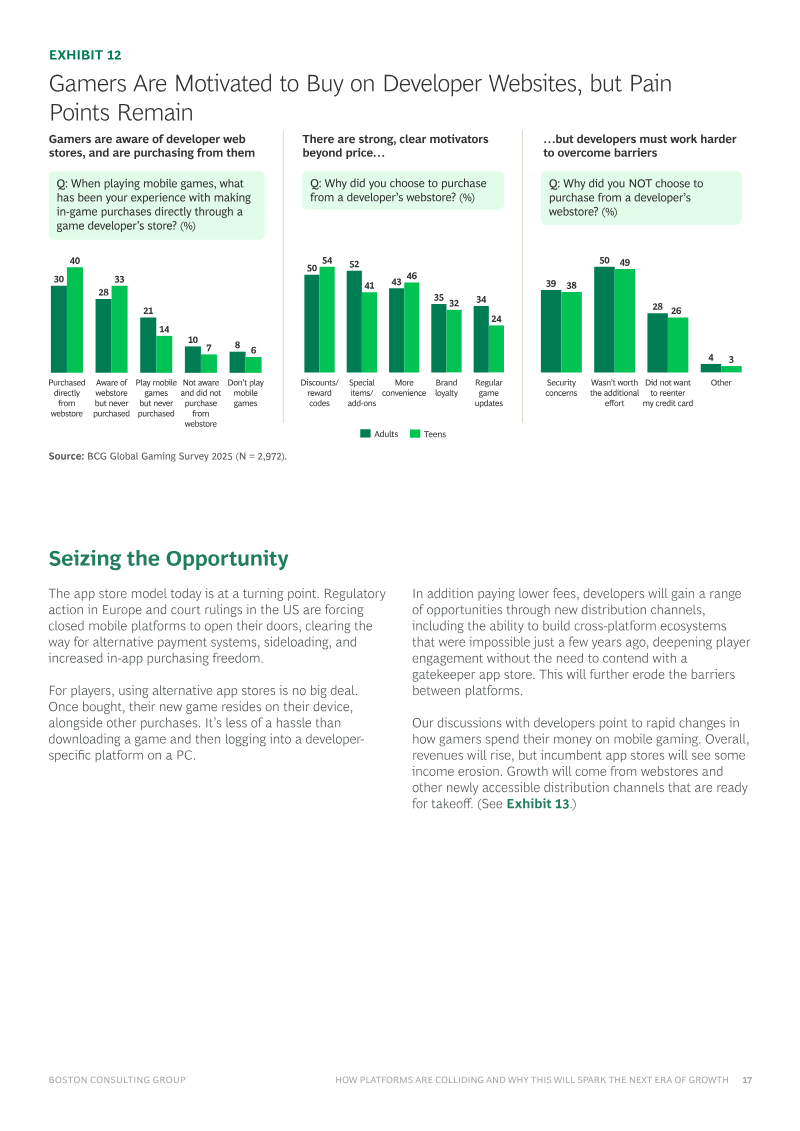
Mobile gaming has become the dominant engine of the global video‑game market, now accounting for more than half of total industry revenue and projected to exceed $126 billion in 2025, with an overall forecast of $150 billion for the segment. The surge is driven by unprecedented user engagement—4.2 trillion hours of app usage in 2024—and a rapid shift toward direct‑to‑consumer (D2C) commerce following the April 2025 court order in Epic Games v. Apple, which obliges iOS platforms to permit external web‑shops and allows developers to retain up to 95 % of transaction value. Early adopters report revenue recoveries measured in millions and a 60 % increase in user engagement for high‑volume titles. Regulatory reforms across the EU, United States, Japan, South Korea and China are dismantling traditional app‑store monopolies, mandating alternative storefronts, transparent odds disclosure and the elimination of hidden fees. Despite tighter oversight, the mobile ecosystem remains robust, with the United States generating roughly $52 billion in in‑app‑purchase sales, while emerging markets in Latin America, Southeast Asia and Saudi Arabia expand the geographic footprint. Hybrid monetisation—combining in‑app purchases, advertising and subscriptions—is employed by 72 % of developers and now represents about three‑quarters of mobile revenue; live‑ops‑driven hybrid‑casual titles are delivering a 30 % year‑over
The global games market has transitioned into a phase of structural maturity, with 2025 revenues projected at $236.9 billion. While this represents a 4.6% year-on-year increase, the growth is essentially flat when adjusted for inflation, signaling an end to the era of consistent double-digit expansion. Significant industry catalysts, specifically the anticipated launch of the Nintendo Switch 2 and the release of Grand Theft Auto 6, are expected to drive a recovery in hardware and software sales. However, these gains will likely be concentrated among market leaders rather than lifting the broader industry. By 2031, the global player base is forecast to reach 4.02 billion, with long-term growth sustained by premium game sales and advertising as the live-service sector faces saturation. Software revenue continues to be dominated by in-game spending, which accounts for 69% of the market in 2025. Despite this dominance, premium full-game purchases are regaining momentum as consumers pivot toward high-quality single-player experiences. The subscription sector, while reaching $11.8 billion in 2024, is also maturing; future revenue in this segment will likely depend on price adjustments and the introduction of ad-supported tiers rather than rapid user acquisition. This shift reflects a broader trend where the industry is moving away from saturated multi-game models toward more traditional premium monetization and the expansion of game-based intellectual property into film and television. Geographically, the Asia Pacific region maintains its position as the largest market by player count and leads in in-game revenue. A significant shift is expected by 2028, as premium game revenue in Asia Pacific is projected to overtake North America, driven by the rising success of high-end titles in China. While North America currently retains its lead in full-game purchase revenue, the global landscape is increasingly defined by regional cultural adaptation and the porting of legacy titles to new hardware platforms. These dynamics suggest a future where growth is driven by strategic price increases and regional expansion rather than the explosive user growth seen in previous decades.